What Is Catastrophizing? Why Your Mind Expects the Worst
- Written by
- Health Daily Advice
- Published
- Reading time
- 7 minutes
- Sources
- 5 cited

In this guide
Catastrophising is a common thinking habit in which your mind jumps to the worst possible outcome, even when it is unlikely. A late reply becomes proof a friend is angry; a headache becomes a serious illness. It is a cognitive distortion linked to anxiety and depression, but it can be recognised and changed with practical, evidence-based techniques.
What Is Catastrophising?
Catastrophising is a type of cognitive distortion — a pattern of thinking that distorts reality in a negative direction. When you catastrophise, you assume the worst outcome will happen, even when the evidence suggests it probably will not. Doctors sometimes call the same pattern “magnifying”, because a small worry is blown up into something far bigger than it is, according to Medical News Today.
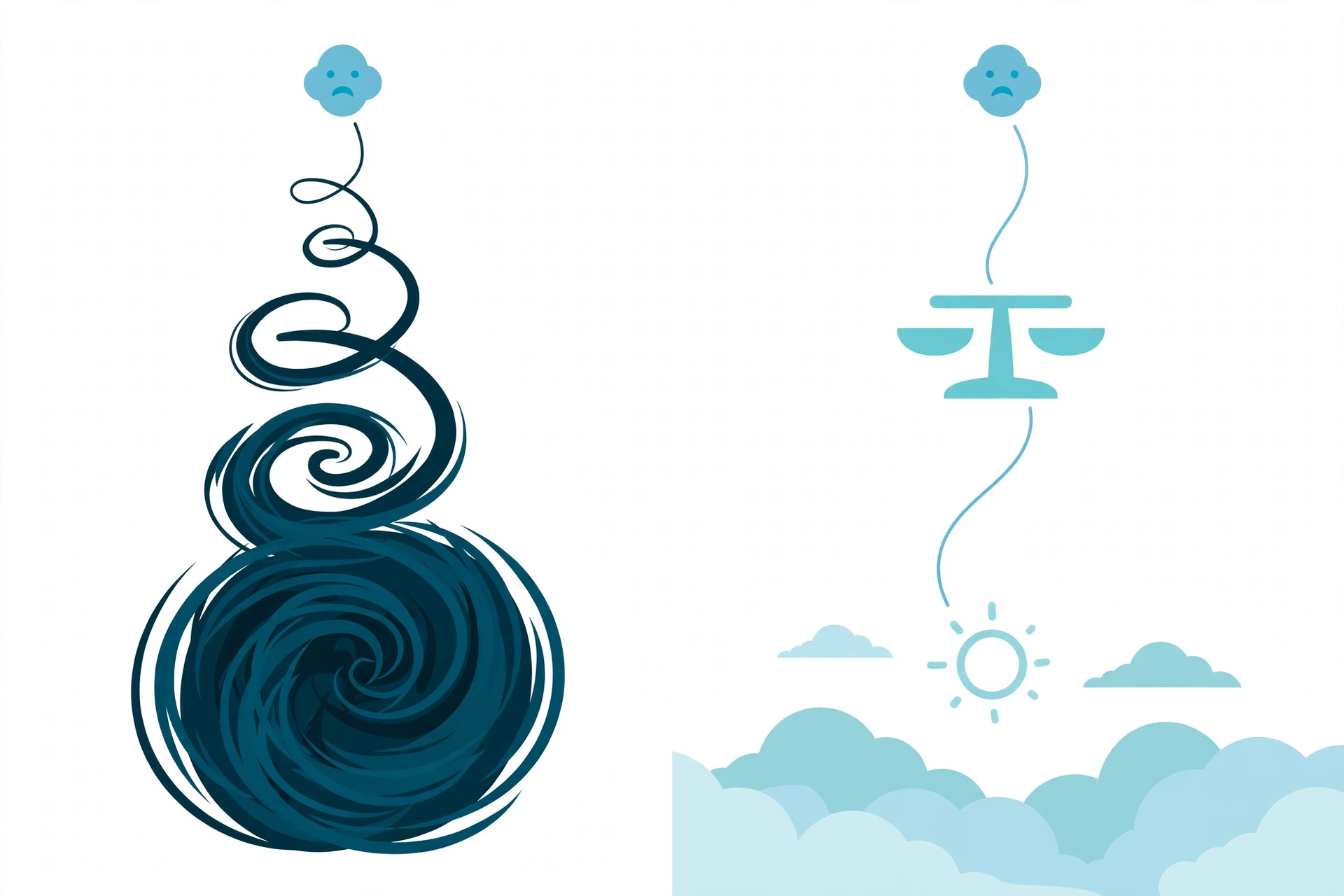
Psychologist Dr Susan Albers describes catastrophising as “negative daydreaming”: instead of imagining good outcomes, your mind rehearses disaster. One anxious thought leads to another, and the worry grows — a snowball effect that can leave you feeling overwhelmed before anything has actually gone wrong. Cleveland Clinic explains that this pattern often triggers the body’s fight-or-flight response, so your heart may race, your breathing may quicken and your muscles may tense, even though there is no real danger.
Catastrophising is not a diagnosis in itself. It is a thinking habit that often appears alongside anxiety, depression, post-traumatic stress disorder (PTSD) and obsessive-compulsive disorder (OCD). Researchers are still working out exactly how it develops: a 2020 review found little agreement on its precise definition and causes, which may include depression, anxiety, trauma, heightened sensitivity to bodily sensations and differences in how the brain handles reward and threat.
Everyday Examples of Catastrophising
Catastrophising usually follows the same shape: a small, uncertain event, then a leap to the worst possible ending.
- A late text message: your partner does not reply for an hour, so you decide they are angry with you or something terrible has happened to them.
- A mistake at work: you spot a typo in an email you already sent, and conclude you will be sacked, lose your income and never find another job.
- A health worry: a headache or a new ache makes you certain it must be a serious illness, even though you have no other symptoms.
- An exam or test: failing one test, as Medical News Today notes, becomes proof that your whole future is ruined.
- A social slip: you stumble over your words in a meeting and spend the rest of the day convinced everyone thinks you are incompetent.
In each case, the first thought may be understandable. The problem is the spiral that follows: each “what if” is treated as a fact, and the worst version of events feels certain rather than merely possible.
Signs You May Be Catastrophising
Catastrophising can be hard to spot in yourself, because the thoughts feel like facts. Common signs include:
- Persistent worry about the worst-case scenario, even when things are going well.
- Difficulty focusing on positives or on evidence that contradicts the fear.
- Feeling overwhelmed by “what if” thoughts that are hard to switch off.
- Jumping from one worry to the next, so that one concern quickly becomes many.
- Physical tension, a racing heart or restless sleep when you are worrying.
- Avoiding situations — such as checking test results or opening emails — because you fear the worst.
Calm notes that these signs often show up as constant worry about what might go wrong, trouble seeing the positive side of a situation, and a feeling of being overwhelmed by imagined outcomes.
What Causes Catastrophising?
There is rarely a single cause. Several factors can make this thinking pattern more likely:
- Anxiety and other mental health conditions: anxiety, depression and related conditions are closely linked to catastrophising, and it can also appear alongside PTSD and OCD.
- Past experiences: difficult or frightening experiences can teach the brain to expect danger, so it scans for threats even when life is calm.
- Personality traits: traits such as neuroticism and perfectionism are associated with a greater tendency to expect the worst.
- Stress and trauma: ongoing stress or past trauma can keep the mind in a state of high alert, making worst-case thinking more automatic.
- Genetics: a 2018 study of 2,401 female twins found a strong genetic association between pain catastrophising and anxiety, suggesting that some people may be more prone to this pattern.
- Childhood patterns: research suggests that catastrophising can be linked to anxious and depressive disorders in children and adolescents, and early interventions in childhood may help reduce it.
Understanding the causes matters because it removes blame: catastrophising is a learned habit of the mind, not a character flaw, and habits can be changed.
How Catastrophising Affects Daily Life
At work
At work, catastrophising can turn ordinary setbacks into crises. A critical comment from a manager may be read as the start of a dismissal, and a looming deadline may feel impossible before it has begun. This can lead to procrastination, avoidance, overworking to prevent imagined disasters, or difficulty concentrating — which then creates the very problems you feared.
Health worries
Health worries are a common trigger. A new symptom can be interpreted as a serious illness, leading to repeated checking, frequent searches for symptoms online, or avoidance of medical appointments out of fear of bad news. The anxiety itself can then cause real physical symptoms, such as tension, fatigue and poor sleep, which are mistaken for further evidence that something is wrong.
Relationships and social life
In relationships, catastrophising can make a partner’s quiet mood feel like rejection, or a friend’s cancelled plan feel like the end of the friendship. Calm notes that this pattern can strain relationships, because constant worst-case expectations make it hard to relax, trust others or enjoy time together. Social plans may be avoided altogether, which increases isolation and gives the worries even more room to grow.
How to Stop Catastrophising: Practical CBT-Based Steps
Cognitive behavioural therapy (CBT) is the standard treatment for catastrophising, and a 2017 study found CBT effective for catastrophising in people with fibromyalgia. Other therapies sometimes used include dialectical behaviour therapy (DBT), mindfulness-based stress reduction (MBSR), acceptance and commitment therapy (ACT), exposure and response prevention (ERP) and psychodynamic therapy. There is no medicine that specifically treats catastrophising, so talking therapies and self-help techniques are the main approaches. Many of the steps below come from CBT and can be practised on your own:
1. Name the thought
When a worst-case thought appears, label it: “That is catastrophising.” Naming the pattern creates distance from it. As Cleveland Clinic advises, remind yourself, “It is just a thought” — a thought is not a fact and not a prediction.
2. Calm your body first
Catastrophising triggers fight-or-flight symptoms, so calming the body helps calm the mind. Try slow, deep breathing, meditation or a mindfulness exercise. The 5-4-3-2-1 grounding technique can help: name five things you can see, four you can touch, three you can hear, two you can smell and one you can taste.
3. Reality-test the thought
Ask yourself: what is the evidence for this fear, and what is the evidence against it? What would you say to a friend who had this thought? What is the most likely outcome, not the worst one? Medical News Today suggests recognising when a thought is irrational, and saying “Stop!” to yourself when the spiral begins.
4. Meet yourself in the middle
Instead of swinging from the worst outcome to forced positivity, try to find a balanced middle. Cleveland Clinic suggests thinking of three other possibilities besides the worst one — including a neutral or mildly positive outcome. Think of another, more realistic ending, and use a gentle, positive affirmation to support it.
5. Focus on what you can control
Much catastrophising is about things outside your control. Write down what you can actually do about the situation, and let go of the rest. Journaling can help here: putting the worry on paper makes it easier to examine it clearly and to spot the leaps in logic.
6. Look after yourself before the worry starts
Self-care makes the spiral less likely. Sleep well, eat regularly and build rest into your day before stress peaks, rather than waiting until you are already overwhelmed. A break from social media can also help — endless scrolling, sometimes called doomscrolling, feeds worst-case thinking.
7. Practise self-compassion
Be kind to yourself when the pattern returns. Catastrophising is a habit, and habits take time to change. Mindfulness practice can support this: a 2020 study found that mindfulness reduced anxiety and stress among nurses. If self-help is not enough, consider talking to a therapist trained in CBT — professional support can make a real difference.
Pain Catastrophising: When Pain Feeds the Spiral
Catastrophising is not only about thoughts and feelings — it also affects how people experience pain. Pain catastrophising means magnifying the threat of pain, ruminating on it and feeling helpless about it. A 2022 study linked fatigue and catastrophising, and research has connected pain catastrophising with anxiety. This matters because expecting the worst from pain can make it feel more intense and harder to cope with, and it can lead people to avoid movement and activity, which in turn worsens stiffness and low mood.
The same CBT techniques apply: noticing the catastrophic thought about pain, testing it against the evidence, and focusing on what you can do rather than on the worst outcome. If pain is persistent or worsening, talk to a doctor or pharmacist about it rather than trying to manage it alone.
When to See a Doctor
Talk to your GP or a mental health professional if catastrophising is frequent, hard to control, or interfering with your work, sleep, relationships or daily life — especially if it comes with persistent low mood, panic attacks, or thoughts of harming yourself. A doctor can help you understand what is going on and discuss talking therapies such as CBT.
If you feel you may act on thoughts of harming yourself, seek help right away. In an emergency call 911 (US), 999 (UK) or 112 (EU). You can also find support and crisis resources at Health Daily Advice: Get Help Now.
Frequently asked questions
What is catastrophizing?
Catastrophizing is a thinking habit in which your mind jumps to the worst possible outcome, even when it is unlikely. It is a type of cognitive distortion, sometimes called magnifying, in which a small worry is blown up into a disaster. The pattern is common in anxiety and depression, but it can be recognised and changed with practical techniques.
Why do I always expect the worst?
Expecting the worst often comes from a mix of anxiety, past experiences, stress and personality traits such as perfectionism. When the brain has learned to scan for danger, worst-case thinking can become automatic. Research also suggests a genetic link: a 2018 study of 2,401 female twins found a strong association between pain catastrophizing and anxiety.
Is catastrophizing a mental illness?
No, catastrophizing is not a diagnosis in itself. It is a pattern of distorted thinking that often appears alongside conditions such as anxiety, depression, PTSD and obsessive-compulsive disorder. Because it is a habit of the mind rather than a fixed trait, it can be changed, often with cognitive behavioural therapy or other talking therapies.
How do I stop catastrophizing?
Start by naming the thought as catastrophizing and reminding yourself that a thought is not a fact. Then calm your body with slow breathing or the 5-4-3-2-1 grounding technique, reality-test the fear by weighing the evidence, and think of three other possible outcomes. CBT is the standard treatment, and a therapist can guide you through these steps.
What is pain catastrophizing?
Pain catastrophizing means magnifying the threat of pain, dwelling on it and feeling helpless about it. A 2022 study linked fatigue and catastrophizing, and research has connected pain catastrophizing with anxiety. Expecting the worst from pain can make it feel more intense and lead to avoiding activity. CBT techniques can help, and persistent pain should be discussed with a doctor.
Sources
- Cleveland Clinic: Catastrophizing health.clevelandclinic.org
- Calm: Always Expecting the Worst www.calm.com
- Healthline: Catastrophizing www.healthline.com
- Medical News Today: What is catastrophizing? www.medicalnewstoday.com

Try the tool
How have you felt over the last 2 weeks?
The PHQ-9 and GAD-7 that GPs use. Private, about 3 minutes.
Start the self-check