Seasonal Affective Disorder (SAD): Signs, Causes and What Helps
Winter low mood that returns each year may be seasonal affective disorder. Here are its signs, why shorter days affect mood, and the treatments that help.
- Written by
- Health Daily Advice
- Published
- Reading time
- 3 minutes
- Sources
- 7 cited
In this guide
Seasonal affective disorder, or SAD, is a type of depression that returns at the same time each year, most often in autumn and winter when daylight is short. Low mood, tiredness, oversleeping and carbohydrate cravings are typical signs. It is treatable: daylight, talking therapy, light therapy and, for some people, antidepressant medication can all help.
What is seasonal affective disorder?
SAD is depression with a seasonal pattern. The NHS explains that the main symptom is depression that happens in winter and goes away in summer, although some people have symptoms in summer instead. The US National Institute of Mental Health (NIMH) notes that symptoms typically last about four to five months a year. It is more than the “winter blues”: the symptoms are persistent, affect daily life, and return around the same time each year.
Signs of SAD
Winter-pattern SAD symptoms, listed by the NHS, include:
- low mood and a lack of interest in things you usually enjoy
- feeling guilty, hopeless or worthless, or feeling restless or irritable
- difficulty concentrating
- being more hungry and eating more than usual, often craving carbohydrates
- being more tired and sleeping more than usual
- thoughts of suicide or self-harm
Some people also feel unusually energetic at the start of spring or summer. Summer-pattern SAD is less common and can bring the opposite pattern, such as trouble sleeping and a reduced appetite.
Why does SAD happen?
The exact cause is not known, but the NHS says it is thought to be linked to reduced levels of daylight in winter, which may change brain chemicals such as melatonin and serotonin that affect mood and sleeping patterns. Mayo Clinic adds that less daylight can disturb the body’s internal clock, and that the effect is stronger in places further from the equator, where winter days are shortest. Having a family history of depression, or a personal history of depression, can also raise the risk.
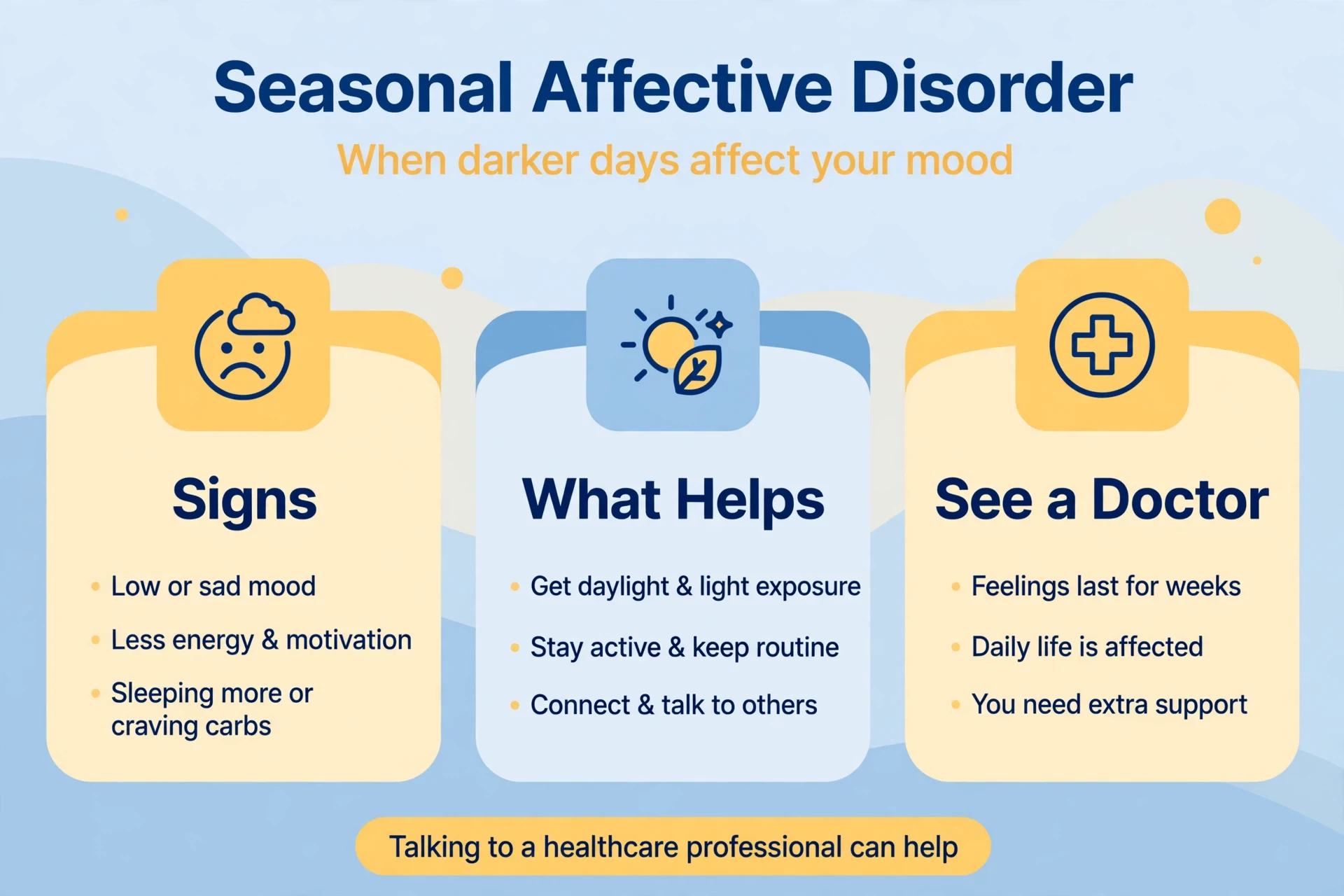
SAD or the winter blues?
Many people feel a little flat on dark winter days, but still manage work, relationships and daily routines. SAD is different because the low mood is persistent, lasts for weeks or months, and interferes with daily life. The NHS says you may be diagnosed with SAD if you have had depression symptoms at a particular time of year for two years or longer. A GP will usually ask about your moods and how they change over time, and may ask you to fill in a questionnaire.
Treatment for SAD
Treatment can help manage symptoms, and many people need treatment every winter to stop symptoms coming back. The NHS lists three main treatments:
- Talking therapies, such as cognitive behavioural therapy (CBT), including a form adapted for SAD
- Antidepressant medication, prescribed and reviewed by a doctor
- Light therapy, using a bright light box to simulate daylight in winter
Light therapy is not usually available on the NHS, because there is not enough evidence to say whether it is effective, but many people find it helps. Speak to a GP before trying light therapy: it might not be suitable if you have certain eye conditions or take medicines that increase sensitivity to light. If you buy a light box, the NHS advises choosing one that is bright enough (10,000 lux is standard), UV-free and marked UKCA or CE, and following the manufacturer’s instructions.
Self-care that can help
Alongside treatment, the NHS recommends:
- getting as much natural daylight as you can, by going outside in the daytime every day
- getting regular exercise
- staying in contact with friends and family and keeping up with usual activities
- going to bed and waking up at the same time every day
- avoiding too much alcohol, and avoiding screens such as smartphones right before bed
Starting helpful routines early in autumn, before symptoms usually peak, can make winter easier to manage. Keeping a simple note of your mood, sleep and energy across the weeks can also help you and your GP spot the pattern.
When to see a doctor
See a GP if you think you might have SAD, if you are finding it difficult to cope, or if treatment is not helping. If you are 18 or over, you can also refer yourself directly to an NHS talking therapies service in many areas. If you feel you may act on thoughts of suicide or self-harm, seek urgent help straight away. You can find support and crisis contacts at Health Daily Advice: Get Help Now.
In an emergency call 911 (US), 999 (UK) or 112 (EU).
Frequently asked questions
What is seasonal affective disorder?
Seasonal affective disorder (SAD) is a type of depression that follows a seasonal pattern, most often starting in autumn or winter and easing in spring and summer. It is more than the winter blues because symptoms are persistent and interfere with daily life. The NHS says you may be diagnosed if depression symptoms occur at a particular time of year for two years or longer.
What causes SAD?
The exact cause is not known, but it is thought to be linked to reduced daylight in winter. Less daylight may change brain chemicals such as melatonin and serotonin, which affect mood and sleep patterns, and may disturb the body's internal clock. The effect is stronger further from the equator, where winter days are shortest.
How is SAD different from the winter blues?
Feeling a little flat on dark days is common, but SAD means low mood that lasts for weeks or months, returns around the same time each year, and makes daily life harder. Signs include losing interest in usual activities, sleeping much more than usual, tiredness and difficulty concentrating. If that pattern sounds familiar, talk to a GP.
Does light therapy help SAD?
Light therapy uses a bright light box to simulate daylight in winter, and many people find it helps. The NHS notes it is not usually available on the NHS because there is not enough evidence to say whether it is effective. Speak to a GP before trying it, especially if you have an eye condition or take medicines that increase light sensitivity.
When should I see a doctor about SAD?
See a GP if you think you might have SAD, if you are finding it difficult to cope, or if treatment is not helping. Adults in many areas can also refer themselves directly to an NHS talking therapies service. Seek urgent help straight away if you feel you may act on thoughts of suicide or self-harm.
Sources
- NHS: Seasonal affective disorder (SAD) www.nhs.uk
- NIMH: Seasonal Affective Disorder (SAD): More Than the Winter Blues www.nimh.nih.gov
- Mayo Clinic Press: What Is Seasonal Affective Disorder mcpress.mayoclinic.org
- Mayo Clinic Health System: Seasonal affective disorder explained sncs-prod-external.mayo.edu

Try the tool
How have you felt over the last 2 weeks?
The PHQ-9 and GAD-7 that GPs use. Private, about 3 minutes.
Start the self-check