What Are Somatic Exercises? Benefits, Types and How to Start
Slow, mindful movement is having a moment: searches for 'somatics' more than tripled in two years. Here is what somatic exercises actually are, what the research supports, and how to try them safely.
- Written by
- Health Daily Advice
- Published
- Reading time
- 6 minutes
- Sources
- 11 cited
In this guide
Somatic exercises are slow, mindful movements done with your attention on how your body feels, rather than on form, speed or goals. Yoga, tai chi, breathwork and gentle stretching can all be somatic. Searches for “somatics” more than tripled in two years, and early research suggests they can ease stress and anxiety, though the evidence is still thin.
What are somatic exercises, exactly?
The word somatic simply means “of the body”. A somatic exercise is any movement performed with your attention on the internal sensation of moving, rather than on the shape you are making or the repetitions you are counting. Cleveland Clinic describes somatic movement as a mindfulness method you can apply to physical activity: a somatic workout does not focus on form, goals or competition, but on how your body feels, being present in the moment and making focused, intentional movements.
That makes “somatic” more of an approach than a fixed set of moves. Almost any movement can be somatic if you turn your attention inward. Cleveland Clinic’s exercise physiologist David Creel gives the example of his morning bike ride: instead of thinking about speed, he noticed how his legs felt, how his feet were grounded on the pedals and how his breathing changed. The same stretch done while watching television is not somatic; done with full attention on the sensation, it is.
Harvard Health puts it the same way: somatic exercises involve paying attention to internal sensations and responses during physical movements. The idea is that many of us move in habitual ways that are not ideal for our bodies, leaving us prone to tension and pain — and that sensing the movement as you do it can retrain the brain to control it better.
Why is everyone talking about somatics now?
Somatic exercise has existed in various cultures for centuries, but it has become one of the fastest-growing health searches of 2026. Trend data from Exploding Topics shows searches for “somatics” growing from about 31,900 to 110,000 a month between October 2024 and September 2026 — more than a threefold rise. Social media has done much of the spreading: short videos promise that shaking, rocking or slow stretching can “release” stress or trauma stored in the body.
Some of those promises go well beyond what research has shown. That does not mean the practice is worthless — it means it is worth separating what is known from what is merely claimed, which is what the rest of this article does.
The main types of somatic exercise
Several established practices already have somatic methods built into them, according to Cleveland Clinic:
- Yoga. A practice that aims to bring body and mind into unity. Western, secular yoga classes may or may not be somatic, depending on how they are taught.
- Tai chi and qigong. Slow, flowing movements from traditional Chinese medicine, with careful breathing patterns that keep you grounded in the moment.
- Dance. Classes tend to focus on form and choreography, but dancing freely, “like nobody’s watching”, can be somatic.
- Pilates. Somatic Pilates focuses on body awareness and experience, while traditional Pilates is more goal-oriented.
- Feldenkrais and Hanna Somatics. Structured methods that teach new movement patterns through slow, attentive exploration.
- Somatic Experiencing. A body-based approach to trauma, developed by Peter Levine, used by therapists rather than as a self-help workout.
Harvard Health adds that somatic workouts combine several elements: body scanning — mentally focusing on each body part in turn and noticing how it feels, without judgement — breath awareness, and micro-movements. These are tiny tilts, rolls or shifts done slowly enough that you can feel every phase of the motion.
What does the evidence actually say?
Here is the honest picture. Cleveland Clinic is clear that there is very little research on the health benefits of somatic exercises as such, and what exists looks only at specific types or schools. But there is plenty of research on the ingredients — physical activity, mindfulness and breathing — and a growing number of studies on mind-body movement in general.
A 2026 network meta-analysis in Frontiers in Public Health pooled 24 randomised trials with 2,413 college students and compared mind-body exercises — mindfulness-based exercise, tai chi, Baduanjin, yoga and a combined approach. Every modality reduced anxiety compared with inactive controls. Mindfulness-based exercise was the strongest for stress, while Baduanjin showed the largest benefit for depression. Notably, no intervention significantly improved sleep quality or general mental well-being, a reminder that the benefits have limits.
A 2026 randomised trial in 80 university students tested a 12-week programme combining core stabilisation, diaphragmatic breathing, relaxation and slow-tempo music, four times a week. Perceived stress and state anxiety both fell with moderate-to-large effects, and trunk endurance improved. Because music, breathing and exercise were always delivered together, the study cannot say which part did the work.
In a clinical setting, a 2026 study in Frontiers in Psychiatry followed 179 psychiatric patients in a structured exercise programme of walking, stretching and diaphragmatic breathing. Anxiety scores fell after sessions in 81% of patients, and people who took part more often saw larger reductions. The study had no control group, so it shows an association rather than proof — but it is consistent with the wider evidence that gentle, breath-led movement can calm anxiety quickly.
Harvard Health notes that research suggests this kind of body awareness can lower levels of the stress hormone cortisol, and that somatic exercise appears to reduce pain and muscle tension, calm anxiety and improve range of motion, sleep and energy. A small study published in June 2025 in the Journal of Bodywork and Movement Therapies found that older adults who joined a twice-weekly, hour-long online somatic movement programme could move their spines more easily after 10 weeks.
What the evidence does not support is the idea that a few shakes or stretches can “release trauma” from the body on their own. Trauma work belongs with a trained therapist, and Cleveland Clinic advises working with a trauma-informed instructor alongside a therapist who specialises in trauma if difficult feelings surface.
Try it in 5 minutes
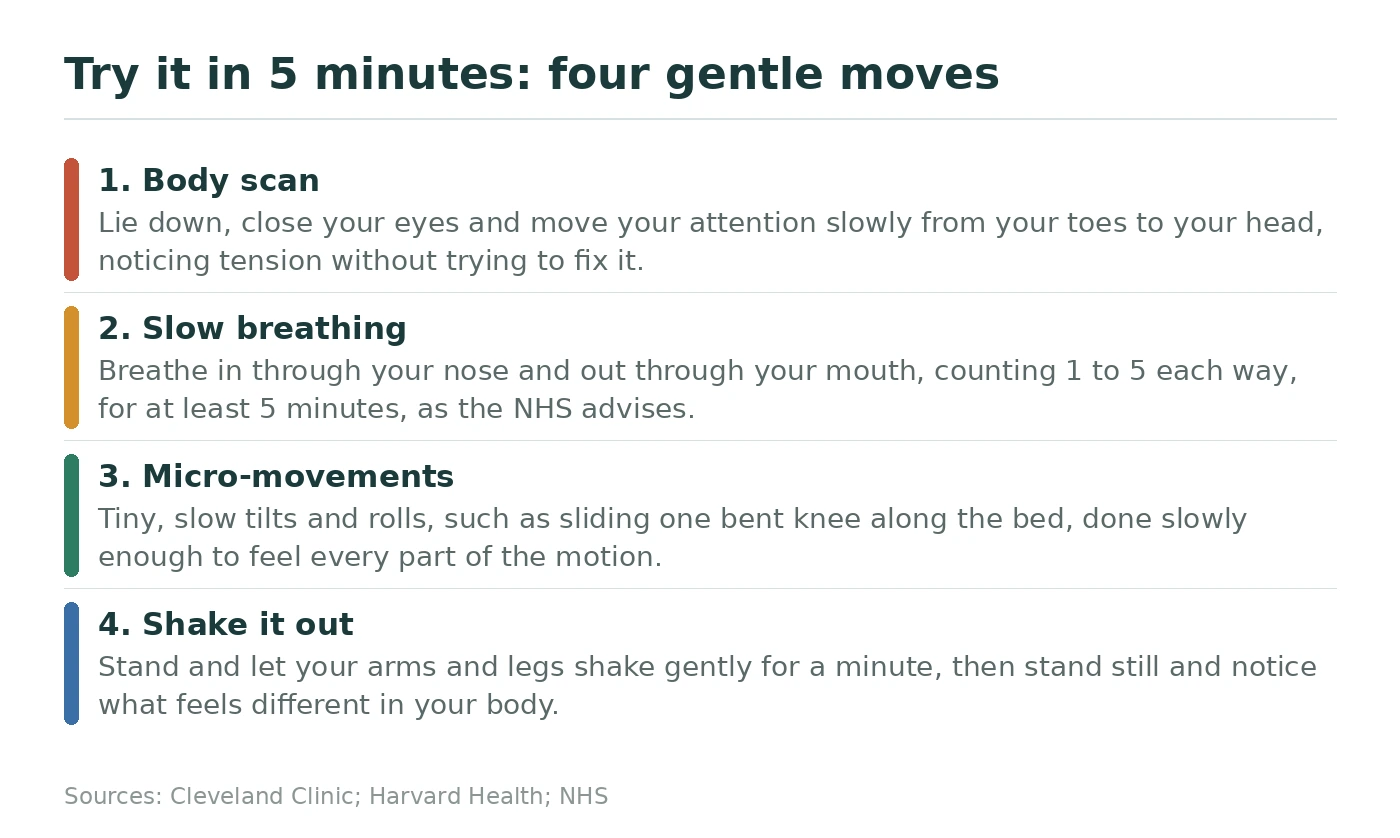
You need no equipment and very little space. Pick a quiet moment, put your phone away, and try one of the moves above. The NHS recommends regular exercise such as walking, swimming and yoga to help you relax, and calming breathing exercises for anxiety — somatic practice fits neatly into both. Its advice for the calming breath is simple: breathe in through your nose and out through your mouth, counting from 1 to 5 each way, for at least 5 minutes, practised regularly. If counting to 5 feels hard at first, that is fine; the NHS says you may not reach 5 straight away.
A few practical rules from the experts: go slowly, keep movements small, and focus on feeling rather than performing. If a movement hurts, stop or adjust it. And check with your doctor before starting a new exercise routine if you have a health condition, balance problems or an injury.
Who should be careful?
Somatic exercise is gentle, but it is not right for everyone in every form. People with balance issues, glaucoma or certain heart conditions should avoid some positions — Cleveland Clinic, for example, advises skipping the “wall roll down” if you have balance issues, glaucoma or POTS. Anyone with a history of trauma should know that body-focused work can bring up strong feelings, which is why a trauma-informed instructor and a therapist matter. And if you have chronic pain, a joint problem or a neurological condition, talk to your doctor or a physiotherapist before trying a new routine.
When to see a doctor
Somatic exercises are a self-care tool, not a treatment. See a GP if anxiety is affecting your daily life, if things you are trying yourself are not helping, or if you would like a referral to an NHS talking therapies service. The NHS lists faster heartbeat, light-headedness, headaches, chest pains, breathlessness, shaking, feeling tense, being unable to relax, worrying, poor sleep and difficulty concentrating among the symptoms of anxiety — and notes that a panic attack usually lasts 5 to 20 minutes. If anxiety is a regular problem, do not self-diagnose; speak to a GP. If you are in crisis or need support right now, visit our get help now page.
In an emergency call 911 (US), 999 (UK) or 112 (EU).
Frequently asked questions
What are somatic exercises?
Somatic exercises are slow, mindful movements done with your attention on how your body feels, rather than on form, speed or goals. Yoga, tai chi, qigong, breathwork and gentle stretching can all be somatic. Cleveland Clinic describes somatic movement as a mindfulness method applied to physical activity. Almost any movement counts as somatic if you do it slowly and pay close attention to the sensations.
Do somatic exercises help with anxiety?
They may help. A 2026 review of 24 trials found that mind-body exercises, including yoga, tai chi and mindfulness-based movement, reduced anxiety in college students, and a 2026 trial of a 12-week breathing and movement programme cut stress and anxiety with moderate-to-large effects. But the evidence for somatic exercises specifically is thin, and they are not a treatment for anxiety. If anxiety affects your daily life, see a GP.
What is the difference between somatic exercises and yoga?
Somatic is an approach, not a specific exercise. Yoga is one practice that can be somatic when done slowly with attention on sensation — but a fast, goal-driven yoga class focused on perfect poses is not. The same applies to tai chi, Pilates and dance: what makes them somatic is the mindful, inward focus, not the name of the class.
Can somatic exercises release trauma?
There is no good evidence that shaking or stretching alone can release trauma from the body, and social media claims about this go beyond the research. Somatic Experiencing, the body-based therapy, is delivered by trained therapists and is different from a self-help workout. If trauma is affecting you, the safest step is to talk to your GP or a qualified therapist.
How do I start somatic exercises at home?
Start small, with five minutes a day. Lie down and do a slow body scan, practise the NHS calming breath by counting 1 to 5 in and out, or try tiny, slow movements such as sliding one bent knee along the bed. Keep movements gentle, focus on how they feel, and stop if anything hurts. Check with your doctor first if you have a health condition or balance problems.
Sources
- Cleveland Clinic: What Are Somatic Exercises? health.clevelandclinic.org
- Harvard Health: What are somatic workouts? www.health.harvard.edu
- NHS: Anxiety, fear and panic www.nhs.uk
- NHS: Breathing exercises for stress www.nhs.uk
- Ersever EM, et al. Effects of a music-accompanied multimodal exercise program on trunk endurance, stress, and anxiety in university students: a randomized controlled trial. Rev Assoc Med Bras, 2026 pmc.ncbi.nlm.nih.gov
- Mind–body exercise and mental health in college students: a systematic review and network meta-analysis. Front Public Health, 2026 www.frontiersin.org
- Perunova S, et al. Therapeutic exercise is associated with dose-dependent reductions in acute anxiety across psychiatric diagnoses. Front Psychiatry, 2026 www.frontiersin.org
- Exploding Topics: Trending Health & Wellness Topics, November 2026 explodingtopics.com

Try the tool
How have you felt over the last 2 weeks?
The PHQ-9 and GAD-7 that GPs use. Private, about 3 minutes.
Start the self-check