What Is Brain Stacking? The TikTok Trend Explained
A journal, a sudoku, a crossword and a novel — piled up instead of your phone. Brain stacking is TikTok's latest anti-scrolling trend, but does it actually do anything for your brain?
- Written by
- Health Daily Advice
- Published
- Reading time
- 9 minutes
- Sources
- 5 cited

In this guide
Brain stacking is a TikTok trend that began in October 2026: you pile up phone-free activities — a journal, a sudoku, a crossword and a novel — and work through them one by one instead of scrolling. No study has tested brain stacking itself, but its ingredients, especially reading, have real evidence behind them.
What is brain stacking?
Merriam-Webster defines brain stacking as the practice of engaging in mentally stimulating activities, such as brainteasers and reading for pleasure, especially as an alternative to passive media consumption on a smartphone. The dictionary added the term as slang in November 2026, after it spread across TikTok and Instagram.
A typical brain stack is a literal pile, kept within arm’s reach where your phone usually sits: a notebook for journaling, a sudoku or crossword book, a colouring book, and a novel or a work of non-fiction. The idea is simple. When the urge to scroll hits, you reach for the pile instead and work through it one activity at a time, with no screen involved.
Some creators add timers — for example, a 12-minute brain dump in a notebook, then ten minutes of planning, 15 minutes of puzzles and 20 minutes of colouring, making a one-hour stack. Others keep it loose and stop whenever they feel like it. There is no official rulebook, and that is part of the appeal.
It is worth clearing up one confusion: brain stacking is not the same as a “nootropic stack” of brain supplements, and it has nothing to do with split-screen “sludge content” videos that play several clips at once. Brain stacking does the opposite — one activity at a time, and no screen at all.
Where did the trend come from?
The trend took off in October 2026, popularised by the American creator Mandy Rulez, a 28-year-old from Indiana who had been posting about her hobbies — writing, puzzles and crafts — on LibraryTok, the library-loving corner of TikTok, since 2024. According to the British magazine Dazed, her accounts gained more than 150,000 followers in October 2026 alone. Her own stack, as described by the Philippine site PhilSTAR Life, runs: an iced coffee, a journal page, a sudoku, a mini crossword and a novel.
The timing was right. In late 2024, “brain rot” was named Oxford Word of the Year, and the backlash against endless scrolling has been building ever since — from the comeback of “dumb phones” to school phone bans. Brain stacking is the latest in a run of analogue trends trying to pull people off their phones, following the “analog bag” trend earlier in 2026. The irony, which the press has been quick to point out, is that most people discover this anti-screen trend by scrolling.
By mid-November the trend had reached the mainstream press. The New York Times described hundreds of videos of people lighting a candle and piling notebooks, puzzle books, journals, novels and e-readers into neat pyramids. Essence called it “the viral wellness routine that replaces mindless doomscrolling with low stakes mental stimulation that actually feels good”. If doomscrolling is wearing you down, our guide to what doomscrolling is and why it hooks you explains the habit brain stacking is trying to replace.
Does brain stacking actually work?
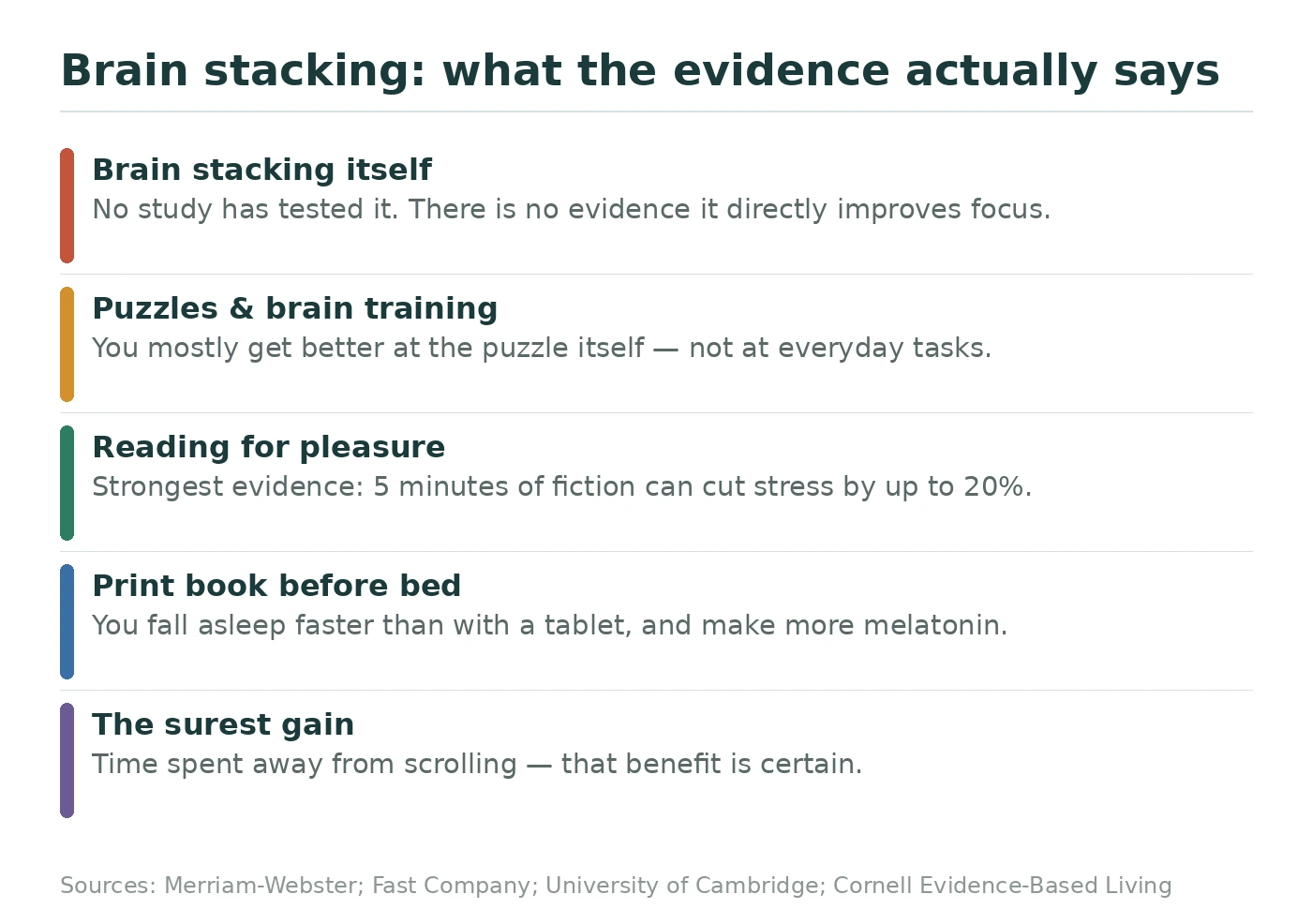
The honest answer is that nobody knows — because no study has tested brain stacking itself. Amy Baglietto, a psychotherapist who works with people with ADHD, anxiety or burnout, told Dazed there is no evidence it helps you focus better. And researchers at Clemson University, the Medical University of South Carolina and Penn State, whose recent findings were reported by Fast Company, found that “brain-training” activities such as crosswords, sudoku, memory games and adult colouring books are not equally effective for everyone: college students, for example, often show only modest benefits compared with older adults who live relatively sedentary lifestyles.
What we can do is look at the evidence for each ingredient in the stack. That picture is more encouraging — with some important caveats.
Puzzles: you mostly get better at puzzles
In 2016, a team of psychologists led by Daniel Simons of the University of Illinois reviewed the studies cited by companies selling brain-training games. Their conclusion: you get better at the exercise you practise, less so at similar exercises, and there is almost no transfer to everyday tasks. A sudoku a day makes you a better sudoku player. Nothing suggests it will help you concentrate on a report at work.
What about dementia? In 2019, researchers at the University of Exeter looked at more than 19,000 people aged 50 and over. Those who most often did number puzzles, like sudoku, scored better on memory and reasoning tests. But that is correlation, not causation: people whose minds are working well may simply do more puzzles, and the researchers said so themselves. Neuroscientist Elena Gross has warned that videos claiming brain stacking protects against dementia are overselling it.
There is one genuinely encouraging trial. In a study published in NEJM Evidence in 2022, researchers followed 107 older adults with mild cognitive impairment for 18 months. One group did crosswords four times a week; the other used the brain-training program Lumosity. The crossword group showed significantly less cognitive decline, better everyday functioning and better-maintained brain volume on MRI scans. A Cochrane review of 33 studies involving about 2,000 participants reached a similar, cautious conclusion: cognitive training may lead to some benefits in overall thinking compared with no treatment, but it was not better than other active treatments for mild dementia.
Reading: the strongest ingredient
Reading has the best evidence of anything in the stack. A review published in Psychological Medicine in 2026 by psychiatry researchers at the University of Cambridge, working with The Queen’s Reading Room, pulled the evidence together. A neuroscience study commissioned by The Queen’s Reading Room in 2024 found that just five minutes of reading fiction could reduce stress by up to 20%, as well as boosting concentration and problem-solving skills and helping readers feel less lonely.
The longer-term associations are striking, too. One study followed nearly 5,500 adults aged 55 and older for five years and found that those who regularly took part in mentally stimulating activities such as reading were significantly less likely to develop cognitive impairment. Another investigation reported that people who read newspapers, magazines and books had a 33% lower risk of Alzheimer’s disease. The researchers stress that these are associations, not proof that reading itself prevents dementia — people who read more may differ from people who read less in other ways. But the pattern is consistent across many studies.
Reading also works better when you do something with it. Psychologists call it retrieval practice: after a chapter, close the book and write down what you remember, without looking back. In a classic 2006 experiment, Henry Roediger and Jeffrey Karpicke found that students who tested themselves on a passage remembered it better a week later than students who had simply reread it. So the journal in a brain stack may be doing more work than it looks: summarising what you have just read is one of the most reliable findings in memory research.
Sleep: paper beats a screen at night
There is also a case for doing your stack before bed — on paper, not a tablet. In a small 2015 study published in the Proceedings of the National Academy of Sciences, researchers at Brigham and Women’s Hospital had 12 adults read for four hours before bed: five evenings on a tablet, five from a printed book. With the tablet, they took longer to fall asleep, produced less melatonin (the hormone that gets the body ready for sleep) and were less alert the next morning. Twelve people is not many, and four hours of reading is a lot — but the logic holds: a notebook or a printed book does not expose you to screen light.
The surest gain: time that does not go to scrolling
Strip away the claims, and the most reliable benefit is the simplest one: while you are doing a puzzle or reading a chapter, you are not scrolling. In one study, researchers blocked Instagram or YouTube on the phones of about 370 people for one to two weeks. Some of the freed time moved to other apps — but the time people genuinely got back went mostly to offline activities. A stack sitting within reach gives that freed time somewhere to go.
Personal stories fit the same pattern. Content creator Jaye Rockett told Dazed she went from 14 hours of screen time a day to 7. That is encouraging, but it is one person with nothing to compare it with — it does not tell you whether it will work for you.
What are the downsides?
Critics have raised three fair objections. First, brain stacking can turn rest into one more to-do list. Elena Gross puts it plainly: not every moment of rest needs to become a productivity exercise. Baglietto worries that tidy, timed routines could make some people feel guilty, especially those who already struggle to get started. If your stack becomes a schedule you have to keep up with, it defeats the purpose.
Second, the trend has become an excuse to buy things. Videos of people unboxing notebooks, pens and puzzle books are a staple of the genre. You do not need any of it: a book you already own and a sheet of paper are enough.
Third, some videos stage a screen-free routine so it can be shown on a screen. If you set up your stack for the photo, your phone is still calling the shots. And the experts add a fourth point: a stack of puzzles is no substitute for the basics. Sleep, movement, diet and seeing other people matter at least as much as puzzles for your brain — a walk or a call with a friend can absolutely be part of your stack.
How to try brain stacking without buying anything
If you want to try it, keep it small and cheap:
- Start with what you already enjoy. A book you have started, a newspaper crossword, a notebook lying around. There is no need to pick up a new hobby.
- Put your stack where your phone usually is. On your nightstand, by the couch, in your bag. It should be closer to your hand than your phone is.
- Start small. One page, one puzzle, three lines in a notebook — or even a single sentence, until the habit sticks.
- Give your memory a workout. After a chapter, close the book and write down what you remember. That is the part with the best evidence behind it.
- Leave some time unplanned. Looking out of the window, or doing nothing at all, counts too.
- Do not let the timer rule you. If you get absorbed in a book or reach a flow state in your writing, stay with it rather than jumping to the next timed activity.
Brain stacking will not rewire your brain or protect you from dementia — no honest reading of the evidence supports that. What it can do is far more modest, and far more useful: it puts something absorbing within reach at the exact moment your hand goes for your phone. For many people, that small switch is the whole point.
When to see a doctor
Brain stacking is a lifestyle habit, not a treatment. If poor concentration, low mood or anxiety are persistent, getting worse, or interfering with work, sleep or relationships, talk to your GP. They can check for underlying causes and discuss support or treatment options. If you are struggling right now, you can also visit our get help now page for support contacts.
In an emergency call 911 (US), 999 (UK) or 112 (EU).
Frequently asked questions
What is brain stacking?
Brain stacking is a TikTok trend that began in October 2026. You pile up phone-free activities — a journal, a sudoku, a crossword and a novel — and work through them one by one instead of scrolling. The idea is that having something absorbing within reach stops your hand going to your phone. Merriam-Webster added the term to its slang dictionary in November 2026.
Does brain stacking improve focus or memory?
Nobody knows yet, because no study has tested brain stacking itself. A psychotherapist told Dazed there is no evidence it helps you focus better. The parts have mixed evidence: brain-training games mostly make you better at the game itself, while reading has stronger support. The most reliable benefit is simpler — while you are reading or puzzling, you are not scrolling.
Does doing sudoku protect against dementia?
We do not know. A 2019 study of more than 19,000 people aged 50 and over found that those who most often did number puzzles scored better on memory and reasoning tests — but that is correlation, not proof. People with sharper minds may simply do more puzzles. In one 18-month trial, crosswords did slow decline in people with mild cognitive impairment, but that is not the same as preventing dementia.
Do you need to buy notebooks or puzzle books for brain stacking?
No. A book you already own, a sheet of paper, a newspaper crossword or a free printable sudoku will do. Videos of people unboxing piles of notebooks are part of what critics hold against the trend. The only thing that matters is having something absorbing within reach at the moment your hand goes for your phone.
How long should a brain stack last?
There is no rule. Some creators spend about an hour, working through timed blocks — a 12-minute journal entry, ten minutes of planning, 15 minutes of puzzles, 20 minutes of colouring. Others do a single page or puzzle. Start small: one page, one puzzle, three lines in a notebook. What matters is having something else within reach when the urge to scroll hits.
Is brain stacking the same as brain training?
No, although they overlap. Brain training usually means computer games or apps designed to improve a specific mental skill, such as memory or processing speed. Brain stacking is a looser, screen-free routine: a pile of ordinary activities — journaling, puzzles, reading, colouring — done one after another instead of scrolling. The evidence for brain training is mixed, and no study has tested brain stacking at all.
Sources
- Merriam-Webster: Brain stacking (slang) www.merriam-webster.com
- Fast Company: Screen time got your brain fried? Try a 'brain stack' www.fastcompany.com
- pourquoi.app: What is brain stacking, and does it actually work? pourquoi.app
- Cornell Evidence-Based Living: Do Brain Games Help Prevent Dementia? evidencebasedliving.human.cornell.edu
- ScienceDaily: This simple habit is linked to a 33% lower risk of Alzheimer's sciencedaily.com

Try the tool
How have you felt over the last 2 weeks?
The PHQ-9 and GAD-7 that GPs use. Private, about 3 minutes.
Start the self-check