ADHD and Anxiety Brain Types: 3 Patterns Found in Children
A Stanford-led study found three brain patterns in children with ADHD and anxiety that cut across the usual diagnoses. Here is what each pattern looks like, and what it could mean for earlier help and better-matched treatment.
- Written by
- Health Daily Advice
- Published
- Reading time
- 5 minutes
- Sources
- 10 cited
In this guide
Researchers at Stanford Medicine have found three distinct brain patterns, called biotypes, in children with attention-deficit/hyperactivity disorder (ADHD), anxiety, or both. The patterns, identified from thousands of brain scans, cut across the usual diagnoses — so a child with ADHD and a child with anxiety can share the same brain pattern.
What the Stanford study found
A Stanford Medicine-led study, published on 16 October 2026 in Nature Mental Health, used an artificial intelligence model to analyse functional MRI scans — pictures of how different parts of the brain work together. The researchers were looking for a biological pattern behind two of the most common childhood mental health conditions, which often overlap: ADHD and anxiety.
The team drew on the Adolescent Brain Cognitive Development study, a long-term project following more than 11,000 children across the United States who joined at age 9 or 10. They analysed scans from 3,508 children who had a diagnosis of ADHD, anxiety, or both when they joined, plus 693 children who had no diagnosis at enrolment but were diagnosed later, and 1,947 children who were never diagnosed. They checked the results against brain scans from a further 224 children in a second study, the Healthy Brain Network.
From the scans and the children’s behavioural test results, the model found two underlying dimensions of difficulty: cognitive-behavioural dysfunction, which affects thinking, planning and self-control, and emotion-attention dysfunction, which affects how feelings and attention interact. Different combinations of these two dimensions produced the three biotypes.
The three brain biotypes
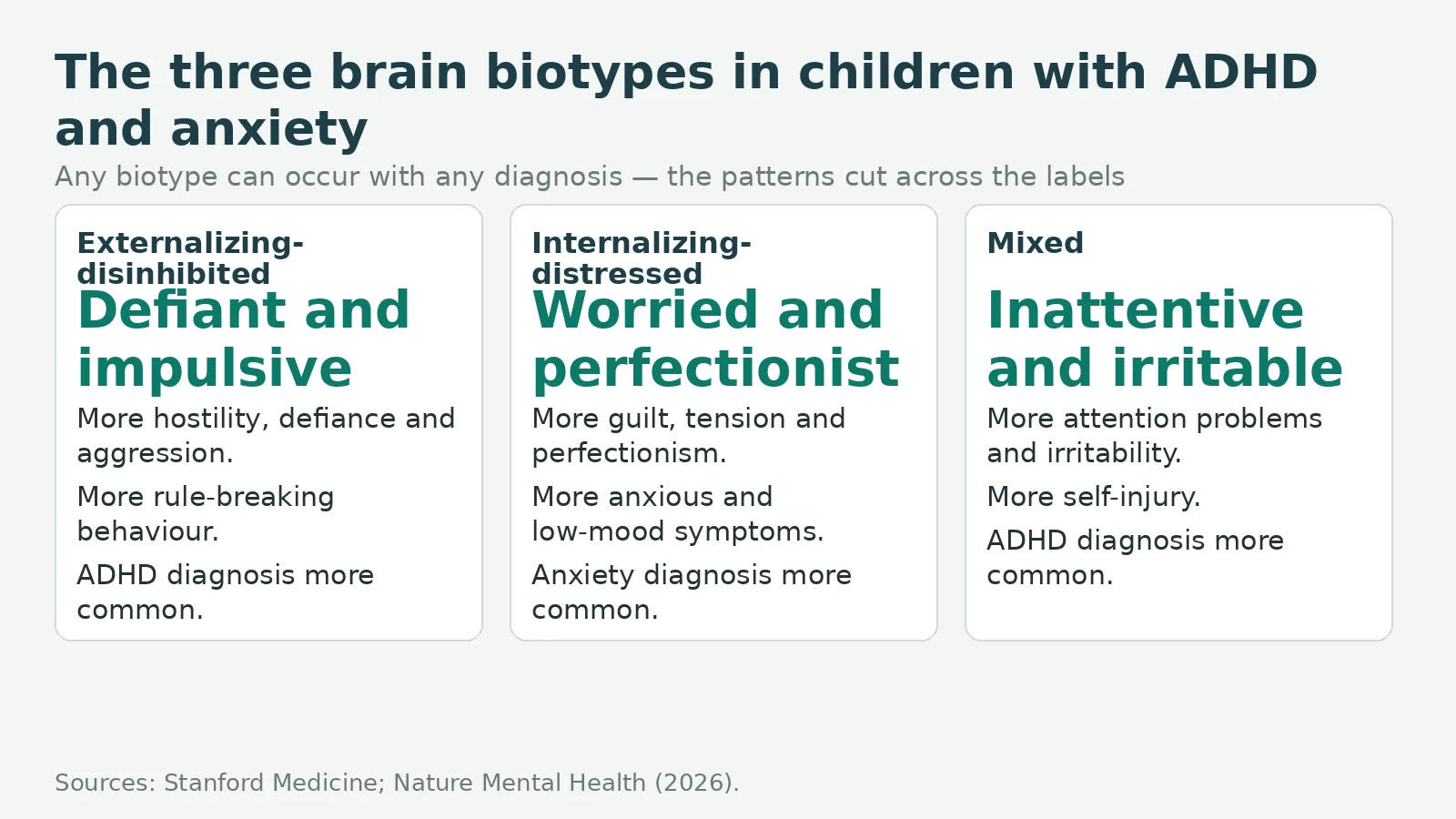
Each biotype is linked to a different set of brain circuits and a different mix of symptoms. Importantly, the biotypes did not line up neatly with the diagnoses doctors use today: children with ADHD, anxiety, or both could belong to any of the three groups, although some patterns were more common with particular diagnoses.
1. Externalizing-disinhibited
Children in this group showed more hostility, defiance and impulsivity, along with aggression and rule-breaking behaviour. An ADHD diagnosis was more common in this group than in the others. The pattern reflects stronger disruption in the brain circuits involved in behaviour control.
2. Internalizing-distressed
Children in this group showed more guilt, tension and perfectionism, along with symptoms of anxiety and low mood. An anxiety diagnosis was more common here. The pattern reflects stronger disruption in the circuits that handle emotion and attention to threat.
3. Mixed
Children in this group had more attention problems, irritability and self-injury. Like the first group, they were more likely to have an ADHD diagnosis. This pattern combines difficulties from both dimensions, so the children’s symptoms span behaviour, attention and mood.
Why brain patterns and diagnoses don’t line up
ADHD and anxiety are diagnosed from symptom checklists, and the two conditions overlap a great deal: a child with one condition often has several symptoms of the other. As co-senior author Yu Zhang of Stanford Medicine put it, that overlap “hinders our understanding of the neurobiology underlying traditional, symptom-based diagnoses”. The new study suggests the biology underneath may be organised differently from the labels — which could explain why two children with the same diagnosis can respond very differently to the same treatment.
The scale of the overlap is large. According to the CDC, about 4 in 10 children with ADHD also had anxiety, and nearly 78% had at least one other condition alongside ADHD. In the United States, an estimated 7 million children aged 3 to 17 — about 11.7% — had a current ADHD diagnosis in 2024.
What this could mean for children and families
The most surprising finding, the researchers said, was that the biotypes could be spotted in the baseline brain scans of children who had no diagnosis when they enrolled but were diagnosed later. That raises the possibility of using the patterns as an early indicator, so support could start sooner — and, the researchers hope, slow down or even reverse how the conditions develop.
The biotypes could also help match children to treatments that work for them. At present, finding the right treatment often takes trial and error: when a doctor prescribes a new medication, it can take weeks or months to see a response, and if the first one does not work, they try another. The researchers now want to use the biotypes in future clinical trials to see which treatments improve which specific patterns of brain activity.
That said, this is research, not a test you can ask for today. Brain scans are not used to diagnose ADHD or anxiety, and the study’s authors say symptom-based diagnosis is unlikely to be replaced — the two approaches would work together.
How ADHD and anxiety are diagnosed today
There is no single test for ADHD. A specialist — such as a paediatrician, psychiatrist or clinical psychologist — makes the diagnosis from a detailed history, observation and standardised questionnaires, with reports from home and school. The NHS explains that symptoms must be present in more than one setting, such as home and school, and must have started before the age of 12.
Anxiety in children is recognised in a similar way. The NHS lists signs such as becoming irritable, tearful or clingy, difficulty sleeping, bad dreams, angry outbursts, constant negative thoughts and avoiding everyday activities like school or seeing friends. Anxiety becomes a problem when it is strong, does not go away, and starts to get in the way of daily life.
Support for both conditions can include talking therapies, parent training and school support, and sometimes medication — the right mix depends on the child, which is why the researchers hope the biotypes will one day help doctors choose sooner. If you are worried about your child, your GP is a good place to start, and your child’s school can help too.
When to see a doctor
Talk to your GP if your child’s difficulties with attention, behaviour or worry have lasted for months, are present at home and at school, or are stopping them from learning, sleeping or enjoying things they used to like. A GP can refer your child to a specialist service for assessment, and can advise on support while you wait.
If your child talks about harming themselves, or you are worried about their immediate safety, seek help urgently — contact your GP, a crisis service, or emergency services. For support and guidance, you can also visit our get help now page. In an emergency call 911 (US), 999 (UK) or 112 (EU).
Frequently asked questions
What are the three brain types in ADHD and anxiety?
The three biotypes are externalizing-disinhibited, internalizing-distressed and mixed. The first is linked to impulsivity, defiance and aggression; the second to guilt, tension and perfectionism; the third to attention problems, irritability and self-injury. They were found by a Stanford-led team using AI to analyse thousands of children's brain scans.
Can a brain scan diagnose ADHD or anxiety?
No. Brain scans are not used to diagnose ADHD or anxiety, and the researchers say the new biotypes will not replace symptom-based diagnosis. Diagnosis still depends on a specialist assessment of a child's behaviour at home and at school. The biotypes are a research finding that may one day help doctors spot problems earlier and choose treatments sooner.
Does my child have ADHD or anxiety if they show these symptoms?
Not necessarily. Many children are restless, worried or inattentive at times, and only a specialist can tell whether symptoms add up to a diagnosis. The NHS says a diagnosis needs symptoms in more than one setting, starting before age 12, that clearly affect daily life. If you are worried, talk to your GP, who can arrange an assessment.
How common are ADHD and anxiety together in children?
Very common. The CDC found that about 4 in 10 children with ADHD also had anxiety, and nearly 78% had at least one other condition, such as a behaviour problem, depression or autism. Around 7 million US children aged 3 to 17 — about 11.7% — had a current ADHD diagnosis in 2024, according to a national parent survey.
Will this study change how ADHD is treated?
Not yet. The study is early research, and the biotypes are not used in clinics. The researchers hope they will help future clinical trials test which treatments improve which brain patterns, so children can be matched to the treatment most likely to help them instead of trying one after another. For now, treatment is decided with your child's doctor.
What is the difference between ADHD and anxiety in children?
ADHD mainly involves inattention, hyperactivity and impulsivity — difficulty focusing, sitting still and waiting a turn. Anxiety mainly involves persistent worry, fear and avoidance, with signs such as clinginess, sleep problems and angry outbursts. The two often occur together, and their symptoms can look alike, which is why a specialist assessment matters.
Sources
- Stanford Medicine: Three brain biotypes found in kids with ADHD, anxiety news.stanford.edu
- Jiao Y, et al. Deep learning of brain–behavior dimensions identifies transdiagnostic biotypes in youth with ADHD and anxiety disorders. Nature Mental Health, 2026 doi.org
- CDC: Data on ADHD in Children www.cdc.gov
- NHS: Anxiety in children www.nhs.uk
- Great Ormond Street Hospital: Attention deficit hyperactivity disorder (ADHD) www.gosh.nhs.uk
- Danielson ML, et al. ADHD Prevalence Among U.S. Children and Adolescents in 2022. J Clin Child Adolesc Psychol, 2024 pubmed.ncbi.nlm.nih.gov

Try the tool
How have you felt over the last 2 weeks?
The PHQ-9 and GAD-7 that GPs use. Private, about 3 minutes.
Start the self-check