What Is Seltorexant? The New Depression and Sleep Drug
Seltorexant blocks the brain's wake signal to treat depression with insomnia — but it is still investigational. Here is what the Phase 3 trials actually found, and why the drug is not available yet.
- Written by
- Health Daily Advice
- Published
- Reading time
- 8 minutes
- Sources
- 8 cited

In this guide
Seltorexant is an investigational drug being studied as an add-on treatment for major depression with insomnia symptoms. It blocks the brain’s orexin-2 receptors, which drive wakefulness, aiming to calm hyperarousal and restore natural sleep. It is not approved by any regulator and cannot be prescribed, and its Phase 3 results so far are mixed.
What is seltorexant?
Seltorexant (development code JNJ-42847922) is a once-daily tablet developed by Johnson & Johnson (Janssen) as an add-on, or adjunctive, treatment for adults with major depressive disorder (MDD) with insomnia symptoms. It is taken alongside an existing SSRI or SNRI antidepressant, not instead of one, and was studied in people aged 18 to 74 whose depression had not improved enough on their current antidepressant. It is a first-in-class selective antagonist of the human orexin-2 receptor (OX2R), and it is still investigational, which means no regulator has approved it and no doctor can prescribe it. Johnson & Johnson describes it as being studied for the adjunctive treatment of MDD with insomnia symptoms.
The interest in it comes from a gap in current care. According to Johnson & Johnson, approximately 60 percent of people with depression still have insomnia symptoms while taking an SSRI or SNRI, and no therapy is approved specifically to treat depression with insomnia symptoms. Poor sleep and low mood feed each other: broken sleep makes depression harder to shift, and depression makes sleep harder to get. A drug that tackles the wakefulness side of that loop, rather than simply sedating the brain, would be a genuinely new approach.
How does seltorexant work?
Orexin, also called hypocretin, is a chemical signal in the brain that promotes wakefulness. It acts through two receptors, OX1R and OX2R. Johnson & Johnson’s explanation is that in depression, orexin-2 receptors can be stimulated “for too long or at inappropriate times”, causing hyperarousal — a state of being wired and alert when the body should be winding down. That hyperarousal shows up as insomnia and excessive cortisol release, and it may contribute to both the depression and the sleeplessness. Seltorexant selectively blocks OX2R, aiming to normalise that overactivation so natural sleep can return and mood can improve. Johnson & Johnson calls it the only investigational therapy being studied in depression that is believed to work this way.
That mechanism is quite different from older sleep medicines. Most conventional insomnia drugs, such as benzodiazepines and Z-drugs like zolpidem, boost GABA, the brain’s main calming signal, and effectively push the brain towards sedation. A 2021 review of orexin antagonists notes that physical dependence is a concern with GABA-based drugs and one of the main limits on long-term use. Orexin antagonists work the other way around: instead of adding sedation, they turn down a wake signal, letting sleep take over on its own.
Seltorexant also differs from the orexin drugs already on pharmacy shelves. Suvorexant and lemborexant are dual orexin receptor antagonists — they block both OX1R and OX2R — and they are approved for chronic insomnia, not for depression. Seltorexant blocks OX2R only, and it is being studied for depression with insomnia, not as a general insomnia drug. In the placebo-controlled Phase 3 trial, seltorexant also improved depression scores when the sleep item was removed from the scale, a result Johnson & Johnson and its investigators present as evidence that the antidepressant effect is not just sedation.
What did the clinical trials find?
Two Phase 3 trials have reported results, and together they tell a mixed story: a win against placebo, and a miss against an established add-on drug. That mixed picture is the honest headline, and it is why the drug’s future is still undecided.
The placebo-controlled trial (MDD3001)
The first Phase 3 trial, known as MDD3001 (registry number NCT04533529), compared seltorexant 20 mg once daily with a matching placebo over six weeks in 588 adults with depression and insomnia symptoms who had not responded well enough to an SSRI or SNRI. Both groups kept taking their background antidepressant. The trial met all its primary and secondary endpoints, according to Johnson & Johnson. On the main measure, the Montgomery-Åsberg Depression Rating Scale (MADRS), seltorexant beat placebo by a least squares mean difference of 2.6 points at day 43 (p = 0.007) — statistically significant, but a modest difference. Sleep disturbance also improved, with a 3.7-point difference on the PROMIS sleep disturbance score (p < 0.001), and depression scores improved even when the sleep item was removed from the scale (difference of 2.0, p = 0.023). Psychiatric Times reported the poster data from the trial, and the investigators concluded the improvement went beyond simply helping people sleep.
The head-to-head trial against quetiapine XR (MDD3005)
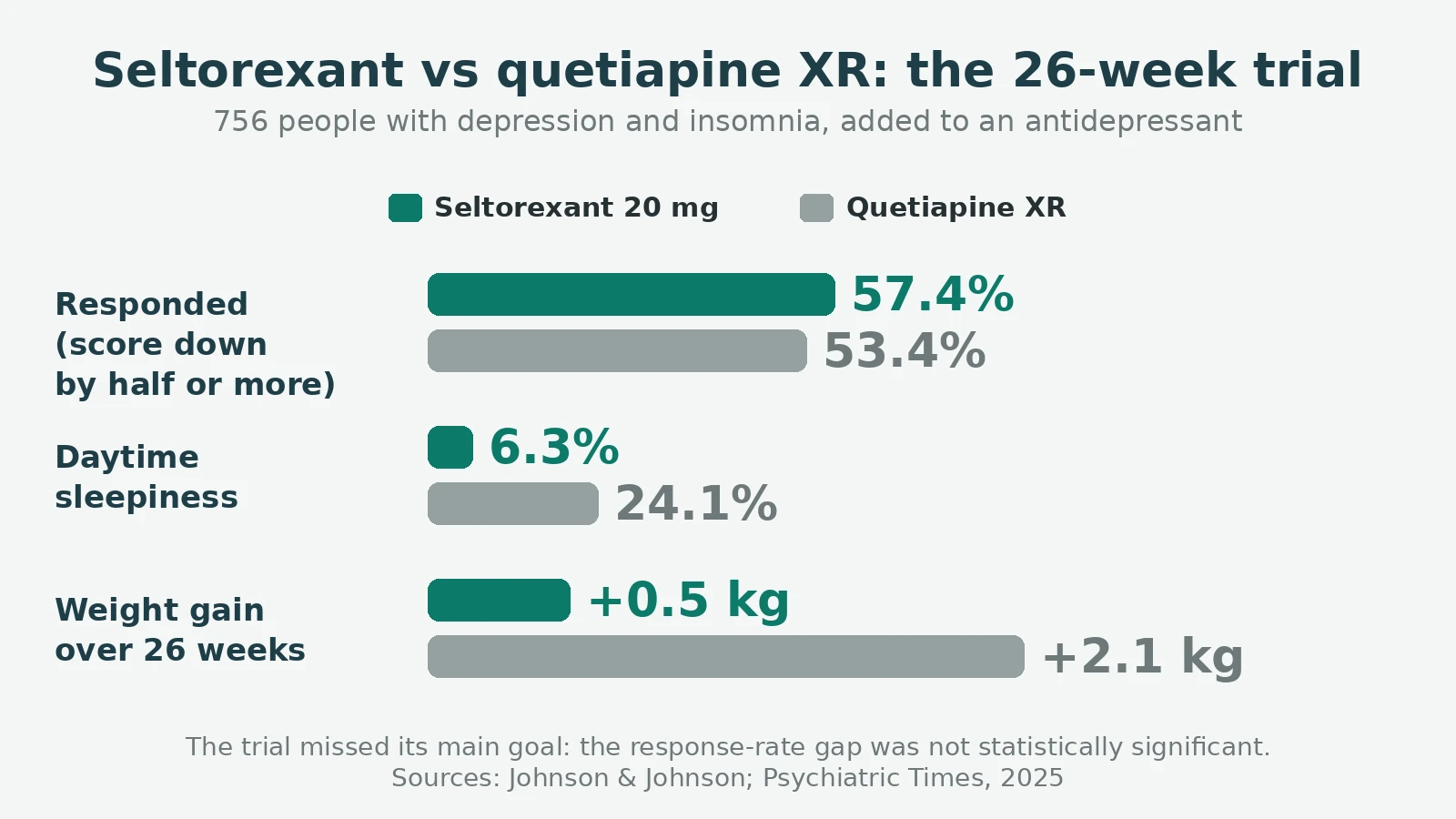
The second Phase 3 trial, MDD3005, took a harder test: 756 people were randomised to either seltorexant 20 mg or quetiapine XR, a commonly prescribed add-on treatment, for 26 weeks, again on top of an SSRI or SNRI. The main goal was the response rate — the share of people whose MADRS score improved by at least half. Seltorexant’s response rate was numerically higher, 57.4 percent against 53.4 percent for quetiapine XR, but the 4.0 percent gap was not statistically significant, so the trial missed its primary endpoint. Depression improved by similar amounts in both groups, with MADRS scores falling by 23.0 points with seltorexant and 22.7 with quetiapine XR. Where the two drugs clearly differed was tolerability: daytime sleepiness affected 6.3 percent of people on seltorexant against 24.1 percent on quetiapine XR, average weight gain was 0.5 kg against 2.1 kg, and fewer people stopped treatment because of side effects (5.7 percent against 11.3 percent). Johnson & Johnson’s framing is that seltorexant showed efficacy comparable to quetiapine XR with a better tolerability profile, and Psychiatric Times concluded the results showed “a favorable benefit-risk balance for further development”. The fair summary is this: similar depression improvement, fewer side effects, but the trial missed its main goal.
Side effects and safety: what the trials showed
In the placebo-controlled trial, seltorexant was generally well tolerated. Treatment-emergent side effects were reported by 36.0 percent of people on seltorexant and 40.3 percent on placebo — slightly fewer on the drug than on the dummy pill — and very few people in either group stopped treatment because of side effects (2.1 percent against 2.3 percent). One serious side effect occurred in each group, and none were attributed to the study drug. In an earlier Phase 2b study, the most common side effects with seltorexant were sleepiness, headache and nausea, and the investigators reported no new safety signal. That Phase 2b study also found the drug’s side-effect profile manageable at the 20 mg dose.
The head-to-head trial told a similar story in a different way: overall side effects and stoppages because of side effects were lower with seltorexant than with quetiapine XR, and the side effects that were at least twice as common with quetiapine XR were sleepiness, increased weight and dry mouth. It is worth noting what was monitored rather than seen: the trial registry lists events such as cataplexy and sleep paralysis as events of special interest that researchers watched for with this class of drug. Those were pre-specified safety checks, not side effects observed in the trials. Long-term safety beyond a year is not established in the published trial data so far.
Why the 20 mg dose matters
Every Phase 3 result for seltorexant comes from the same dose: 20 mg once daily. That is not a coincidence, and it is not a starting point for a higher dose. In the Phase 2b study, the 20 mg dose improved depression scores, with a difference of 3.1 points against placebo at week 6 and 4.5 points at week 3, while the 40 mg dose did not show the same benefit and was dropped from the study after an interim analysis. The same pattern — benefit at 20 mg, not at 40 mg — has shown up across the programme. People with worse insomnia at the start of the Phase 2b study also saw a larger benefit from the 20 mg dose, which fits the idea that the drug works best where sleep disturbance is part of the depression. None of this is a dosing recommendation: the trials used 20 mg once daily as a research dose, and the drug is not available to prescribe.
What seltorexant is not, and where it stands now
Seltorexant is not an approved medicine. It has no approval from the FDA, the EMA or the MHRA, it cannot be prescribed, and it is not available to buy. No application for marketing approval has been announced, and no timeline for one was given in the trial reports. It is also not a general sleeping pill: it is being studied only as an add-on for depression with insomnia symptoms, and it is not a replacement for an antidepressant. After the second Phase 3 trial missed its main goal, Johnson & Johnson’s position was that the results support further development as a potential add-on treatment. Whether that leads to an approval application, and when, is not known. For now, seltorexant is best understood as a promising idea with one positive placebo-controlled trial and one head-to-head trial that missed its primary endpoint — interesting science, but not a treatment anyone can use yet.
When to see a doctor
If you are living with depression and your sleep is still broken despite taking an antidepressant, talk to a doctor or pharmacist rather than waiting it out or changing anything on your own. Do not stop or alter your antidepressant without medical advice, and do not try to obtain an investigational drug outside of a clinical trial. A doctor can review whether your current treatment is working, check for other causes of poor sleep, and discuss the options that are available now, including talking therapies and adjustments to your existing treatment. If you feel you may act on thoughts of harming yourself, seek help right away — you can find immediate support options on our get help now page.
In an emergency call 911 (US), 999 (UK) or 112 (EU)
Frequently asked questions
Is seltorexant approved or available?
No. Seltorexant is investigational and has not been approved by the FDA, EMA or MHRA, so no doctor can prescribe it and it cannot be bought. It has only been given to people taking part in clinical trials. Johnson & Johnson has not announced any application for marketing approval or a timeline for one, so there is no date when it might become available.
How is seltorexant different from sleeping pills?
Most sleeping pills boost GABA, the brain's main calming signal, and push the brain towards sedation, which carries a risk of dependence with long-term use. Seltorexant works the other way: it blocks orexin-2 receptors, turning down the brain's wake signal so natural sleep can take over. It is also selective for one receptor, unlike the approved dual orexin blockers suvorexant and lemborexant, and it is studied for depression with insomnia rather than insomnia alone.
What did the seltorexant trials actually show?
The results are mixed. In a 588-person placebo-controlled Phase 3 trial, seltorexant 20 mg improved depression scores by 2.6 points more than placebo, a modest but statistically significant difference, and sleep disturbance improved too. In a 756-person trial against quetiapine XR, response rates were 57.4 percent versus 53.4 percent, but that gap was not statistically significant, so the trial missed its main goal, although seltorexant caused less sleepiness and weight gain.
What side effects were seen in the seltorexant trials?
In the placebo-controlled trial, side effects were reported by 36.0 percent of people on seltorexant and 40.3 percent on placebo, and very few stopped treatment because of side effects. In an earlier Phase 2b study the most common side effects were sleepiness, headache and nausea. Against quetiapine XR, seltorexant caused far less daytime sleepiness, 6.3 percent versus 24.1 percent, and less weight gain, 0.5 kg versus 2.1 kg.
Why is the 20 mg dose important?
All the Phase 3 results for seltorexant come from 20 mg once daily, and the trials show that more is not better. In the Phase 2b study, the 20 mg dose improved depression scores while the 40 mg dose did not show the same benefit and was dropped after an interim analysis. The same pattern has appeared across the programme, so 20 mg is the dose the evidence supports, not a starting point for a higher one.
Can I ask my doctor about seltorexant?
Yes, you can ask, but your doctor cannot prescribe it because it is not approved. What a doctor can do is review whether your current antidepressant is working, check for other causes of poor sleep, and discuss the treatments that are available now, including talking therapies and adjustments to your existing treatment. If you are interested in research, a doctor can also tell you whether any clinical trials are recruiting in your area.
Sources
- Johnson & Johnson: Johnson & Johnson's investigational seltorexant shows numerically higher response in patients with depression with insomnia symptoms, with fewer side effects compared to quetiapine XR (22 September 2025) www.jnj.com
- Johnson & Johnson: Pivotal study of seltorexant shows statistically significant and clinically meaningful improvement in depressive symptoms and sleep disturbance outcomes (29 May 2024) www.jnj.com
- Psychiatric Times: New Poster Data: Seltorexant Compared With Quetiapine XR as Adjunctive Treatment for MDD With Insomnia Symptoms (20 September 2025) www.psychiatrictimes.com
- Psychiatric Times: Poster Explores Safety, Efficacy of Seltorexant for MDD, Insomnia (31 May 2024) www.psychiatrictimes.com
- ClinicalTrials.gov: NCT04533529 (MDD3001) clinicaltrials.gov
- Savitz A, et al. Efficacy and Safety of Seltorexant as Adjunctive Therapy in Major Depressive Disorder: A Phase 2b, Randomized, Placebo-Controlled, Adaptive Dose-Finding Study. Int J Neuropsychopharmacol. 2021 pubmed.ncbi.nlm.nih.gov
- Kishi T, et al. Evidence-based insomnia treatment strategy using novel orexin antagonists: A review. Neuropsychopharmacol Rep. 2021 pubmed.ncbi.nlm.nih.gov

Try the tool
How have you felt over the last 2 weeks?
The PHQ-9 and GAD-7 that GPs use. Private, about 3 minutes.
Start the self-check