What Is Pathological Demand Avoidance (PDA)?
When even a favourite activity feels impossible, it may not be defiance. PDA is an anxiety-driven resistance to everyday demands, most often seen in autistic people.
- Written by
- Health Daily Advice
- Published
- Reading time
- 8 minutes
- Sources
- 5 cited

In this guide
Pathological demand avoidance (PDA) is a pattern of intense, anxiety-driven resistance to demands — even ones the person wants to meet — most often seen in autistic people. It is not a separate diagnosis and does not appear in the DSM-5 or ICD-11. The avoidance is best understood as “can’t, not won’t”: the nervous system treats expectations as a threat.
Most of us put off a chore or dodge an awkward request. With PDA, the reaction is different in scale and in kind. A simple instruction — get dressed, come to the table, answer a question — can trigger a wave of panic. The person may distract, negotiate, make excuses, or melt down entirely, and the harder the demand is pressed, the stronger the resistance becomes. For families, it can look like defiance. For the person living it, it feels like fear.
What does pathological demand avoidance mean?
PDA was first described in 1983 by Elizabeth Newson, a British psychologist who noticed a group of autistic children whose behaviour did not fit the picture of autism recognised at the time. They were socially motivated and often charming, yet they resisted everyday demands with an intensity that set them apart.
The term has always been contested. Some people prefer “persistent drive for autonomy”, which keeps the same initials and puts the need for control at the centre. Others use “extreme demand avoidance”. The word “pathological” bothers many people, because it can sound as if the person is the problem — when, from the inside, the avoidance is a response to anxiety that feels anything but chosen.
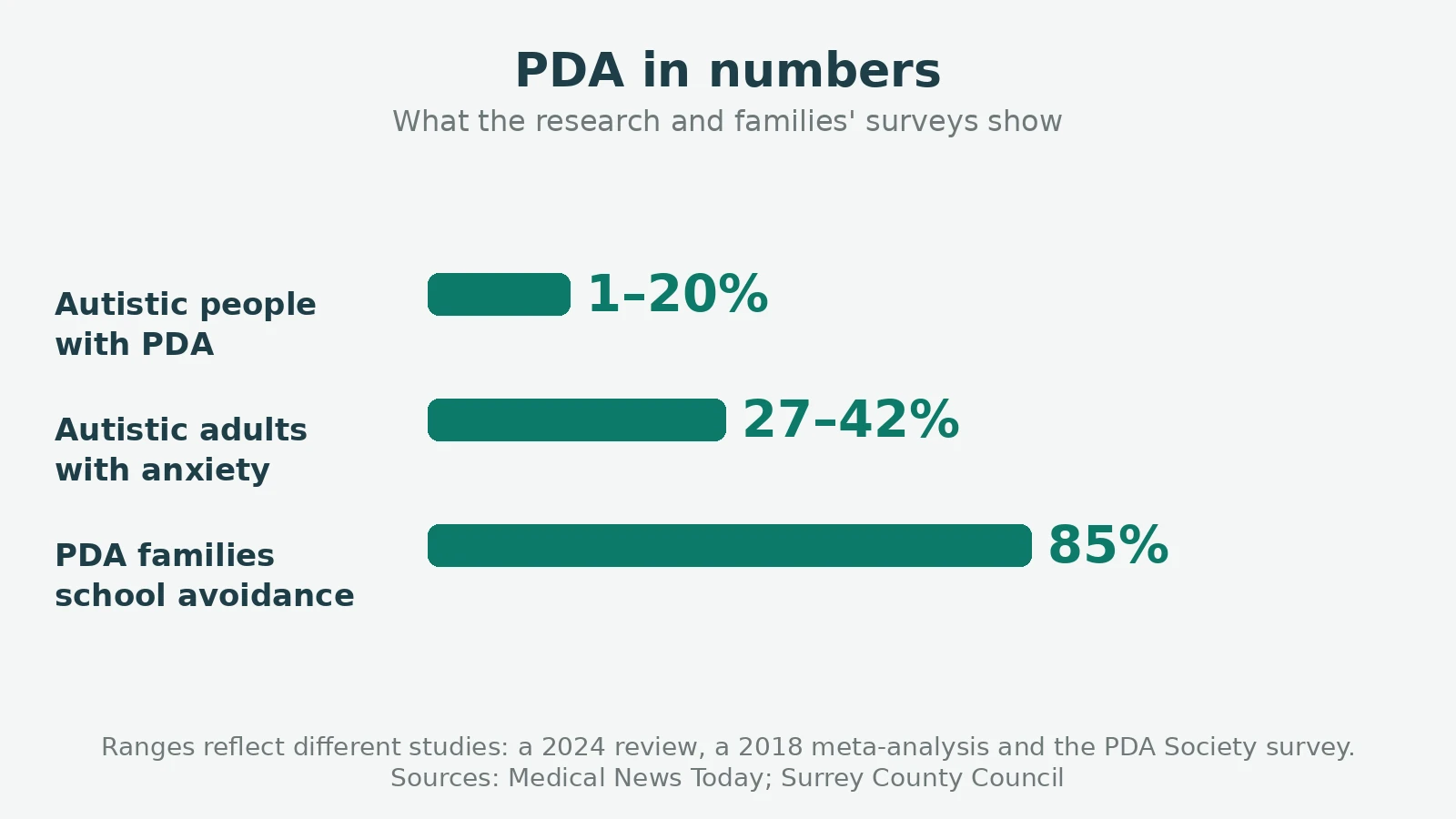
What has not changed is the core idea: PDA describes a profile within autism, not a condition on its own. A 2024 review of the research estimated that between 1% and 20% of autistic people experience it, though the true figure is unknown — and there is still no agreed set of features that defines it.
What are the signs of PDA?
There is no checklist that settles it, and the signs overlap with autism itself. But certain patterns come up again and again in research and in families’ accounts.
- Extreme avoidance of everyday demands — including things the person wants or enjoys, such as a favourite activity or a treat. This is the feature that most sets PDA apart.
- Social strategies to avoid demands — distracting, changing the subject, negotiating, making excuses, charming or role-playing to steer attention away.
- Strong emotional responses — if avoidance fails, the person may have a panic attack or a meltdown that looks wildly out of proportion to the request.
- An anxiety-driven need for control — trying to stay in charge of what happens, when and how, because losing control feels unsafe.
- Rapid mood shifts — calm one moment, in crisis the next, over something that seems trivial to everyone else.
- Surface sociability — appearing socially fluent and engaged in short exchanges, while finding the demands of deeper social interaction exhausting.
- Comfort with role play and fantasy — some people find it easier to navigate the world through a character or an imagined scenario.
In children, PDA can show up as school refusal, refusal of self-care such as bathing or brushing teeth, control over food, noise or routines at home, and conflict with siblings. In adults, it more often appears at work, in relationships or in parenting — a meeting that feels impossible to attend, a phone call that cannot be made, a form that stays blank for weeks.
What counts as a “demand”?
A demand is far wider than an instruction. The National Autistic Society groups demands into three kinds, and all three can trigger the same response.
- Direct demands — being told to do something, such as “put your coat on”.
- Indirect demands — an expectation that needs a response, such as a question, a plan that has been made for you, or a social rule.
- Internal demands — needs from inside the body, such as hunger, tiredness or needing the toilet.
That last group surprises most people. A child may avoid going to the toilet simply because it feels like a demand, and the pressure of being asked makes it harder still. Even eating and drinking can become overwhelming when the expectation to do them registers as a threat. It is why the PDA Society’s shorthand is so often quoted by families: “can’t, not won’t”.
How is PDA different from defiance?
The difference is what drives the behaviour. Defiance is a choice to push back against a rule. PDA is driven by anxiety: the nervous system registers a demand as a threat and switches on a fight, flight, freeze or fawn response before conscious thought catches up. By the time the person is aware of what is happening, their body has already decided the demand is dangerous.
That is also why pressure usually makes things worse. Telling someone with PDA to “just do it” adds another demand on top of the first, and the anxiety — and the avoidance — grows. By contrast, when anxiety falls, demands often become manageable. The PDA does not disappear, but the person can cope with far more of daily life.
Other conditions can look similar, which is why a professional assessment matters. Avoidance is also a feature of post-traumatic stress disorder, obsessive-compulsive disorder and ADHD, and oppositional defiant disorder involves persistent defiance and hostility. People can have more than one of these at the same time, and only a clinician can unpick which pattern fits.
Is PDA a diagnosis?
No. PDA does not appear as a diagnosis in the DSM-5-TR, the manual clinicians use to diagnose mental health conditions, or in the ICD-11. A 2018 study and a 2023 review both concluded that there is not enough evidence to treat it as a separate condition — it is best understood as a behavioural profile within autism.
That means there is no standalone PDA assessment and no test that can confirm it. The profile is usually identified during an autism assessment, and it should be noted in the diagnosis paperwork. Questionnaires exist — the Extreme Demand Avoidance Questionnaire (EDA-Q), developed in 2013, and a shorter eight-item version from 2021 — but they support an assessment rather than replacing one, and an online quiz cannot tell you whether you or your child has PDA.
The lack of a formal diagnosis has real consequences. Some services do not recognise the profile, and families can find themselves told that the behaviour is a parenting problem. In Surrey, the county council’s position statement — written with autistic people, parents and professionals — says the profile is often missed or misunderstood, and that this can lead to poor outcomes. It also says formal identification should not be a barrier to support: PDA-friendly help should be part of what services ordinarily offer.
What causes PDA?
The honest answer is that nobody knows yet. Research is thin, and the causes are thought to be a mix of genetic, neurological and environmental influences, as with autism more broadly.
The leading explanation is anxiety. Anxiety disorders commonly co-occur with autism: a 2018 review and meta-analysis found that between 27% and 42% of autistic adults live with an anxiety disorder at some point in their lives. In PDA, that anxiety is tied specifically to demands and to a loss of autonomy — the feeling that someone else is in control.
Other factors may add to it: a strong need for predictability, difficulty adapting to change, sensory differences, and trouble recognising the body’s internal signals. None of these is a cause on its own, and none of them is the person’s fault — or their family’s.
What helps?
Traditional approaches often backfire with PDA. Firm rules, reward charts and consequences can raise anxiety and make demands harder, not easier. What tends to help is lowering the pressure and giving the person a genuine sense of control.
For the person themselves, the PDA Society suggests letting others know what makes a demand feel difficult, setting realistic expectations, and building in demand-free time every day. Reframing a demand as a choice — “would you like to go now or later?” rather than “go now” — can take the threat out of it. So can pausing before answering, breaking a task into small steps, and finding different ways to do the same thing. Connecting with other people who share the experience, and working with a mental health professional who understands neurodivergence, can make a real difference.
For parents and carers, the advice is similar but starts with trust. Let go of how things “should” happen, and prioritise a warm, calm and consistent relationship. Soften the language: “your coat is here” or “I wonder where your coat is?” instead of “put your coat on”. Explain why something matters, offer real choices, and accept “no” when a task is genuinely not possible — it can be tried again later, when the person is calmer. Rewards can backfire too, because they add another demand. Low-arousal approaches, which keep anxiety to a minimum, are a good starting point.
At school and at work, small adjustments help: flexible hours, a quiet space to retreat to, advance warning of changes, and tasks offered as options rather than orders. One parent in Surrey’s position statement described stopping asking her daughter to have a shower — and finding that, after a while, her daughter started doing it herself. The demand had been the barrier, not the shower.
When to see a doctor
Talk to a GP if demand avoidance is affecting daily life — school, work, relationships or self-care — or if anxiety is frequent and hard to manage. A GP can refer for an autism assessment or to mental health services, and can help rule out other causes. It helps to keep notes of specific examples: what the demand was, what happened, and what seemed to make it easier or harder.
If you are supporting a child, ask the school what adjustments are already in place, and whether an assessment of their needs would help. You do not need a PDA label to ask for support — describing the pattern, and what helps, is enough to start the conversation.
If anxiety is overwhelming, or you are having thoughts of harming yourself, please reach out straight away. In the UK you can call Samaritans on 116 123 at any time, and our get help now page lists support services in the US, UK and EU. In an emergency call 911 (US), 999 (UK) or 112 (EU).
Frequently asked questions
Is pathological demand avoidance a diagnosis?
No. PDA is not listed in the DSM-5-TR or the ICD-11, and there is no standalone PDA assessment. It is described as a behavioural profile within autism, usually identified during an autism assessment. Questionnaires such as the EDA-Q can support an assessment, but they are not a diagnosis, and online quizzes cannot tell you whether you have PDA.
Is PDA the same as being defiant?
No. Defiance is a choice to push back against a rule, while PDA is driven by anxiety: the nervous system treats a demand as a threat and triggers a fight, flight, freeze or fawn response. That is why pressure usually makes PDA worse, while lowering demands and offering choices can make the same task possible. Families often describe it as 'can't, not won't'.
What are the signs of PDA in adults?
Adults with a PDA profile may avoid everyday demands at work, at home or in relationships — unanswered emails, calls that never get made, appointments that feel impossible. They may negotiate or distract to avoid tasks, need a strong sense of control, and swing quickly from calm to distress. Many also live with high anxiety, and some find role play or fantasy helps them cope.
How is PDA identified?
PDA is identified as part of an autism assessment, by a clinician who takes a detailed history from the person and, where relevant, their family. There is no blood test, brain scan or single questionnaire that confirms it. If you recognise the pattern in yourself or your child, a GP can refer you for an autism assessment or to mental health services with experience of neurodivergence.
What helps someone with PDA?
Lowering demands and building trust help more than pressure or rewards. Reframing demands as choices, allowing demand-free time, pausing before answering, and using calm, indirect language all reduce anxiety. At school or work, flexible hours and advance warning of changes help. A mental health professional who understands neurodivergence can help build coping strategies over time.
Can PDA be outgrown?
PDA is generally understood as a lifelong profile, but how it shows up changes with age and with support. Children may find some demands easier as they develop coping strategies and gain more control over their lives. Adults often learn which approaches work for them — more choice, less pressure, trusted routines — even though the underlying sensitivity to demands remains.
Sources
- Medical News Today: Pathological demand avoidance: Signs and support www.medicalnewstoday.com
- Psych Central: PDA Autism: Definition, Signs, and Coping Tips psychcentral.com
- PDA Society: PDA Society — Pathological Demand Avoidance www.pdasociety.org.uk
- ERIC: What is Pathological Demand Avoidance (PDA)? eric.org.uk
- Surrey County Council: Pathological Demand Avoidance position statement www.surreycc.gov.uk

Try the tool
How have you felt over the last 2 weeks?
The PHQ-9 and GAD-7 that GPs use. Private, about 3 minutes.
Start the self-check