Why Do I Cry for No Reason? Causes and What Helps
Tears out of nowhere? Crying for no reason is more common than it feels, and it usually has a cause hiding underneath. Here are the reasons doctors see most, and when tears are a sign to get help.
- Written by
- Health Daily Advice
- Published
- Reading time
- 6 minutes
- Sources
- 4 cited

In this guide
Crying for no reason is more common than it feels. Tears often arrive when stress, tiredness, hormones or low mood build up quietly, and they can also be a sign of anxiety, depression, burnout or grief. Occasional tears are normal, but frequent, uncontrollable crying that disrupts your life deserves a conversation with a doctor.
Tears in the middle of an ordinary day, with nothing obviously wrong, can feel confusing and even embarrassing. But crying is a normal human response, and “no reason” usually means the reason is not obvious yet. This guide explains why tears arrive out of nowhere, the common causes doctors see, what helps in the moment, and when crying is a sign to get help.
Is crying for no reason normal?
Yes, sometimes. Everyone cries, and how often varies a lot from person to person. A large study of men and women around the world found that people report crying one to ten times per month. In the United States, women reported crying 3.5 times a month and men 1.9 times. These are only averages, and other studies have found different results, but they show that regular tears are part of normal life.
Crying comes in two kinds. Reflex tears protect your eyes, for example when you chop an onion or get dust in your eye. Emotional tears are different: strong feelings switch on the nervous system and trigger extra tear production. Sadness is the best-known trigger, but people also cry from happiness, laughter, frustration, anger and fear. Cleveland Clinic notes that researchers still do not fully understand emotional crying, and that whether a good cry helps depends partly on the situation and the support around you. One key study found that crying made people feel worse straight afterwards, but 90 minutes later they felt better than before they cried.
Hormones play a part too. Testosterone, which is higher in men, may hold crying back, while prolactin, which is higher in women, may encourage it. That is one reason women tend to report crying more often than men.
Common reasons for crying for no reason
When tears keep arriving without an obvious trigger, one of these is usually behind them.
Depression
Depression is one of the most common reasons for crying that seems to come from nowhere. The NHS lists feeling tearful among the psychological symptoms of depression, alongside continuous low mood, hopelessness, low self-esteem, guilt, irritability and loss of interest in things you used to enjoy. For a diagnosis, symptoms usually last at least two weeks. Depression changes how the brain handles emotion, so feelings can spill over as tears before you even know what you are feeling. The good news is that treatment works: in about 80% of cases, people who seek treatment see significant improvement.
Anxiety and stress
Anxiety can make you feel vulnerable and out of control, and those feelings often end in tears. Anxiety affects around 40 million adults in the United States each year. A 2016 study found that people with anxiety were more likely to say crying feels helpful but uncontrollable. Constant stress has a similar effect: it keeps the body’s fight-or-flight system switched on, and tears are one way the pressure escapes. Our guide to why you feel anxious for no reason explains how anxiety can build without an obvious cause.
Burnout
Burnout is extreme mental and physical exhaustion from excessive, prolonged stress. It weakens your ability to regulate negative emotions, which can lead to emotional outbursts and crying over small things. Other features include anxiety, depression, irritability, insomnia, fatigue, difficulty concentrating and forgetfulness. If work or caring duties have left you running on empty for months, tears may be the first sign that you have hit your limit.
Hormones and your period
Hormonal shifts are a common reason for tears that seem to come from nowhere. Between 80% and 90% of females experience at least one sign of premenstrual syndrome, and crying spells are one of them, along with sadness, tension, anxiety and irritability. In 2.5% to 3% of females, PMS is severe enough to interfere with daily activities. Pregnancy brings major hormonal changes too, and if low mood and crying last for more than two weeks after giving birth, they can indicate postnatal depression. A severe form of PMS called PMDD can also bring tearfulness in the weeks before a period.
Grief
Grief is a complex, ongoing process, and crying is often part of it. Most grief eases with time, but some people develop complicated or unresolved grief, which can make them cry suddenly or without warning, months or even years after a loss. Other signs include an inability to accept the loss, emotional numbness, intense emotional pain, guilt and feeling detached from others.
Tiredness
Being very tired makes it harder to manage emotions, and many people report being quicker to cry when they are short of sleep. Adults need seven to nine hours of sleep a night, and it can take a long time to come back from a sleep deficit. If you have been crying more lately and you know you are not sleeping enough, rest is a good place to start.
Pseudobulbar affect
Pseudobulbar affect is a neurological condition that makes people cry, or laugh, suddenly and uncontrollably, often at times that do not match how they feel. It happens because of a disconnect between the parts of the brain that control emotions and the parts that regulate reflexes. It can follow a stroke, dementia, multiple sclerosis, Parkinson’s disease or motor neurone disease. If your crying feels completely disconnected from your emotions, tell your doctor.
What can help in the moment?
You do not have to force yourself to stop crying, and in a supportive setting a good cry can leave you feeling better. But there are times when you need to hold the tears back, and several techniques can help:
- Slow your breathing. Breathe in through your nose for a few seconds, let the air expand your belly, then release it slowly through your mouth. Cleveland Clinic recommends deep, slow breathing, such as 4-7-8 breathing or box breathing.
- Relax your face and throat. Loosen your facial muscles and the lump in your throat, and press your tongue to the roof of your mouth.
- Drink some water. A sip of water can break the pattern and give your body something else to do.
- Try grounding. Use your senses to focus on your surroundings, naming what you can see, hear and feel. Grounding pulls you out of your head and calms the fight-or-flight response.
- Step away briefly. If you can, give yourself a few minutes alone until the wave passes.
Over the longer term, the same habits that support mental health help with tears: regular sleep, exercise, talking to someone you trust, and cutting back on stress where you can. Meditation and mindfulness exercises can also help you manage emotions better over time.
When to see a doctor
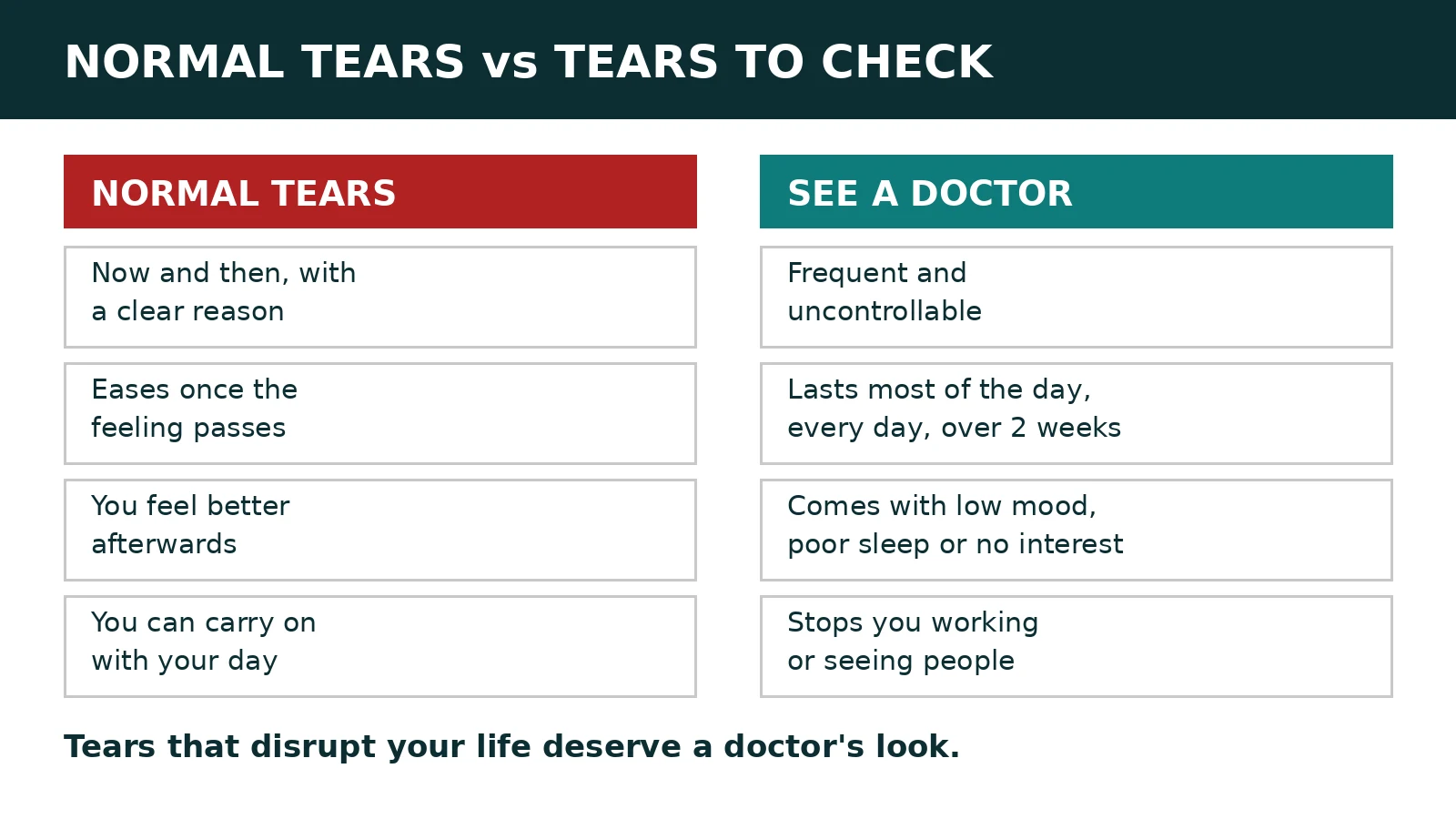
Speak to your GP if your crying is frequent, uncontrollable and happens for no apparent reason, if it interferes with your ability to do everyday things, or if it comes with other symptoms such as low mood, poor sleep, loss of interest or thoughts of harming yourself. The NHS advises seeing a GP if you experience symptoms of depression for most of the day, every day, for more than two weeks. A doctor can check for an underlying mental health condition, a hormonal problem or a neurological cause, and refer you to a psychiatrist or psychotherapist if needed.
If you are struggling right now, you do not have to face it alone. Our get help now page lists support you can reach today.
In an emergency call 911 (US), 999 (UK) or 112 (EU).
Frequently asked questions
Is it normal to cry for no reason?
Yes, sometimes. Everyone cries, and a large study found people report crying one to ten times a month. Tears can be a release for stress, tiredness or feelings you have not named yet. It becomes a concern when crying is frequent, uncontrollable or starts to interfere with work, relationships or daily life, or when it comes with other symptoms such as low mood or poor sleep.
Why do I cry easily over small things?
It usually means your emotional reserves are low. Tiredness, stress, hormones and low mood all make it harder to regulate feelings, so a small trigger can release a lot of built-up tension. Anxiety can also leave you feeling vulnerable and out of control, which makes tears come more easily. If it is a new pattern for you, it is worth asking what has changed.
Can anxiety make you cry for no reason?
Yes. Anxiety affects around 40 million adults in the United States each year, and it can make you feel vulnerable and out of control, which often ends in tears. A 2016 study found people with anxiety were more likely to say crying feels helpful but uncontrollable. If worry, racing thoughts and poor sleep come with the tears, tell your doctor, as anxiety responds well to treatment.
Is crying for no reason a sign of depression?
It can be. Feeling tearful is one of the psychological symptoms of depression listed by the NHS, along with continuous low mood, loss of interest and poor sleep. For a diagnosis, symptoms usually last at least two weeks. The NHS advises seeing a GP if you feel low most of the day, every day, for more than two weeks. About 80% of people who seek treatment for depression see significant improvement.
How can I stop crying in the moment?
Slow your breathing, relax your facial muscles and throat, press your tongue to the roof of your mouth and take a sip of water. Cleveland Clinic suggests deep, slow breathing and grounding exercises, which use your senses to focus on your surroundings. These techniques calm the fight-or-flight response. If tears keep coming despite this, step away briefly and let them pass.
Sources
- Medical News Today: Crying for no reason: Support, causes, and how to stop www.medicalnewstoday.com
- NHS: Symptoms - Depression in adults www.nhs.uk
- Cleveland Clinic: Crying: Why We Cry & How It Works my.clevelandclinic.org
- Healthline: Crying Spells: Underlying Causes www.healthline.com

Try the tool
How have you felt over the last 2 weeks?
The PHQ-9 and GAD-7 that GPs use. Private, about 3 minutes.
Start the self-check