Cannabis and Psychosis: Onset 2.5 Years Earlier, Study Finds
A major 2026 analysis of 149 studies found cannabis users developed psychosis years earlier than non-users, with the gap widest after 30. The link is strong — but it is not proof of cause.
- Written by
- Health Daily Advice
- Published
- Reading time
- 6 minutes
- Sources
- 6 cited

In this guide
Cannabis users developed psychosis an average of 2.5 years earlier than non-users, according to a 2026 meta-analysis of 149 studies and more than 71,000 people. The gap grew with age, reaching 6.3 years for people whose psychosis began after 30. The study shows a link, not proof that cannabis causes psychosis.
For years, warnings about cannabis and mental health have focused on teenagers, whose brains are still developing. A large new analysis suggests that picture is incomplete. The risk does not fade once you reach your twenties — if anything, the difference between cannabis users and non-users grows larger the later psychosis begins. Here is what the research found, why the age pattern surprised even the scientists, and what it does not prove.
What is psychosis?
Psychosis is when a person loses some contact with reality. The NHS describes three main symptoms: hallucinations, such as hearing voices that other people cannot hear; delusions, which are strong beliefs not shared by others, such as being convinced of a conspiracy to cause harm; and disordered thinking and speaking, where thoughts race and speech becomes fast and confusing. Experiencing these symptoms is often called a psychotic episode.
Psychosis is a feature of conditions including schizophrenia and bipolar disorder, and it can also be triggered by severe depression, traumatic experiences, stress, drug misuse or alcohol problems. It usually emerges in late adolescence or early adulthood, but it can begin at any age. According to Psychosis Australia, up to 3% of adults experience a diagnosed disorder involving psychosis at some point in their lives.
The meta-analysis: what it found
The study, published in August 2026 in the journal Biological Psychiatry, was carried out by researchers at the University of New South Wales in Sydney. They searched three medical databases for every peer-reviewed cohort and case-control study that reported the average age at which psychosis began in cannabis users and non-users, covering research published up to April 2025.
The final analysis pulled together 181 samples from 149 studies, covering 18,272 cannabis users and 52,801 non-users — 71,073 people with psychosis in total. Most of the studies came from Europe, North America and Australia, and most focused on people with schizophrenia.
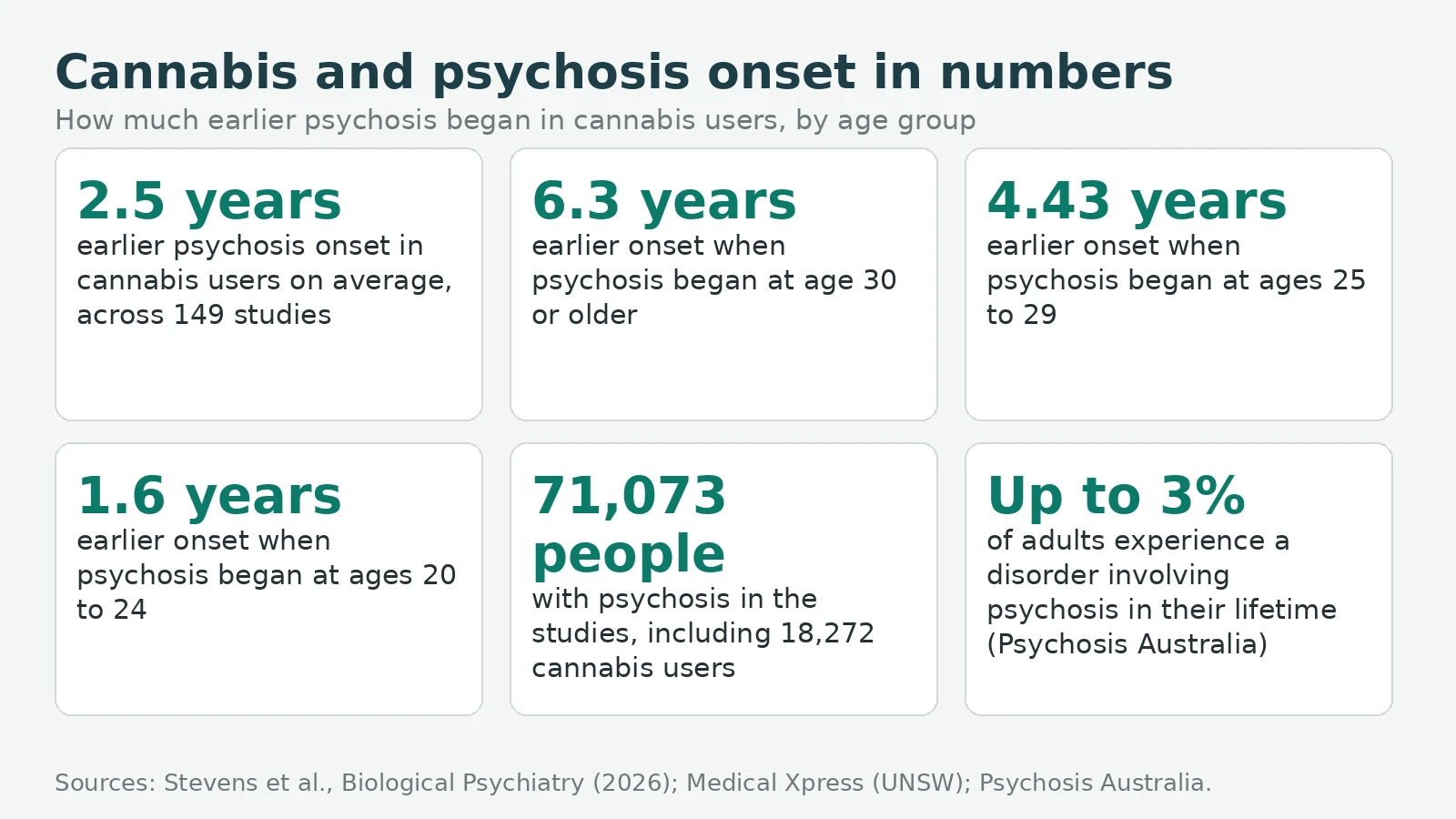
Overall, cannabis users developed psychosis 2.5 years earlier, on average, than people who had not used cannabis. That headline figure matches an earlier, smaller meta-analysis from 2011, which found a gap of 2.7 years — so the finding has now been replicated in a much larger pool of evidence.
The gap grows with age
The most striking part of the study is how the gap changes across the lifespan. When the researchers split the results by the average age at which psychosis began, they found:
- Under 20: no significant difference between cannabis users and non-users.
- Ages 20 to 24: psychosis began 1.6 years earlier in cannabis users.
- Ages 25 to 29: psychosis began 4.43 years earlier in cannabis users.
- Age 30 and over: psychosis began 6.3 years earlier in cannabis users.
The researchers suggest the pattern points to a cumulative effect — the longer someone has used cannabis, the more the timing shifts, in a way the lead psychiatrist Matthew Large compared to alcohol or nicotine. People who develop psychosis in their thirties have typically been using cannabis for much longer than those who develop it in their teens.
The lack of a difference in the youngest group surprised the team. One explanation they offer is a “floor effect”: psychosis that starts very early may have little room to shift any earlier, and strong genetic or developmental factors may dominate at that age. It is also the case that psychosis before the mid-teens is rare, leaving a narrow window for any earlier onset to show up.
Lead author Carly Stevens said the finding challenges the assumption that waiting until your mid-twenties to use cannabis makes it safe. “There’s been so much emphasis on adolescents not smoking cannabis, which is important, but we need to broaden the warnings for everyone,” she said.
What the study does not prove
This is where careful reading matters. The meta-analysis shows a strong, consistent association — but it does not prove that cannabis causes psychosis or brings it forward. Proving that would require an experiment that deliberately gave people cannabis to see if they developed psychosis, which would be unethical. The researchers are open about this, while arguing that the consistency of the evidence — especially the strong effect in older adults who have used cannabis longest — supports a causal role in the timing of onset.
Independent commentary has added useful caution. Writing for the charity DrugScience, chief research officer Michael Lynskey noted that the analyses already accounted for how much cannabis people had used over their lifetimes, which weakens a simple “more use equals earlier onset” explanation. He also pointed out that tobacco and alcohol show similar-sized associations with later psychosis, which may mean that shared factors among people who use substances — rather than the drugs themselves — explain part of the link. And like much research in this area, the studies relied on people remembering, sometimes decades later, when they first used cannabis — and memory errors can inflate the apparent association.
None of that dismisses the finding. It means the link is real and robust, but the exact mechanism, and how much of it is cannabis itself, is still not settled.
Why a few years matter
Two and a half years — or six — may not sound like much. The researchers argue it can change a life. People who develop psychosis later are more likely to have finished education or training, started work, travelled and built relationships and support networks first. Stevens noted that people may miss out on study, job opportunities, travel and relationships in those years, and that treatment can come with physical side effects that make life harder.
There is a wider cost too: up to 3% of health-related spending in developed countries is attributed to psychotic disorders, according to the researchers. Delaying onset, even by a few years, would ease that burden as well.
Potency, edibles and the “therapeutic halo”
The researchers also flagged changes in the cannabis landscape that make the findings more urgent. High-potency products and edibles, which can carry much higher concentrations of THC — the main psychoactive compound in cannabis — are more widely available than they were when many of the older studies were done.
Medical cannabis is another concern. Large said a growing number of people he treats for psychosis had been prescribed cannabis for conditions where the evidence of benefit is limited, and that the drug’s medical image can blind people to its risks. “It’s got this therapeutic halo around it,” he said.
On the hopeful side, the researchers were clear that reducing or stopping cannabis use has clear benefits, and that delaying psychosis gives people a better chance of reaching the milestones that protect against decline. Our earlier articles explain two other sides of the same picture: how cannabis use relates to suicide risk and the newer evidence on cannabis and stroke risk.
When to see a doctor
See a GP immediately if you or someone close to you is experiencing symptoms of psychosis, such as hearing voices, holding beliefs that seem untrue to everyone else, or thinking and speaking in a confused, racing way. The NHS stresses that psychosis should be treated as soon as possible, because early treatment can be more effective. A GP can refer you to a mental health specialist for assessment.
If you are worried about your own cannabis use, or someone else’s, talk to your GP or a drug support service — cutting down or stopping is something a doctor can help you plan safely. If you feel you may act on thoughts of harming yourself, call the Samaritans free on 116 123 in the UK, or find urgent help through our get help now page. In an emergency call 911 (US), 999 (UK) or 112 (EU).
Frequently asked questions
Does cannabis cause psychosis?
The evidence shows a strong link, but not proof of cause. A 2026 meta-analysis of 149 studies found cannabis users developed psychosis 2.5 years earlier on average, and the effect was consistent across studies. Proving causation would need experiments that would be unethical. The researchers say the evidence supports stronger public-health warnings about the psychiatric risks of cannabis.
How much earlier does psychosis start in cannabis users?
On average, 2.5 years earlier. The gap depends on age: it was 1.6 years for psychosis beginning at 20 to 24, 4.43 years at 25 to 29, and 6.3 years for psychosis beginning at 30 or older. There was no significant difference when psychosis began before age 20. The analysis covered 18,272 cannabis users and 52,801 non-users.
Is cannabis only risky for teenagers?
No — and that is the point of the new research. Warnings have focused on teenagers, whose brains are still developing, but the study found the gap in psychosis onset was largest in adults whose psychosis began after 30. Lead author Carly Stevens said the findings challenge the idea that waiting until your mid-twenties makes cannabis use safe.
Does stopping cannabis help?
The researchers say reducing or stopping cannabis use has clear benefits. Delaying psychosis by even a few years can protect education, work, relationships and support networks, which in turn guard against decline. If you use cannabis and are worried, talk to your GP or a drug support service about cutting down safely.
What are the early signs of psychosis?
The NHS lists hallucinations, such as hearing voices other people cannot hear; delusions, or strong beliefs not shared by others; and disordered thinking and speaking. Behaviour may change, and the person may become distressed or withdrawn. See a GP immediately if you notice these signs — early treatment can be more effective.
Sources
- Stevens et al. Cannabis Use and Age-Related Acceleration of Psychosis Onset: A Meta-Analysis. Biological Psychiatry, 2026 (PubMed) pubmed.ncbi.nlm.nih.gov
- Medical Xpress: Cannabis use linked to earlier onset of psychosis (UNSW) medicalxpress.com
- NHS: Psychosis overview www.nhs.uk
- DrugScience: Does Cannabis Cause an Earlier Onset of Psychosis? Comments on a Recent Meta-Analysis www.drugscience.org.uk
- Stevens et al. Cannabis Use and Age-Related Acceleration of Psychosis Onset: A Meta-Analysis. Biological Psychiatry, 2026 (journal) doi.org

Try the tool
How have you felt over the last 2 weeks?
The PHQ-9 and GAD-7 that GPs use. Private, about 3 minutes.
Start the self-check