Cannabis and Stroke Risk: What the New Study Found
A study of almost 443,000 US adults found cannabis use linked to higher odds of stroke — even for people who used it only a few days a month. Here is what the research did and did not show.
- Written by
- Health Daily Advice
- Published
- Reading time
- 5 minutes
- Sources
- 9 cited
In this guide
Research presented at the American Heart Association’s Scientific Sessions 2026 links cannabis use to higher odds of stroke — even for people who used it on just one to five days a month. In a study of 443,000 US adults, occasional users had 40% higher odds of stroke. The study shows an association, not proof that cannabis causes strokes.
What the new study found
The research, led by Dr Aabha Divya of Tulane University School of Medicine, analysed pooled data from almost half a million US adults who took part in the Behavioral Risk Factor Surveillance System, a large telephone survey run by the CDC, between 2020 and 2024. The findings were presented at the American Heart Association’s Scientific Sessions 2026 in Chicago.
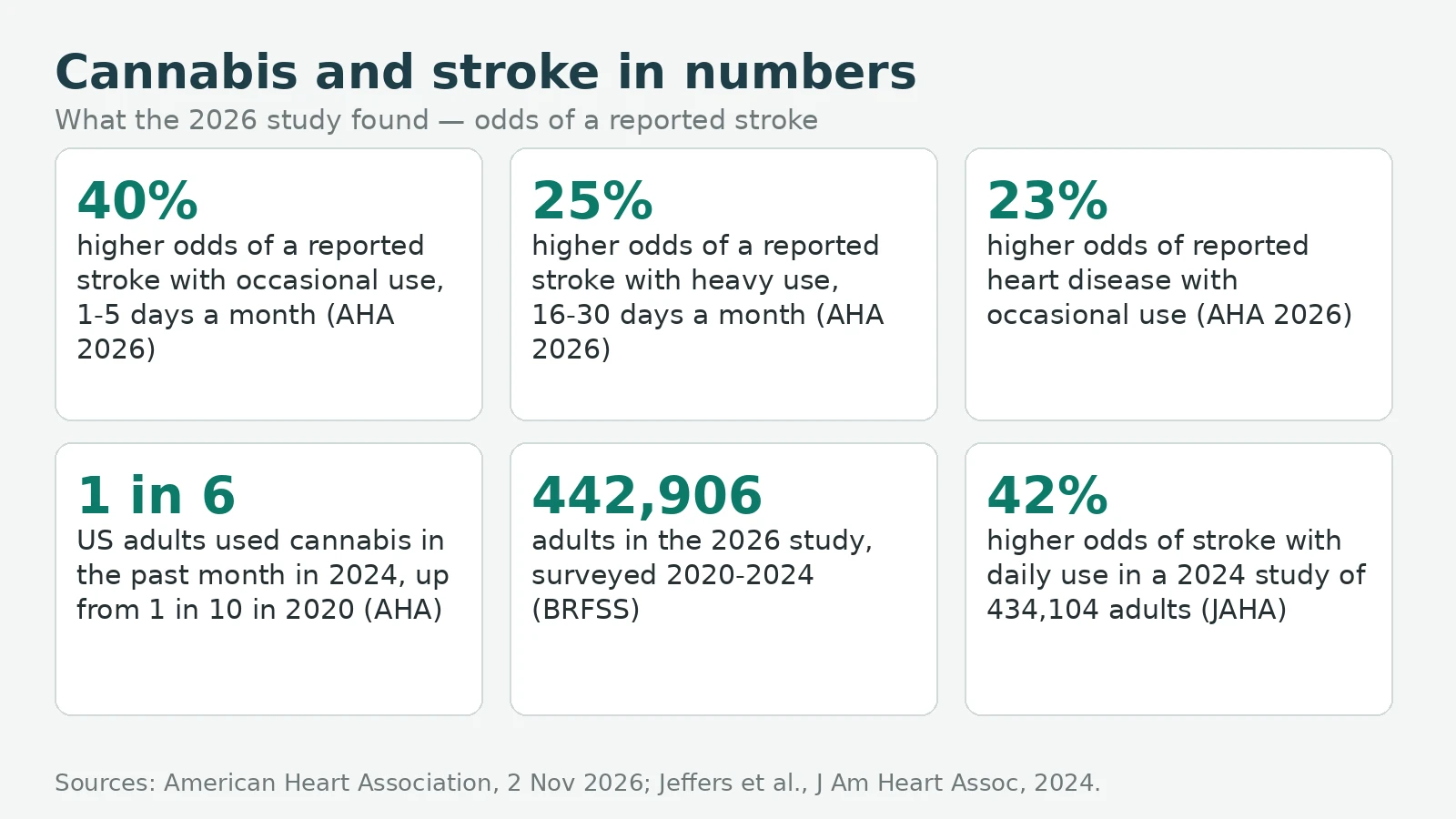
Compared with people who reported no cannabis use, those who used cannabis on one to five days a month had 23% higher odds of reporting a history of cardiovascular disease, and 40% higher odds of reporting a stroke. Heavy users — those who used it on 16 to 30 days a month — had 21% higher odds of cardiovascular disease and 25% higher odds of stroke.
The link was the same regardless of how cannabis was used — smoked, vaped or eaten. And there was no link with heart attack: the researchers found no statistically significant association between how often people used cannabis and a history of heart attack.
The pattern surprised the researchers. “We expected that the chances of heart disease would gradually rise as people used cannabis more often, but that wasn’t the case,” Divya said. “Both low-use and heavy-use groups had higher odds of developing heart disease.”
The numbers in detail
The study included 442,906 US adults with an average age of 49, about half of them women. The results were adjusted for factors including tobacco smoking, alcohol use, obesity, diabetes, kidney disease, physical inactivity, education and income.
| Cannabis use in the past month | Odds of a reported stroke | Odds of reported heart disease |
|---|---|---|
| None | Reference group | Reference group |
| 1–5 days (occasional) | 40% higher | 23% higher |
| 16–30 days (heavy) | 25% higher | 21% higher |
Results for the middle group — people who used cannabis on six to 15 days a month — were not reported in the release. Cannabis use itself has become far more common: past-month use among US adults rose from one in 10 in 2020 to one in six in 2024, a 51% increase.
What the study cannot tell us
This is important. The study looked at a single point in time, so it cannot prove that cannabis causes strokes or heart disease. It can only show that the two go together in the survey data. Several limits matter:
- Both cannabis use and diagnoses were self-reported, so memory errors are possible.
- The study had no information on the strength of the cannabis used or how much people consumed.
- People may have cut down or stopped using cannabis after a diagnosis, and the “no recent use” group could include former users.
- The findings come from a conference abstract, which has not yet been peer-reviewed. They are preliminary until published as a full paper in a peer-reviewed journal.
None of that makes the findings meaningless — the sample is very large, and the pattern held after accounting for smoking and other risk factors — but it does mean the results should be read as a warning signal, not a verdict. For more on cannabis and mental health, see our article on cannabis use disorder and suicide risk.
What earlier research found
This is not the first study to raise the question. A peer-reviewed study published in the Journal of the American Heart Association in 2024 looked at 434,104 US adults surveyed between 2016 and 2020. It found that daily cannabis use was linked to 42% higher odds of stroke, 25% higher odds of heart attack and 16% higher odds of coronary heart disease — with the odds rising the more days a month people used it.
Strikingly, the link held even in people who had never smoked tobacco. Among never-tobacco smokers, daily cannabis use was linked to more than double the odds of stroke. The American Heart Association’s 2020 scientific statement on cannabis had already warned that cannabis was “beginning to emerge as a major contributor to premature heart disease”, and urged clinicians to discuss cannabis use with patients in the same way they discuss tobacco.
How cannabis might affect the heart
Scientists have several plausible explanations. THC, the main active compound in cannabis, affects heart rate and blood pressure and can cause blood vessels to narrow. The authors of the 2024 study note that THC has effects on circulation that may lead to fainting, stroke and heart attack, and that receptors for cannabinoids are found throughout the cardiovascular system.
Smoking is also part of the picture: in the 2024 study, smoking was the most common way people used cannabis, reported by almost three in four current users, and inhaling smoke of any kind irritates blood vessels. But the 2026 study found the same association for edibles and vaping, which suggests smoking alone does not explain it. More research is needed to pin down the mechanism.
Know the warning signs of a stroke
Whatever the cause, recognising a stroke quickly saves lives. The CDC uses B.E. F.A.S.T.: Balance loss, Eye or vision changes, Face drooping, Arm weakness, Speech difficulty — and Time to call 911. The NHS uses the shorter FAST test: Face, Arms, Speech, Time to call 999.
Other warning signs include sudden confusion, sudden trouble seeing or walking, and a sudden severe headache with no known cause. The CDC notes that the treatments that work best are available only if a stroke is recognised and diagnosed within three hours of the first symptoms. Even if symptoms stop after a few minutes — a possible “mini-stroke” — get medical help straight away. Our guide to sleep problems and stroke risk covers other factors that affect stroke risk.
When to see a doctor
Talk to your doctor if you use cannabis and have risk factors for heart disease or stroke, such as high blood pressure, diabetes, high cholesterol or a family history of early heart disease. The American Heart Association says cannabis use should be part of conversations about heart health, just like tobacco and alcohol. A doctor can help you weigh the evidence for your own situation — this article cannot diagnose or advise you personally.
Call emergency services immediately if you or someone near you shows signs of a stroke. In an emergency call 911 (US), 999 (UK) or 112 (EU).
Frequently asked questions
Does cannabis cause strokes?
The evidence does not prove that. The 2026 study found that cannabis users had higher odds of reporting a past stroke, but it looked at one point in time and cannot show cause and effect. A peer-reviewed 2024 study found a similar link, including in people who never smoked tobacco. Taken together, the studies are a warning signal that needs more research, not proof of causation.
How much cannabis use was linked to stroke risk?
Even occasional use was linked to higher odds: people who used cannabis on one to five days a month had 40% higher odds of a reported stroke, while heavy users on 16 to 30 days a month had 25% higher odds. Results for the middle group, six to 15 days a month, were not reported. The study had no data on the strength of the cannabis or how much people used.
Does the way you use cannabis matter?
In the 2026 study, the link with stroke was the same whether cannabis was smoked, vaped or eaten as edibles. That surprised some experts, because smoking was expected to carry extra risk from inhaling smoke. In the earlier 2024 study, smoking was the most common method, used by almost three in four cannabis users. More research is needed on whether different forms carry different risks.
What did the earlier 2024 study find?
The peer-reviewed 2024 study in the Journal of the American Heart Association covered 434,104 US adults surveyed between 2016 and 2020. Daily cannabis use was linked to 42% higher odds of stroke, 25% higher odds of heart attack and 16% higher odds of coronary heart disease. Among people who had never smoked tobacco, daily use was linked to more than double the odds of stroke.
What are the warning signs of a stroke?
Use B.E. F.A.S.T.: sudden balance loss, eye or vision changes, face drooping, arm weakness and speech difficulty — then Time to call 911. Other signs include sudden confusion, trouble seeing or walking, and a sudden severe headache. The best stroke treatments only work if the stroke is recognised within three hours, so call emergency services immediately, even if the symptoms stop after a few minutes.
Should I tell my doctor I use cannabis?
Yes. The American Heart Association says cannabis use should be part of conversations about heart health, just like tobacco and alcohol. Your doctor needs the full picture to assess your risk of heart disease and stroke, and to advise you for your own situation. This article gives general information only — it cannot diagnose you or tell you what to do personally.
Sources
- American Heart Association: Cannabis use linked to an increased risk of cardiovascular disease, especially strokes, 2 Nov 2026 newsroom.heart.org
- AJMC: Occasional Cannabis Use Linked to 40% Higher Odds of Stroke www.ajmc.com
- HCPLive: Cannabis Use Tied to Higher Odds of Stroke, Cardiovascular Disease www.hcplive.com
- ScienceDaily: Even occasional marijuana use linked to 40% higher odds of stroke, 10 Nov 2026 sciencedaily.com
- Jeffers AM et al. Association of Cannabis Use With Cardiovascular Outcomes Among US Adults. J Am Heart Assoc, 2024 www.ahajournals.org
- CDC: Signs and Symptoms of Stroke www.cdc.gov
- NHS: Symptoms of a stroke www.nhs.uk

Try the tool
Not sure if it can wait?
Common causes and warning signs for 16 everyday symptoms.
Open the symptom guide