How Long Does Flu Last? Duration, Contagious Period and Recovery
Flu usually lasts about a week, with fever easing in three to four days and a cough that can linger for weeks. Here is the day-by-day timeline, how long you stay contagious and the warning signs.
- Written by
- Health Daily Advice
- Published
- Reading time
- 6 minutes
- Sources
- 11 cited

In this guide
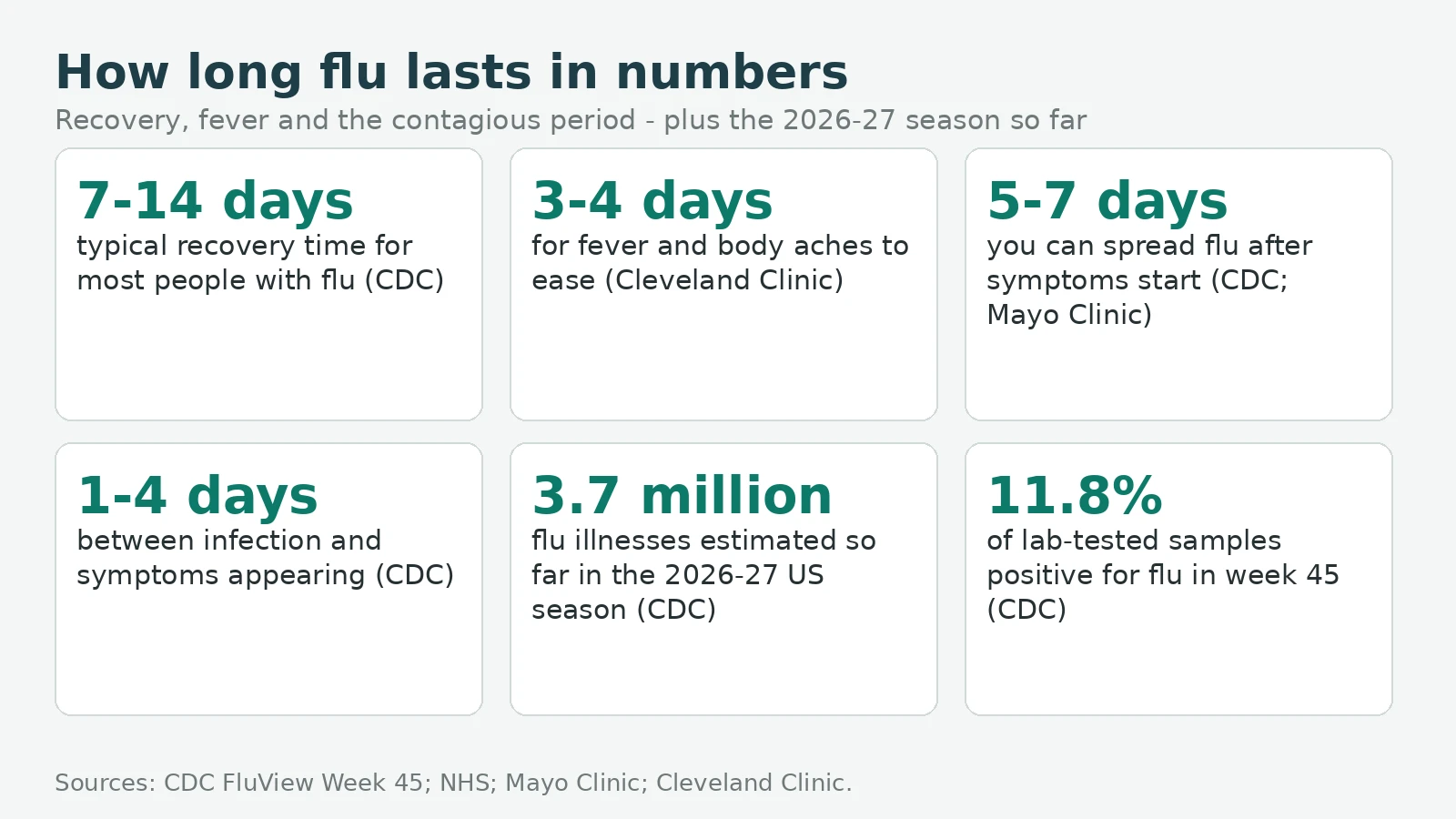
Most flu lasts about a week, and most people recover fully within two weeks. Fever and body aches usually ease within three to four days, though a cough and tiredness can linger for weeks. You can spread flu from a day before symptoms appear until five to seven days after they start.
The question is being asked more than usual right now. The 2026–27 flu season has arrived early in the United States, and the CDC estimates at least 3.7 million illnesses, 50,000 hospitalisations and 2,800 deaths so far this season. With Thanksgiving travel under way, doctors expect the virus to keep spreading. Knowing how long flu lasts, and how long you can pass it on, helps you plan time off, protect the people around you and spot the point where a lingering illness needs a doctor.
How long does flu last day by day?
Flu does not follow the same timetable for everyone, but the pattern is fairly steady. Symptoms usually appear one to four days after infection, according to the CDC, and the NHS puts it at one to three days. Most people recover on their own within a few days to two weeks, and the Mayo Clinic says flu usually goes away in a week or two with no lasting effects in young, healthy people.
| When | What usually happens |
|---|---|
| Days 1–2 | Symptoms arrive suddenly and are at their worst: fever, chills, headache, muscle aches and a dry cough |
| Days 3–4 | Fever and body aches usually start to ease |
| Days 5–7 | Most people feel much better, though they may still be tired |
| Week 2 | Most symptoms have gone; a cough and tiredness can linger |
| Weeks 2–3 | A lingering cough and low energy can persist, especially after a bad bout |
The Cleveland Clinic notes that fever and body aches usually improve within three to four days, while milder symptoms such as tiredness, cough or a runny nose can last for several weeks. The NHS says much the same: most people feel better within a week, but a lingering cough and tiredness can last a few more weeks. Children, older adults and people with weakened immune systems may be ill for longer.
How long flu stays contagious
You can spread flu from about a day before your symptoms appear, which is why it moves through households and workplaces so easily. The CDC, the Mayo Clinic and the Cleveland Clinic all agree on that point. You are most contagious during the first three days of illness, and you can keep spreading the virus until about five to seven days after your symptoms start. Young children and people with weakened immune systems may be contagious for longer.
Flu spreads mainly through droplets made when people cough, sneeze or talk, and it can also spread by touching a surface with the virus on it and then touching your face. That early contagious window is the reason staying home matters even before you feel at your worst: by the time the fever arrives, you may already have passed it on.
When can you go back to work or school?
The Mayo Clinic advises staying home for at least 24 hours after your fever is gone, without using fever-reducing medicine. The NHS advises staying off work or school until you are feeling better, which for most people takes about a week. The two framings differ, but they point the same way: do not rush back while you still have a fever or feel rough, and remember you can still be contagious for several days after symptoms start.
If you do go back while you still have a cough, keep some distance from others, wash your hands often and cover coughs and sneezes. People who work with babies, older adults or anyone with a weakened immune system should be extra careful about returning too soon, and should ask their employer or a healthcare professional if they are unsure.
Who takes longer to recover?
Most healthy adults are back on their feet within a week or so, but flu hits some groups harder. Those at higher risk of complications include children under five, especially babies under six months; adults aged 65 and older; pregnant women and women up to two weeks after giving birth; people with weakened immune systems; people with long-term conditions such as asthma, heart, kidney or liver disease or diabetes; and people with a body mass index of 40 or higher. In the current season, adults aged 65 and over have the highest hospitalisation rate, followed by children aged 0 to 4 and adults aged 50 to 64.
Children are also more likely than adults to have vomiting and diarrhoea with flu. Pregnant people with a fever or other flu symptoms should contact a healthcare provider right away. Antiviral medicines work best when started within two days of symptoms appearing, and doctors may prescribe them for people who are at risk of severe illness or whose symptoms are severe, so early contact matters for high-risk groups.
The 2026–27 flu season so far
This season started earlier than usual. The CDC’s FluView report for the week ending 14 November 2026 shows flu-like illness in 3.8% of outpatient visits, up from 3.2% the week before and above the national baseline of 2.9% for the second week in a row. Of the clinical laboratory samples tested that week, 11.8% were positive for flu, and almost all the viruses found were influenza A. Of the influenza A viruses that were subtyped, 96.4% were A(H1N1)pdm09.
The CDC estimates there have been at least 3.7 million illnesses, 50,000 hospitalisations and 2,800 deaths associated with flu so far this season. These are modelled estimates, not exact counts, because many flu cases are never tested. Seven children have died with flu this season, two of them reported in that week. The weekly hospital admission rate stood at 3.5 per 100,000 people, and the cumulative rate of 12.0 per 100,000 is the highest for this point in a season since 2010–11. Even so, the CDC’s early severity assessment still classes overall severity as low across all age groups, and the agency notes that an early rise does not necessarily lead to a higher peak or a more severe season overall.
The CDC’s FluSight forecasts predict flu hospital admissions and emergency department visits will likely keep rising nationally into early December. With Thanksgiving travel and family gatherings under way, doctors expect the virus to spread faster over the holiday week. The CDC recommends an annual flu vaccine for everyone aged six months and older, and almost all the viruses characterised so far this season are similar to the strains the vaccine covers. Our guide to the flu vaccine in 2026 explains who should get it and when.
Flu or a cold?
Flu and a cold share symptoms, but flu usually arrives suddenly with a high fever, chills, headache and aching muscles, while a cold builds gradually and mainly affects the nose and throat. A cold rarely causes a high fever or leaves you exhausted, and it usually clears up within a week without complications. If you are unsure which you have, our guide to flu symptoms in 2026 sets out the differences in more detail.
When to see a doctor
Contact a doctor promptly if your symptoms do not start to improve after seven to ten days, if a fever lasts longer than three days, if you are pregnant and have flu symptoms, or if you have a condition that raises your risk of severe illness. Get medical care right away for difficulty breathing or shortness of breath, chest pain, ongoing dizziness, seizures, severe weakness or muscle pain, or if an existing condition is getting worse.
For children, get medical care right away for difficulty breathing, blue lips, chest pain, dehydration, severe muscle pain or seizures. Go to the emergency department for a fever over 103°F (40°C), not peeing or peeing very little, chest or stomach pain that does not go away, confusion, bluish or greyish skin, lips or nails, or a fever or cough that gets better and then comes back worse.
The NHS advises contacting a GP urgently if you are more short of breath than usual, have pain when breathing in or coughing, feel confused, dizzy or lightheaded, are sick or cannot keep food or fluids down, are coughing up blood, have heart palpitations or are peeing less than usual. If the GP practice is closed, phone 111. Flu can lead to complications including pneumonia, bronchitis, asthma flare-ups, heart problems, ear infections and acute respiratory distress syndrome, and pneumonia can be deadly for older adults and people with long-term illness.
In an emergency call 911 (US), 999 (UK) or 112 (EU).
Frequently asked questions
How long does flu last in adults?
Most adults feel better within a week and recover fully within two weeks. Fever and body aches usually ease in three to four days, but a cough and tiredness can linger for weeks. Children, older adults and people with weakened immune systems may be ill for longer.
How long are you contagious with flu?
You can spread flu from about a day before symptoms appear until five to seven days after they start, and you are most contagious in the first three days. Young children and people with weakened immune systems may stay contagious for longer.
When can I go back to work after flu?
Stay home for at least 24 hours after your fever is gone without fever-reducing medicine, and until you feel well enough to work. The NHS advises staying off work or school until you feel better, which takes about a week for most people.
Why is my cough lasting weeks after flu?
A cough and tiredness often linger after the fever and aches have gone, sometimes for two to three weeks. This is common and usually settles on its own. See a doctor if the cough is getting worse, you are coughing up blood, or you are more short of breath than usual.
When should I see a doctor for flu?
See a doctor promptly if symptoms do not improve after seven to ten days, if a fever lasts longer than three days, if you are pregnant, or if you have a condition that raises your risk. Get urgent care for breathing difficulty, chest pain, confusion or a fever over 103°F (40°C).
Sources
- CDC: Weekly US Influenza Surveillance Report, FluView Week 45 www.cdc.gov
- CDC: Similarities and Differences between Flu and COVID-19 www.cdc.gov
- NHS inform: Flu www.nhsinform.scot
- Mayo Clinic: Influenza (flu) — Symptoms and causes www.mayoclinic.org
- Cleveland Clinic: Influenza (Flu) my.clevelandclinic.org
- CIDRAP: US flu activity continues to climb www.cidrap.umn.edu
- Drugs.com / HealthDay: Flu Season Arrived Early, And Thanksgiving Could Speed It Up www.drugs.com

Try the tool
Not sure if it can wait?
Common causes and warning signs for 16 everyday symptoms.
Open the symptom guide