Flu Vaccine 2026: Should You Get One This Season?
Flu is surging early in the US, with hospital admissions up 22% in a week. Here is who should get the 2026 flu vaccine, how well it works, and why November is not too late.
- Written by
- Health Daily Advice
- Published
- Reading time
- 7 minutes
- Sources
- 8 cited

In this guide
Yes — for most people aged six months and older, getting this season’s flu vaccine is still worth doing, and November is not too late. Flu activity is climbing early in the United States, protection takes about two weeks to build, and the vaccine cuts the chance of serious illness even when it doesn’t prevent infection entirely.
Why is flu in the news right now?
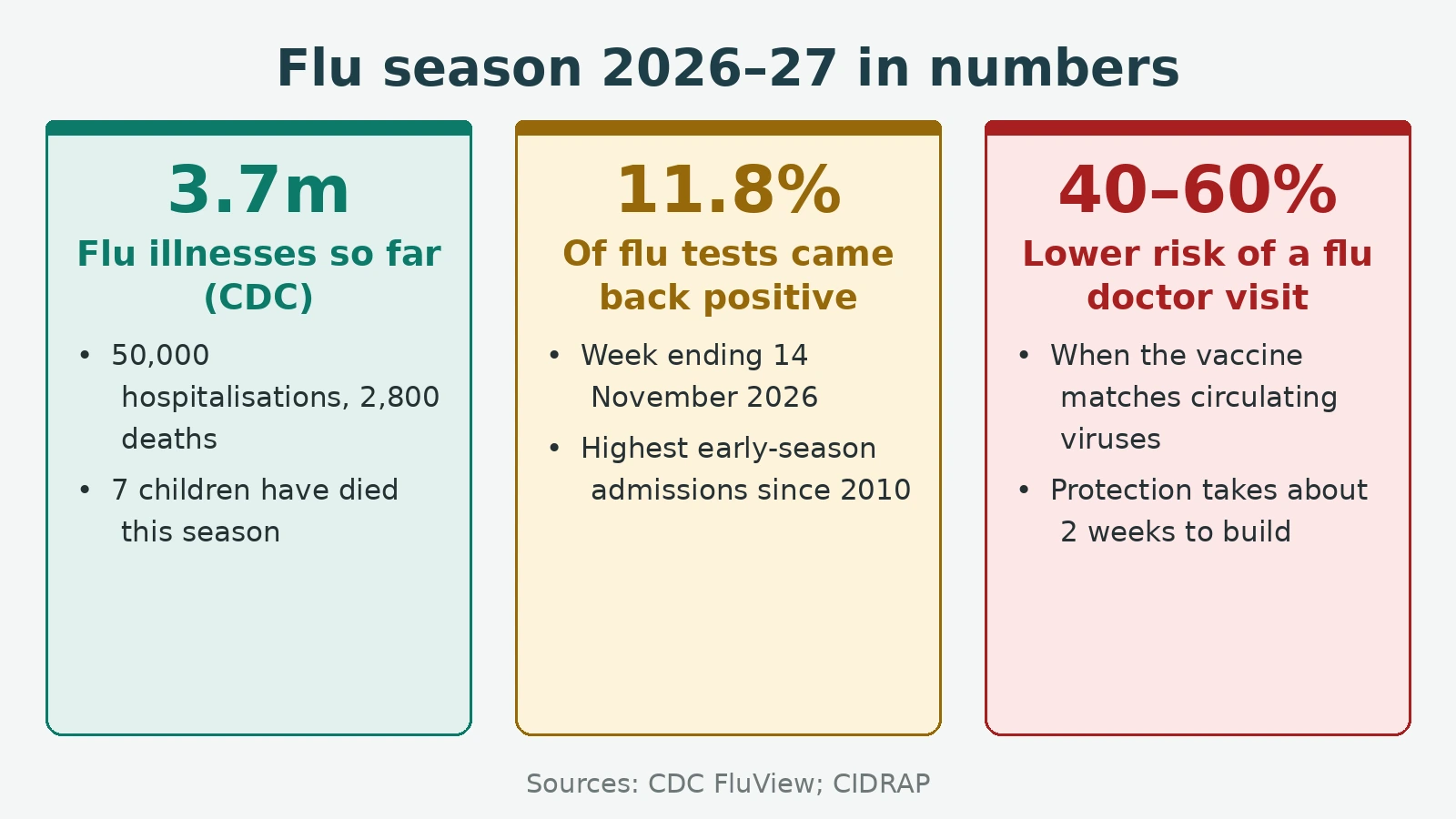
Flu season has started earlier than usual in the United States. In the week ending 14 November 2026, the US Centers for Disease Control and Prevention (CDC) estimated at least 3.7 million illnesses, 50,000 hospitalisations and 2,800 deaths so far this season, including seven children. Both of the two most recently reported child deaths were linked to influenza A(H1N1).
Hospital admissions tell the story most clearly: 11,734 laboratory-confirmed admissions in that week, up 22% from 9,584 the week before, and the first week this season to pass 10,000. The share of lab tests positive for flu was 11.8%.
The cumulative hospitalisation rate stands at 12 per 100,000, the highest for this point in the season since 2010–11, and adults aged 65 and over have been hit hardest, at 10.6 per 100,000. Even so, the CDC still classes overall severity as low, and warns that an early rise does not necessarily mean a higher peak or a more severe season.
Should you get a flu vaccine this season?
For most people, yes. In the United States, the CDC and the leading medical societies recommend an annual flu vaccine for everyone aged six months and older, with only rare exceptions. Their joint guidance for 2026–27 was issued on 2 September 2026 and endorsed on 5 November 2026 by the American Thoracic Society and other specialist societies.
Older adults, young children, pregnant people and anyone with a long-term health condition are especially urged to get vaccinated. Children aged six months to eight years who have not previously had at least two flu vaccine doses should have two doses at least four weeks apart, and pregnant people can be vaccinated in any trimester. Adults aged 65 and over are advised to take an enhanced vaccine — recombinant, adjuvanted or high-dose — when available; if none is available, a standard dose is still better than waiting.
There are a few exceptions. The vaccine is not given to children under six months old, or to anyone who has had a severe, life-threatening allergic reaction to a flu vaccine or one of its ingredients. If you have a history of Guillain-Barré syndrome, a severe egg allergy or a current illness with a fever, talk to a doctor first.
How well does the 2026 flu vaccine work?
Honesty first: there is no effectiveness figure for the 2026–27 season yet. The CDC has said it is too early to know which viruses will dominate, or what that might mean for how well this year’s vaccine works.
In seasons when the vaccine viruses are well matched to the viruses actually circulating, vaccination reduces the risk of needing to see a doctor for flu by 40 to 60%, according to the CDC. Last season shows what happens when the match is less good: in 2025–26, the vaccine was 35% effective at preventing flu-related emergency department and urgent care visits, and 27% effective at preventing flu hospitalisation, according to data published in JAMA Network Open in June 2026 — down to a drifted influenza A(H3N2) virus, subclade K, that the vaccine did not cover well.
That matters less this year, because all three components of the 2026–27 vaccine have been changed, including an updated H3N2 component designed to cover subclade K. Early checks are encouraging: 95.2% of H1N1 viruses tested were well recognised by antibodies raised against the vaccine virus, and all H3N2 and B/Victoria viruses tested were well recognised too.
| Measure | Effectiveness | Source |
|---|---|---|
| Flu-related doctor visit, well-matched season | 40–60% reduction | CDC |
| Flu-related emergency or urgent care visit, 2025–26 | 35% | JAMA Network Open / CDC |
| Flu hospitalisation, 2025–26 | 27% | JAMA Network Open / CDC |
| Flu hospitalisation, adults 65+, 2025–26 | 31% | VISION Network |
| Flu hospitalisation, adults 18–64, 2025–26 | 29% | VISION Network |
| High-dose vs standard-dose vaccine, flu hospitalisation in older adults | 43.6% relative effectiveness | DANFLU-2 trial |
A University of Maryland analysis published in JAMA Network Open on 10 November 2026 found a median effectiveness of 39.5% against flu infection across 18 seasons, with the vaccine mismatched to circulating strains in 11 of them — yet the researchers stressed that vaccination remains the most effective way to prevent flu.
Is the flu vaccine safe?
A flu vaccine cannot give you flu. The injected vaccines contain inactivated virus or a virus-like particle, and the nasal spray uses a live virus changed so it cannot cause flu. If you feel unwell shortly after vaccination, it is almost always because you were already exposed to a virus, or because your immune system is responding.
Common side effects are mild and short-lived: a sore, red or slightly swollen arm, and possibly a headache, a mild fever, nausea or aching muscles, usually settling within one to two days. Serious problems are very rare. A severe allergic reaction is extremely uncommon, and its signs — difficulty breathing, swelling around the eyes or lips, hives or a fast heartbeat — usually appear within minutes to hours. Some studies have found a possible small link with Guillain-Barré syndrome, at fewer than one to two cases per million people vaccinated, while other studies found no link at all; the condition is more common after a flu illness than after a flu vaccine.
When should you get it — and is November too late?
September and October are the ideal months for most people who need a single dose, and the aim is to be vaccinated by the end of October. Most adults are generally advised against July or August vaccination, because protection can fade before the season peaks.
But November is not too late. Vaccination should continue throughout the season while flu viruses circulate, and the CDC has encouraged people who have not yet been vaccinated to get vaccinated now. Protection takes about two weeks to build, so the sooner you go, the sooner you are covered. All US flu vaccines for 2026–27 are trivalent, covering two influenza A viruses (H1N1 and H3N2) and one influenza B/Victoria virus, with all three components changed from last season.
Can you get the flu, COVID-19 and RSV vaccines together?
Yes. The flu, COVID-19 and RSV vaccines can be given at the same visit, with no minimum interval between them, alongside other vaccines that are due. The NHS takes the same approach, noting that flu can be given at the same time as the COVID-19 and shingles vaccines.
This season, COVID-19 and RSV activity in the United States is low nationally, although RSV emergency department visits are climbing in children under five. The joint guidance recommends an updated COVID-19 vaccine for all adults aged 19 and over — with adults aged 65 and over having two doses per season, six months apart — and routine vaccination during pregnancy and for children aged six to 23 months. For RSV, vaccination is recommended for all adults aged 75 and over and for adults aged 50 to 74 at increased risk of severe illness.
Flu vaccine in the UK vs the US: who gets it free?
The two countries take different approaches. In the United States, annual flu vaccination is recommended for everyone aged six months and older. In the United Kingdom, the NHS offers the flu vaccine free to specific groups, and others can usually pay for it at a pharmacy.
The free NHS vaccine covers people aged 65 and over (including those who turn 65 by 31 March 2027), adults aged 18 to 64 with certain long-term conditions — such as asthma needing steroids, COPD, heart disease, diabetes, chronic kidney or liver disease, a weakened immune system, a BMI of 40 or more or spleen problems — and pregnant people at any stage. Care-home residents, main carers and people living with someone whose immune system is weakened are also covered, as are children aged two to three on 31 August 2026, school-aged children from Reception to Year 11, and children aged six months to 17 with certain long-term conditions. The last date for the free NHS flu vaccine this season is 31 March 2027.
What if you still catch flu after the vaccine?
It happens, and it does not mean the vaccine failed you. No flu vaccine is 100% effective, and you can also catch flu in the two weeks before protection has fully built up. But vaccinated people who do catch flu tend to have a milder, shorter illness: among vaccinated adults hospitalised with flu in 2024–25, the risk of intensive care admission was 26% lower and the risk of death 31% lower.
When to see a doctor
Most people with flu recover at home within a week or so, but some situations need medical attention sooner. If you are at high risk of complications — pregnant, under two, aged 65 or over, living with a chronic condition or with a weakened immune system — and you develop flu symptoms, seek care promptly: antiviral medicines work best when started early.
For adults, get emergency help for difficulty breathing, persistent pain or pressure in the chest or abdomen, persistent dizziness or confusion, seizures, not passing urine, severe muscle pain or weakness, a fever or cough that improves and then comes back or gets worse, or any worsening of a chronic condition.
For children, the warning signs include fast or laboured breathing, bluish lips or face, ribs pulling in with each breath, chest pain, severe muscle pain — a child who refuses to walk — and dehydration, such as no urine for eight hours, a dry mouth or no tears when crying. Also seek urgent care if a child is not alert when awake, has a seizure, or has a fever above 104°F that fever-reducing medicine does not bring down.
In an emergency call 911 (US), 999 (UK) or 112 (EU).
Frequently asked questions
Can the flu vaccine give me flu?
No. The injected flu vaccines contain inactivated virus or a virus-like particle, and the nasal spray uses a weakened live virus that cannot cause flu. Feeling a little achy or feverish for a day or two afterwards is your immune system responding, not flu itself. If you catch flu soon after vaccination, you were most likely exposed before protection had time to build, which takes about two weeks.
How long does flu vaccine protection last?
Protection begins about two weeks after vaccination and gradually weakens over the following months. That is why the vaccine is offered every year rather than once. A single dose cannot be relied on for more than one season, and last year's vaccine may not match this year's circulating viruses, which can change from one winter to the next.
Do I need the flu vaccine every year?
Yes. Flu viruses change constantly, and the vaccine is updated each year to match the strains expected to circulate. Your protection also fades over time. Annual vaccination is recommended for everyone aged six months and older in the United States, and the NHS offers it each year to eligible groups in the United Kingdom.
Can I get the flu vaccine at the same time as my COVID vaccine?
Yes. The flu, COVID-19 and RSV vaccines can all be given at the same visit, with no minimum interval between them, according to the medical societies behind the joint 2026–27 guidance. The NHS takes the same approach, noting that flu can be given alongside COVID-19 and shingles vaccines. Ask your clinician if you have questions about timing.
I missed October — is it too late to get the flu vaccine?
No. September and October are the ideal months, but vaccination is recommended throughout the flu season while the virus is still circulating. The CDC has encouraged people who have not yet been vaccinated to get vaccinated now. Protection takes about two weeks to develop, so the sooner you go, the sooner you are covered.
Is the flu vaccine safe in pregnancy?
Yes. Pregnant people are advised to have an age-appropriate inactivated or recombinant flu vaccine in any trimester. Pregnancy raises the risk of severe flu, so vaccination protects both mother and baby. The joint medical-society guidance also recommends routine COVID-19 vaccination during pregnancy. If you have concerns, talk to your midwife or doctor.
Sources
- CDC FluView, Week 44 (week ending 7 November 2026) www.cdc.gov
- CIDRAP: US flu activity continues to climb www.cidrap.umn.edu
- Becker's Hospital Review: Weekly flu admissions top 10K for 1st time this season www.beckershospitalreview.com
- American Thoracic Society: Interim Joint Guidance for 2026–27 Respiratory Virus Vaccines site.thoracic.org
- CDC: Benefits of Flu Vaccination www.cdc.gov
- CDC: Flu Vaccine Safety www.cdc.gov
- NHS: Flu vaccine www.nhs.uk
- CDC: Signs and Symptoms of Flu www.cdc.gov

Try the tool
Not sure if it can wait?
Common causes and warning signs for 16 everyday symptoms.
Open the symptom guide