Weight-Loss Peptides: What Works and What Is Not Safe
Searches for peptides for weight loss are climbing fast, driven by retatrutide trial headlines. Here is what the approved medicines do, what the trials really showed, and why anything bought online is a gamble.
- Written by
- Health Daily Advice
- Published
- Reading time
- 10 minutes
- Sources
- 9 cited

In this guide
Peptides for weight loss are medicines that copy gut hormones to curb appetite and slow digestion. A few are approved by regulators — semaglutide, tirzepatide and liraglutide — while others, like retatrutide, are still being tested and cannot legally be sold. Products bought online are unregulated and may be fake, contaminated or unsafe.
Searches for “peptides for weight loss” are still accelerating, up 39% in a year and 19% in the last three months, according to the Next Big health-trends tracker, with data as of 20 November 2026. Much of that curiosity follows headlines about retatrutide, an experimental drug whose trial results were published in the New England Journal of Medicine in September 2026. The numbers look striking. The safety picture, and the market that has grown up around them, is more complicated — and that is where most people get caught out.
What are peptides for weight loss?
A peptide is a short chain of amino acids, the building blocks of protein. Your gut makes several peptide hormones after you eat, and they act as messengers telling your brain you have had enough. Weight-loss peptides are medicines built to copy or strengthen those signals. Most are given as a weekly injection, though some now come as a daily tablet or a daily injection.
Not every product sold under the word “peptide” is a medicine. The term also covers a sprawling online trade in powders and vials sold as “research chemicals” or “for research use only”. Those products have not been through any regulator’s checks, and what is printed on the label may have little to do with what is inside the vial. That distinction — approved medicine versus unregulated product — is the most important thing in this whole subject.
How do peptides for weight loss work?
The best-studied ones copy a gut hormone called glucagon-like peptide-1, or GLP-1. Your body makes GLP-1 naturally after a meal, but it only lasts about 20 to 30 minutes before it is broken down. Scientists engineered versions that last a week or more.
As clinicians at the Cleveland Clinic explain, GLP-1 medicines work in several ways at once. They act on receptors in the brain and gut to quiet hunger and cravings, slow the rate at which the stomach empties so you feel full for longer, and help keep blood sugar steadier after meals. Many people describe the effect as the constant background chatter about food — sometimes called “food noise” — going quiet.
Newer medicines add more hormone signals to the mix. Tirzepatide also switches on the GIP receptor, a second gut-hormone pathway. Retatrutide goes further still, adding a third target, the glucagon receptor. The idea is that combining signals could produce bigger weight loss than switching on GLP-1 alone, though it also means more effects to watch.
Which weight-loss peptides are approved?
Three medicines in this family are approved by the US Food and Drug Administration (FDA) for weight management, according to a Mayo Clinic review of the evidence: liraglutide, approved in 2014; semaglutide, approved in 2021; and tirzepatide, approved in 2023. They are prescription-only, and in the UK they are available through the NHS or private prescription only for people who meet specific criteria — they are not available over the counter anywhere.
The same review pulled together what the big trials actually achieved. After correcting for the placebo effect, liraglutide produced about 5% weight loss, semaglutide about 12% and tirzepatide about 18%. In the individual trials, semaglutide averaged 14.9% weight loss against 2.4% on placebo, while tirzepatide averaged 20.9% against 3.1% on placebo. Those are averages across hundreds or thousands of people, so any one person’s result can be very different.
All three are meant to be used alongside changes to eating and activity, not instead of them. And weight tends to return when the medicine is stopped, because obesity is a long-term condition — something the Cleveland Clinic team compares to blood pressure medicine: stop the treatment and the problem it was holding back comes back.
What is retatrutide, and why is everyone talking about it?
Retatrutide is an investigational medicine made by Eli Lilly. It is a “triple agonist”: it switches on three hormone receptors — GIP, GLP-1 and glucagon — where semaglutide switches on one and tirzepatide switches on two. It is given as a once-weekly injection in trials.
Here is the part that matters most: retatrutide is not approved by any regulator anywhere in the world. That is the position set out by the FDA, by Lilly itself, and by LegitScript, which tracks the online market for unapproved medicines. Lilly has said it plans to submit retatrutide to the FDA for review in 2027. Until a regulator approves it, the only legitimate way anyone receives it is inside one of Lilly’s clinical trials.
The buzz comes from the trial results. In September 2026 the New England Journal of Medicine published TRIUMPH-1, the first large phase 3 trial of retatrutide in people with obesity who did not have diabetes. It is the trial behind most of the headlines you will have seen this autumn.
What did the retatrutide trials actually show?
TRIUMPH-1 enrolled 2,339 adults with obesity and assigned them at random to a weekly injection of retatrutide or a placebo for 80 weeks — about a year and a half. Everyone, including the placebo group, also received advice on healthy eating and physical activity.
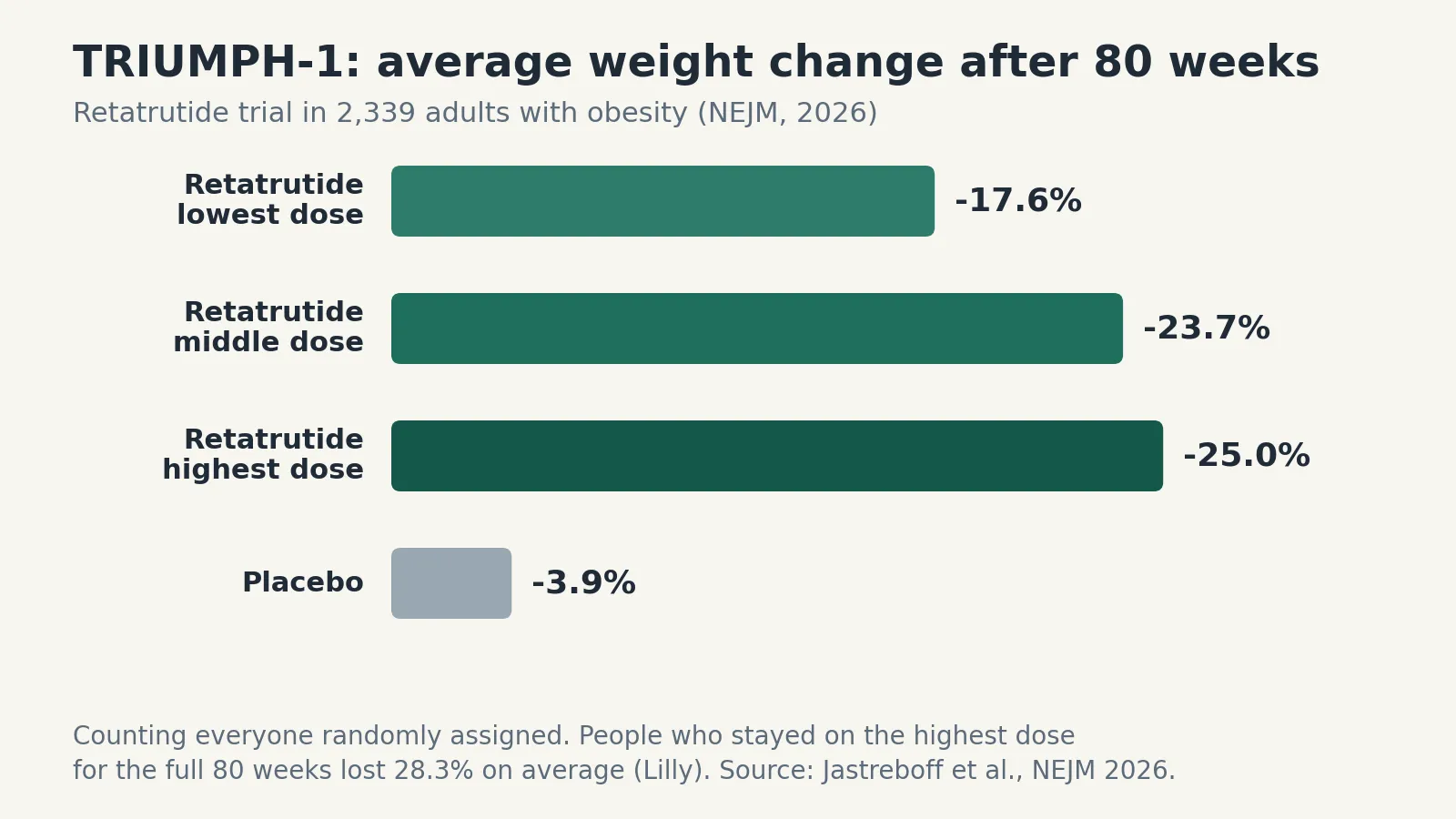
Counting everyone who was randomly assigned, average weight fell by 17.6% on the lowest dose tested, 23.7% on the middle dose and 25.0% on the highest dose, compared with 3.9% on placebo. Among people who stayed on the highest dose for the full 80 weeks, the average loss was 28.3%, according to Lilly’s report of the trial. The trial also found less knee pain in the 574 participants who had knee osteoarthritis, and fewer breathing interruptions in the 243 participants with obstructive sleep apnoea.
| TRIUMPH-1, 80 weeks | Average weight change |
|---|---|
| Retatrutide, lowest dose | −17.6% |
| Retatrutide, middle dose | −23.7% |
| Retatrutide, highest dose | −25.0% |
| Placebo | −3.9% |
Those numbers are real, and they are larger than anything an approved weight-loss medicine has shown in a trial. But they come with caveats that the headlines usually skip. The trial ran for 80 weeks, so nobody yet knows what happens over five or ten years. The participants were carefully screened, given a verified product, and checked regularly by a study team — conditions that do not exist when someone buys a vial online. And a trial average is not a promise: some people in the trial lost far less, and some stopped the drug because of side effects.
What are the side effects of peptides for weight loss?
For the approved medicines, the most common side effects affect the stomach and gut: nausea, diarrhoea, constipation and vomiting. The Mayo Clinic review found nausea in about four in ten people taking semaglutide and about three in ten taking tirzepatide, with diarrhoea and constipation each affecting roughly one to three in ten. These effects are usually mild to moderate, tend to be worst when starting or increasing the dose, and often ease with time. Rare but serious problems include gallbladder disorders and inflammation of the pancreas.
Retatrutide’s side effects follow a similar pattern, but with one newer signal. In TRIUMPH-1, nausea affected 42.4% of people on the highest dose against 14.8% on placebo, diarrhoea 32.0% against 13.5%, constipation 26.1% against 10.9% and vomiting 25.3% against 4.8%. About one in nine people on the highest dose stopped the trial drug because of side effects, compared with about one in twenty on placebo, according to a compilation of the published trial safety tables.
What is dysesthesia?
The newer signal is dysesthesia — an unusual skin sensation that can feel like tingling, burning, prickling or skin that is sore to the touch, often with no visible rash. In TRIUMPH-1 it was reported by 5.1% of people on the lowest dose, 12.3% on the middle dose and 12.5% on the highest dose, against 0.9% on placebo. In a smaller trial of people with knee arthritis, it reached 20.9% on the highest dose. Researchers think it is linked to the glucagon part of the drug, and most cases in the trials were mild and rarely led to stopping treatment. It is worth knowing about because it is not the kind of side effect most people expect from a weight-loss medicine, and it is also listed on the label of one approved semaglutide product at a higher dose. New or worsening tingling, burning or numbness should always be mentioned to a doctor.
Why are peptides sold online so risky?
The trial results have created a grey market, and it is large. LegitScript reports that Lilly has flagged more than 14,000 websites, adverts, social media posts and product listings offering retatrutide in more than 100 countries, and that its own monitoring has logged over 1,000 cases of elevated retatrutide-related risk since 2024. In August 2026, Lilly filed six lawsuits against sellers, including a compounding pharmacy and peptide vendors, over products sold under “research use only” marketing.
The FDA’s position, set out in its October 2026 alert on unapproved GLP-1 drugs, is blunt. Retatrutide and a related compound, cagrilintide, cannot be used in compounding under federal law. They are not ingredients in any FDA-approved drug and have not been shown to be safe and effective for any condition. The agency has sent warning letters to telehealth companies marketing unapproved drugs such as retatrutide directly to consumers, to ingredient suppliers selling it to compounders, and to facilities repackaging it.
A “for research use only” or “not for human consumption” label changes nothing. The FDA has warned companies that sold unapproved drugs containing semaglutide, tirzepatide, retatrutide and similar compounds under exactly those labels, with dosing instructions, directly to consumers. The agency urges people not to buy them, saying they are of unknown quality and may be harmful.
The risks are not theoretical. Products bought online may be counterfeit, mislabelled, non-sterile or contaminated, and a buyer has no reliable way to tell what is in the vial. Some contain too little active ingredient, some too much, some none at all. Because these are injections, they bypass the body’s main defences against germs and toxins. LegitScript notes that black-market retatrutide has been potentially linked to two deaths in reports sent to the FDA, although it could not be confirmed that the products involved actually contained retatrutide, since they came through illicit channels. The FDA has also received hundreds of adverse-event reports linked to compounded versions of the approved drugs — 990 for compounded semaglutide and more than 730 for compounded tirzepatide as of 31 May 2026 — including some that needed hospital care after dosing mistakes.
How can you tell a safe source from a risky one?
The FDA lists warning signs for weight-loss medicines sold online. Be cautious if a seller claims its product is the same as an approved medicine, offers prices that look too good to be true, does not require screening and a prescription from a licensed doctor, has no licensed doctor available to answer questions afterwards, or sends medicine that looks different from what was pictured, arrives damaged, or comes without instructions for use.
With retatrutide there is a simpler test: no lawful seller exists. Any offer to sell it for human use is a red flag on its own. The safest route for any weight-loss medicine is a prescription from your own doctor, filled at a licensed pharmacy, with a clinician you can contact afterwards.
Who should talk to a doctor?
Anyone thinking about a weight-loss medicine should talk to a doctor or pharmacist first — not a seller, not a social media account, and not a forum. That conversation matters most if you have diabetes, thyroid problems, a history of pancreatitis or gallbladder disease, kidney problems, or if you are pregnant, planning a pregnancy or breastfeeding. It also matters if you take other medicines, because these drugs slow the stomach and can change how other medicines are absorbed.
A doctor can also check whether a medicine is appropriate at all. These drugs are licensed for people above a certain weight, or with weight-related health problems — not for shedding a few pounds before a holiday. And they work best as one part of a plan that includes food, movement, sleep and support, rather than as a shortcut on their own.
If cost is the barrier, say so. A doctor or pharmacist may know about licensed alternatives, patient support programmes, or a referral to a weight-management service. What they cannot do is make an unapproved product safe.
When to see a doctor
Get medical help promptly if you are taking a weight-loss medicine — approved or not — and you develop severe stomach pain that does not go away, vomiting or diarrhoea you cannot keep up with, yellowing of the skin or eyes, dark urine, a racing or irregular heartbeat, or new tingling, burning or numbness in the skin. Swelling of the face, lips or tongue, trouble breathing, or fainting needs emergency help straight away.
If you have used a product bought online and feel unwell, tell the clinician exactly what you took and where it came from. That information helps them help you, and it is also how regulators learn what is circulating. In the UK, suspected side effects can be reported through the Yellow Card scheme; in the US, through the FDA’s MedWatch programme.
In an emergency call 911 (US), 999 (UK) or 112 (EU)
The search numbers explain why this topic is everywhere right now. The science explains why the excitement is real — and why the safest response to it is patience. The approved medicines took years of trials and regulatory review to reach patients. Retatrutide is still on that road. Until it arrives, the only version of it that exists is inside a clinical trial, and everything else sold under its name is a gamble with an unknown product.
This article is educational only. It is not medical advice and does not recommend any medicine. Talk to a doctor or pharmacist before making decisions about weight-loss treatment.
Frequently asked questions
Are peptides for weight loss safe?
Approved weight-loss peptides such as semaglutide and tirzepatide have been through years of trials and regulatory review, and their side effects are well documented, but they still need a prescription and medical supervision. Unapproved peptides bought online have not been tested or checked for quality, so their safety is unknown. No weight-loss peptide is risk-free, and the safest choice is to talk to a doctor or pharmacist first.
What is retatrutide?
Retatrutide is an investigational medicine made by Eli Lilly that switches on three hormone receptors — GIP, GLP-1 and glucagon — to reduce appetite and increase energy use. In its largest trial, TRIUMPH-1, people lost an average of 25.0% of their body weight over 80 weeks on the highest dose, against 3.9% on placebo. It is not approved by any regulator, and Lilly plans to submit it to the FDA in 2027.
Can I buy retatrutide online?
No — not legally. Retatrutide is not approved anywhere in the world, and the FDA says it cannot be used in compounding under federal law. Any website, clinic or seller offering it for human use is breaking the rules, whatever the label says. Products sold this way may be counterfeit, contaminated or contain the wrong ingredient, and the FDA urges people not to buy them.
What are the side effects of weight-loss peptides?
The most common side effects are stomach and gut problems: nausea, diarrhoea, constipation and vomiting, usually worst when starting or increasing the dose. Retatrutide trials also reported dysesthesia, unusual tingling or burning skin sensations, in up to one in five people on the highest dose in one trial. Rare but serious risks include gallbladder problems and inflammation of the pancreas. Tell a doctor about new symptoms.
Do weight-loss peptides work without diet and exercise?
No. In every major trial, participants also followed advice on healthy eating and physical activity, and the medicines are prescribed as part of a wider weight-management plan. They make eating less easier by curbing appetite, but they do not replace good food choices or movement. Weight also tends to return after stopping, because obesity is a long-term condition that needs ongoing care.
Which weight-loss peptide is best?
There is no single best option — it depends on your health, weight, other conditions and what you can tolerate. In trials, tirzepatide produced more weight loss than semaglutide, and liraglutide less, but averages do not predict one person's result. Only a doctor can weigh the benefits and risks for you, and only approved medicines prescribed by a doctor should be considered.
Sources
- Jastreboff AM, et al. Retatrutide, a Triple Hormone Receptor Agonist, for Treatment of Obesity. New England Journal of Medicine, 2026 pubmed.ncbi.nlm.nih.gov
- LegitScript: Retatrutide — The Risks Posed by This Popular Peptide www.legitscript.com
- FDA: Concerns with Unapproved GLP-1 Drugs Used for Weight Loss www.drugs.com
- Ghusn W, Hurtado MD. GLP-1 agonists for obesity: weight loss outcomes, tolerability, side effects, and risks (Mayo Clinic) pmc.ncbi.nlm.nih.gov
- Cleveland Clinic: GLP-1 Weight Loss Medications — Separating Science from Social Media my.clevelandclinic.org
- The RX Index: Retatrutide Side Effects — 5 Trials (2026) therxindex.com
- Next Big: Health trends 2027 nextbig.io

Try the tool
Not sure if it can wait?
Common causes and warning signs for 16 everyday symptoms.
Open the symptom guide