What Are Microneedle Patches? Needle-Free Vaccines Explained
Microneedle patches could make the dreaded jab a thing of the past: stamp-sized stickers with tiny dissolving needles that deliver vaccines painlessly through the skin. Here's what the trials show — and when you might actually get one.
- Written by
- Health Daily Advice
- Published
- Reading time
- 7 minutes
- Sources
- 6 cited
In this guide
Microneedle patches are small, stamp-sized stickers covered in hundreds of tiny needles — typically 50 to 2,000 micrometres tall — that press painlessly into the top layers of skin and dissolve within minutes, releasing a vaccine. They could one day replace many injections, but no microneedle vaccine is licensed yet.
Why are microneedle patches trending now?
Searches for microneedle patches have climbed sharply in 2026, with roughly 14,800 monthly searches and rising, according to Exploding Topics. The buzz is easy to understand: after years of laboratory work, the technology has reached human trials, and a major review published in August 2026 pulled together the evidence so far. People want to know whether the dreaded jab could soon be replaced by something you stick on like a plaster.
The idea is not brand new. The first practical microneedle was demonstrated in 1998, and researchers have been refining the design ever since. What has changed is the evidence: clinical trials now show the patches can work as well as a needle and syringe, and several research groups are pushing towards larger trials and, eventually, approval.
What are microneedle patches?
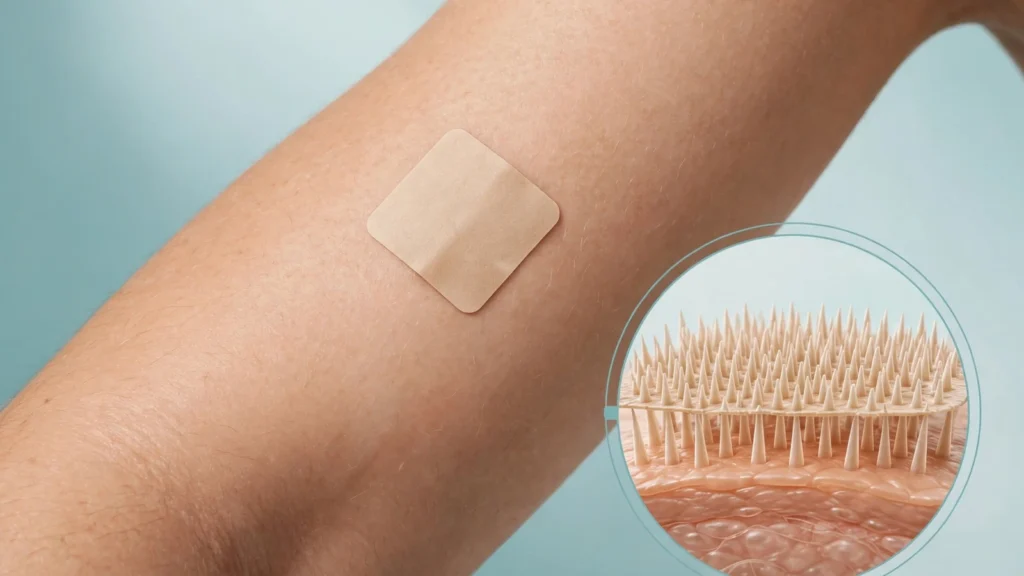
A microneedle patch is a small adhesive patch, roughly the size of a postage stamp, carrying an array of microscopic cones on its underside. Each cone is a needle so small you can barely see it: microneedles are typically 50 to 2,000 micrometres tall and 1 to 100 micrometres wide at the base, according to a 2026 review in the journal Pharmaceutics. The flu vaccine patch tested in the first human trial was the size of a coin and held 100 tapered microneedles, each 650 micrometres long — thinner than a human hair at the tip.
Press the patch onto your arm and the tiny needles pierce only the outermost layer of skin, the stratum corneum. They stop well short of the nerves and blood vessels deeper down, which is why the sensation has been described as feeling like a cat’s tongue rather than a sharp sting. Once in place, the needles either dissolve or release their contents, and you peel the patch off and throw it away.
How do microneedle patches work?
The clever part is not just the size of the needles — it is where they deliver the vaccine. A normal injection goes deep into muscle, but a microneedle patch deposits its cargo into the epidermis and upper dermis, the skin layers just below the surface. These layers are packed with immune sentinels called antigen-presenting cells, including Langerhans cells, which occur at a density of 500 to 1,000 cells per square millimetre in the epidermis. The upper dermis holds roughly ten times the density of dendritic cells found in circulating blood.
When those cells pick up the vaccine, they travel to nearby lymph nodes and alert the rest of the immune system, triggering the same antibody and memory-cell response as an injection. Because the skin is so rich in these cells, a smaller amount of vaccine can do the same job: dose-sparing of up to six-fold has been recorded for influenza, polio and SARS-CoV-2 vaccines, and one study cited by The Pharmaceutical Journal needed only 4% of a subcutaneous dose to produce a similar immune response.
Dissolving microneedles, the most advanced type, are made from water-soluble materials such as sugars and polymers. The moisture in your skin melts them away — in one early influenza study, almost 90% of the microneedle material had dissolved within five minutes. The tiny punctures they leave behind close quickly, with the skin recovering within about 100 minutes.
What are the five types of microneedle patches?
Researchers generally sort microneedle patches into five types, each working in a slightly different way:
- Solid microneedles: tiny solid spikes, usually metal or silicon, that poke holes in the skin so a vaccine or drug applied afterwards can seep in.
- Coated microneedles: solid needles with the vaccine dried onto their surface, so the dose is carried into the skin as the needle goes in.
- Hollow microneedles: miniature versions of a hypodermic needle that can push a liquid vaccine through a tiny channel.
- Dissolving microneedles: needles made from materials that melt away inside the skin, releasing the vaccine as they disappear. This is the type furthest along in clinical trials.
- Hydrogel microneedles: the newest type, made from a gel-like material that swells in the skin and can carry a relatively larger dose without leaving polymer behind.
Microneedle patches vs injections: what’s the difference?
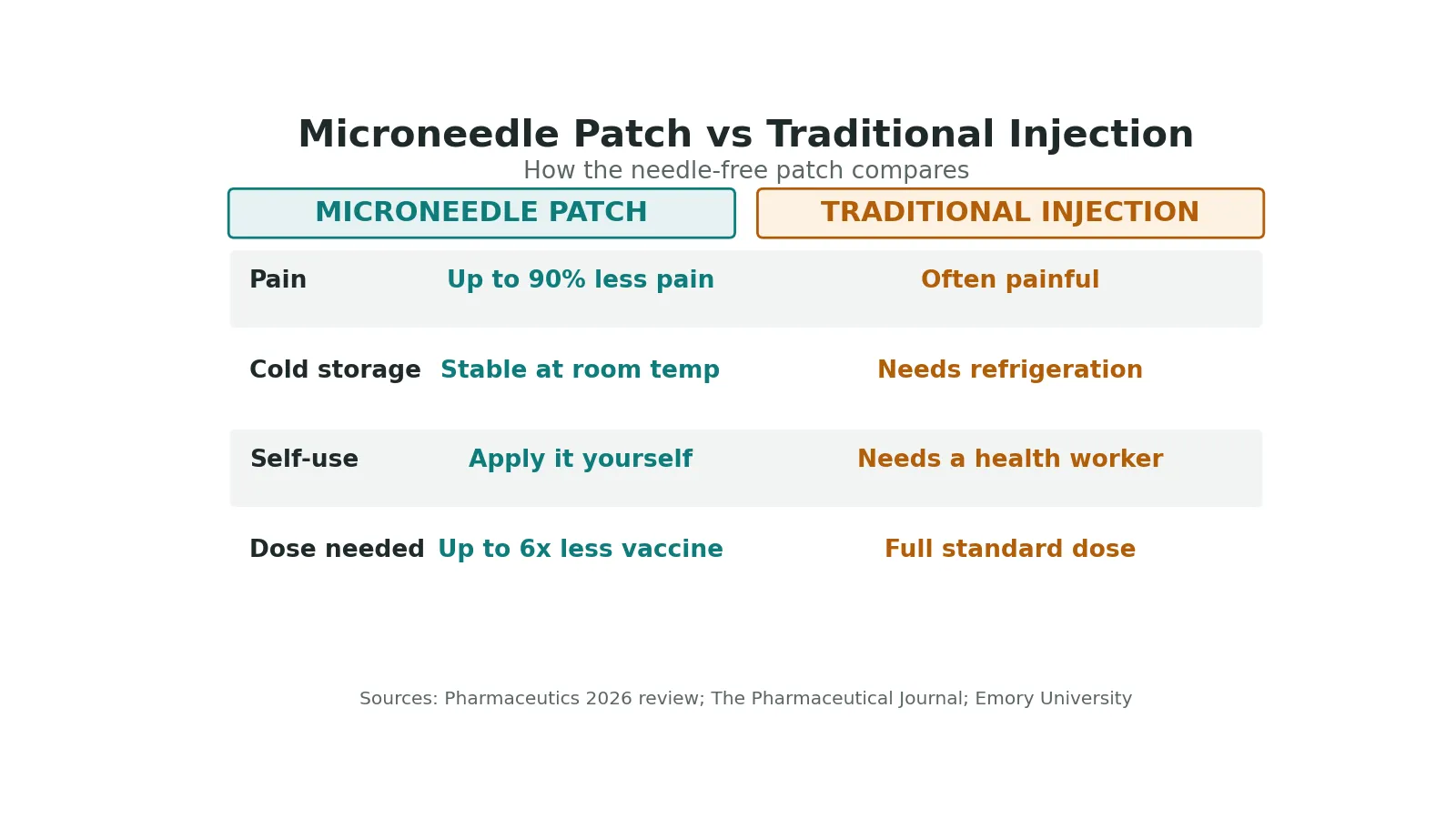
On paper, the patch wins on comfort and convenience. Here is how the two approaches compare:
| Microneedle patch | Traditional injection | |
|---|---|---|
| Pain | Minimal — pain perception falls by up to 90% compared with a standard needle | Often painful; needle fear affects at least 1 in 10 people |
| Who gives it | Can be self-applied, like a plaster | Needs a trained health worker |
| Cold storage | Many formulations stay potent at room temperature for months to two years | Most vaccines need constant refrigeration |
| Dose needed | Often less vaccine for the same response | Standard full dose |
| Waste | No sharps — used patches go in normal waste | Needles and syringes need special sharps disposal |
What are microneedle patches used for now?
Vaccines are the furthest along, and flu leads the way. In the first human trial, published in The Lancet in 2017, 100 adults aged 18 to 49 received either a dissolving microneedle flu patch or a standard flu jab. The antibody response from the patch was similar to the injection, and protection was still present six months later. There were no serious adverse effects, and 70% of participants said they preferred the patch to the syringe. Importantly, people who applied the patch themselves did just as well as those who had it applied by a nurse.
Since then, trials have widened. A Phase I/II measles–rubella trial in The Gambia reached 93% measles and 100% rubella seroconversion in infants, with no related serious adverse events. Researchers are also testing patches for COVID-19, including mRNA vaccines — one 2026 review describes an automated printer that makes thermostable mRNA patches retaining activity for six months at room temperature — as well as for polio, hepatitis B, rabies, HPV and other diseases.
Beyond vaccines, the same idea is being explored for delivering other medicines through the skin, including insulin and other drugs that normally need an injection. Cosmetic microneedle patches for skin care are already sold in shops, although those are a different product from the medical patches being tested in trials.
Are microneedle patches safe?
So far, the safety record in trials looks encouraging. In the flu patch trial, the main side effects were faint redness and mild itching at the patch site, lasting two to three days. No serious adverse effects were reported, and the used patches had dissolved completely, so they could be thrown away as ordinary waste rather than handled as sharps.
That said, the evidence base is still small. Most trials so far have involved tens or hundreds of volunteers, not the thousands needed for a full licence. Researchers are still working through questions about getting exactly the same dose into every person, since skin thickness and moisture vary, and about keeping the patches sterile during manufacture — the sugar-based materials that make dissolving needles work can also feed bacteria if they are not handled carefully.
What are the limitations of microneedle patches?
- Dose varies between people: how much vaccine you receive can depend on your skin thickness, moisture and how firmly the patch is pressed on.
- Storage is fiddly: because the needles are designed to dissolve on contact with skin, patches must be kept dry until use, usually sealed with a desiccant.
- Manufacturing at scale is hard: making millions of identical patches with a perfectly even dose is still a work in progress.
- Regulation is catching up: guidance for approving a patch that is part device, part medicine is still fragmented, and the clinical pipeline is concentrated on only a few vaccines.
- Not every vaccine suits a patch: some vaccines need larger doses or different formulations than a small patch can carry.
Will microneedle patches replace injections?
Not yet — and probably not entirely, even when they arrive. As of late 2026, no microneedle vaccine has been licensed anywhere, and the patches remain in clinical trials. The flu patch still needs larger Phase II and Phase III trials, and the measles–rubella patch is being prepared for pivotal studies. The World Health Organization, UNICEF, Gavi and the Gates Foundation have all backed the technology, and the US Biomedical Advanced Research and Development Authority runs a “Patch Forward” prize to speed development, so the momentum is real.
The most likely future is a mix: patches for routine vaccinations that suit them — flu, measles, and vaccines in places without reliable refrigeration or enough trained staff — alongside injections for everything else. Around 3 billion of the 5 billion vaccine doses given each year still rely on a hypodermic needle, and needle fear alone affects at least 10% of the population. If patches can close even part of that gap, and cut the 25% to 50% of vaccines currently wasted through cold-chain failures, they could change how the world gets vaccinated — without ever fully replacing the syringe.
When to see a doctor
Microneedle patches are still experimental, so you cannot get one at your GP surgery or pharmacy yet. If you are due a vaccine, talk to a doctor or pharmacist about the options that are currently available to you, and ask whether any microneedle patch trials are recruiting in your area. Do not try to buy a medical microneedle patch online — products sold as “microneedle patches” for skin care are not vaccines and should never be used as a substitute.
Seek medical advice promptly if you develop a spreading rash, swelling, blistering or signs of infection after any vaccination, or if you have a known allergy to a vaccine ingredient. In an emergency call 911 (US), 999 (UK) or 112 (EU).
Frequently asked questions
What are microneedle patches?
Microneedle patches are small adhesive patches, about the size of a postage stamp, covered in hundreds of microscopic needles typically 50 to 2,000 micrometres tall. Pressed onto the skin, the needles pierce only the outer layer and dissolve within minutes, releasing a vaccine into the immune-cell-rich layers just below the surface.
Do microneedle patches hurt?
Barely at all. The needles are far too short to reach the nerves deeper in the skin, so most people feel only a light pressure or a texture like a cat's tongue. Research shows pain perception falls by up to 90% compared with a standard needle, and in the first flu patch trial the main side effects were faint redness and mild itching for two to three days.
Are microneedle patches available yet?
No. As of late 2026, no microneedle vaccine has been licensed anywhere, and the patches are still in clinical trials. A flu patch has passed a Phase I trial in 100 adults, and a measles-rubella patch has been tested in infants in The Gambia, but larger Phase II and Phase III trials are needed before the patches can reach pharmacies.
What vaccines can microneedle patches deliver?
Flu is the furthest along, with a successful Phase I trial, and measles-rubella patches have shown 93% measles and 100% rubella seroconversion in infants. Researchers are also testing patches for COVID-19, including mRNA vaccines, as well as polio, hepatitis B, rabies and HPV, with the same patch technology being explored for other medicines such as insulin.
Will microneedle patches replace injections?
Not entirely, and not soon. No microneedle vaccine is licensed yet, and some vaccines need larger doses than a small patch can carry. The most likely future is a mix: patches for routine vaccinations that suit them, especially where refrigeration or trained staff are scarce, alongside injections for everything else.
Are microneedle patches safe?
So far, trials look encouraging. In the first flu patch trial there were no serious adverse effects, only faint redness and mild itching for a couple of days, and the skin recovered within about 100 minutes. However, trials so far have involved hundreds of volunteers rather than thousands, so safety in larger and more diverse groups still needs to be confirmed.
Sources
- Pharmaceutics (MDPI) 2026: Microneedles for Vaccination mdpi.com
- The Pharmaceutical Journal: Microneedles: a new way to deliver vaccines pharmaceutical-journal.com
- American Society for Microbiology: Vaccines Delivered via Dissolvable Skin Patches asm.org
- PNAS / PMC: Under the skin of intradermal vaccines pmc.ncbi.nlm.nih.gov
- Emory University: No Pain, Big Gains www.emory.edu
- Medicines (MDPI) 2025 / PMC: Beyond the Needle: Innovative Microneedle-Based Transdermal Vaccination pmc.ncbi.nlm.nih.gov

Try the tool
Not sure if it can wait?
Common causes and warning signs for 16 everyday symptoms.
Open the symptom guide