Ebola Outbreak in DR Congo 2026: Latest Cases and What to Know
DR Congo's 2026 Ebola outbreak, caused by Bundibugyo virus, has reached 11,504 confirmed cases and 5,630 deaths — the largest Ebola outbreak the country has ever recorded.
- Written by
- Health Daily Advice
- Published
- Reading time
- 12 minutes
- Sources
- 11 cited
In this guide
The Ebola outbreak in DR Congo in 2026, caused by the Bundibugyo virus, has reached 11,504 confirmed cases and 5,630 deaths as of 16 November 2026. It is the largest Ebola outbreak ever recorded in the country, and the World Health Organization declared it a global health emergency on 17 May 2026.
Transmission is still running at a high, sustained level — around 65 to 67 new cases a day — six months after the outbreak was declared. Cases have now been confirmed in eight provinces, and imported cases have reached Kenya, Nigeria, France and Uganda. For most readers in the UK, the US and Europe, the risk remains low, but the scale of this outbreak is now far beyond anything DR Congo has faced before. Here is what is known, what is still uncertain, and what to do if you have recently travelled to an affected area.
What is the Ebola outbreak in DR Congo 2026?
On 15 May 2026, DR Congo’s Ministry of Public Health declared an outbreak of Ebola disease in Ituri Province, in the north-east of the country, after laboratory testing confirmed Bundibugyo virus in samples from patients. Uganda declared an outbreak the same day. The first known case was a nurse who died in a health facility in Bunia, the capital of Ituri Province, and investigators believe the outbreak had already been spreading for weeks before it was recognised.
This is DR Congo’s 17th recorded Ebola outbreak since the virus was first identified in 1976, and its second caused by Bundibugyo virus — the first was a small outbreak in 2012. The previous outbreak in the country, in Kasai Province in 2025, was caused by the better-known Ebola virus (Orthoebolavirus zairense) and had ended by December 2025.
Two days after the declaration, on 17 May 2026, the World Health Organization’s Director-General determined that the outbreak constituted a public health emergency of international concern (PHEIC) — the highest level of alarm under international health law. Africa CDC declared it a continental emergency the following day. The PHEIC remains in force: at the latest WHO Emergency Committee meeting, on 18 August 2026, the outbreak was still judged a public health emergency of international concern.
How many Ebola cases and deaths have been reported in DR Congo?
As of 16 November 2026, 11,504 confirmed cases and 5,630 deaths have been reported in DR Congo. That puts the case fatality rate at around 49% — roughly one in every two confirmed patients has died, in line with the World Health Organization’s figure that Ebola kills around half of those it infects on average.
The UK Health Security Agency’s week-45 update, covering data to 9 November 2026, reported 11,042 confirmed cases and 5,387 confirmed deaths — an increase of 510 cases and 261 deaths in a single week. Cases have been reported in 67 health zones across eight provinces: Ituri, North Kivu, South Kivu, Haut-Uélé, Bas-Uélé, Tshopo, North Ubangi and South Ubangi.
Ituri remains the epicentre, with 7,684 cases and 3,628 deaths as of 9 November, followed by North Kivu with 2,737 cases and 1,505 deaths. But the balance is shifting: as of 7 November, North Kivu’s seven-day average of new cases (31 a day) had overtaken Ituri’s (29 a day) for the first time. By 9 November, 2,990 people had recovered.
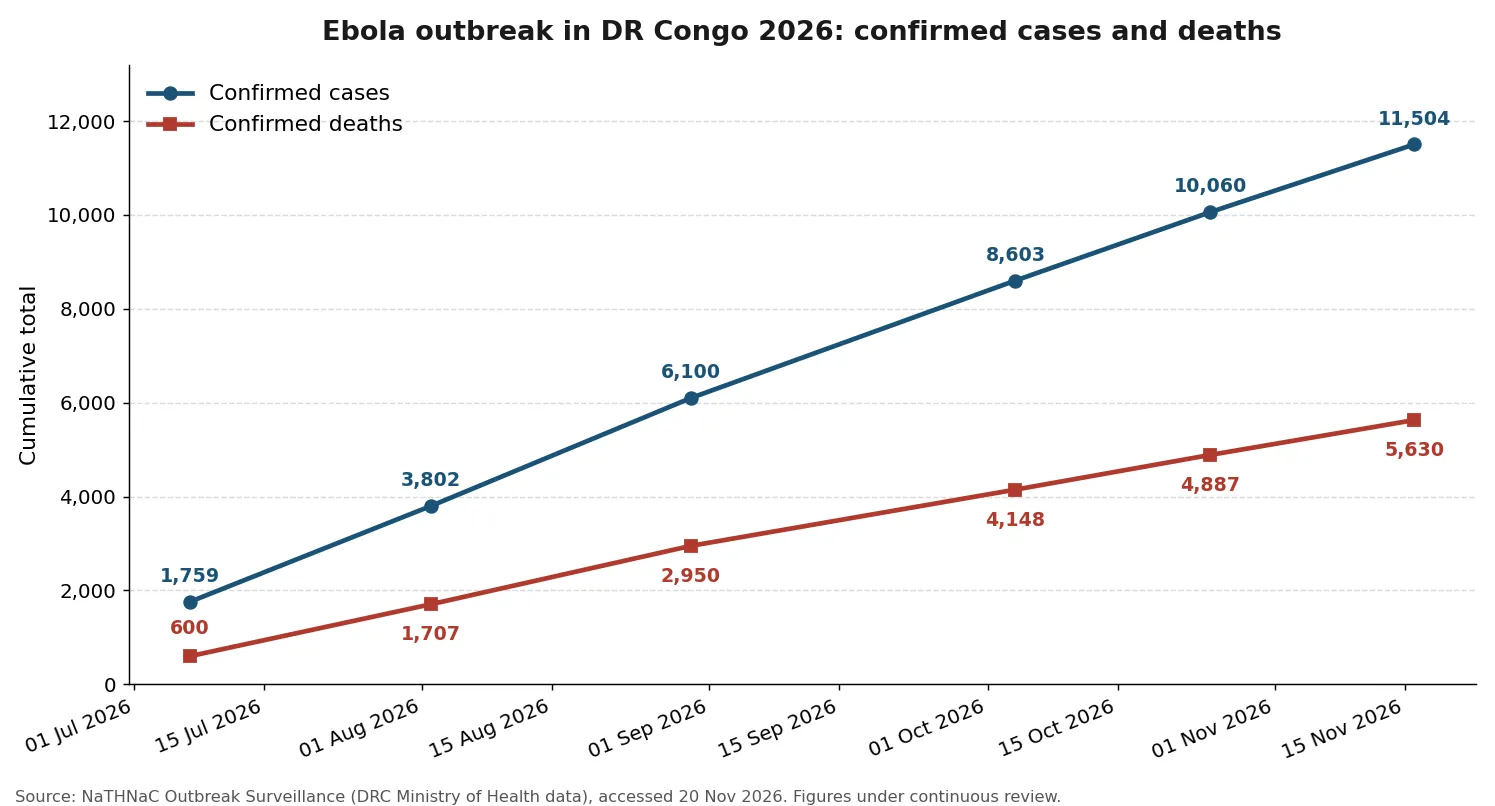
| Date | Confirmed cases | Confirmed deaths | What the figure shows |
|---|---|---|---|
| 21 August 2026 | 5,458 | 2,606 | About 5,000 cases in the first 100 days |
| 7 September 2026 | 6,757 | 3,267 | Outbreak reaches 61 health zones |
| 20 October 2026 | 9,704 | 4,687 | Imported cases reach Kenya and Nigeria |
| 1 November 2026 | 10,532 | 5,126 | Cases pass 10,000 |
| 9 November 2026 | 11,042 | 5,387 | UKHSA week-45 update |
| 16 November 2026 | 11,504 | 5,630 | Latest verified total |
These are confirmed cases only. Health agencies warn the true toll is likely higher: many deaths still happen in communities rather than in treatment centres, and contact tracing is incomplete. In the three weeks to 21 August, only about 10 contacts were identified per confirmed case against a target of 20, and 59% of confirmed deaths occurred outside an Ebola treatment unit, according to the US Centers for Disease Control and Prevention. Figures are under continuous review and are revised as data are harmonised.
Why is this the largest Ebola outbreak in DR Congo’s history?
The World Health Organization states plainly that this is now the largest Ebola disease outbreak ever recorded in DR Congo, whichever virus species caused it. It has also become the second largest Ebola outbreak ever recorded anywhere in the world — behind only the West Africa epidemic of 2014–2016.
The comparison with DR Congo’s previous record outbreak shows the scale of the change:
| Outbreak | Virus | Cases | Deaths | Duration |
|---|---|---|---|---|
| 2018–2020, North Kivu/Ituri | Ebola virus (Zaire) | 3,470 | 2,287 | Almost 2 years |
| 2026, eight provinces | Bundibugyo virus | 11,504 | 5,630 | 6 months and counting |
The 2026 outbreak passed the 2018–2020 total of 3,470 cases within about two months, and its death toll is now more than double the 2,287 deaths recorded in that earlier outbreak. The speed is striking: the CDC recorded roughly 5,000 cases in the first 100 days, a pace it described as unprecedented compared with previous Ebola outbreaks. Conflict and insecurity in eastern DR Congo, displacement, limited health infrastructure and fear of treatment centres have all made the response harder, and most new cases are still occurring outside known chains of transmission.
What is the Bundibugyo virus?
Bundibugyo virus is one of three viruses known to cause large Ebola outbreaks, alongside Ebola virus and Sudan virus. It was first identified in 2007, during an outbreak in Bundibugyo district in western Uganda, and caused a second, smaller outbreak in DR Congo in 2012. Before 2026, those were the only two Bundibugyo outbreaks ever recorded.
That rarity is part of the problem. The licensed Ebola vaccines and the approved antibody treatments were all developed against Ebola virus (Orthoebolavirus zairense), the strain behind the West Africa epidemic — not against Bundibugyo virus. As the WHO puts it, there are currently no approved vaccines or specific treatments for Bundibugyo virus disease, although candidate products are in development.
Genetic sequencing of viruses from this outbreak shows they are distinct from previous outbreaks, confirming this is a new emergence rather than a flare-up of an old one. Fruit bats are the suspected natural reservoir, as with other Ebola viruses.
What are the symptoms of Ebola?
Symptoms usually appear suddenly, between 2 and 21 days after infection. According to the World Health Organization, early symptoms are fever, fatigue, muscle pain, headache and sore throat. These are followed by vomiting, diarrhoea, abdominal pain, rash and signs that the kidneys and liver are struggling.
Bleeding is less common than many people assume, and when it happens it tends to come later — blood in vomit or stools, bleeding from the nose, gums or vagina, or bleeding where a needle has punctured the skin. Some patients become confused, irritable or aggressive as the illness affects the nervous system.
Two points matter for anyone worried they may have been exposed. First, people cannot pass the virus on before they develop symptoms. Second, early symptoms look like many other common illnesses in the region, including malaria, so Ebola can only be confirmed with a laboratory test. That is one reason detection has been slow: in the early weeks, cases were easily missed.
How does Ebola spread?
Ebola spreads through direct contact with the blood or body fluids of a person who is sick with, or has died from, the disease — through broken skin or the lining of the mouth, nose or eyes. It can also spread through objects and surfaces contaminated with those fluids, such as clothing, bedding, needles and medical equipment.
It does not spread through the air like flu or a cold, and casual contact with a healthy person carries no risk. But three routes have driven this outbreak:
- Close contact at home: caring for a sick relative, or touching the body of someone who has died, without protection.
- Health-care settings: health workers have frequently been infected while treating patients, and transmission is amplified where infection prevention and control measures are weak. The outbreak began with deaths among health workers.
- Unsafe burials: funeral ceremonies that involve direct contact with the body of a person who has died can spread the virus, which is why safe and dignified burials are a central part of the response.
The virus is thought to first enter the human population when people have close contact with the blood or secretions of infected wild animals, such as fruit bats, chimpanzees, gorillas, monkeys or forest antelope found ill or dead. Once in people, it spreads from person to person.
Has the Ebola outbreak spread beyond DR Congo?
Yes — cases have now been reported in five countries since the outbreak was declared on 15 May 2026, although so far every case outside DR Congo has been imported or linked to travel, with no sustained transmission abroad.
- Uganda: 20 confirmed cases, including 2 deaths. The outbreak there was declared over on 27 August 2026, after no new cases since the last patient was discharged on 16 July.
- Kenya: 9 confirmed cases, including 2 deaths, all linked to one traveller who arrived in Nairobi from DR Congo via Uganda on 3 October. All secondary cases were found while in quarantine, and by 11 November the last patient had been discharged and contacts had completed their 21-day follow-up.
- Nigeria: one imported case, confirmed in Abuja on 20 October in a woman who had travelled from Uganda. She was medically evacuated to Switzerland on 26 October. No further cases have been reported.
- France: one case in a doctor returning from a humanitarian mission in an affected area, reported on 24 June.
- Europe (medical evacuations): a British health worker who tested positive in DR Congo was flown to the UK on 5 November for specialist treatment in a high-level isolation unit. A health worker was evacuated to the Netherlands in September and discharged on 9 October, and US citizens working in DR Congo were evacuated to Germany for treatment in May and July.
Neighbouring countries that share a land border with DR Congo are assessed as at high risk of further spread, because of population movement, trade and travel links — which is why border screening and cross-border surveillance have been stepped up across the region.
What is the WHO doing about the outbreak?
The response is built on the standard Ebola playbook: surveillance and rapid case detection, laboratory testing, isolating and caring for patients, tracing and monitoring contacts for 21 days, safe and dignified burials, infection prevention in health facilities, and community engagement. The WHO and partners are also supporting research, logistics and essential health services alongside the outbreak response, in a region already facing a humanitarian crisis.
Progress has been slow. As of 10 November, only 79.7% of identified contacts were under follow-up, against a target of 95%. In the most recent WHO update, of 482 deaths reported since the previous update, 307 occurred in communities and only 175 in treatment centres — a sign that many people are still not reaching care in time.
One hopeful development is the TUMAINI vaccine trial, launched on 23 October 2026 with the first participants enrolled in Bunia. It is a pivotal Phase 2/3 trial of vaccine candidates against Bundibugyo virus, supported by the WHO and partners, and the first real step towards a vaccine for this strain. Results, however, will take time, and the trial does not change the advice for travellers today.
Is there a vaccine or treatment for Bundibugyo Ebola?
There is no approved vaccine and no specific treatment for Bundibugyo virus disease. That is the single most important difference between this outbreak and the 2018–2020 outbreak, when the Ervebo vaccine and antibody treatments were available because that outbreak was caused by Ebola virus (Orthoebolavirus zairense).
For Ebola virus disease, two vaccines are approved — Ervebo and Zabdeno/Mvabea — and the WHO strongly recommends two antibody treatments, mAb114 (ansuvimab) and REGN-EB3 (Inmazeb). None of these is approved for Bundibugyo virus disease, and candidate vaccines and treatments for Bundibugyo are still in development.
That does not mean nothing can be done. Early, intensive supportive care — rehydration, treating symptoms and managing other infections such as malaria — improves survival, and seeking care early can be lifesaving. If you think you may have been exposed, talk to a doctor or pharmacist, or contact your local health authority, rather than trying to treat yourself. No medicine, supplement or product has been shown to prevent or cure Bundibugyo virus disease.
What is the risk to the UK, US and Europe?
For the general public in the UK, the US and Europe, the risk is low. The UK Health Security Agency assesses the risk to the UK population as low, and the WHO continues to assess the global risk as low — even as it rates the risk inside DR Congo as very high and the risk to neighbouring countries as high.
Imported Ebola cases are extremely rare in the UK. Since 1976, there have been only five confirmed cases in the UK: one laboratory-acquired case in 1976, three health workers linked to the West Africa epidemic in 2014–2015, and the health worker medically evacuated from DR Congo in November 2026. Each was managed in a high-level isolation unit, and none led to spread in the community.
In the US, the CDC has put temporary entry restrictions in place: travellers, including US citizens, who have been in DR Congo within 21 days of their flight are not allowed to board commercial flights to the US, and US citizens are advised to remain outside DR Congo for 21 days before entering the country. The WHO, for its part, advises against any restriction of travel to, or trade with, affected countries — a position that reflects its view that restrictions do more harm than good to the response. Travellers should follow the advice of their own government.
What is the travel guidance for DR Congo?
The US CDC currently advises travellers to avoid all travel to Ituri and North Kivu provinces unless travelling for humanitarian aid or emergency response, and to avoid nonessential travel to Haut-Uélé and Tshopo provinces. For all other provinces, it recommends enhanced precautions. The UK Foreign Office advises against travel to several eastern provinces, including Ituri, North Kivu and South Kivu.
If you must travel to an affected area, the CDC advises avoiding contact with people who have symptoms such as fever, muscle pain and rash; avoiding blood and other body fluids, dead bodies, and funeral practices that involve touching the body; avoiding health-care facilities, traditional healers, bats, non-human primates and raw meat from wild animals; and avoiding caves and mines where bats live.
Monitor yourself for symptoms while you are there and for 21 days after leaving. If you develop fever, headache, muscle pain, weakness, diarrhoea, vomiting, stomach pain or unexplained bleeding or bruising, isolate yourself immediately, do not travel, and contact local health authorities or a health facility by phone first, so they can prepare for your arrival. Tell them exactly where you have travelled.
When to see a doctor
Seek urgent medical care if you develop a sudden fever, severe headache, muscle pain, weakness, vomiting, diarrhoea or unexplained bleeding within 21 days of leaving DR Congo or another affected area — especially if you had contact with someone who was ill, with a dead body, or with blood or body fluids. Call ahead before going to a clinic or hospital, tell them where you have travelled, and follow their instructions. Do not travel on public transport or visit a health facility unannounced if you think you may have Ebola.
Health workers and anyone who has cared for a sick person in an affected area should contact their local health authority or occupational health service for advice, even if they feel well, because monitoring arrangements apply to high-risk contacts. If you are unsure whether your symptoms matter, talk to a doctor or pharmacist — it is always better to ask early. In an emergency call 911 (US), 999 (UK) or 112 (EU).
What happens next with the Ebola outbreak in DR Congo?
The honest answer is that the outbreak is not yet under control. Transmission remains high and sustained, with 65 to 67 new cases reported each day, and North Kivu is now recording more new cases than Ituri. The response is hampered by armed conflict, displacement and gaps in contact tracing, and most new cases are still appearing outside known transmission chains.
Three things will decide how this ends. First, whether contact tracing and safe burials can reach the levels needed to break transmission — both are still well short of their targets. Second, whether the TUMAINI vaccine trial produces a vaccine that can protect health workers and contacts in future outbreaks. And third, whether the outbreak stays contained to DR Congo: so far, every case abroad has been caught quickly, but the WHO has warned that the risk of further cross-border spread remains, and its rapid risk assessment is being revised.
For readers outside the region, the practical advice has not changed: the risk at home is low, but check official travel advice before any trip to DR Congo, and know the symptoms and the 21-day window. We will update this article as new figures are published.
Figures in this article are dated. The latest verified totals are 11,504 confirmed cases and 5,630 deaths as of 16 November 2026 (NaTHNaC). The detailed provincial breakdown comes from the UK Health Security Agency’s week-45 update, covering data to 9 November 2026. Figures are revised as DR Congo’s data are reviewed and harmonised.
Frequently asked questions
How many people have died in the DR Congo Ebola outbreak in 2026?
As of 16 November 2026, 5,630 deaths have been reported among 11,504 confirmed cases in DR Congo — a case fatality rate of around 49%. The UK Health Security Agency's week-45 update reported 5,387 deaths among 11,042 cases as of 9 November. This is already more than double the 2,287 deaths in DR Congo's previous largest outbreak in 2018–2020, making it the deadliest Ebola outbreak the country has recorded.
Is the DR Congo Ebola outbreak a global health emergency?
Yes. On 17 May 2026, the World Health Organization declared the outbreak a Public Health Emergency of International Concern, its highest alert level, two days after DR Congo declared the outbreak. Africa CDC declared it a continental emergency the next day. The emergency status was still in force at the latest WHO Emergency Committee meeting on 18 August 2026, and the WHO rates the risk inside DR Congo as very high, while the global risk remains low.
Is there a vaccine for the Bundibugyo strain of Ebola?
No. There is no approved vaccine or specific treatment for Bundibugyo virus disease. The licensed vaccines, Ervebo and Zabdeno/Mvabea, and the approved antibody treatments were developed against Ebola virus, a different strain, and do not cover Bundibugyo. A Phase 2/3 trial of Bundibugyo vaccine candidates, called TUMAINI, began enrolling participants in Bunia on 23 October 2026, but results will take time.
Can Ebola from DR Congo spread to the UK or the US?
The risk is assessed as low. The UK Health Security Agency rates the risk to the UK population as low, and the WHO rates the global risk as low. Imported cases are extremely rare: the UK has had only five confirmed Ebola cases since 1976, all in travellers or health workers, with no spread in the community. Cases imported to Kenya and Nigeria in this outbreak were caught quickly and did not spread further.
What should I do if I develop symptoms after travelling from DR Congo?
If you develop a sudden fever, headache, muscle pain, weakness, vomiting, diarrhoea or unexplained bleeding within 21 days of leaving an affected area, isolate yourself immediately and do not travel. Phone a doctor, a health facility or your local health authority before going in, and tell them where you have travelled. Early care improves survival, so do not wait to see if symptoms pass. In an emergency call 911 (US), 999 (UK) or 112 (EU).
How does Ebola spread from person to person?
Ebola spreads through direct contact with the blood or body fluids of a person who is sick with, or has died from, the disease, through broken skin or the lining of the mouth, nose or eyes. It can also spread via objects contaminated with body fluids, such as bedding or needles. It does not spread through the air, and people cannot pass it on before they develop symptoms.
Sources
- UK Health Security Agency — Outbreaks under monitoring: week 45 (week ending 8 November 2026) www.gov.uk
- European Centre for Disease Prevention and Control — Ebola disease outbreak caused by Bundibugyo virus, multi-country, 10 November 2026 update www.ecdc.europa.eu
- World Health Organization — Disease Outbreak News: Ebola disease caused by Bundibugyo virus, DRC, Kenya and Nigeria (20 October 2026) www.who.int
- World Health Organization — Ebola disease fact sheet www.who.int
- US Centers for Disease Control and Prevention — MMWR: Characteristics and Monitoring of the 2026 Outbreak of Ebola Disease Caused by Bundibugyo Virus, DRC, August 2026 www.cdc.gov
- US Centers for Disease Control and Prevention — Travel Health Notice, Level 3: Ebola Bundibugyo virus disease in the Democratic Republic of the Congo wwwnc.cdc.gov
- NaTHNaC (National Travel Health Network and Centre) — Outbreak Surveillance travelhealthpro.org.uk
- World Health Organization — 10th Ebola outbreak in the Democratic Republic of the Congo declared over (25 June 2020) www.who.int

Try the tool
Not sure if it can wait?
Common causes and warning signs for 16 everyday symptoms.
Open the symptom guide