What Is Retatrutide? The New Triple Weight-Loss Drug Explained
Eli Lilly's triple-agonist drug produced the largest weight loss ever seen in a phase 3 obesity trial — but it is still investigational, unapproved and unavailable to buy. Here is what TRIUMPH-1, TRIUMPH-2 and TRIUMPH-3 actually showed.
- Written by
- Health Daily Advice
- Published
- Reading time
- 8 minutes
- Sources
- 8 cited

In this guide
Retatrutide is an investigational weight-loss drug from Eli Lilly that targets three gut hormones at once — GLP-1, GIP and glucagon. In its largest phase 3 trial, people taking the highest dose lost a quarter of their body weight on average. It is not approved anywhere yet, so it cannot legally be prescribed or bought.
Why is everyone searching for retatrutide?
Searches for retatrutide have surged through 2026, and the reason is simple: the results are the biggest ever reported for a weight-loss drug in a large trial. On 29 September 2026, the first two phase 3 papers landed on the same day — TRIUMPH-1 in the New England Journal of Medicine and TRIUMPH-2 in The Lancet — and both showed weight loss well beyond anything the current generation of weight-loss injections has managed. That is a genuine scientific milestone. It is also, for now, only a milestone: a published trial is not an approved medicine, and retatrutide has not been licensed by any regulator in the world.
The gap between the headlines and the reality matters, because the gap is where the risks live. While the drug itself is still in trials, products labelled “retatrutide” are already being sold online. None of them is the real, regulated medicine, and the UK regulator has warned that they may contain nothing of the sort.
What is retatrutide and how does it work?
Retatrutide (development code LY3437943) is a “triple agonist” made by Eli Lilly. It mimics three hormones your gut releases after eating: GLP-1, GIP and glucagon. Each does a different job. GLP-1 medicines work by making you feel fuller, slowing how fast your stomach empties and damping down appetite signals in the brain, as the UK medicines regulator’s guide to GLP-1 medicines explains. GIP adds a second appetite and blood-sugar pathway. Glucagon is the new ingredient: it is thought to raise energy expenditure and help the liver burn fat. In the trials, retatrutide was given as a once-weekly injection, with the dose built up gradually over weeks.
That three-way action is what sets it apart from the weight-loss drugs people can already get. Semaglutide (Wegovy) targets GLP-1 alone. Tirzepatide (Mounjaro) targets GLP-1 and GIP. Retatrutide adds glucagon on top — which is why some researchers have nicknamed this class “GLP-3”, though that is not an official name. The idea is that the extra pathway keeps weight falling where two-hormone drugs tend to level off. The phase 3 results suggest the idea has something to it.
| Medicine | Hormones targeted | Status |
|---|---|---|
| Semaglutide (Wegovy) | GLP-1 | Approved and prescribed |
| Tirzepatide (Mounjaro) | GLP-1 + GIP | Approved and prescribed |
| Retatrutide | GLP-1 + GIP + glucagon | Investigational — not approved anywhere |
What did the TRIUMPH-1 trial find?
TRIUMPH-1 is the headline trial. It enrolled 2,339 adults with obesity, or overweight with a weight-related health problem, who did not have diabetes, across 131 sites in 11 countries. They were randomly assigned to a once-weekly injection of retatrutide at 4 mg, 9 mg or 12 mg, or a placebo, for 80 weeks, alongside advice on diet and activity. The doses here describe the trial’s study groups, not a recommended dose — there is no approved dose yet.
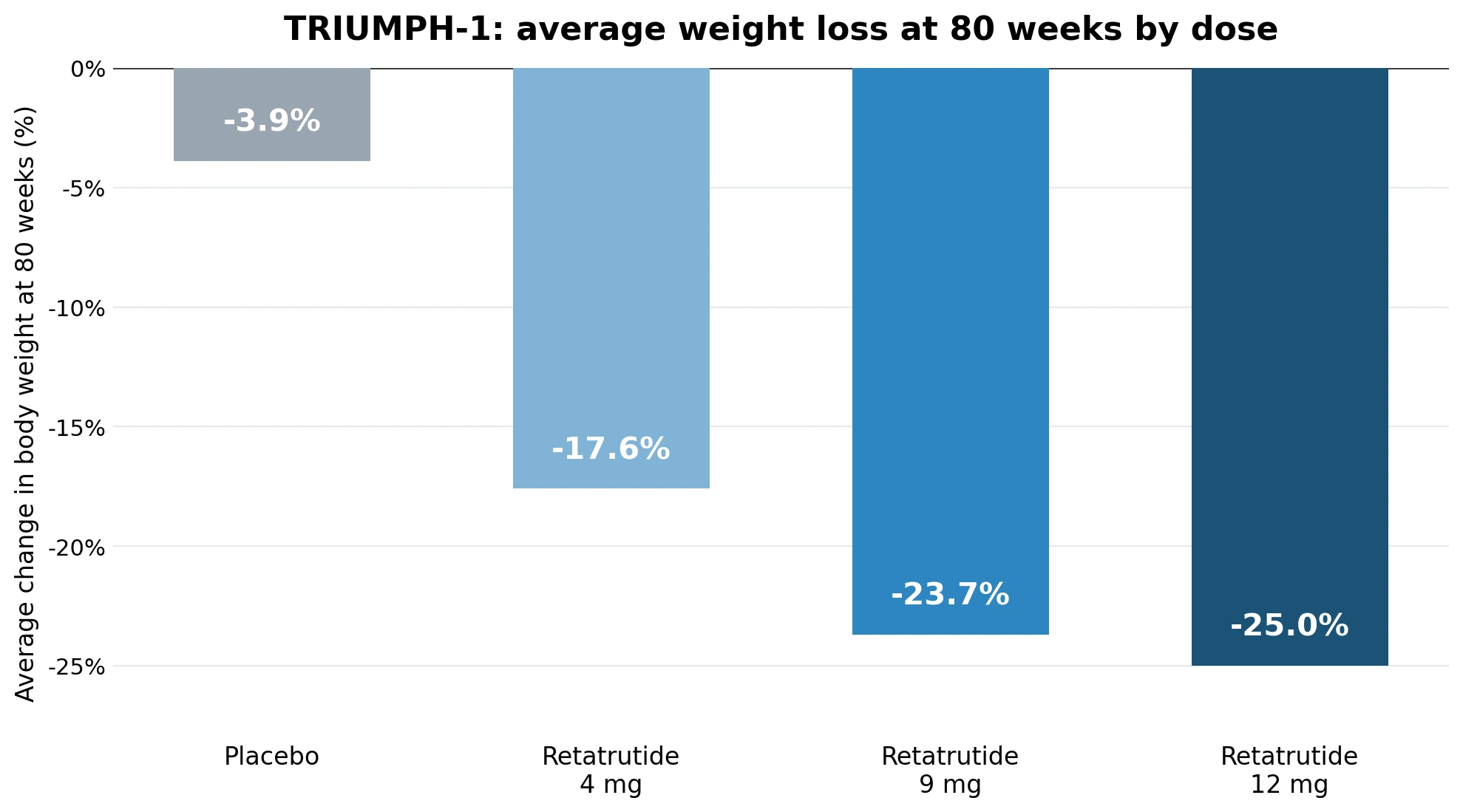
Counting everyone who was randomised, whether or not they stayed on treatment, average body weight fell by 17.6% on 4 mg, 23.7% on 9 mg and 25.0% on 12 mg, against 3.9% on placebo. Among the people who stayed on the 12 mg dose for the full 80 weeks, the average loss was larger — 28.3%, or about 70 lb (32 kg) — and 45.3% of them lost 30% or more of their starting weight. A pre-specified extension for people with a BMI of 35 or higher who continued to 104 weeks reached an average loss of 30.3%. No weight-loss drug has produced average losses of that size in a phase 3 trial before; the numbers approach what bariatric surgery typically achieves.
The trial looked beyond the scales, too. The researchers reported that retatrutide reduced pain in participants with knee osteoarthritis and reduced apnoea–hypopnoea events in participants with obstructive sleep apnoea. In the knee osteoarthritis subgroup of 574 people, pain scores fell by 3.2 to 3.6 points on retatrutide against 1.9 points on placebo. Those are secondary findings, not the trial’s main question, but they hint at why Lilly is testing the drug across so many obesity-related conditions.
Two cautions belong next to the headline number. First, a trial average is not a promise: some people in the trial lost far less, and a few stopped the drug because of side effects. Second, the bigger figures quoted in some coverage — 28.3% rather than 25.0% — come from counting only the people who stayed on treatment. Both numbers are real; they answer different questions, and the 25.0% figure is the more conservative one.
What about people with type 2 diabetes?
People with type 2 diabetes usually lose less weight on this class of drug than people without diabetes, so TRIUMPH-2 was the harder test. It enrolled 1,152 adults with obesity and type 2 diabetes at 92 centres in eight countries, again for 80 weeks. Counting everyone randomised, average weight fell by 11.9% on 4 mg, 16.8% on 9 mg and 18.8% on 12 mg, against 5.1% on placebo. Among those who stayed on the 12 mg dose, the average loss was 20.8%, or about 49.6 lb.
Blood sugar improved sharply as well. HbA1c — the standard measure of average blood sugar — fell by up to 1.6 percentage points on retatrutide, against 0.2 points on placebo, and about 40% of people on the higher doses reached an HbA1c below 5.7%, which is in the non-diabetic range, compared with 4.4% on placebo. More than half of those on the 12 mg dose no longer met the BMI criteria for obesity at the end of the trial. For people living with both obesity and type 2 diabetes, that combination of weight loss and blood-sugar control is the result that matters most — though, as with TRIUMPH-1, these are averages from a closely supervised trial, not a guarantee for any individual.
What did TRIUMPH-3 show?
TRIUMPH-3 tested the drug in the highest-risk group yet: 1,949 adults with severe obesity (BMI of 35 or higher) and established cardiovascular disease. At 80 weeks, the 12 mg dose produced an average weight loss of 22.6%, or about 55.8 lb. The trial also reported early cardiovascular data: major adverse cardiovascular events — death, heart attack, stroke, heart failure or revascularisation — occurred in 44 people on retatrutide against 52 on placebo, a hazard ratio of about 0.82. That leans in the right direction, but the trial was not designed or powered to prove a heart benefit, and the difference could be chance. A dedicated cardiovascular outcomes trial, TRIUMPH-Outcomes, is still running and will give the definitive answer.
What are the side effects?
The side-effect pattern will be familiar to anyone who follows GLP-1 medicines: the most common problems were gut-related, and they were worst while the dose was being increased. In TRIUMPH-2, diarrhoea affected 27%, 34% and 34% of people on the 4, 9 and 12 mg doses, against 13% on placebo, and nausea affected 14%, 21% and 28%, against 8% on placebo. Vomiting was also common. Most of these effects were mild to moderate, but they were the main reason people stopped treatment: in TRIUMPH-2, discontinuation due to adverse events was 4% on 4 mg, 12% on 9 mg and 8% on 12 mg, against 5% on placebo.
Retatrutide also has a side effect that is unusual for this drug family: dysesthesia, an altered or heightened skin sensation often described as tingling. In TRIUMPH-2 it was reported by 4%, 6% and 7% of people on the three doses, against 1% on placebo, and in TRIUMPH-1 by about 12.5% of people on the 12 mg dose, against 0.9% on placebo. Pharmacists who have reviewed the data describe it as usually mild and transient, and say it did not lead to people stopping treatment in the trials — but it is something future patients would need warning about in advance. Low blood pressure was also more common on retatrutide than on placebo.
Seven deaths were reported across the TRIUMPH-2 treatment groups and one on placebo; the investigators judged all of them unrelated to the study drug. That is the kind of detail regulators will examine closely before any approval, and it underlines why long-term safety data matters as much as the weight-loss numbers.
When could retatrutide be approved?
Lilly has said it plans to submit a Biologics License Application — the formal request to market a biologic medicine — to the US Food and Drug Administration in the first quarter of 2027. A submission is not an approval. The FDA then reviews the full data package, a process that typically takes most of a year for a new obesity medicine, so the earliest realistic availability would be late 2027 — and only if the agency is satisfied on both benefit and safety. No UK application or timeline has been announced, so a British launch would come later still.
That timeline is the answer to the question most searchers are really asking. There is no way to get retatrutide legally today outside a clinical trial, in the US, the UK or anywhere else. The UK’s Medicines and Healthcare products Regulatory Agency warned in July 2026 that retatrutide has not been authorised for use in the UK and that anyone selling it is doing so illegally, adding that there is no guarantee products sold under the name even contain retatrutide. In October 2025 its enforcement unit raided an illicit factory in Northampton and seized more than 2,000 unlicensed retatrutide and tirzepatide pens. Vials sold online as “research chemicals” or “not for human use” are the same unlicensed products with a different label, and nothing about them has been tested for safety, strength or sterility. If you are considering a weight-loss medicine now, talk to your GP or pharmacist about the licensed options that already exist.
What is still unknown?
Quite a lot, and it is worth being straight about it. The trials lasted 80 weeks, so nobody yet knows how the drug performs — or how safe it is — over five or ten years. The dedicated heart-outcomes trial is still running, so the cardiovascular benefit is unproven. We do not know how much weight people regain if they stop, or whether the drug keeps working at the same strength over years. The trials also enrolled selected, closely monitored volunteers, so the results may look different in everyday practice, where support and follow-up are thinner. And the price, the eligible patient group and the conditions of any approval are all still to be decided by regulators. Retatrutide is a genuinely important advance in obesity science. It is not yet a medicine you can take — and the difference between those two things is exactly what the next year of regulatory review is for.
When to see a doctor
If you are living with obesity or type 2 diabetes and want to discuss weight-loss treatment, speak to your GP or pharmacist. They can talk through the licensed medicines that are available now, whether you are eligible, and what else can help alongside them. Do not buy any weight-loss product online without a prescription, and do not use a product labelled “retatrutide” from an unregulated seller — if you have already used one and feel unwell, seek medical help promptly and tell the clinician exactly what you took.
Get urgent medical help straight away if you develop severe stomach pain that does not go away or spreads to your back, persistent vomiting, signs of severe dehydration, or a sudden change in your vision. In an emergency call 911 (US), 999 (UK) or 112 (EU).
Frequently asked questions
What is retatrutide?
Retatrutide is an investigational weight-loss drug from Eli Lilly that targets three gut hormones at once: GLP-1, GIP and glucagon. It was given as a once-weekly injection in clinical trials. In its largest phase 3 trial, TRIUMPH-1, people on the highest dose lost 25% of their body weight on average over 80 weeks. It is not approved by any regulator anywhere yet.
How much weight can you lose on retatrutide?
In the TRIUMPH-1 phase 3 trial, average weight loss at 80 weeks was 17.6% on 4 mg, 23.7% on 9 mg and 25.0% on 12 mg, against 3.9% on placebo. Among people who stayed on the 12 mg dose, the average loss was 28.3%, and 45.3% lost 30% or more. These are trial averages, not a promise for any individual, and the drug is not available outside trials.
Is retatrutide approved?
No. Retatrutide has not been approved by the FDA, the MHRA or any other regulator for any use. Eli Lilly plans to submit a Biologics License Application to the US FDA in the first quarter of 2027, and a review would then take months. The earliest realistic availability would be late 2027, and only if the FDA approves it.
What are the side effects of retatrutide?
The most common side effects in the trials were gut problems: diarrhoea, nausea and vomiting, mostly while the dose was being increased. Retatrutide also caused dysesthesia — tingling or heightened skin sensitivity — in up to about 12.5% of people on the highest dose in TRIUMPH-1, against 0.9% on placebo. Low blood pressure was also more common. Long-term safety is still unknown.
When will retatrutide be available?
There is no launch date. Lilly plans to file for US approval in the first quarter of 2027, and the FDA review would take most of a year, so late 2027 is the earliest realistic date if approval is granted. No UK application or timeline has been announced, so a UK launch would come later. Until then, the only legal way to receive it is as a participant in a clinical trial.
Can I buy retatrutide online?
No — not legally, and not safely. Retatrutide is not approved anywhere, so anything sold online under that name is unlicensed. The UK's MHRA has warned that such products may not contain retatrutide at all, and has seized thousands of fake weight-loss pens. If you want weight-loss treatment now, talk to your GP or pharmacist about licensed medicines such as semaglutide or tirzepatide.
Sources
- Jastreboff AM, et al. Retatrutide, a Triple Hormone Receptor Agonist, for Treatment of Obesity (TRIUMPH-1). N Engl J Med. 2026;395(18):1781-1793 pubmed.ncbi.nlm.nih.gov
- Bellido V, et al. Retatrutide in adults with obesity and type 2 diabetes (TRIUMPH-2). Lancet. 2026;408(10563):1455-1472 pubmed.ncbi.nlm.nih.gov
- Pharmacy Times: Retatrutide Cuts Weight Up to 18.8% in Adults With T2D, Obesity (30 Sep 2026) www.pharmacytimes.com
- Pharmacy Times: Lilly Prepares for Retatrutide FDA Filing Following Additional Phase 3 Data in Diabetes, CVD (24 Jul 2026) www.pharmacytimes.com
- AJMC: Retatrutide Yields Up to 20.8% Weight Loss in Obesity With T2D (30 Sep 2026) www.ajmc.com
- MHRA / GOV.UK: GLP-1 medicines for weight loss and diabetes: what you need to know www.gov.uk
- MediWatch: Retatrutide UK 2026 — Is the Triple-Agonist Weight-Loss Drug Available? mediwatch.co.uk

Try the tool
Not sure if it can wait?
Common causes and warning signs for 16 everyday symptoms.
Open the symptom guide