Flu Season 2026 Arrives Early: What the CDC Numbers Show
Flu is surging weeks earlier than usual on both sides of the Atlantic. Here are the CDC and UKHSA figures, the seven hardest-hit US states, and what to do before Thanksgiving.
- Written by
- Health Daily Advice
- Published
- Reading time
- 7 minutes
- Sources
- 10 cited

In this guide
Yes — flu season has arrived early. The CDC’s latest FluView report shows flu activity in the United States running higher than usual for early November, with seven states already at high or very high levels and an estimated 2.6 million illnesses so far this season. England is seeing a similar climb, though from lower levels.
That timing matters. Thanksgiving falls on 26 November this year, and millions of people will travel and gather indoors in the days ahead — exactly the conditions flu likes best. The good news is that the season is still rated low severity so far, and the flu vaccine remains available. The catch is timing: protection takes about two weeks to build, so a jab given now lands after the holiday but well before the usual December and January peak.
What do the latest CDC figures actually show?
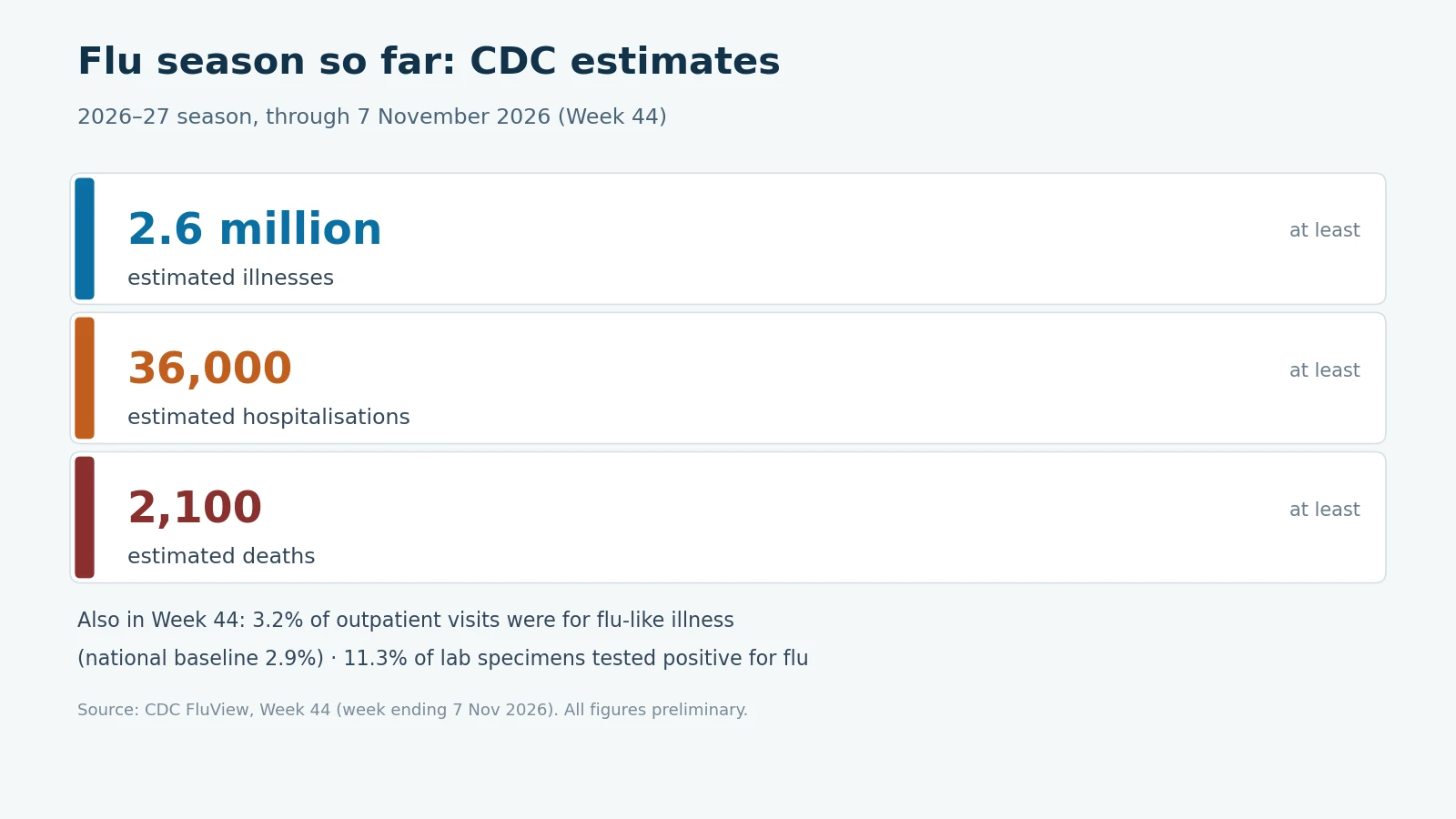
The CDC’s FluView report for Week 44, covering the week ending 7 November 2026 and published on 13 November, paints a consistent picture across every indicator it tracks. Activity is rising in many parts of the country and is, in the CDC’s words, higher than typically observed at this time of year.
| Indicator | Week 44 (week ending 7 Nov 2026) | What it means |
|---|---|---|
| Estimated illnesses so far this season | At least 2.6 million | Up from 1.7 million a week earlier |
| Estimated hospitalisations | At least 36,000 | Up from 25,000 in Week 43 |
| Estimated deaths | At least 2,100 | Up from 1,400 in Week 43 |
| Outpatient visits for flu-like illness | 3.2% | Above the national baseline of 2.9% |
| Clinical lab specimens testing positive | 11.3% | 5,911 of 52,287 specimens |
| New hospital admissions with flu | 9,584 | A rate of 2.8 per 100,000 people |
| Paediatric flu deaths this season | 5 | Two more reported during Week 44 |
The CDC stresses that these are estimates, not counted cases, and that all figures are preliminary and may change as more reports arrive. Even so, the direction is unmistakable: every major indicator moved up in the same week. Flu-like illness made up 3.2% of outpatient visits, crossing above the 2.9% national baseline after sitting below it a week earlier, and 11.3% of specimens tested in clinical labs came back positive for flu.
Which states are seeing the most flu?
Seven states are now at high or very high flu activity, up from just two the week before, according to CDC data reported by the Associated Press: California, Louisiana, Oregon, South Carolina, Tennessee, Texas and Washington. The CDC’s own tally lists one jurisdiction at very high and six at high. The surge is not confined to whole states, either — the number of metro areas at very high activity rose from three to eight in a single week, and those at high levels climbed from 19 to 37.
Louisiana is seeing the most intense activity so far. An infectious diseases specialist at LSU Health Sciences Center in New Orleans told the AP the season is “taking off in a direction that’s only likely to increase”, linking the early surge in part to low vaccination rates and barriers to health care.
Colorado tells a similar story at state level. Hospitals there admitted 157 people with flu in the week ending 14 November, and the season total since 4 October now stands at 689 hospitalisations, compared with 107 at the same point last season. The state’s sentinel test positivity has reached 10.4%. For context, last season was Colorado’s worst on record, with 5,931 flu hospitalisations in total.
Is flu rising in the UK too?
Yes, though from a lower starting point. The UK Health Security Agency’s surveillance report for 19 November 2026 says flu activity in England has increased but is still circulating at low levels, and it has issued a briefing note to the NHS that activity is now above baseline.
The numbers behind that: flu positivity rose to 11.4%, up from 8.3% the previous Sunday, and the weekly hospital admission rate for flu climbed to 4.68 per 100,000 people, up from 3.76. GP consultations for flu-like illness rose to 7.3 per 100,000 registered patients, up from 6.2 the previous week. Positivity is highest among children aged 5 to 11, at 23.2%.
One figure worth watching is vaccination. Among people aged 65 and over in England, uptake so far is 65.8%, slightly below the 67.8% seen at the same point last season, and only around a third of 2- and 3-year-olds have had their flu vaccine. UKHSA notes that flu usually peaks in December and January, often around Christmas — so there is still time for the numbers to climb further.
What is driving this early season?
Almost all of this autumn’s illness is influenza A, and within that, one strain dominates. Of the influenza A viruses subtyped by public health laboratories in Week 44, 98.9% were influenza A(H1N1)pdm09 — the descendant of the virus behind the 2009 pandemic, which has caused seasonal epidemics every year since.
There is an early reassuring sign on vaccines. Laboratory testing found that 95.2% of the H1N1 viruses tested were well recognised by antibodies raised against this season’s vaccine reference strain. That is a laboratory result, not a real-world effectiveness figure — those estimates take months — but it suggests the vaccine is well matched to what is circulating. The CDC also cautions that the circulating H1N1 viruses are showing more genetic diversity than before, and that it is too early to say whether that will affect vaccine effectiveness.
How is flu different from a cold?
The two are easy to confuse, but they behave differently, and the NHS sets out the contrast plainly: flu appears quickly, within a few hours, while a cold builds gradually over one to two days. Flu affects more than just your nose and throat — it brings a sudden high temperature, aching body, exhaustion, dry cough, sore throat and headache — and it can leave you too unwell to carry on as normal. A cold mainly affects the nose and throat, and most people can still do their normal activities.
If you catch flu, the NHS advice is straightforward: rest and sleep, drink plenty of water, and take paracetamol or ibuprofen to lower your temperature and ease aches — but talk to a pharmacist or GP first if you are unsure what suits you. Antibiotics do not work against flu, because it is a viral infection. You are most likely to pass flu on in the first five days after getting infected, and the germs from coughs and sneezes can live on hands and surfaces for 24 hours, so hand washing and covering coughs and sneezes matter. If you have a high temperature or feel too unwell for normal activities, stay at home and avoid contact with other people.
What should you do now?
The single most useful step is vaccination, and the timing is what makes this week matter. The CDC recommends an annual flu vaccine for everyone aged 6 months and older, with rare exceptions, and says it takes about two weeks after vaccination for protective antibodies to develop. A jab this week will not reach full protection by Thanksgiving, but it will cover December and January, when flu seasons usually peak. In England, the flu vaccine is offered free on the NHS every autumn to adults and children at higher risk of serious illness — check the NHS flu pages to see if you are eligible, or ask a pharmacist.
For people at higher risk — adults 65 and over, young children, pregnant people and those with long-term heart, lung or kidney conditions, diabetes or a weakened immune system — early treatment matters too. The CDC says prescription flu antiviral drugs work best when started as early as possible, so talk to a doctor promptly if symptoms start rather than waiting to see how they develop.
Does an early season mean a worse winter?
Not necessarily. The CDC is explicit on this point: an earlier increase in activity does not necessarily lead to a higher seasonal peak or greater overall severity. Its preliminary severity assessment rates the season as low across all age groups so far — children, working-age adults and older adults alike — while warning that the assessment may change as activity rises.
What is clearer is the short-term direction. The CDC’s FluSight forecasts predict a likely increase nationally in both flu hospital admissions and the percentage of emergency department visits due to flu for the week ending 28 November, with weekly admissions forecast between 8,300 and 34,400. So the next two weeks, covering Thanksgiving travel and gatherings, are the ones to watch. The next FluView update, covering the week ending 14 November, is due on Friday 20 November.
When to see a doctor
Most people with flu recover at home with rest and fluids, but some situations need medical advice. The NHS advises asking for an urgent GP appointment or help from NHS 111 if you have flu symptoms and are 65 or over, pregnant or recently given birth, have a long-term medical condition or a weakened immune system, feel very unwell or short of breath, or your symptoms have not improved after seven days. Parents should seek urgent help if they are worried about a baby’s or child’s symptoms.
Call 999 or go to A&E if you get sudden chest pain, have severe difficulty breathing, or start coughing up blood. In an emergency call 911 (US), 999 (UK) or 112 (EU).
If you are in a higher-risk group and flu symptoms start, talk to a doctor or pharmacist promptly — antiviral treatment works best when it starts early, and they can advise whether it is right for you.
Frequently asked questions
Is flu season early in 2026?
Yes. The CDC's FluView report for the week ending 7 November 2026 says flu activity in the United States is higher than typically observed at this time of year. Outpatient visits for flu-like illness reached 3.2%, above the 2.9% national baseline, and the CDC estimates at least 2.6 million illnesses so far this season. England is also seeing flu activity rise, though it remains at low levels.
Which states have the highest flu activity?
Seven states are at high or very high flu activity: California, Louisiana, Oregon, South Carolina, Tennessee, Texas and Washington, according to CDC data reported by the Associated Press. That is up from just two states the week before. Louisiana is seeing the most intense activity so far, and the number of metro areas at very high activity rose from three to eight in one week.
How bad is flu in the UK right now?
Flu activity in England is increasing but still circulating at low levels, according to the UK Health Security Agency's report of 19 November 2026. Flu positivity rose to 11.4%, up from 8.3% the previous Sunday, and the weekly hospital admission rate reached 4.68 per 100,000, up from 3.76. GP consultations for flu-like illness rose to 7.3 per 100,000. UKHSA says flu usually peaks in December and January.
Is it too late to get a flu vaccine before Thanksgiving?
It is not too late to get vaccinated, but a jab this week will not reach full protection by Thanksgiving on 26 November. The CDC says it takes about two weeks after vaccination for protective antibodies to develop. A vaccine given now should still protect you through December and January, when flu seasons usually peak, so it is worth getting one as soon as you can.
How can I tell flu from a cold?
Flu appears quickly, within a few hours, while a cold builds gradually over one to two days, according to the NHS. Flu affects more than just your nose and throat: it brings a sudden high temperature, aching body, exhaustion, dry cough, sore throat and headache, and can leave you too unwell to carry on as normal. A cold mainly affects the nose and throat, and most people can still do their normal activities.
When should I see a doctor for flu?
The NHS advises asking for an urgent GP appointment or help from NHS 111 if you have flu symptoms and are 65 or over, pregnant or recently given birth, have a long-term medical condition or a weakened immune system, feel very unwell or short of breath, or your symptoms have not improved after seven days. Call 999 or go to A&E for sudden chest pain, severe difficulty breathing or coughing up blood.
Sources
- CDC: Weekly US Influenza Surveillance Report, Week 44 ending November 7, 2026 (FluView) www.cdc.gov
- CDC: Weekly US Influenza Surveillance Report, Week 43 ending October 31, 2026 (FluView) www.cdc.gov
- CDC: Key Facts About Seasonal Flu Vaccine www.cdc.gov
- UKHSA: National flu and COVID-19 surveillance report, 19 November 2026 (week 47) www.gov.uk
- NHS: Flu www.nhs.uk
- Medical Daily: Colorado Flu Hospitalizations Hit 157 in One Week (19 Nov 2026) www.medicaldaily.com
- KSUT: Colorado could be in for another bad flu season (19 Nov 2026) www.ksut.org
- Nature World News: Flu Season's Child Death Toll Rises to Five as High Activity Spreads to Seven States (18 Nov 2026) www.natureworldnews.com

Try the tool
Not sure if it can wait?
Common causes and warning signs for 16 everyday symptoms.
Open the symptom guide