Cyclospora Outbreak 2026: What Happened and How to Stay Safe
The 2026 Cyclospora outbreak was the largest ever recorded in the US: 12,883 people fell ill after eating iceberg lettuce. Here is what happened, the symptoms to know, and how to protect yourself.
- Written by
- Health Daily Advice
- Published
- Reading time
- 4 minutes
- Sources
- 6 cited

In this guide
The 2026 Cyclospora outbreak was the largest recorded in the United States, with 12,883 people falling ill after eating iceberg lettuce from central Mexico. Cyclosporiasis is a gut infection caused by a microscopic parasite, and it brings watery diarrhoea that can last for weeks. The outbreak is over, but the FDA has announced new measures to stop it happening again.
What is Cyclospora?
Cyclosporiasis is a gut illness caused by Cyclospora cayetanensis, a microscopic, single-celled parasite that infects the small intestine. The CDC says it is not usually life-threatening, but it can make some people very ill. In the United States it is uncommon, and outbreaks have most often been linked to fresh produce. It is more common in tropical and subtropical regions, where the parasite is endemic.
What happened in the 2026 outbreak?
In July 2026, the FDA and CDC began investigating a multistate outbreak linked to iceberg lettuce. The final figures, published by the FDA, were stark: 12,883 illnesses, 570 hospitalisations and 2 deaths across 21 states, with both deaths in Michigan. The last illness began on 17 August 2026.
Traceback work quickly pointed to one supplier, Taylor Farms de Mexico, which voluntarily recalled all iceberg lettuce sourced from central Mexico on 17 July 2026. The recall included Marketside-brand iceberg salad and shredded lettuce sold at Walmart, and Taco Bell stopped using lettuce from that supplier the same day. The CDC declared the outbreak over on 11 September 2026, and the FDA closed its investigation on 2 October 2026.
The outbreak was not the whole story. As of 15 September 2026, the CDC had recorded 19,883 laboratory-confirmed cases of cyclosporiasis in the United States, meaning around 7,000 cases had no food identified. The lettuce outbreak alone was the largest Cyclospora outbreak ever recorded in the country.
What are the symptoms of cyclosporiasis?
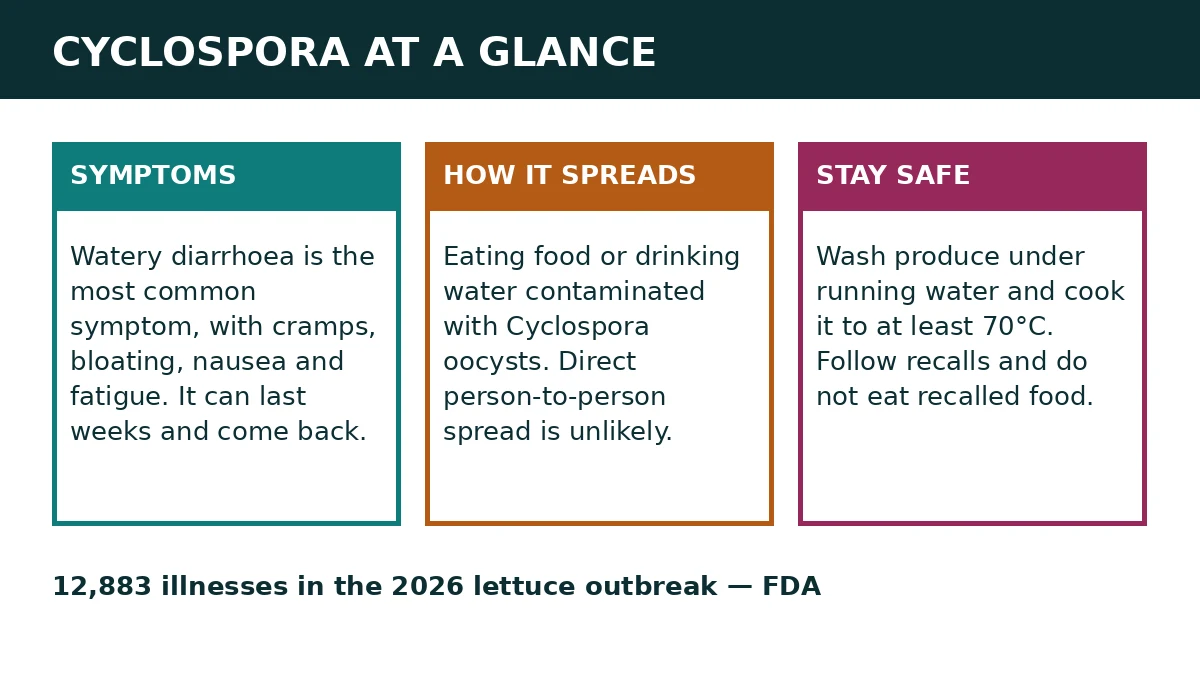
The most common symptom is watery diarrhoea with frequent bowel movements. Other common symptoms include loss of appetite, weight loss, stomach cramps, bloating, increased gas, nausea and fatigue. Some people also get vomiting, body aches, headache or a low-grade fever, and some infected people have no symptoms at all.
Symptoms usually begin about a week after exposure, but the CDC says they can start anywhere from 2 days to 2 weeks or more afterwards. If untreated, the illness may last from a few days to more than a month, and symptoms can seem to go away and then come back. Reported complications have included malabsorption, gallbladder inflammation and reactive arthritis. Children, older people and people with weakened immune systems may have more severe illness.
How does Cyclospora spread?
People become infected by eating food or drinking water contaminated with Cyclospora oocysts, which are shed in the stool of infected people. The oocysts must mature in the environment for at least one to two weeks before they can infect anyone, so direct person-to-person spread is unlikely.
That quirk also makes the parasite hard to control: the CDC notes that Cyclospora is unlikely to be killed by routine chemical disinfection or sanitising methods. In the 2026 investigation, FDA inspectors in Mexico found two environmental samples that tested positive for Cyclospora — one from a wastewater tank at the processing facility and one from a drainage ditch at a lettuce grower — but no lettuce sample tested positive, and the FDA says there is not enough evidence to say conclusively how the contamination happened.
How is it diagnosed and treated?
Diagnosis is made by examining stool samples, but testing for Cyclospora is not routine in most US laboratories, even when stool is tested for parasites — a doctor needs to ask for it specifically, and several samples taken on different days may be needed.
The usual treatment is the antibiotic trimethoprim-sulfamethoxazole, and a doctor decides the course. Most people with healthy immune systems eventually recover without treatment, but they may be ill for a few days to a month or longer. Rest and plenty of fluids matter with diarrhoea, and anyone who becomes dehydrated or very unwell should get medical care.
What is the FDA doing to prevent another outbreak?
On 2 October 2026, the FDA published a 10-point post-outbreak plan to be carried out before the 2027 growing and harvesting season. The measures include expanded testing and genomic surveillance so outbreaks can be traced faster, more laboratory capacity in Mexico, closer work with Mexican food safety authorities, expert panels on worker hygiene and water monitoring, and more checks on importers under the Foreign Supplier Verification Program.
The FDA also says it will publish a full outbreak investigation report and update its Cyclospora Prevention, Response and Research Action Plan with the lessons learned. Taylor Farms has said it will suspend harvesting and processing iceberg lettuce from central Mexico during the Cyclospora season.
How to protect yourself
There is no vaccine for cyclosporiasis, so prevention comes down to food and water hygiene. The CDC advises washing hands and fresh produce thoroughly under running water before eating, cutting or cooking, and cooking produce to at least 70°C (158°F), since washing alone cannot guarantee the parasite is removed. It also helps to stay up to date on food recalls and not to eat recalled food.
When travelling in regions where Cyclospora is common, take extra care with raw produce and drinking water, and follow local food safety advice.
When to see a doctor
See a doctor if you develop watery diarrhoea that lasts more than a few days, keeps coming back, or comes with weight loss, severe stomach pain or signs of dehydration such as very dark urine, dizziness or not passing urine. Tell the doctor if you recently ate recalled lettuce or travelled somewhere Cyclospora is common, and mention that Cyclospora testing needs to be requested specifically. Seek urgent care if you cannot keep fluids down, have blood in your stool, or feel faint.
In an emergency call 911 (US), 999 (UK) or 112 (EU)
Frequently asked questions
What is Cyclospora?
Cyclospora cayetanensis is a microscopic, single-celled parasite that infects the small intestine and causes the gut illness cyclosporiasis. People catch it by eating food or drinking water contaminated with the parasite's oocysts. In the US, outbreaks have most often been linked to fresh produce. It is more common in tropical and subtropical regions, where the parasite is endemic.
What caused the 2026 Cyclospora outbreak?
The outbreak was linked to iceberg lettuce from central Mexico, supplied by Taylor Farms de Mexico. The company recalled the lettuce on 17 July 2026. FDA inspectors found Cyclospora in two environmental samples in Mexico, a wastewater tank and a drainage ditch, but no lettuce sample tested positive, and the FDA says there is not enough evidence to say conclusively how the contamination happened.
What are the symptoms of cyclosporiasis?
The most common symptom is watery diarrhoea with frequent bowel movements. Other symptoms include loss of appetite, weight loss, stomach cramps, bloating, increased gas, nausea and fatigue. Some people also get vomiting, body aches, headache or a low-grade fever, and some have no symptoms at all. Without treatment, illness can last from a few days to more than a month.
How long after eating contaminated food do symptoms start?
Symptoms usually begin about a week after exposure, but the CDC says they can start anywhere from 2 days to 2 weeks or more afterwards. Because the parasite's oocysts need at least one to two weeks in the environment to become infective, direct person-to-person spread is unlikely. If you develop watery diarrhoea after eating recalled lettuce, tell your doctor.
How is cyclosporiasis treated?
Diagnosis is made by examining stool samples, but testing for Cyclospora is not routine in most US laboratories, so a doctor needs to request it specifically. The usual treatment is the antibiotic trimethoprim-sulfamethoxazole, and a doctor decides the course. Most people with healthy immune systems eventually recover without treatment, but rest and plenty of fluids are important.
Is the 2026 Cyclospora outbreak over?
Yes. The CDC declared the outbreak over on 11 September 2026, and the FDA closed its investigation on 2 October 2026. The recalled iceberg lettuce is off the market and its best-by dates have passed. The FDA has since announced a 10-point plan to reduce the risk of future outbreaks, including expanded testing, genomic surveillance and more laboratory capacity in Mexico.
Sources
- CDC: About Cyclosporiasis www.cdc.gov
- CDC: Clinical Overview of Cyclosporiasis www.cdc.gov
- FDA: Investigation of Multistate Outbreak of Cyclospora Illnesses: Iceberg Lettuce (July 2026) www.fda.gov
- FDA: Post-Outbreak Response Activities: Multistate Outbreaks of Cyclospora Illnesses www.fda.gov
- Food Safety News: FDA announces plan to address Cyclospora on fresh produce www.foodsafetynews.com

Try the tool
Not sure if it can wait?
Common causes and warning signs for 16 everyday symptoms.
Open the symptom guide