What Is Tianeptine? The ‘Gas Station Heroin’ Explained
Tianeptine is an unapproved antidepressant sold unlawfully in US gas stations and online. It can act on opioid receptors, cause dependence and overdose, and has been linked to seizures and death.
- Written by
- Health Daily Advice
- Published
- Reading time
- 8 minutes
- Sources
- 6 cited
In this guide
Tianeptine is an antidepressant prescribed in some countries for depression and anxiety, but it is not approved by the US Food and Drug Administration (FDA) for any medical use. In the United States it is sold unlawfully as a supplement in gas stations and convenience stores, where high doses can act on opioid receptors and cause dependence, overdose and death.
If you have bought a product containing tianeptine, do not use it. The FDA warns consumers not to purchase or use any tianeptine product, and to call US Poison Control on 1-800-222-1222 if someone has taken it and feels unwell.
What is tianeptine?
Tianeptine is an atypical tricyclic antidepressant. It is prescribed in some countries in Europe, Asia and Latin America to treat depression and anxiety, where it is sold under brand names such as Stablon and Coaxil. In those countries it is a prescription medicine, dispensed under medical supervision.
In the United States, tianeptine has a very different status. It is not approved by the FDA for any medical use, it is not recognised as safe for use in food, and it does not meet the legal definition of a dietary ingredient. That means any product sold in the US claiming to contain tianeptine as a supplement is being sold unlawfully. The FDA has issued warning letters to companies selling it and import alerts to help detain tianeptine shipments at the border.
Why is tianeptine called “gas station heroin”?
The nickname comes from where the drug is sold and how it behaves. Tianeptine products are widely available over the counter at gas stations, convenience stores, vape shops and online retailers — places where nobody would expect to find a powerful psychoactive drug. At the high doses people take in the US, tianeptine activates the brain’s mu-opioid receptors, the same receptors targeted by opioid drugs. That can produce euphoria, and with repeated use, dependence and withdrawal symptoms that closely resemble opioid withdrawal.
The nickname is a warning, not a joke. The FDA has described the rising number of adverse events involving tianeptine as “a dangerous and growing health trend”, particularly for young people.
Why is tianeptine sold in gas stations and convenience stores?
Tianeptine falls into a regulatory gap. Because it is not scheduled under the federal Controlled Substances Act, it is not illegal to possess in the same way as a controlled drug in most states — although that is changing, as state bans and a 2026 federal proposal show. Sellers exploit the gap by marketing tianeptine as a “research chemical”, a “nootropic” cognitive enhancer, or a dietary supplement, and by making unproven claims that it can improve brain function or treat anxiety, depression, pain and opioid use disorder.
Because these products are not regulated as medicines, there is no guarantee about what is actually inside the bottle. The FDA has warned that some tianeptine products contain other harmful ingredients not listed on the label. In New Jersey in early 2024, a cluster of severe illnesses linked to Neptune’s Fix was found to involve products containing synthetic cannabinoids as well as tianeptine.
How does tianeptine affect the brain?
At the doses used in countries where it is prescribed, tianeptine works mainly as an antidepressant. But case reports in the medical literature describe people in the US taking far larger amounts — between 1.3 and 250 times the daily amount typically recommended in countries where the drug is approved, according to the FDA. At those levels, its action on mu-opioid receptors dominates, producing opioid-like effects.
That opioid-receptor activity is what makes tianeptine dangerous. It explains why people can develop tolerance, need ever larger amounts to get the same effect, and experience withdrawal when they stop. A 2025 case report in the medical literature described a 22-year-old man who developed severe tianeptine use disorder, with cycles of intoxication and withdrawal that worsened his depression and suicidal thoughts.
Tianeptine may also not show up on routine drug-screening panels, which can delay diagnosis and treatment when someone arrives at hospital with symptoms.
What are the risks of tianeptine?
The FDA and the CDC have linked tianeptine to a wide range of serious harms, including:
- Agitation, confusion and drowsiness
- Rapid heartbeat and high blood pressure
- Nausea and vomiting
- Seizures and loss of consciousness
- Slowed or stopped breathing
- Coma and death
Risks are higher when tianeptine is combined with alcohol or with other medicines, especially certain antidepressants known as monoamine oxidase inhibitors (MAOIs). The FDA has also warned that there is a risk of suicidal thoughts or behaviour in children, adolescents and young adults aged 25 and under.
Can tianeptine cause dependence and withdrawal?
Yes. Medical journals, poison centre calls and reports to the FDA all suggest tianeptine has potential for abuse, and people with a history of opioid use disorder may be at particular risk. Some people find it difficult to stop using tianeptine and experience withdrawal symptoms. According to the CDC, the clinical effects of tianeptine abuse and withdrawal can mimic opioid toxicity and withdrawal.
If you or someone you know is struggling to stop using tianeptine, talk to a doctor or pharmacist. In the US, help for substance use disorders is available through findtreatment.gov or by calling 1-800-662-HELP (4357).
How common are tianeptine poisonings?
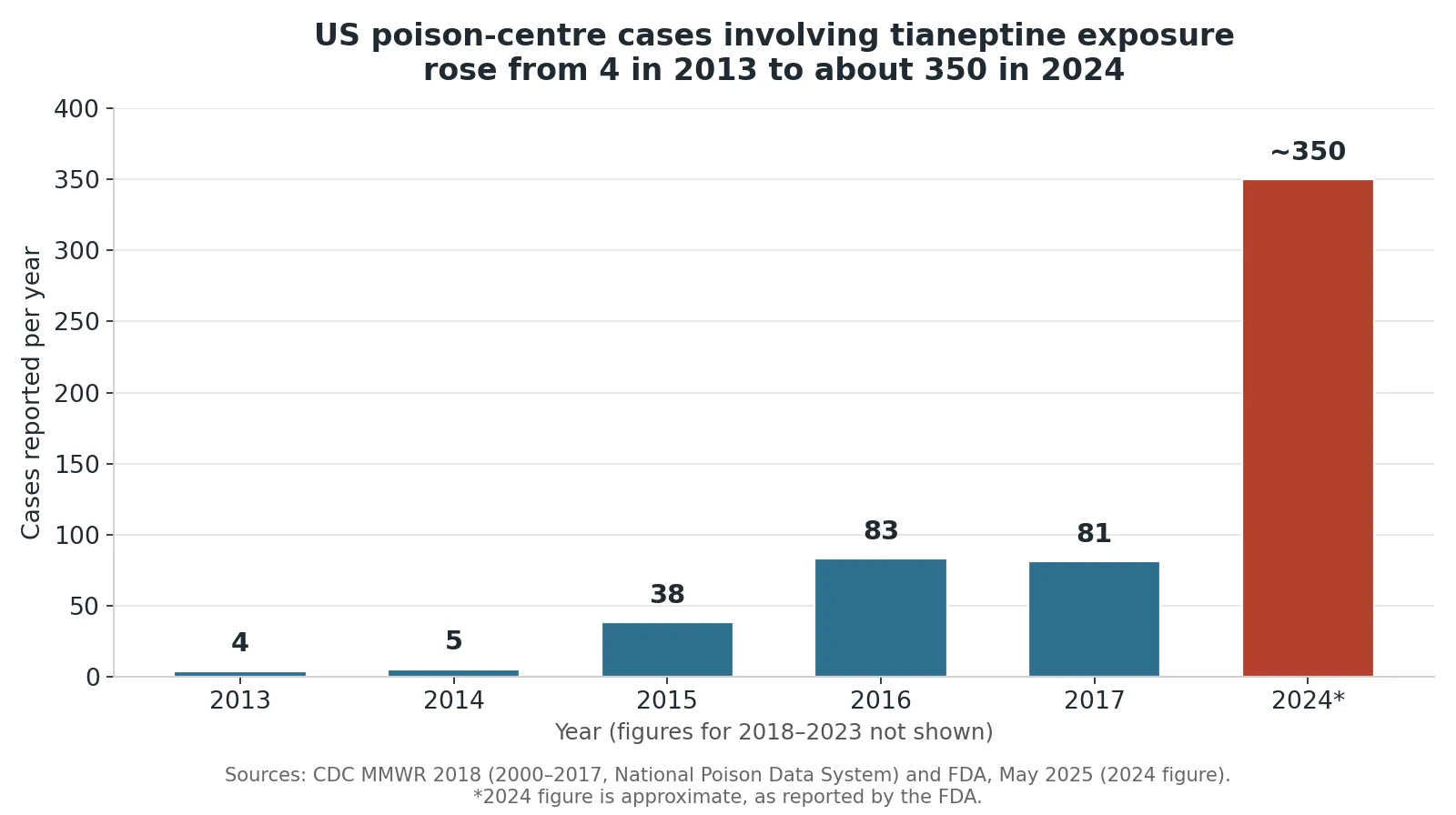
Poison centre cases involving tianeptine have risen sharply. The CDC analysed calls to US poison control centres reported to the National Poison Data System between 2000 and 2017. There were only 11 tianeptine exposure calls in the first 14 years of that period, but calls rose from 5 in 2014 to 38 in 2015, 83 in 2016 and 81 in 2017. Most exposures occurred in people aged 21 to 40.
The trend has continued. The FDA reports that annual poison control centre cases involving tianeptine exposure rose from 4 cases in 2013 to about 350 cases in 2024.
What has the FDA said and done about tianeptine?
The FDA has warned consumers about tianeptine repeatedly. Key actions include:
| Date | Action |
|---|---|
| 21 November 2023 | FDA warns consumers not to purchase or use Neptune’s Fix or any tianeptine product, after reports of seizures and loss of consciousness leading to hospitalisation. |
| 11 January 2024 | FDA sends a letter to gas station, convenience store and other retail organisations urging them to stop selling Neptune’s Fix and other tianeptine products. |
| 23 January 2024 | FDA updates its warning after continuing to receive severe adverse event reports, including seizures, loss of consciousness and death. |
| 28 January 2024 | Neptune Resources, LLC voluntarily recalls all lots of Neptune’s Fix Elixir, Extra Strength Elixir and Tablets nationwide. |
| 15 February 2024 | Super Chill Products, another distributor of Neptune’s Fix, also recalls its products. |
| 8–9 May 2025 | FDA updates its consumer warning and publishes a consumer update on tianeptine’s serious harms, overdoses and deaths. |
The FDA has also issued warning letters to companies selling unlawful tianeptine products and import alerts to help detain shipments. Consumers can report adverse events to the FDA’s MedWatch programme.
Which US states have banned tianeptine?
At least 15 US states had banned or restricted tianeptine by March 2026. Michigan was the first, classifying tianeptine as a Schedule II controlled substance in 2018. Other states that have acted include Alabama, Florida, Georgia, Indiana, Kentucky, Michigan, Mississippi, Ohio, Oklahoma and Tennessee, with several more considering legislation.
The picture is now changing at the federal level. On 8 July 2026, the US Drug Enforcement Administration (DEA) proposed placing tianeptine in Schedule I of the Controlled Substances Act — the category reserved for substances with a high potential for abuse and no accepted medical use in the United States. The public comment period closed on 7 August 2026. If the rule is finalised, tianeptine would be controlled nationwide, not just in the states that have acted on their own.
In the UK and the EU, tianeptine is not licensed as a medicine and is not sold legally as a supplement either. Anyone who sees it for sale should treat it as an unregulated, unapproved drug.
How can you spot a tianeptine product?
Tianeptine is sold under many brand names. The FDA lists examples including Tianaa, Zaza, Neptune’s Fix, Pegasus and TD Red. Products may be sold as tablets, capsules, powders or liquids (elixirs), often in small bottles or blister packs, and marketed as mood boosters, focus enhancers or “nootropics”.
Warning signs to look out for:
- The label lists tianeptine, tianeptine sodium or tianeptine sulfate as an ingredient
- Claims to treat anxiety, depression, pain or opioid withdrawal
- Sold as a “research chemical” or “nootropic” rather than a licensed medicine
- Bought from a gas station, convenience store, vape shop or an unfamiliar online seller
- No licensed manufacturer, no proper patient information leaflet, or a label that looks unprofessional
If you are unsure whether a product contains tianeptine, ask a doctor or pharmacist before using it — and do not use it in the meantime.
What should you do if someone has taken tianeptine?
Do not wait for symptoms to get worse. If someone has taken a tianeptine product and feels unwell, call US Poison Control on 1-800-222-1222 straight away for expert advice. Poison Control is free, confidential and available 24 hours a day, and can connect you with your local poison centre.
Call emergency services immediately if the person is unconscious, has trouble breathing, has a seizure, or shows signs of overdose such as very slow breathing, blue lips or extreme drowsiness. In an emergency call 911 (US), 999 (UK) or 112 (EU).
Try to keep the product packaging, if it is safe to do so, and tell the medical team exactly what was taken and when. Do not try to treat the person yourself, and do not give them other medicines or alcohol.
When to see a doctor
See a doctor promptly if you have used a tianeptine product and have any symptoms at all — including agitation, confusion, drowsiness, nausea, vomiting, a fast heartbeat or breathing problems — or if you are finding it hard to stop using it. Tell the doctor honestly what you took, even if it feels embarrassing: it helps them give you the right care, and tianeptine may not appear on routine drug tests.
Seek urgent help for severe symptoms such as seizures, loss of consciousness, slowed or stopped breathing, or thoughts of harming yourself. In an emergency call 911 (US), 999 (UK) or 112 (EU). In the US, you can also call Poison Control on 1-800-222-1222 at any time.
If you need help with anxiety, depression, pain or opioid dependence, talk to a doctor or pharmacist. There are approved, regulated treatments for all of these conditions, and a clinician can help you find one that is safe and right for you.
The FDA’s advice is clear: consumers should avoid all products containing tianeptine. If you have a tianeptine product at home, stop using it and dispose of it safely or return it to the place of purchase.
Frequently asked questions
Is tianeptine legal in the United States?
Tianeptine is not approved by the FDA for any medical use, and it is not a legal dietary ingredient, so selling it as a supplement is unlawful. It is not scheduled under the federal Controlled Substances Act, but at least 15 states had banned or restricted it by March 2026, and the DEA proposed placing it in Schedule I in July 2026.
Is tianeptine an opioid?
Tianeptine is an antidepressant, not a classical opioid, but at high doses it activates the brain's mu-opioid receptors. That is why it can cause euphoria, dependence and withdrawal that resemble opioid effects, and why the FDA and CDC warn that its abuse and withdrawal can mimic opioid toxicity and withdrawal.
Can tianeptine cause withdrawal?
Yes. People who use tianeptine regularly can develop dependence and find it difficult to stop. Withdrawal symptoms can resemble opioid withdrawal, according to the CDC. Anyone struggling to stop should talk to a doctor or pharmacist, and in the US can find licensed treatment providers through findtreatment.gov or by calling 1-800-662-HELP.
What should I do if someone has taken tianeptine?
Call US Poison Control on 1-800-222-1222 straight away for expert advice, even if the person feels well. Call emergency services immediately if they are unconscious, have trouble breathing, have a seizure or show signs of overdose. Keep the product packaging if safe to do so, and tell the medical team exactly what was taken.
Is tianeptine approved anywhere in the world?
Yes. Tianeptine is prescribed as an antidepressant in some countries in Europe, Asia and Latin America, where it is sold under names such as Stablon and Coaxil. Even there, some countries have restricted how it is prescribed or warned about addiction. It is not approved for any medical use in the United States.
Sources
- US Food and Drug Administration — Tianeptine Products Linked to Serious Harm, Overdoses, Death www.fda.gov
- US Food and Drug Administration — FDA Warns Consumers Not to Purchase or Use Any Tianeptine Product Due to Serious Risks www.fda.gov
- Centers for Disease Control and Prevention — Characteristics of Tianeptine Exposures Reported to the National Poison Data System, United States, 2000–2017 (MMWR) www.cdc.gov
- US Food and Drug Administration — Neptune Resources, LLC Issues Voluntary Nationwide Recall of Neptune's Fix www.fda.gov
- Federal Register — Schedules of Controlled Substances: Placement of Tianeptine in Schedule I (DEA proposed rule, 8 July 2026) www.govinfo.gov
- PubMed / Cureus — Gas Station Heroin: A Case Report of Tianeptine Use Disorder and a Literature Review (2025) pubmed.ncbi.nlm.nih.gov

Try the tool
Not sure if it can wait?
Common causes and warning signs for 16 everyday symptoms.
Open the symptom guide