E. coli Outbreak 2026: Ground Beef, Symptoms and What to Do
US food safety officials have opened a new E. coli O157:H7 investigation linked to ground beef — the first since 2024. No brand or case count has been named yet, so here is what is known, the symptoms to watch for and how to cook beef safely.
- Written by
- Health Daily Advice
- Published
- Reading time
- 5 minutes
- Sources
- 9 cited
In this guide
A new investigation into an E. coli O157:H7 outbreak linked to ground beef has opened, the first of its kind since 2024. No brand, shop or case count has been named yet, so there is nothing to check in your fridge — but the symptoms to watch for, and the cooking steps that kill the bacteria, are well established.
What has happened with the E. coli outbreak in 2026?
The US Department of Agriculture’s Food Safety and Inspection Service (FSIS) has added a new entry to its outbreak investigations table: investigation 2027-01, dated October 2026, for E. coli O157:H7 in “Ground Beef (suspect)”, marked as active. Food Safety News reported that the entry carries no case count, no list of affected states, no hospitalisation or HUS figures, and no recall or public health alert. The same morning, the CDC’s current outbreaks dashboard moved from 26 to 27 active multistate investigations, with the E. coli line going from three to six — and no notice accompanied any of them.
That silence is the striking part. The FSIS says it only posts an investigation when there is compelling epidemiologic, sampling or traceback evidence that a meat, poultry or egg product is a confirmed or suspected source. By the agency’s own rule, that evidence exists for this outbreak — yet the public has been told almost nothing about it.
What do we know so far — and what is still unknown?
Here is everything that has been published about the new outbreak to date:
| Detail | What has been published |
|---|---|
| Investigation number | 2027-01 |
| Outbreak month | October 2026 |
| Pathogen | E. coli O157:H7 |
| Product | Ground beef (suspect) |
| Status | Active |
| Case count | Not published |
| States affected | Not published |
| Hospitalisations and HUS | Not published |
| Recall or public health alert | None |
| Brand, retailer or establishment | Not published |
The outbreak is the first of the USDA’s fiscal year 2027, which began on 1 October 2026, and the first ground-beef E. coli O157 outbreak on the table since 2024. For comparison, the last entry — 2025-03, the November 2024 outbreak — ended with Wolverine Packing Co. recalling 167,277 pounds of ground beef after Minnesota tied 15 illnesses to the product. In that case, the public knew the brand, the states and the numbers. This time, none of that has been released.
Food safety attorney Bill Marler told Food Safety News that the entry on the table already tells industry and the trade press that the FSIS has a ground-beef O157 file open, and it should tell the public the same things it told the public in May: how many people are sick, in which states, how many are hospitalised, how many children have HUS, when the illnesses began, and whether a product sample has matched a patient by whole genome sequencing.
Is there a separate E. coli outbreak at Ohio University?
Yes — and it is a different outbreak. At Ohio University, the Athens City-County Health Department has confirmed 17 laboratory-confirmed E. coli patients, all of them students, plus four suspected cases still under investigation. Symptom onset for the confirmed patients ran from 5 to 10 November 2026. One patient was hospitalised and has since been released, and no cases of HUS have been reported in this outbreak. Health officials have not said whether the students ate at a shared cafeteria or event, so no food source has been named there either.
What are the symptoms of E. coli infection?
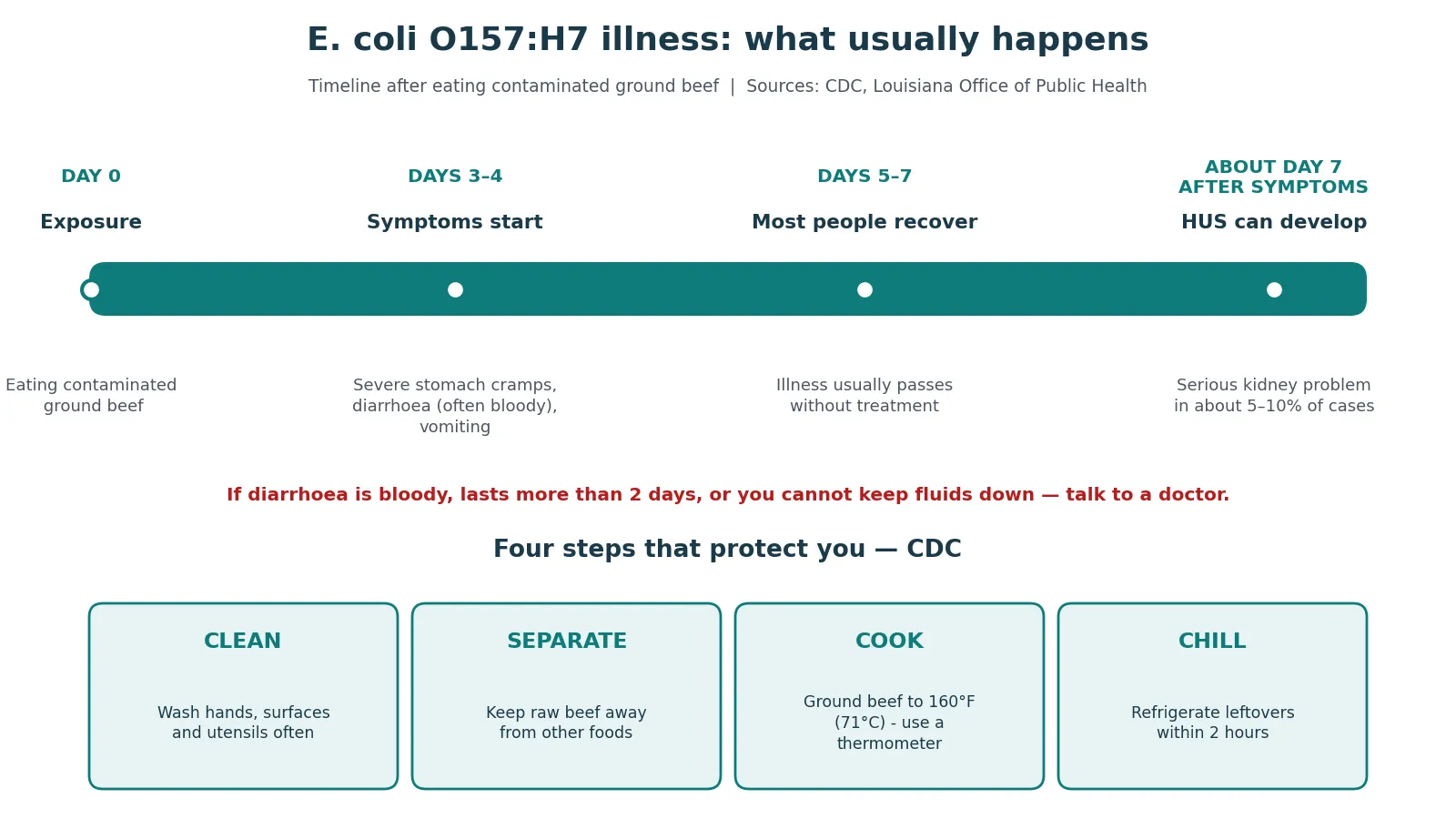
Most people with E. coli infection develop diarrhoea that can be bloody or watery, and stomach cramps that can be severe, according to the CDC. Some people also have vomiting or a low fever. Symptoms usually start 3 to 4 days after swallowing the bacteria, though they can appear as early as 1 day or as late as 10 days afterwards, and most people get better within 5 to 7 days without specific treatment.
A small share of people develop a far more serious complication. About 5% to 10% of people diagnosed with Shiga toxin-producing E. coli develop haemolytic uraemic syndrome (HUS), a life-threatening kidney problem. HUS, when it happens, develops on average 7 days after the first symptoms, often just as the diarrhoea seems to be improving. Its warning signs include peeing less often, feeling very tired, losing the pink colour in the cheeks and inside the lower eyelids, and unexplained bruising or tiny red spots on the skin.
How can I cook ground beef safely?
Ground beef needs more care than a steak, because grinding spreads any bacteria through the meat. The CDC’s four food safety steps — clean, separate, cook and chill — cover the basics:
- Clean: wash your hands, surfaces and utensils often, especially after touching raw meat.
- Separate: keep raw beef away from other foods, and never put cooked food back on a plate that held raw meat.
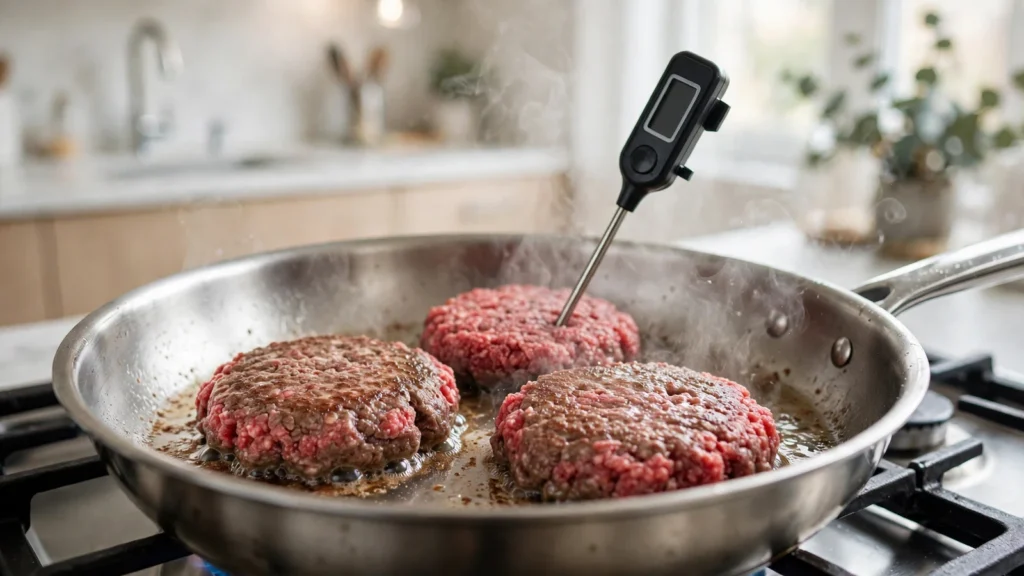
- Cook: cook ground beef to an internal temperature of 160°F (71°C). Colour alone does not show it is safe — use a food thermometer, and send a burger back in a restaurant if it arrives undercooked.
- Chill: refrigerate perishable food within 2 hours of cooking or buying it.
It also helps to drink only pasteurised milk and juices, and to wash your hands often — including after using the toilet, changing nappies and handling animals.
What should I avoid if I think I have E. coli?
Do not reach for antibiotics on your own. The CDC says antibiotics are not recommended for suspected E. coli infection until diagnostic testing is done and E. coli has been ruled out — with Shiga toxin-producing E. coli, antibiotics can increase the chance of HUS. Anti-diarrhoeal medicines such as loperamide should also be avoided for the same reason. Most people recover without antibiotics, and the main treatment is drinking plenty of fluids to prevent dehydration. If you are unsure what to take, talk to a doctor or pharmacist first.
When to see a doctor
Contact a doctor if you have diarrhoea or vomiting lasting more than 2 days, bloody diarrhoea, a fever higher than 102°F, or signs of dehydration such as peeing very little, very dark urine, extreme thirst or dizziness. Get help straight away if you notice signs of HUS — little or no peeing, loss of pink colour in the cheeks, unexplained bruising or a rash of tiny red spots, blood in the urine, or feeling very tired and less alert.
The NHS advises that diarrhoea usually stops within 5 to 7 days, and that you should stay off school or work until you have not been sick or had diarrhoea for at least 2 days. Call NHS 111 if you have bloody diarrhoea, signs of dehydration, diarrhoea for more than 7 days or vomiting for more than 2 days. Call 999 or go to A&E if you vomit blood, have a sudden severe tummy ache, are confused, or have severe difficulty breathing.
In an emergency call 911 (US), 999 (UK) or 112 (EU).
What happens next?
The FSIS says it updates its outbreak investigations table at least weekly, so the next update may finally attach numbers, states or a named product to investigation 2027-01 — or a recall or public health alert, if the traceback reaches a specific lot. Until then, the honest position is that nobody outside the investigation knows which beef, if any, is involved. What is certain is the part you can control: cook ground beef to 160°F (71°C), keep raw meat away from everything else, and take bloody diarrhoea or dehydration seriously.
Frequently asked questions
Is there an E. coli outbreak linked to ground beef in 2026?
Yes. The USDA's Food Safety and Inspection Service has opened investigation 2027-01, dated October 2026, for E. coli O157:H7 in ground beef, and it is listed as active. It is the first ground-beef E. coli O157 outbreak since 2024. No case count, affected states, brand or retailer have been named yet, and there is no recall or public health alert.
What are the symptoms of E. coli from ground beef?
The CDC lists diarrhoea that can be bloody or watery and stomach cramps that can be severe, with some people also having vomiting or a low fever. Symptoms usually start 3 to 4 days after swallowing the bacteria, though they can appear as early as 1 day or as late as 10 days afterwards. Most people get better within 5 to 7 days without specific treatment.
How long does E. coli illness last?
Most people recover within 5 to 7 days. The NHS says diarrhoea usually stops within 5 to 7 days and vomiting within 1 or 2 days. A small share of people develop haemolytic uraemic syndrome (HUS), a serious kidney problem, which usually appears about 7 days after symptoms first begin, often just as the diarrhoea seems to be improving.
What temperature should ground beef be cooked to?
Ground beef should reach an internal temperature of 160°F (71°C), and a food thermometer is the only reliable way to check, because colour alone does not show it is safe. Send a burger back in a restaurant if it arrives undercooked. Keep raw beef away from other foods, wash your hands and surfaces often, and refrigerate leftovers within 2 hours.
Should I take antibiotics for E. coli?
No, not on your own. The CDC says antibiotics are not recommended for suspected E. coli infection until diagnostic testing is done and E. coli has been ruled out, because with Shiga toxin-producing E. coli they can increase the chance of HUS. Anti-diarrhoeal medicines such as loperamide should also be avoided. Drink plenty of fluids and talk to a doctor or pharmacist first.
Sources
- Food Safety News: FSIS announces outbreak with ground beef as suspected source www.foodsafetynews.com
- Food Safety News: E. coli outbreak at Ohio University continues to grow www.foodsafetynews.com
- CDC: Symptoms of E. coli Infection www.cdc.gov
- CDC: Treatment of E. coli Infection www.cdc.gov
- CDC: How to Prevent E. coli Infection www.cdc.gov
- NHS: Diarrhoea and vomiting www.nhs.uk
- Louisiana Office of Public Health: Shiga toxin-producing E. coli fact sheet ldh.la.gov

Try the tool
Not sure if it can wait?
Common causes and warning signs for 16 everyday symptoms.
Open the symptom guide