Kirkland Cold and Flu Recall: The Phenylephrine Story Explained
The Kirkland cold and flu recall is all over the news again — but the recall itself is from November 2024. Here are the lots, the dates, and the phenylephrine story behind it.
- Written by
- Health Daily Advice
- Published
- Reading time
- 6 minutes
- Sources
- 6 cited
In this guide
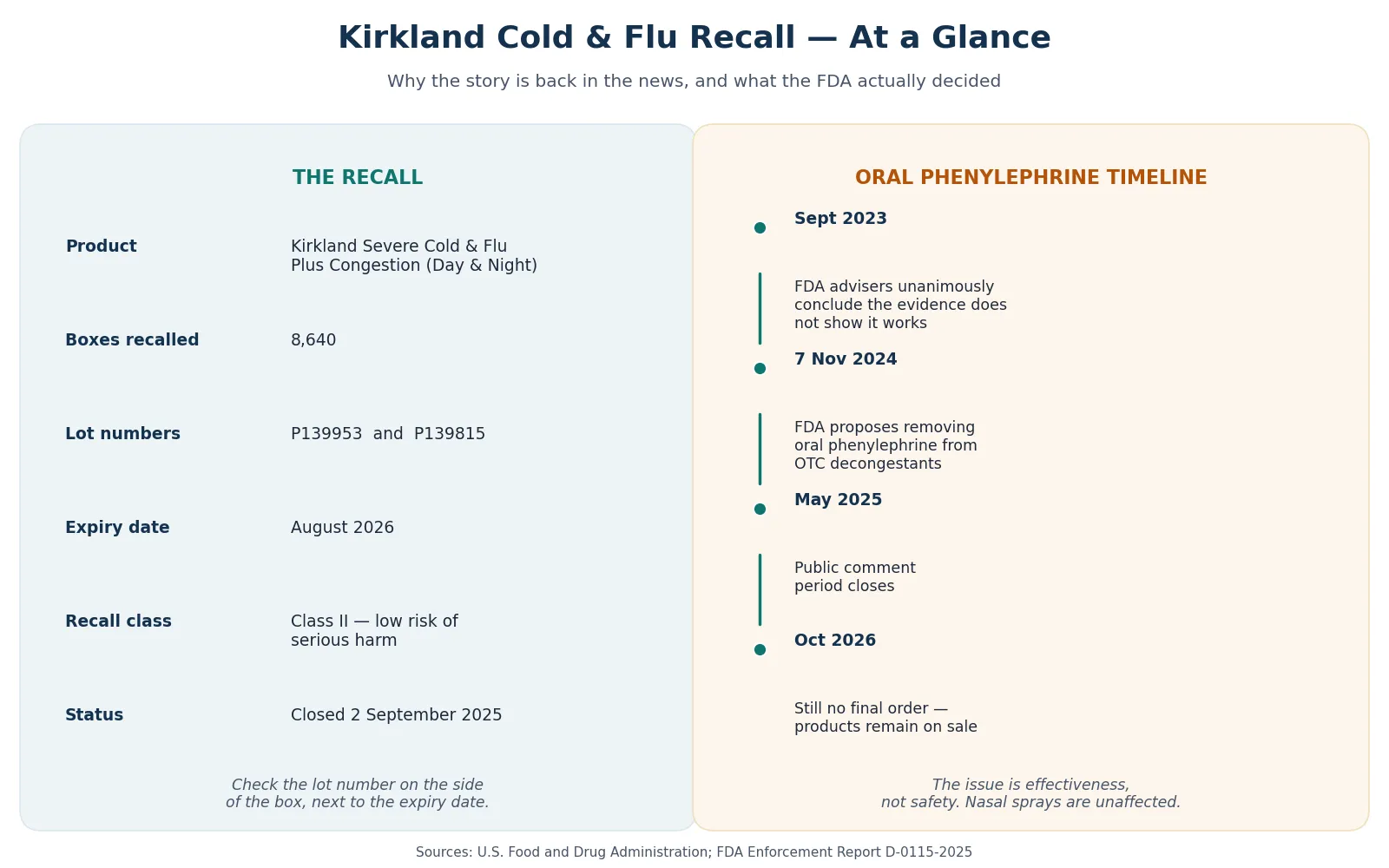
The Kirkland cold and flu recall story circulating today is not a new recall. In November 2024, the FDA recalled 8,640 boxes of Kirkland Severe Cold & Flu Plus Congestion from Costco over manufacturing quality-control failures. The boxes, lots P139953 and P139815, were later closed out — but the phenylephrine debate behind them is still live.
Why is this Kirkland cold and flu recall back in the news today?
Because the story has been republished. Fox News Digital put its December 2024 report on the recall back in front of readers on 20 November 2026, and syndicated copies have been circulating since, which makes a two-year-old recall look like breaking news. The underlying facts have not changed since 2024 — and that is exactly what makes the story worth a second look as cold and flu season gets going.
The recall itself began on 14 November 2024, when manufacturer LNK International pulled the product, and the FDA classified it as a Class II recall on 9 December 2024. The FDA closed the recall on 2 September 2025, after deciding that all reasonable efforts to remove the product had been made. There is one more reason to check your medicine cabinet now: the recalled boxes carried an expiry date of August 2026, so any box still sitting at home is past its date as well as recalled.
Which Kirkland cold and flu boxes were recalled?
The recall covered the 168-count twin pack of Kirkland Severe Cold & Flu Plus Congestion, sold nationwide at Costco near the pharmacy section. Each pack held 112 coated caplets for daytime use and 56 for nighttime use.
| Detail | What to check |
|---|---|
| Product | Kirkland Severe Cold & Flu Plus Congestion, Day and Night packs |
| Manufacturer | LNK International, Inc. |
| Boxes recalled | 8,640 |
| Lot numbers | P139953 or P139815 |
| Expiry date | August 2026 |
| National Drug Code | 63981-795-81 |
| Recall number | D-0115-2025 |
The lot number is printed on the side of the box, next to the expiry date. The daytime caplets contained acetaminophen 325 mg, dextromethorphan HBr 10 mg, guaifenesin 200 mg and phenylephrine HCl 5 mg. Acetaminophen is the same painkiller sold as paracetamol in the UK.
Why were the boxes recalled?
The problem was in the factory, not in the formula. The FDA’s enforcement record gives the reason as “CGMP deviations: released product should have been rejected” — in plain terms, the product failed the Current Good Manufacturing Practice quality-control checks that every drug maker must meet, and it should never have left the factory. The FDA notice does not say which specific quality check failed.
That is why the FDA made it a Class II recall, which it describes as “a situation in which use of, or exposure to, a violative product may cause temporary or medically reversible adverse health consequences or where the probability of serious adverse health consequences is remote.” A New York pharmacist, Katy Dubinsky, told Fox News Digital that the product “failed to meet required quality control standards and should have been rejected before release,” and that a Class II recall “suggests low consumer risk and typically addresses issues unlikely to cause serious harm.”
It is easy to mix this recall up with the phenylephrine story, because the two landed within days of each other. On 7 November 2024, the FDA proposed removing oral phenylephrine from over-the-counter decongestants after finding it ineffective. The Kirkland recall followed a week later, on 14 November. But the recall was about manufacturing quality control, not about the ingredient — a distinction worth keeping straight, since the recalled boxes also contained three other widely used active ingredients.
What should you do if you have one of these boxes?
Do not use it. Return it to Costco for a full refund, or throw it away. That was the advice when the recall was announced, and it still applies — doubly so now that the August 2026 expiry date has passed. Check the lot number on the side of the box first, because only lots P139953 and P139815 were affected; other Kirkland cold and flu products were not part of this recall.
If you already took the medicine and you are worried, or you develop symptoms that concern you, talk to a doctor or pharmacist. There is no need to panic: the recall was a low-risk, quality-control action, and the pharmacist who spoke to Fox News Digital stressed that recalls like this exist to keep over-the-counter medicines trustworthy.
Why is oral phenylephrine being phased out?
Phenylephrine is the decongestant in hundreds of cold, cough and allergy remedies, and for decades it was assumed to work when swallowed. That assumption fell apart in stages. In September 2023, the FDA’s Nonprescription Drug Advisory Committee met to review the evidence and unanimously concluded that the current scientific data do not support the recommended dose of oral phenylephrine as a nasal decongestant.
On 7 November 2024, the FDA proposed removing oral phenylephrine as an active ingredient in over-the-counter monograph products for the temporary relief of nasal congestion, after a review of the available data determined it was not effective for this use. The agency stressed that the proposed order was about effectiveness, not safety, and that it covered only the oral form — phenylephrine nasal sprays, which act directly on the lining of the nose, were not part of the proposal.
Two years on, the ingredient has not actually been banned. The public comment period closed in May 2025, and as of October 2026 the FDA had still not issued a final order, so manufacturers remain free to sell products containing oral phenylephrine while the process drags on. Only a final order would change what can be marketed, and the FDA has said it would give manufacturers time to reformulate or withdraw products if one is issued.
The FDA’s own advice in the meantime is practical: “Consumers should know that a range of safe and effective drugs and other treatments is available to temporarily relieve congestion symptoms due to allergies or a common cold,” said Theresa Michele, director of the FDA’s Office of Nonprescription Drug Products, adding that people can talk to their doctor or pharmacist about ways to treat these symptoms. The other ingredients in combination cold remedies — the painkiller, the cough suppressant and the expectorant — are unaffected by the phenylephrine question, so the rest of the medicine still does what it is meant to do.
What actually helps a cold instead?
No medicine cures a cold, and the most useful steps are unglamorous ones. The NHS advises resting, drinking plenty of fluids, eating healthily, gargling with salt water to soothe a sore throat, drinking a hot lemon and honey drink, and breathing in steam — for example, by sitting in a bathroom with a hot shower running. Colds are caused by viruses, usually last 1 to 2 weeks, and antibiotics will not relieve the symptoms or speed up recovery.
A pharmacist can advise on the best medicine for your symptoms. The NHS points to paracetamol or ibuprofen to ease aches or bring down a temperature, and decongestant nasal sprays, drops or tablets to unblock the nose — nasal sprays should not be used for more than a week, as this can make symptoms worse, and decongestants should not be used by children under 6. There is little evidence that supplements such as vitamin C, echinacea or garlic prevent colds or help you get better more quickly, so they are not a substitute for rest and fluids.
If you are choosing a cold remedy off the shelf, read the Drug Facts label before you buy. Products sold under the same brand name can contain different ingredients, and checking the label is the only way to know whether the one in your hand contains oral phenylephrine — or anything else you were not expecting. When in doubt, ask the pharmacist: that is what they are there for.
When to see a doctor
Most colds clear up on their own, but the NHS advises seeing a GP if you have a high temperature for more than 3 days, your symptoms get worse, your temperature is very high or you feel hot, cold or shivery, you feel short of breath or have chest pain, your cold does not get better after 10 days, you have a cough for more than 3 weeks, or you have a long-term medical condition or a weakened immune system. GPs do not recommend antibiotics for colds, because colds are caused by viruses.
In an emergency call 911 (US), 999 (UK) or 112 (EU)
Frequently asked questions
Is the Kirkland cold and flu recall new?
No. The recall began on 14 November 2024, when LNK International pulled 8,640 boxes of Kirkland Severe Cold & Flu Plus Congestion, and the FDA classified it as Class II on 9 December 2024. It looks new because Fox News Digital republished its December 2024 report on 20 November 2026. The FDA closed the recall on 2 September 2025.
Which Kirkland cold and flu lot numbers were recalled?
Lots P139953 and P139815, with an expiry date of August 2026. The recall covered the 168-count Day and Night twin pack, national drug code 63981-795-81, sold nationwide at Costco. Check the lot number on the side of the box, next to the expiry date. Only those two lots were affected.
Is oral phenylephrine banned in the US now?
No. In November 2024 the FDA proposed removing oral phenylephrine from over-the-counter decongestants after finding it ineffective, but a final order is still needed before anything changes. The comment period closed in May 2025, and as of October 2026 no final order had been issued, so products containing it remain legally on sale.
Does the phenylephrine proposal affect nasal sprays?
No. The FDA's proposal covers only phenylephrine taken by mouth — tablets, capsules and liquids. Phenylephrine nasal sprays act directly on the lining of the nose and were not part of the review. The proposal is also about effectiveness, not safety, so there is no safety warning attached to the ingredient.
What should I do if I have a recalled box?
Do not use it. Return it to Costco for a full refund or throw it away. The affected boxes expired in August 2026, so any box still at home is past its date as well as recalled. If you already took the medicine and you are worried, or you develop symptoms that concern you, talk to a doctor or pharmacist.
What works for a stuffy nose instead of oral phenylephrine?
The NHS advises rest, plenty of fluids, steam inhalation and a hot lemon and honey drink, and a pharmacist can advise on decongestant nasal sprays, which should not be used for more than a week. Paracetamol or ibuprofen can ease aches and fever. Always read the Drug Facts label so you know what is in the product you buy.
Sources
- FDA: FDA Proposes Ending Use of Oral Phenylephrine as OTC Monograph Nasal Decongestant Active Ingredient After Extensive Review www.fda.gov
- FDA Enforcement Report D-0115-2025 (via Recall Record): LNK International recalls recallrecord.org
- Fox News Digital: Costco-brand cold and flu medication recalled by FDA: 'Not effective' (syndicated copy, republished 20 Nov 2026) www.goldcoastaccountants.com
- The Healthy: Nearly 9,000 Boxes of Cold and Flu Medicine Were Just Recalled by a Major Retailer www.thehealthy.com
- NHS: Common cold www.nhs.uk
- The Leverage Wire: FDA Delays Final Ban on Oral Phenylephrine in OTC Cold Remedies www.theleveragewire.com

Try the tool
Not sure if it can wait?
Common causes and warning signs for 16 everyday symptoms.
Open the symptom guide