New Malaria Vaccine Shows 87% Protection in Early Trial
An experimental malaria vaccine protected 13 of 15 volunteers in a small early trial. Here is how PfSPZ-LARC2 works, what the 87% figure really means, and what has to happen before it can reach the people who need it most.
- Written by
- Health Daily Advice
- Published
- Reading time
- 5 minutes
- Sources
- 6 cited

In this guide
A new experimental malaria vaccine has protected 13 of 15 healthy volunteers from infection in a small early trial, an efficacy of 87%. The vaccine, called PfSPZ-LARC2, uses a live malaria parasite weakened so it stalls in the liver and cannot cause disease. All seven volunteers who received a dummy injection became infected.
What PfSPZ-LARC2 is and how it works
PfSPZ-LARC2 is a whole-parasite vaccine made from Plasmodium falciparum, the parasite behind the deadliest form of malaria. Scientists removed two of its genes, PfMei2 and PfLINUP, so the parasite can enter the liver and grow there, but cannot go on to invade red blood cells — the stage that causes illness. The weakened parasite dies in the liver, so it cannot cause malaria and cannot be passed on by mosquitoes.
The idea behind it is straightforward: a whole parasite shows the immune system thousands of proteins, far more than the one or two proteins targeted by existing malaria vaccines. The team behind it, at Seattle Children’s and the company Sanaria, spent more than a decade developing the approach in the hope that this broader exposure would produce stronger protection that blocks infection outright rather than only softening the illness.
How the trial was run
The study was a randomised, double-blind, placebo-controlled Phase 1 trial at the University of Washington in Seattle. Twenty-two healthy adults aged 18 to 45 who had never had malaria took part. Fifteen received the vaccine and seven received a saltwater placebo, and neither the volunteers nor the study team knew who had received which. Each person had three injections, 28 days apart.
Three to four months after the final dose, every volunteer was deliberately exposed to live malaria parasites under close medical supervision — a method known as controlled human malaria infection. Infections were picked up early with a highly sensitive blood test, and everyone who became infected was treated promptly.
The test was deliberately demanding in two ways. First, the gap of 12 to 16 weeks between the last dose and the challenge is longer than in many early vaccine trials. Second, the challenge used a parasite strain from Brazil that is genetically distant from the West African strain used to make the vaccine — a tougher test, because the parasite varies a great deal from place to place.
What the results showed
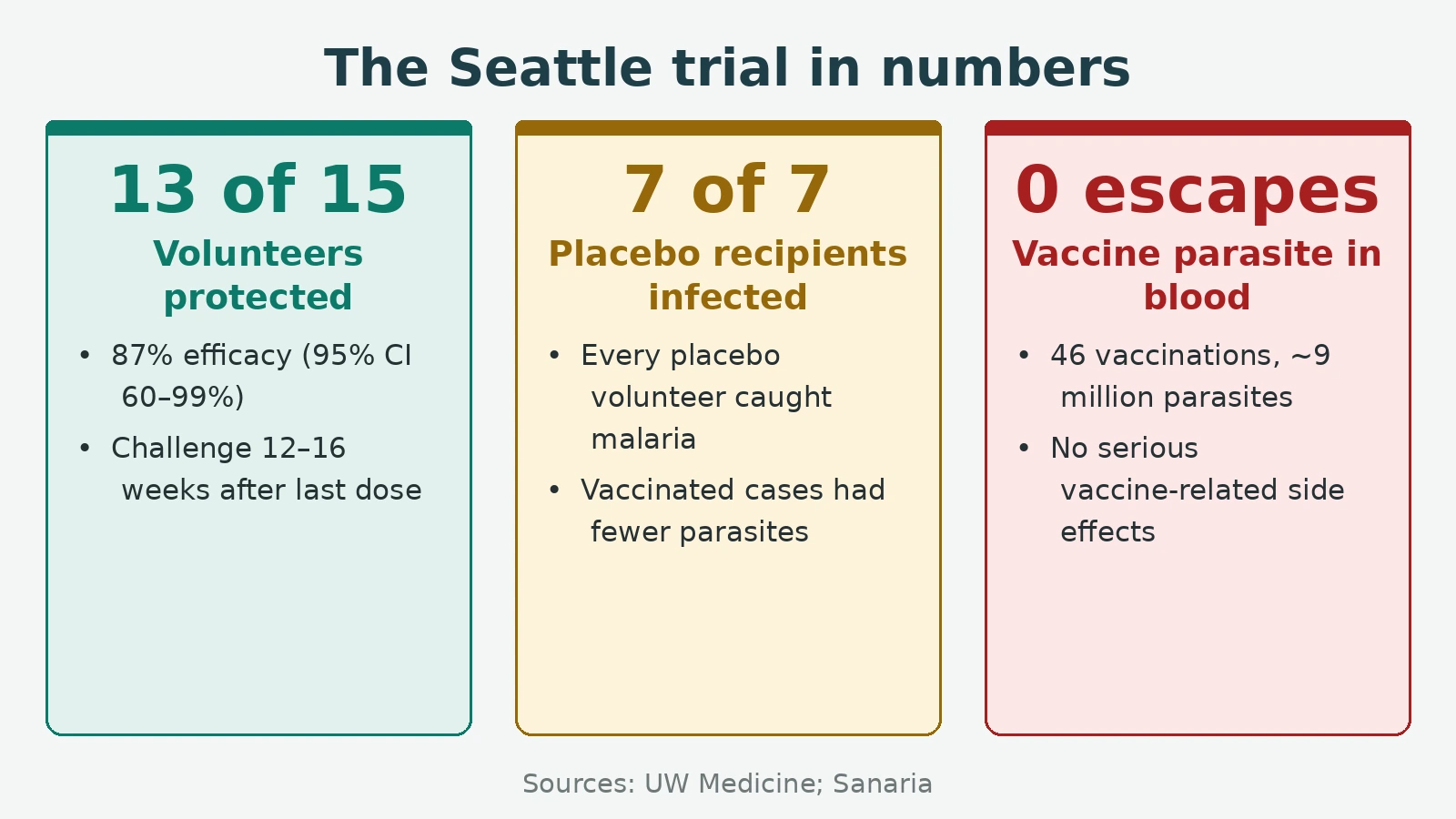
Thirteen of the 15 vaccinated volunteers stayed free of infection — an efficacy of 87%, with a 95% confidence interval of 60% to 99%. All seven placebo recipients became infected. The two vaccinated volunteers who did become infected had fewer parasites in their blood than the placebo group.
Safety was the trial’s main goal. Across 46 vaccinations, delivering about nine million parasites in total, the vaccine parasite never once escaped into the bloodstream. There were no vaccine-related serious adverse events and no severe side effects. One laboratory finding reached the severe grade: a temporary drop in neutrophils, a type of white blood cell, one week after the second dose.
The vaccine also produced the immune responses the researchers expected: antibodies against the parasite’s main surface protein, plus lasting responses from helper and killer T cells. The killer T cell responses are thought to matter most, because they can find and destroy infected liver cells before the parasite reaches the blood.
How it compares with the malaria vaccines already in use
Two malaria vaccines are already in use. The World Health Organization has recommended RTS,S since October 2021 and R21 since October 2023, both for children in areas where P. falciparum malaria is common. They are given in four doses from around five months of age, and more than 10 million children a year are now targeted for vaccination across 25 African countries.
In large trials, both vaccines cut malaria cases by more than half in the first year after vaccination, and by about 75% when given seasonally alongside preventive medicine in areas with a short malaria season. A pilot programme that gave RTS,S to more than two million children in Ghana, Kenya and Malawi was linked to a 13% fall in deaths among children old enough to be vaccinated.
PfSPZ-LARC2 aims higher: to stop infection altogether. That is a different goal from reducing cases, and it is why the 87% figure has drawn attention. But the comparison comes with a large caveat — the existing vaccines were tested in tens of thousands of children where malaria is common, while PfSPZ-LARC2 has so far been tested in 22 adults who had never had malaria.
Why a better malaria vaccine matters
Malaria is still one of the world’s biggest killers. The WHO estimates there were about 282 million cases and 610,000 deaths in 2024, across 80 countries. Africa carried about 95% of cases and deaths, and children under five accounted for about three quarters of deaths in the region. More than half of the region’s deaths were in three countries: Nigeria, the Democratic Republic of the Congo and Niger.
Malaria is preventable and curable, and it does not spread from person to person — it is passed on by infected mosquitoes. But the parasite is hard to beat: it changes, it hides in the liver, and immunity after infection fades. That is why researchers have chased a vaccine that blocks infection completely for decades.
What happens next
The results were presented on 19 November 2026 at the annual meeting of the American Society of Tropical Medicine and Hygiene, by Dr Sean C. Murphy of the University of Washington School of Medicine. They have not yet been published in a peer-reviewed journal, and the full study report is expected in the first quarter of 2027.
The vaccine has completed Phase 1 trials in Burkina Faso and the United States, and is now in a Phase 1 trial in Germany and Phase 2 trials in Burkina Faso and Mali. The next questions, as Sanaria’s chief medical officer put it, are how it performs in people who have lived with malaria all their lives, and what the best dose and schedule are. Until those trials report, PfSPZ-LARC2 is not available to the public.
The wide confidence interval — 60% to 99% — is a reminder of how small this trial was. The true level of protection in a larger group could sit anywhere in that range, and it could look different again in children or in people already exposed to malaria.
When to see a doctor
Malaria symptoms usually appear 7 to 30 days after an infected mosquito bite, and most often include fever, chills, sweats, headache, nausea and vomiting, body aches and a general feeling of being unwell. P. falciparum malaria can become severe and life-threatening within 24 hours if untreated, so a fever after travel to a region where malaria occurs needs urgent medical attention — tell the doctor where you have travelled. In an emergency call 911 (US), 999 (UK) or 112 (EU).
Frequently asked questions
What is PfSPZ-LARC2?
PfSPZ-LARC2 is an experimental malaria vaccine made from a live Plasmodium falciparum parasite with two genes removed. The weakened parasite grows in the liver, showing the immune system thousands of parasite proteins, then stalls and dies before it can reach the blood. Because it never invades red blood cells, it cannot cause malaria illness or be passed on by mosquitoes.
How effective is the new malaria vaccine?
In a small Phase 1 trial, PfSPZ-LARC2 protected 13 of 15 vaccinated volunteers — 87% efficacy — while all seven people who received a placebo became infected. The result comes with a wide 95% confidence interval of 60% to 99%, which reflects the trial's small size of 22 people. Larger trials in malaria-endemic countries are needed before the true level of protection is known.
Is the PfSPZ-LARC2 vaccine available yet?
No. PfSPZ-LARC2 is still in early testing and is not available to the public. It has completed Phase 1 trials in Burkina Faso and the United States and is in a Phase 1 trial in Germany and Phase 2 trials in Burkina Faso and Mali. The results so far were presented at a scientific meeting in November 2026 and have not yet been peer-reviewed or published in a journal.
How is PfSPZ-LARC2 different from the RTS,S and R21 vaccines?
RTS,S and R21 are protein-based vaccines that target a single parasite protein and are given to young children in four doses. They cut malaria cases by more than half in the first year. PfSPZ-LARC2 is a whole-parasite vaccine that exposes the immune system to thousands of proteins and aims to block infection outright — 87% protection in one small trial, though that figure still needs confirming in larger studies.
Who took part in the trial?
The trial involved 22 healthy adults aged 18 to 45 who had never had malaria. Fifteen received three doses of the vaccine, 28 days apart, and seven received a saltwater placebo. Three to four months after the last dose, all 22 were deliberately exposed to live malaria parasites under close medical supervision, and anyone who became infected was treated promptly.
Is the new malaria vaccine safe?
In this small trial, yes, as far as can be told so far. Across 46 vaccinations the weakened parasite never once escaped into the bloodstream, and there were no vaccine-related serious adverse events or severe side effects. One volunteer had a temporary drop in a type of white blood cell after the second dose. Safety in larger groups, including children, still has to be confirmed.
Sources
- UW Medicine Newsroom: Malaria vaccine shows 87% efficacy in clinical trial newsroom.uw.edu
- Sanaria: Genetically Engineered Malaria Vaccine Stops Infection in 87% of Volunteers sanaria.com
- WHO: Malaria fact sheet www.who.int
- WHO: Malaria vaccines (RTS,S and R21) Q&A www.who.int
- CDC: Clinical Features of Malaria www.cdc.gov

Try the tool
Not sure if it can wait?
Common causes and warning signs for 16 everyday symptoms.
Open the symptom guide