Dengue Fever Outbreak 2026: Symptoms and Warning Signs
Florida is facing its largest locally acquired dengue outbreak since the 1930s, with 624 cases in 2026 — most of them around Tampa Bay. Here are the symptoms, the warning signs of severe dengue, and how to protect yourself.
- Written by
- Health Daily Advice
- Published
- Reading time
- 9 minutes
- Sources
- 11 cited
In this guide
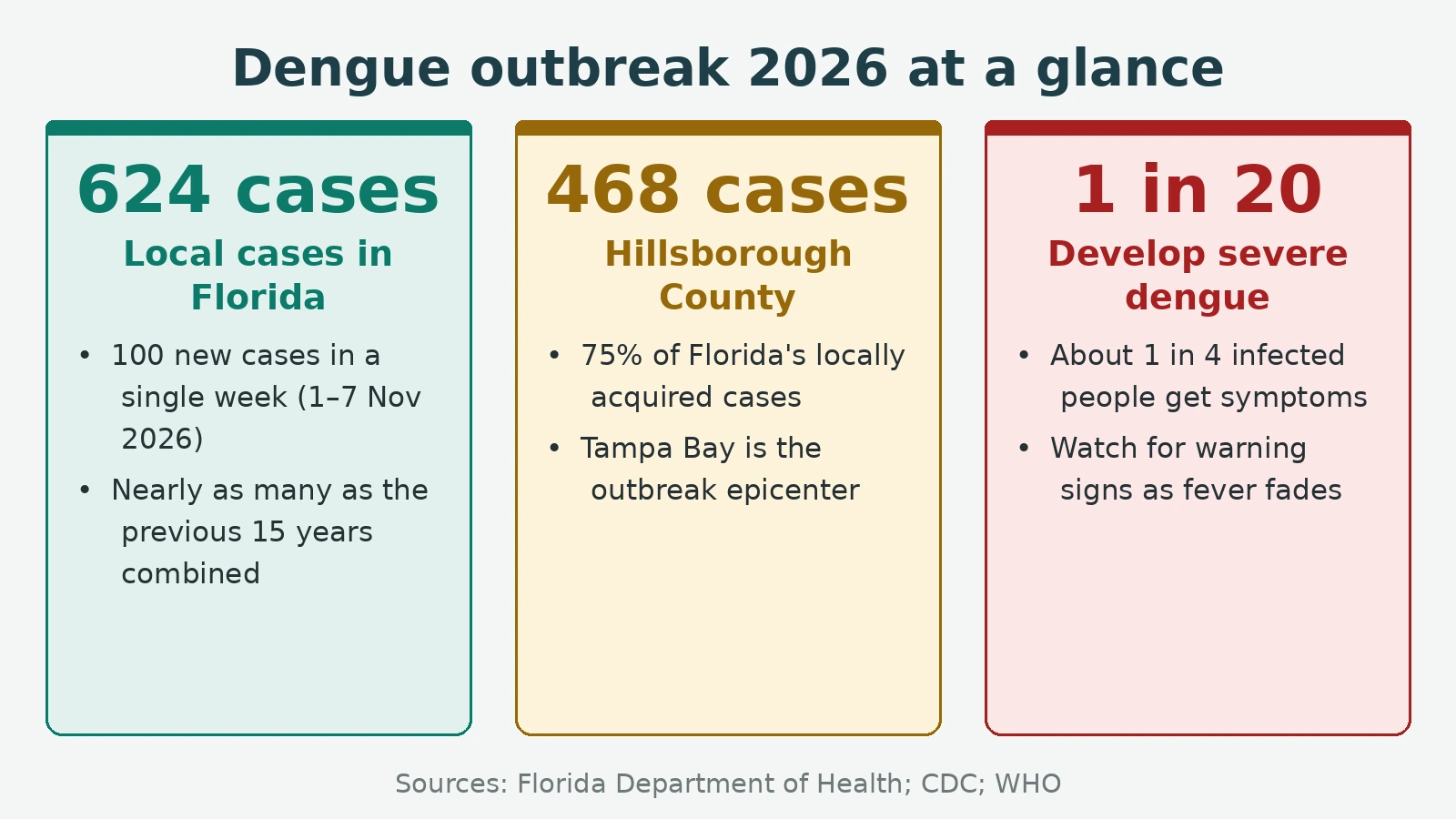
Florida is facing its largest locally acquired dengue fever outbreak since the 1930s, with 624 cases reported in 2026 as of November 7, most around Tampa Bay. Dengue is a mosquito-borne viral illness that usually brings a high fever, severe aches and a rash, and about 1 in 20 people who fall ill develop severe dengue, a medical emergency.
Until this year, dengue in Florida was mostly a travel story. People picked it up on trips to the Caribbean or Latin America and came home sick. The 2026 outbreak is different: hundreds of people have caught the virus from mosquitoes right where they live, in neighborhoods around Tampa and St. Petersburg. Three counties have declared local states of emergency. Here is what the outbreak looks like, what dengue feels like, the warning signs that need urgent care, and how to protect yourself.
The 2026 Florida dengue outbreak in numbers
The Florida Department of Health’s weekly arbovirus report for November 1–7, 2026 counted 624 locally acquired dengue cases so far this year — people who caught the virus in Florida, not abroad. A hundred of those cases were reported in that one week alone. A CDC epidemiologist told clinicians on a briefing call that this is the largest locally acquired dengue outbreak in Florida since the 1930s.
To put that in perspective, Florida recorded just 650 locally acquired cases in total across the whole of 2010 to 2025, according to CDC data. This single year has nearly matched 15 years of cases. The state’s previous recent peak was 176 locally acquired cases in 2023, and last year there were only 72.
| County | Locally acquired cases in 2026 |
|---|---|
| Hillsborough (Tampa) | 468 |
| Pinellas (St. Petersburg) | 109 |
| Miami-Dade | 16 |
| Orange | 14 |
| Pasco | 6 |
| Citrus | 3 |
| Manatee | 2 |
| Seminole | 2 |
| Brevard, Broward, Palm Beach, Polk | 1 each |
| Total | 624 |
Hillsborough County, which includes Tampa, accounts for three quarters of all cases, with Pinellas County — home to St. Petersburg — a distant second. Cases began appearing in July, with 21 that month, then climbed fast: 172 in August, 294 in September and 137 in October. Most infections have been with dengue virus serotype 2, which accounted for 565 of the 624 cases.
The human cost has been real. Around 47% of the people infected needed hospital care, according to the CDC. Florida health officials have also reported one dengue-related death this year: an 80-year-old Tampa woman who died on September 4, 2026. Hillsborough, Pasco and Pinellas counties each declared a local state of emergency in September, freeing up funds for mosquito control.
Florida’s outbreak is part of a wider US picture. As of October 22, 2026, the CDC had counted 2,470 dengue cases across the US, 1,776 of them locally acquired, mainly in Puerto Rico, Florida and American Samoa. For comparison, the CDC reported 10,112 US cases in 2024 and 5,374 in 2025. Florida has also recorded 422 travel-associated cases this year, most of them linked to travel to Cuba.
What is dengue fever?
Dengue fever is a viral illness spread by the bite of an infected mosquito. It is caused by one of four closely related dengue viruses, known as DENV-1 through DENV-4. It is sometimes called “break-bone fever” because of the crushing muscle, joint and bone pain it can cause. The illness is common in tropical and subtropical parts of the world, and the World Health Organization estimates that 100 to 400 million dengue infections happen every year, with about half the world’s population now at risk. A record 14.6 million cases were reported to the WHO in 2024. For more background, see our guide to dengue fever causes, symptoms, treatment and prevention.
One thing that surprises many people is how often dengue passes unnoticed. About 1 in 4 people infected with the virus develop symptoms, according to the CDC, which means roughly three quarters feel nothing at all. But people without symptoms can still pass the virus to mosquitoes, which then bite someone else. Having dengue once does not protect you forever, either. Infection with one serotype gives lifelong immunity against that type only, so you can catch dengue up to four times — and a second infection with a different type carries a higher risk of severe illness.
What are the symptoms of dengue fever?
Dengue usually starts abruptly. Symptoms most often begin 4 to 10 days after the bite of an infected mosquito, though the CDC notes they can appear anywhere from 3 to 14 days afterwards. The illness typically lasts 2 to 7 days, and most people feel better within about a week.
Common dengue fever symptoms
The most common symptom is a sudden high fever, which can reach 104°F (40°C). Alongside the fever, people often notice:
- Severe headache
- Pain behind the eyes
- Muscle, joint or bone pain — often severe enough to give dengue its “break-bone fever” nickname
- Nausea and vomiting
- Swollen glands
- A rash, which may appear a few days into the illness
- Fatigue and a general feeling of being unwell
Because these symptoms look a lot like flu or other viral illnesses, dengue is easy to miss. If you develop a fever with any of them and you live in, or have recently visited, an area where dengue is spreading, tell a doctor about the possible exposure. A blood test can confirm the infection, but treatment should not wait for the result.
How long does dengue last?
Most people with mild dengue recover within a week or so. The illness tends to move through phases: a feverish phase lasting 2 to 7 days, then a short critical window of about 24 to 48 hours as the fever breaks, and finally recovery. That middle window is the one to watch. Some people seem to be getting better as their temperature falls — and then, within hours, the warning signs appear. This is why doctors advise close monitoring for a day or two after the fever goes away.
What are the warning signs of severe dengue?
About 1 in 20 people who get sick with dengue develop severe dengue, according to the CDC. Severe dengue is a medical emergency. It can cause dangerous fluid leakage from blood vessels, severe bleeding, shock and damage to organs such as the liver, heart and brain — and it can kill. Catching the warning signs early and getting prompt hospital care, including intravenous fluids, can cut the risk of death to under 0.5%.
The warning signs usually show up in the 24 to 48 hours after the fever has gone away. Get to a clinic or emergency room right away if you or a family member develops any of these:
- Severe belly pain or tenderness
- Vomiting three or more times in 24 hours
- Bleeding from the nose or gums
- Vomiting blood, or blood in the stool
- Feeling extremely tired, restless or irritable
- Rapid breathing
- Pale, cold or clammy skin
- Being very thirsty or feeling weak
Any bleeding that seems unusual is worth flagging to a doctor, including changes in the color of urine or stools and heavier-than-usual menstrual bleeding. Severe dengue can develop within a few hours, so do not wait to see whether the symptoms pass on their own.
How does dengue spread?
Dengue is spread by the bite of an infected female Aedes mosquito, mainly Aedes aegypti. These mosquitoes are day-biters — most active in the hours after sunrise and before sunset — although they can bite at night too. They breed in small pools of standing water around homes: flowerpot saucers, birdbaths, clogged gutters, buckets and old tires.
Here is how the chain works. A mosquito bites a person who has dengue virus in their blood and picks up the virus. After about 8 to 12 days, the virus reaches the mosquito’s salivary glands, and from then on the mosquito can pass it to everyone it bites for the rest of its life. That is how one infected traveler can seed local transmission.
One reassuring fact: dengue does not spread directly from person to person through coughing, sneezing or everyday contact. You can only catch it from a mosquito bite — which is also why bite prevention and clearing standing water are so effective at breaking the chain.
Who is most at risk of severe dengue?
Anyone can catch dengue, but some people are more likely to become seriously ill. The CDC lists infants under one year old, pregnant women, adults aged 65 and over, and people with certain medical conditions — such as asthma, diabetes, obesity and high blood pressure — as being at higher risk of severe disease. A previous dengue infection is also a risk factor, because a second infection with a different serotype is more likely to turn severe.
In the Florida outbreak, most cases have been in adults aged 30 to 49, and about half have been in men. Older adults are the group most likely to be hospitalized or to die, which is why the death of the 80-year-old Tampa woman in September was a stark reminder that this outbreak is not just a nuisance illness. People who spend a lot of time outdoors face the highest exposure in the Tampa Bay area right now.
How can you prevent dengue fever?
There is no dengue vaccine currently available in the United States — the only one ever licensed here was withdrawn from the market — so prevention comes down to avoiding bites and getting rid of mosquito breeding sites. The WHO and the Mayo Clinic recommend the following:
- Use repellent. Apply an EPA-registered insect repellent containing DEET, picaridin or oil of lemon eucalyptus to exposed skin, following the label instructions.
- Cover up. Wear long-sleeved shirts, long pants, socks and shoes when you are outdoors, especially in the morning and late afternoon when Aedes mosquitoes are most active.
- Keep mosquitoes out of the house. Use window and door screens and repair any holes. Air conditioning helps too.
- Dump standing water at least once a week. Empty birdbaths, flowerpot saucers, pet bowls, buckets and children’s toys that collect rainwater. Clear clogged gutters and get rid of old tires and containers.
- Look after anyone who is ill. A person with dengue should avoid further mosquito bites, so the mosquitoes around them cannot pick up the virus and pass it on.
These steps sound simple, and that is the point: in a neighborhood outbreak, the whole street’s effort matters. One forgotten bucket of standing water can breed enough mosquitoes to keep transmission going for weeks.
What should you do if you think you have dengue?
There is no specific medicine that kills the dengue virus. Treatment is supportive: rest, drink plenty of fluids, and use acetaminophen (paracetamol) for fever and pain. The WHO advises against ibuprofen, aspirin and other non-steroidal anti-inflammatory drugs, because they can increase the risk of bleeding. If you are unsure which pain reliever is safe for you, talk to a doctor or pharmacist.
If you develop a fever after being in an area with dengue, contact a doctor promptly and mention the possible exposure. They can arrange testing and keep an eye on you through the critical window after the fever breaks. While you are ill, keep drinking fluids and rest. If you cannot keep fluids down, feel increasingly unwell, or notice any warning signs, get medical help the same day.
Is dengue contagious?
No. Dengue does not spread from person to person through coughing, sneezing, hugging or sharing food. The only way to catch it is through the bite of an infected mosquito. That said, a person with dengue in their blood can infect the mosquitoes that bite them — for up to two days before symptoms appear and two days after the fever has gone — which is how the virus moves through a neighborhood. Protecting a sick family member from further bites protects everyone else too.
When to see a doctor
See a doctor promptly if you develop a fever with headache, pain behind the eyes, muscle or joint pain, nausea or a rash — especially if you live in or have recently visited an area with dengue, such as the Tampa Bay area. Mention the possible exposure so dengue is considered early.
Get emergency help straight away if you notice any warning sign of severe dengue: severe belly pain, vomiting three or more times in a day, bleeding from the nose or gums, blood in vomit or stool, rapid breathing, or extreme tiredness, restlessness or confusion. These signs most often appear in the day or two after the fever breaks.
In an emergency call 911 (US), 999 (UK) or 112 (EU)
The 2026 Florida outbreak is a reminder that a disease most Americans associate with tropical travel can take hold at home when mosquitoes, warm weather and an infected traveler meet. The numbers are historic, but the advice is straightforward: protect yourself from bites, clear standing water, and know the warning signs. Most people who catch dengue recover fully — and the ones who do best are the ones who get checked early.
Frequently asked questions
How many dengue cases has Florida reported in 2026?
Florida has reported 624 locally acquired dengue cases in 2026 as of November 7, according to the Florida Department of Health. Hillsborough County, which includes Tampa, accounts for 468 of them, and Pinellas County for 109. Another 422 cases were linked to travel abroad. It is the largest locally acquired dengue outbreak in Florida since the 1930s.
Can you get dengue more than once?
Yes. Dengue is caused by four different virus types, and infection with one gives lifelong immunity against that type only. You can catch dengue up to four times in your life. A second infection with a different type carries a higher risk of severe dengue, so people who have had dengue before should be extra careful about mosquito bites.
Is there a dengue vaccine available in the US?
No. There is currently no dengue vaccine available in the United States. The only vaccine ever licensed in the US, Dengvaxia, was approved for children aged 9 to 16 with a confirmed previous infection in endemic areas, but it was withdrawn from the market. For now, prevention means avoiding mosquito bites and removing standing water where mosquitoes breed.
How can I avoid dengue while in Florida?
Use an EPA-registered repellent with DEET, picaridin or oil of lemon eucalyptus, and wear long sleeves and long pants outdoors, especially in the morning and late afternoon. Keep window screens in good repair, use air conditioning, and dump standing water around your home at least once a week, including birdbaths, flowerpot saucers and clogged gutters.
When should I go to the emergency room with dengue?
Go to the emergency room right away if you notice any warning sign of severe dengue: severe belly pain, vomiting three or more times in 24 hours, bleeding from the nose or gums, blood in vomit or stool, rapid breathing, or extreme tiredness, restlessness or confusion. These signs usually appear in the 24 to 48 hours after the fever goes away, and severe dengue can develop within hours.
Sources
- Florida Department of Health: Florida Arbovirus Surveillance, Week 44 (November 1–7, 2026) www.floridahealth.gov
- CDC: Symptoms of Dengue and Testing www.cdc.gov
- CDC: Clinical Features of Dengue www.cdc.gov
- WHO: Dengue and severe dengue (fact sheet) www.who.int
- Mayo Clinic News Network: Mayo Clinic expert explains dengue fever newsnetwork.mayoclinic.org
- Medscape: Florida Has Most Locally Acquired Dengue Cases in 100 Years www.medscape.com
- Healio: Expert sees concerning trend in Florida's dengue emergencies www.healio.com
- Johns Hopkins Center for Outbreak Response Innovation (CORI): Dengue in the United States cori.centerforhealthsecurity.org

Try the tool
Not sure if it can wait?
Common causes and warning signs for 16 everyday symptoms.
Open the symptom guide