Daraxonrasib: The Pancreatic Cancer Pill Behind the Headlines
A once-a-day pill made tumours shrink or vanish in six in ten people with advanced pancreatic cancer — but the study was small, and the combination is not yet approved.
- Written by
- Health Daily Advice
- Published
- Reading time
- 8 minutes
- Sources
- 8 cited

In this guide
A once-a-day pill called daraxonrasib has made headlines after a trial found tumours shrank or vanished in six in ten people with advanced pancreatic cancer, and disappeared completely on scans in about one in twelve. Doctors call it a breakthrough — but the study was small, and the combination is not yet approved.
The results, presented in Barcelona on 20 November 2026, are the most encouraging seen yet for a cancer with some of the bleakest survival figures in medicine. Cancer Research UK called the drug “the biggest leap forward we’ve seen in decades for pancreatic cancer patients” — while stressing that more research is needed before anyone calls it a cure.
How daraxonrasib works
Daraxonrasib, also known by its development name RMC-6236 and sold under the brand name Rasonque, is a once-daily pill made by the California company Revolution Medicines. It works by switching off a protein called RAS, which acts like a molecular on-off switch telling cells when to grow.
In more than 90% of pancreatic cancers, a mutation — most often in a gene called KRAS — jams that switch in the “on” position, so cancer cells keep dividing. Daraxonrasib locks onto the active RAS protein and shuts the signal down. For decades, RAS was considered “undruggable”: no approved treatment could target it in pancreatic cancer. Cancer Research UK’s Dr Sam Godfrey told BBC News the drug had “found a way of drugging the undruggable”.
The pill is taken by mouth once a day. In the new trial it was combined with standard chemotherapy — gemcitabine and nab-paclitaxel, given by infusion — in people whose pancreatic cancer had already spread and who had not yet had treatment for the advanced disease.
What the new trial found
The trial, known as RMC-GI-102, involved 61 people with newly diagnosed metastatic pancreatic adenocarcinoma, the most common form of pancreatic cancer. The results were presented by Dr Wungki Park, a gastrointestinal cancer specialist at Memorial Sloan Kettering Cancer Center in New York, at the EORTC-NCI-AACR symposium in Barcelona on 20 November 2026, with a median follow-up of 18.3 months.
The headline figures were striking:
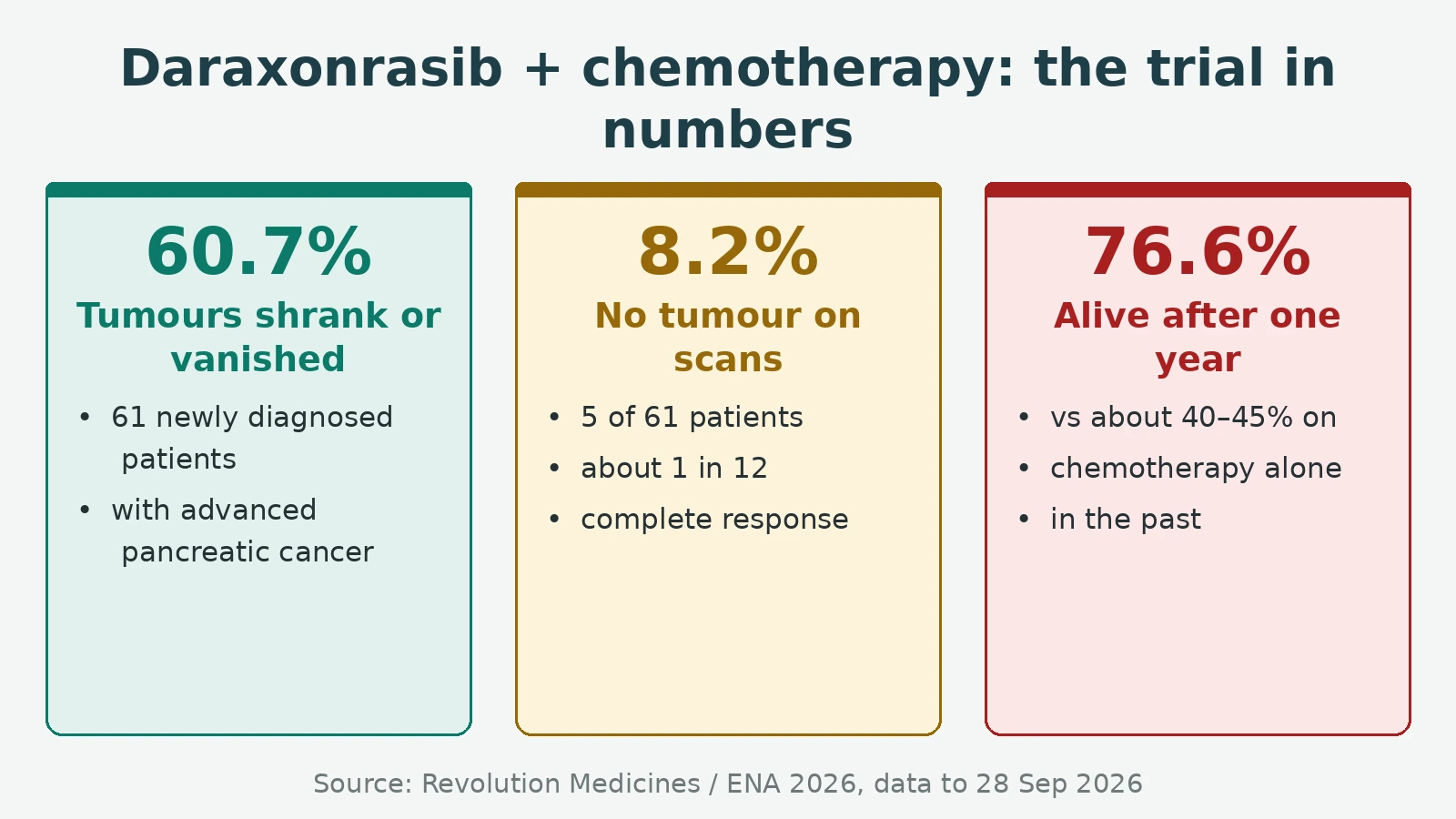
- Tumours shrank or disappeared in 60.7% of patients — the confirmed response rate.
- Tumours vanished completely on scans in 8.2% of patients — 5 of the 61 people, about one in twelve.
- The disease was held in check in 90.2% of patients — tumours stopped growing.
- It took a median of 12.8 months before the cancer started growing again or the patient died.
- An estimated 76.6% of patients were alive after one year, compared with roughly 40–45% of patients given chemotherapy alone in the past.
Asked whether the one in twelve patients whose tumours vanished could be called cured, Dr Park said: “This is the closest to cure.” He added that he had never seen so many tumours disappear in patients whose cancer had spread, and that the team was seeing “not only a higher percentage of tumour response rates, but also deeper responses and a near doubling in the duration of disease control”.
For comparison, with standard chemotherapy alone, tumours shrink in only about 23–42% of patients, most tumours start growing again after five to six months, and most people with metastatic pancreatic cancer survive eight to eleven months. The new figures look dramatically better — but, as the researchers themselves stress, this trial had no chemotherapy-only group to compare against, so it cannot prove the combination beats chemotherapy alone.
Why pancreatic cancer is so hard to treat
Pancreatic cancer is one of the deadliest cancers precisely because it is usually found late. Around 500,000 people worldwide are diagnosed with pancreatic adenocarcinoma each year, and about 80% are diagnosed only after the disease has already spread, when treatment options are far more limited. For metastatic disease, the five-year survival rate is around 3% worldwide.
In the UK, around 11,500 people are diagnosed each year and around 10,200 die from it. It is the tenth most common cancer in the UK but the fifth most common cause of cancer death. According to Cancer Research UK, 25 in 100 people survive for a year or more after diagnosis, and only just over 5 in 100 survive for five years or more — the lowest survival rate of all common cancers in the UK. Half of people with pancreatic cancer die within three months of diagnosis, and only around 10% are eligible for surgery, which offers the best chance of recovery.
Part of the problem is that the disease often causes no clear symptoms at first. The NHS lists symptoms that can be easy to miss or to blame on something else: yellowing of the skin or the whites of the eyes, itchy skin, darker urine, paler stools, loss of appetite or unexplained weight loss, tiredness, feeling or being sick, changes in bowel habits, pain at the top of the tummy and back, and indigestion or bloating.
The bigger trial behind the drug’s approval
The new results build on a larger, randomised trial that has already changed practice. In the phase 3 RASolute 302 trial, 500 patients whose metastatic pancreatic cancer had kept growing after earlier treatment were randomly assigned to daraxonrasib alone or to chemotherapy chosen by their doctor. The results, presented at the American Society of Clinical Oncology meeting in May 2026 and published in the New England Journal of Medicine, showed:
- Median survival of 13.2 months with daraxonrasib versus 6.7 months with chemotherapy — a 60% lower risk of death.
- 53.2% of patients alive after one year, compared with 17.3% on chemotherapy.
- Tumours shrank in 31.6% of patients on the pill, against 11.2% on chemotherapy.
- Patients on daraxonrasib had fewer serious side effects than those on chemotherapy, less pain, and a better quality of life.
Dr Brian Wolpin of the Dana-Farber Cancer Institute, who led the trial, said daraxonrasib “significantly elevates the survival bar in the treatment of one of the deadliest human cancers, while better preserving quality of life compared to chemotherapy”. The benefit held whether or not a RAS mutation had been identified in the patient’s tumour.
Is daraxonrasib available now?
Yes — but only for a narrower group of patients than those in the new trial. The US Food and Drug Administration approved Rasonque on 26 August 2026 for adults with metastatic pancreatic cancer who have already had at least one earlier treatment, or who cannot have multi-drug chemotherapy. The European Commission approved it for the same previously treated group, with the approval announced on 16 November 2026.
The new combination — daraxonrasib plus chemotherapy as the first treatment for newly diagnosed metastatic disease — is not approved anywhere yet. It is now being tested in a large randomised phase 3 trial called RASolute 303, which compares daraxonrasib alone, daraxonrasib plus chemotherapy, and chemotherapy alone. The US regulator has given the combination Breakthrough Therapy Designation, a status meant to speed up the development of promising treatments.
Cost is already a talking point: the BBC reported the drug costs around £30,000 a month. No UK approval has been announced, so it is not available on the NHS, and it would be wrong to assume it will be. Patients who think the drug might be relevant to them should talk to their cancer team about whether any trial is recruiting — the final phase 3 study has places in some European centres.
What are the side effects?
In the combination trial, the most common side effects were rash, diarrhoea, tiredness and low blood-cell counts linked to the chemotherapy. Side effects were managed with standard medical care, and daraxonrasib was stopped because of side effects in only 5% of patients.
The drug’s US prescribing information lists warnings that matter for anyone taking it. Skin problems, including rash, itching, nail problems and dry, cracked skin, occurred in 86% of patients. Mouth ulcers affected 57%, and diarrhoea 63%. Rare but serious risks include a hole in the bowel wall and inflammation of the lungs, each of which caused one death in the studies. Doctors recommend preventive skin care, sun protection and, in some cases, preventive antibiotics.
In the larger RASolute 302 trial, patients taking daraxonrasib alone had fewer serious side effects than those on chemotherapy, and fewer stopped treatment because of them. The most common serious side effects were rashes and mouth sores.
What the results do not prove
The excitement is real, but so are the caveats — and the doctors behind the trial are the first to state them. RMC-GI-102 was a small, early-phase study of 61 patients with no comparison group, and the results have not yet been published in a peer-reviewed journal. The figures come from a company press release and a conference presentation, and the trial was funded by Revolution Medicines, the company that makes the drug.
As Dr Park put it: “This is an early-phase study, and the results must be interpreted carefully because patients were not compared with patients receiving chemotherapy alone. The next step is to determine whether these remarkable early findings translate into improved outcomes in a large randomised clinical trial.” Only the RASolute 303 trial can answer whether the combination genuinely beats chemotherapy alone.
It is also not a cure. Cancer Research UK’s Dr Godfrey cautioned that even when scans show no sign of disease, “you don’t necessarily know you are cancer-free until more time has passed”, and that it is unclear how long the drug can keep the disease at bay. Cancer Research UK chief executive Michelle Mitchell called it “the biggest leap forward we’ve seen in decades for pancreatic cancer patients” — and added: “More research is needed.”
The drug was tested only in metastatic pancreatic adenocarcinoma. It is not a treatment for early-stage disease that can be operated on, and it has not been tested as a first-line option outside a trial. Other cancers driven by RAS mutations — including some lung, bowel and gynaecological cancers — would need their own trials before the drug could be used for them.
Pancreatic cancer symptoms to know
Because the disease is so often found late, knowing the warning signs matters. The NHS advises seeing a GP urgently, or calling NHS 111, if you notice yellowing of the skin or eyes, unexplained weight loss, persistent pain in the upper tummy or back, or ongoing indigestion that does not settle. These symptoms have many causes, and most people with them will not have pancreatic cancer — but they are worth getting checked, especially if they persist or get worse.
There is no screening programme for pancreatic cancer in the general population. If pancreatic cancer runs in your family, talk to your GP about whether you should be referred for specialist advice.
When to see a doctor
See a GP urgently if you develop yellowing of the skin or the whites of your eyes, unexplained weight loss, persistent upper tummy or back pain, or indigestion that keeps coming back. If you are already being treated for pancreatic cancer and want to know whether daraxonrasib or a trial could apply to you, ask your oncology team — they can explain the current approvals and whether any study is recruiting near you.
Do not try to obtain the drug outside a prescription or a trial, and do not delay standard treatment while waiting for a new one. If you feel very unwell, cannot keep fluids down, develop a high temperature during cancer treatment, or have severe pain, seek urgent medical help. In an emergency call 911 (US), 999 (UK) or 112 (EU).
Frequently asked questions
What is daraxonrasib?
Daraxonrasib (RMC-6236, brand name Rasonque) is a once-daily pill that switches off RAS, a protein that tells cells when to grow. In more than 90% of pancreatic cancers, a mutation — usually in the KRAS gene — jams that switch in the 'on' position. The drug locks onto the active RAS protein and stops the growth signal. It is made by Revolution Medicines and is taken by mouth, usually alongside chemotherapy.
How well did daraxonrasib work in the new trial?
In the 61-patient RMC-GI-102 trial, tumours shrank or disappeared in 60.7% of people given daraxonrasib plus chemotherapy, vanished completely on scans in 8.2% (about 1 in 12), and stopped growing in 90.2%. It took a median of 12.8 months for the cancer to start growing again, and an estimated 76.6% of patients were alive after one year — against roughly 40–45% on chemotherapy alone in the past.
Is daraxonrasib a cure for pancreatic cancer?
No — doctors are clear about this. The trial was small, had no comparison group and has not yet been peer-reviewed, so it cannot prove the combination beats chemotherapy alone. It is also unclear how long the drug can keep the disease at bay. Cancer Research UK's Dr Sam Godfrey said that even when scans show no sign of disease, 'you don't necessarily know you are cancer-free until more time has passed'.
Is daraxonrasib available on the NHS?
No. The drug is approved in the US and the EU only for adults with metastatic pancreatic cancer who have already had at least one earlier treatment, or who cannot have multi-drug chemotherapy. The first-line combination with chemotherapy is not approved anywhere and is being tested in a phase 3 trial. The BBC reported the drug costs around £30,000 a month, and no UK approval has been announced.
What are the side effects of daraxonrasib?
In the combination trial, the most common side effects were rash, diarrhoea, tiredness and low blood-cell counts, and the pill was stopped for side effects in only 5% of patients. The US prescribing information lists skin problems in 86% of patients, mouth ulcers in 57% and diarrhoea in 63%, with rare but serious risks including a hole in the bowel wall and lung inflammation.
What is KRAS and why does it matter in pancreatic cancer?
KRAS is a gene that carries instructions for the RAS protein, a switch that tells cells when to grow. In more than 90% of pancreatic cancers, KRAS is mutated, jamming the switch in the 'on' position so cancer cells keep dividing. For decades, RAS was considered 'undruggable' because no treatment could target it. Daraxonrasib is the first drug to block RAS in pancreatic cancer effectively.
Sources
- Revolution Medicines: RASONQUE (daraxonrasib) plus chemotherapy in first-line metastatic pancreatic cancer, 19 Nov 2026 rss.globenewswire.com
- EORTC/ENA 2026: Metastatic pancreatic cancer responds well to initial treatment event.eortc.org
- BBC News: Massive hope for pancreatic cancer pill after trial saw tumours vanish iwpost.com
- ASCO: RASolute 302 pancreatic cancer research summary www.asco.org
- Park et al. Daraxonrasib in pancreatic cancer. New England Journal of Medicine, 2026 pubmed.ncbi.nlm.nih.gov
- NHS: Symptoms of pancreatic cancer www.nhs.uk
- Cancer Research UK statistics on pancreatic cancer (via Edinburgh Live) www.edinburghlive.co.uk

Try the tool
Not sure if it can wait?
Common causes and warning signs for 16 everyday symptoms.
Open the symptom guide