Wine vs Beer: Which Is Worse for Your Heart?
A 340,924-person UK Biobank study found wine, beer and spirits carry very different heart risks — but wine is not proven to protect your heart.
- Written by
- Health Daily Advice
- Published
- Reading time
- 7 minutes
- Sources
- 10 cited
In this guide
A UK Biobank study of 340,924 adults found moderate wine drinking linked to a 21% lower risk of dying from heart disease, while even low beer, cider or spirits intake was linked to higher mortality. The study was observational, so wine is not proven to protect the heart — and heavy drinking of any type raised death risk.
What the new study found
Published in Nutrition Journal in July 2026 and presented at the American College of Cardiology’s annual meeting (ACC.26), the study followed 340,924 UK adults for an average of 13.4 years — and found the type of alcohol people drank mattered almost as much as how much they drank.
The headline numbers
Compared with never or occasional drinkers, moderate wine drinkers had a 21% lower risk of dying from cardiovascular disease (hazard ratio 0.79). Low wine drinkers also fared better, with a 14% lower risk of cardiovascular death and an 11% lower risk of death from any cause.
Beer, cider and spirits told a different story. Even low spirits intake — roughly three measures a week — was linked to a 9% higher risk of cardiovascular death, while even low beer or cider intake, about a pint a week, was linked to a 7% higher risk of dying from cancer. Heavy beer or cider drinking carried a 47% higher risk of cardiovascular death, and moderate-to-high spirits drinking a 51% higher risk. Moderate total alcohol intake was linked only to higher cancer mortality, up 11%, with no protective association at any dose.
How the study was done
The study drew on UK Biobank data from 2006 to 2022. Most participants were around 56 at the start, and former drinkers and anyone who already had cardiovascular disease or cancer were excluded, so ill health was less likely to explain the results. Over the follow-up, 22,381 participants died, including 4,288 from cardiovascular disease and 11,063 from cancer. The analysis adjusted for age, sex, smoking, education, deprivation, diet, activity, blood pressure, cholesterol and body mass index.
How much is low, moderate and heavy drinking?
The study measured drinking in grams of pure alcohol. Never or occasional drinking meant 20 grams or less a week — about one and a half standard drinks a week. Low drinking meant more than 20 grams a week up to 20 grams a day for men, and up to 10 grams a day for women. Moderate drinking meant more than 20 to 40 grams a day for men, or more than 10 to 20 grams a day for women. High drinking meant more than 40 grams a day for men and more than 20 grams a day for women — over three drinks a day for men, and over one and a half for women.
In the United States, a standard drink contains 14 grams of pure alcohol — a 12-ounce beer at 5%, a 5-ounce glass of wine at 12%, or a 1.5-ounce shot of spirits — while in the UK one unit is 8 grams: a 125-millilitre glass of wine is 1.6 units, a pint of beer 2.6 units, and a 25-millilitre measure of spirits one unit.
Wine vs beer vs spirits — the results side by side
The table summarises the risk of dying from cardiovascular disease at each drinking level, compared with never or occasional drinkers.
| Drink | Low intake | Moderate intake | High intake |
|---|---|---|---|
| Wine | 14% lower (HR 0.86) | 21% lower (HR 0.79) | CVD: no clear difference; cancer +10% |
| Beer or cider | CVD: no clear difference; cancer +7% | CVD: no clear difference; cancer +25% | 47% higher (HR 1.47) |
| Spirits | 9% higher (HR 1.09) | Moderate-to-high intake: 51% higher (HR 1.51) | |
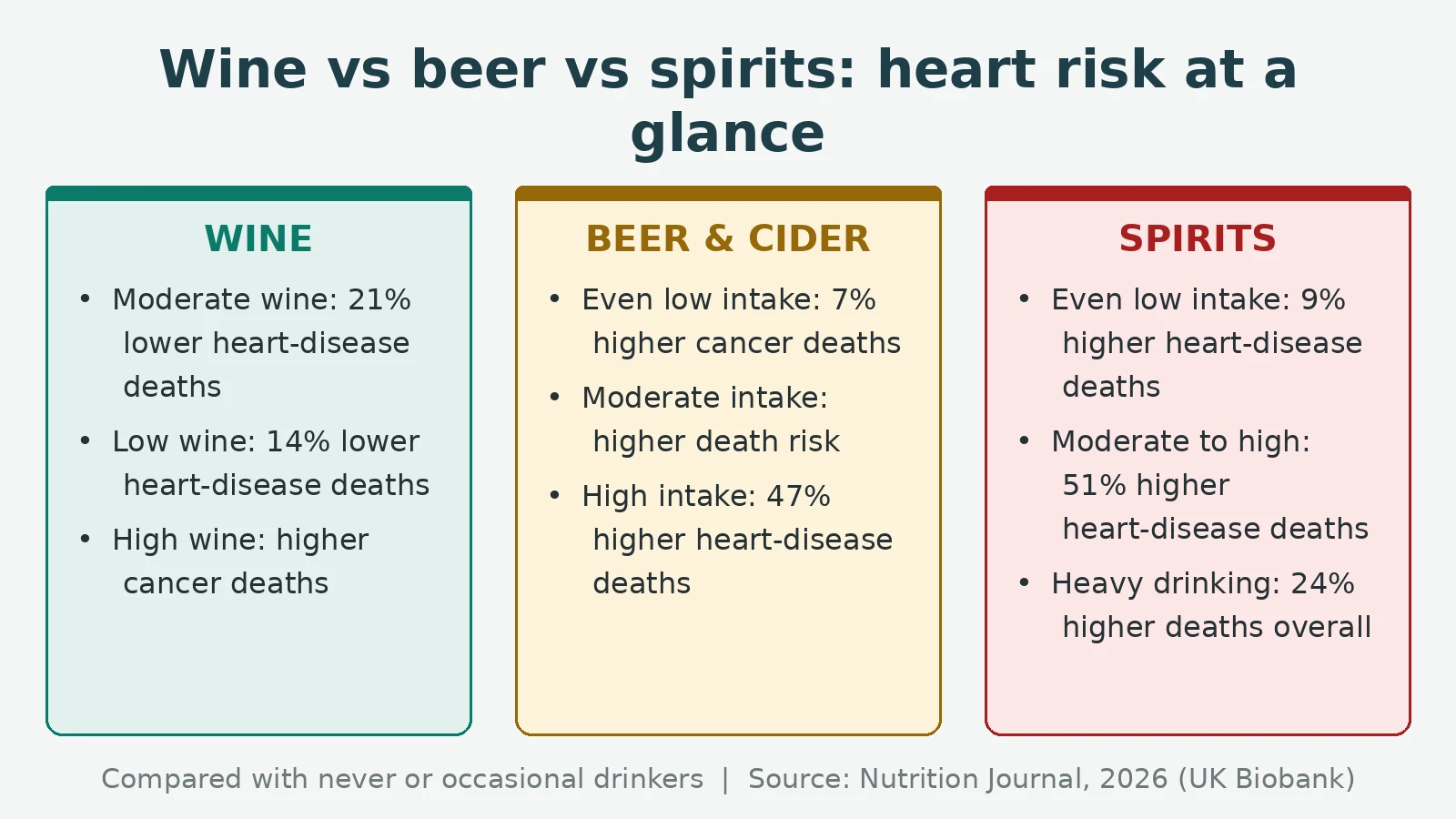
The type of wine mattered too. The lower mortality at low and moderate intakes was mainly driven by red wine, but heavy drinking reversed the pattern: heavy red wine was linked to 9% higher all-cause and 25% higher cancer mortality, heavy white wine to 16–25% higher mortality, and heavy fortified wine to a 59% higher risk of death from any cause.
Overall, total alcohol showed a straight-line relationship with higher mortality, driven mainly by beer, cider and spirits. Wine showed a J-shaped pattern instead: lower risk at low and moderate intakes, rising again at high intakes. Alcohol intake was also linked to higher mortality from 15 of the 20 site-specific cancers examined.
Why might wine look better?
One possible explanation is red wine’s polyphenols — plant compounds with antioxidant properties that have been investigated for possible effects on blood vessels and heart function. The authors suggest antioxidants such as resveratrol “may mainly explain” the lower risk with low and moderate wine drinking, but the study did not establish that they caused it. Purines in beer could also play a part, though this too is unproven.
How people drink may matter as much as what they drink. People who drank with meals “usually” had 12–22% lower mortality than those who drank outside meals, and “sometimes” was linked to 7–18% lower mortality. Drinking outside meals also weakened wine’s lower-risk link and worsened the harm linked to beer, cider and spirits.
Lifestyle is the other big confounder. Wine drinkers often report healthier diets and habits. In this study, heavy wine drinkers were more likely to be women with higher diet quality, while heavy beer and cider drinkers were more likely to be men with lower educational attainment and diet quality — so the drink may partly be a marker of other behaviours, not the cause.
Does this mean wine is good for your heart?
No — and the researchers are clear about that. This was an observational study, so it can show associations but cannot prove that wine protects the heart or that beer and spirits cause the extra deaths. Residual confounding cannot be ruled out: unmeasured differences between wine drinkers and beer drinkers could explain part of the gap. Alcohol intake was also self-reported once, at the start of the study, and may have been underreported, while UK Biobank participants tend to be healthier than the general population.
The British Heart Foundation puts it plainly: “Despite its reputation, there is no conclusive evidence that red wine protects your heart. Alcohol carries health risks, so drinking red wine is not recommended as a way to improve heart health.” As the BHF says, “If you do not drink alcohol, there’s no heart-health reason to start.”
Senior author Zhangling Chen cautioned: “These results come from the general population, and in certain high-risk groups, such as people with chronic diseases or cardiovascular conditions, the risks could be even higher.” The wider guidance agrees: the World Health Organization says there is no safe amount of alcohol for health.
What the official guidance says
In the UK, the Chief Medical Officers advise men and women not to drink more than 14 units a week on a regular basis — about six pints of average-strength beer or six medium glasses of average-strength wine — spread over three or more days, with several drink-free days each week. The NHS describes this as “low risk” rather than “safe”, because there is no safe drinking level. Pregnant women are advised not to drink at all.
In the United States, adults who choose to drink are advised to limit intake to one drink or less a day for women and two drinks or less a day for men — and that drinking less is better. The World Health Organization goes further: “When it comes to alcohol consumption, there is no safe amount that does not affect health.” Alcohol is a Group 1 carcinogen linked to at least seven cancers. As the WHO’s Dr Carina Ferreira-Borges put it, “It doesn’t matter how much you drink – the risk to the drinker’s health starts from the first drop… the more you drink, the more harmful it is – or, in other words, the less you drink, the safer it is.”
Heavy drinking harms — whatever you drink
Heavy drinking raised the risk of death no matter which drink people chose. Compared with never or occasional drinkers, heavy drinkers had a 24% higher risk of death from any cause, a 36% higher risk of cancer death, a 14% higher risk of cardiovascular death and a 12% higher risk of death from other causes.
How to cut down if you drink
Small changes can make a real difference: build in several drink-free days each week, keep a note of how many units you drink, choose smaller glasses or lower-strength drinks, and alternate alcoholic drinks with water or soft drinks. Avoid drinking on an empty stomach — people who usually drank with meals had lower mortality in this study, though that is an association, not proof. If cutting down feels difficult, or drinking is affecting your sleep, mood, work or relationships, talk to your GP or pharmacist, who can point you towards support.
When to see a doctor
See your GP promptly if you notice chest pain or tightness, breathlessness, palpitations or swollen ankles, or if you feel unwell after drinking. Also seek advice if you are worried about how much you drink, have found cutting down hard, or have a heart condition and are unsure whether drinking is safe for you.
In an emergency call 911 (US), 999 (UK) or 112 (EU)
Sources: the study in Nutrition Journal, the ACC.26 press release, the British Heart Foundation, the NHS and the World Health Organization.
Frequently asked questions
Is wine better for your heart than beer?
In this study, yes in relative terms: moderate wine was linked to 21% lower cardiovascular death risk, while heavy beer or cider was linked to 47% higher risk and even low spirits to 9% higher risk. But the study was observational, so it cannot prove wine protects the heart, and heavy drinking of any type raised death risk.
Is red wine good for your heart?
There is no conclusive evidence that red wine protects the heart, according to the British Heart Foundation. The lower mortality seen with low and moderate red wine in the UK Biobank study may reflect antioxidants such as resveratrol, drinking with meals, or healthier lifestyles among wine drinkers — none of it proven. Do not start drinking for heart health.
How much alcohol is low, moderate or heavy drinking?
In the study, never or occasional drinking meant 20 grams of pure alcohol or less a week. Low was up to 20 grams a day for men and 10 grams for women; moderate was 20 to 40 grams a day for men and 10 to 20 grams for women; high was over 40 grams a day for men and over 20 grams for women.
Does drinking wine with meals make a difference?
In the study, people who usually drank with meals had 12 to 22% lower mortality than those who drank outside meals, and sometimes drinking with meals was linked to 7 to 18% lower mortality. Drinking outside meals also weakened wine's lower-risk link. This is an association, not proof that eating makes drinking safer.
Is there a safe level of alcohol?
The World Health Organization says there is no safe amount of alcohol for health, and alcohol is a Group 1 carcinogen linked to at least seven cancers. UK guidance calls drinking within 14 units a week low risk rather than safe. The less you drink, the lower the risk.
Should I start drinking wine for my heart?
No. The study was observational and cannot prove wine protects the heart. The British Heart Foundation says there is no conclusive evidence red wine protects the heart, and the WHO says there is no safe level of alcohol. If you do not drink, there is no heart-health reason to start.
Sources
- Nutrition Journal: Li et al. 2026 — total and beverage-specific alcohol use and mortality nutritionj.biomedcentral.com
- ScienceDaily: Beer, wine or spirits — health impacts depend on what you drink www.sciencedaily.com
- EurekAlert! / American College of Cardiology: The health impacts of alcohol depend on what you drink www.eurekalert.org
- British Heart Foundation: Is red wine good for you? www.bhf.org.uk
- British Heart Foundation: Alcohol and heart disease — what are the risks? www.bhf.org.uk
- NHS: The risks of drinking too much www.nhs.uk
- WHO: No level of alcohol consumption is safe for our health www.who.int
- CDC: About standard drink sizes www.cdc.gov

Try the tool
Not sure if it can wait?
Common causes and warning signs for 16 everyday symptoms.
Open the symptom guide