Do GLP-1 Drugs Lower Cancer Risk? What the New Study Found
A large new study links GLP-1 drugs to lower obesity-related cancer rates than insulin in type 2 diabetes — but it does not prove the drugs prevent cancer. Here is what the study found, and what it cannot tell us.
- Written by
- Health Daily Advice
- Published
- Reading time
- 7 minutes
- Sources
- 8 cited

In this guide
In adults with type 2 diabetes, starting a GLP-1 drug was linked to a lower rate of obesity-related cancers than starting insulin or a sulfonylurea over three years, a study found. There was no clear difference against metformin or other diabetes drugs. The study does not prove the drugs prevent cancer, and it should not change treatment choices.
What the new study found
Published in JAMA Network Open on 3 November 2026, the study used the health records of 359,595 adults with type 2 diabetes treated at UT Southwestern Medical Center in the United States between January 2010 and July 2025, comparing GLP-1 starters with people who started metformin, insulin, an SGLT2 inhibitor, a DPP-4 inhibitor or a sulfonylurea.
It was observational, built on routine health records rather than a randomised trial, so it can show patterns but cannot prove that one drug caused a different outcome.
The headline numbers vs insulin and sulfonylureas
Over three years, GLP-1 starters had a lower rate of obesity-related cancers than insulin or sulfonylurea starters. Against insulin, the hazard ratio was 0.62 — a 38% lower hazard. Against sulfonylureas, it was 0.67, or 33% lower. The gap held at five years: 0.61 against insulin and 0.75 against sulfonylureas.
| Comparison (3 years) | Hazard ratio | Relative difference | Absolute difference |
|---|---|---|---|
| GLP-1 drugs vs insulin | 0.62 (95% CI 0.49–0.77) | 38% lower hazard | −1.25 percentage points |
| GLP-1 drugs vs sulfonylureas | 0.67 (95% CI 0.54–0.84) | 33% lower hazard | −1.14 percentage points |
| GLP-1 drugs vs metformin | Closer to null | No difference | None |
| GLP-1 drugs vs SGLT2 inhibitors | Closer to null | No difference | None |
| GLP-1 drugs vs DPP-4 inhibitors | Closer to null | No difference | None |
In that comparison, 13,649 GLP-1 starters and 16,750 insulin starters were followed; 181 and 421 respectively developed an obesity-related cancer within three years.
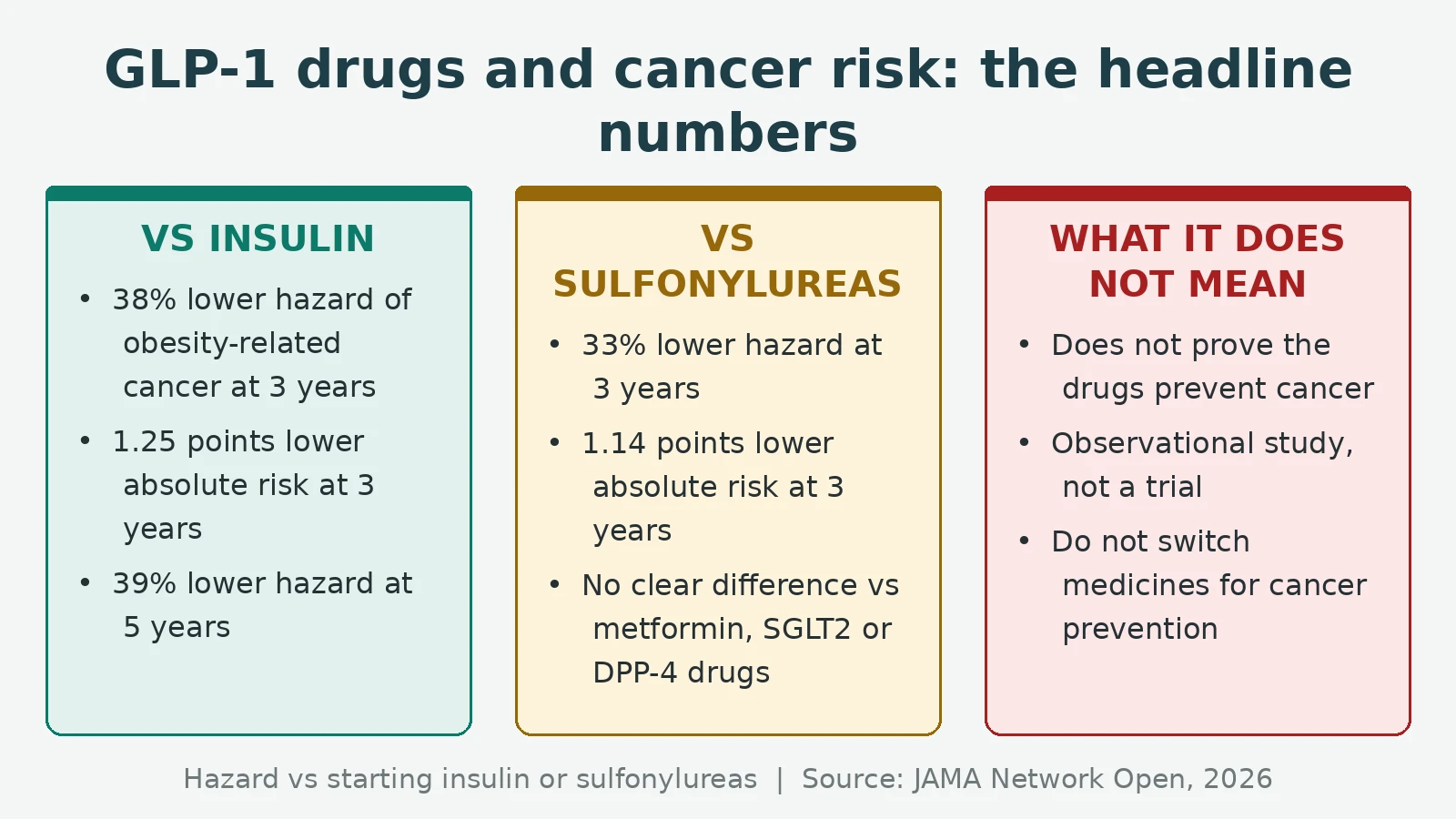
No clear difference vs metformin, SGLT2 inhibitors and DPP-4 inhibitors
Against the other three treatments, the three-year estimates were “closer to null” — no statistically significant difference.
The absolute risk — what 1.25 percentage points means in plain terms
Over three years, about 2.0% of GLP-1 starters developed an obesity-related cancer, against about 3.3% of insulin starters — a gap of 1.25 percentage points. Most people in either group did not develop one in three years.
Why diabetes severity mattered
People were split by diabetes severity: high meant macrovascular disease or advanced kidney disease (stages 4–5); moderate meant microvascular complications or earlier kidney disease; low meant neither.
Strongest link in milder type 2 diabetes
The link was most apparent in low-severity diabetes: the three-year absolute differences were −1.10 percentage points against insulin and −1.22 against sulfonylureas. These results were exploratory, with confidence intervals not adjusted for multiple comparisons.
What happened in severe diabetes
In high-severity diabetes, the pattern flipped in one comparison: the three-year risk difference favoured SGLT2 inhibitors over GLP-1 drugs by 1.61 percentage points. Different treatments are given to different people for different reasons, and in advanced diabetes heart and kidney problems shape who receives which drug.
What are obesity-related cancers?
The CDC says being overweight or having obesity is associated with a higher risk of 13 types of cancer, which account for 40% of all cancers diagnosed in the United States each year. More than 716,000 occurred in the US in 2022, and more than 90% were in people aged 50 or older.
The 13 cancers linked to excess weight
- Adenocarcinoma of the oesophagus
- Breast (after the menopause)
- Colon and rectum
- Uterus and endometrium
- Gallbladder
- Upper stomach (gastric cardia)
- Kidneys (renal cell)
- Liver
- Ovaries
- Pancreas
- Thyroid
- Meningioma (tumour of the brain and spinal cord lining)
- Multiple myeloma, a cancer of blood cells
About 2 in 5 US adults have obesity. In 2019, about 43,720 new cases in men (4.8%) and 92,200 in women (10.6%) were attributed to excess body weight, according to the National Cancer Institute.
How excess weight may raise cancer risk
Fat tissue produces excess oestrogen, linked to breast, endometrial and ovarian cancers. High insulin and insulin-like growth factor levels are linked to colorectal, thyroid, breast, prostate, ovarian and endometrial cancers, and long-lasting inflammation can encourage tumour growth. People with severe obesity have about seven times the risk of type 1 endometrial cancer and nearly five times the risk of oesophageal cancer, according to the NCI.
How do GLP-1 drugs work?
The gut hormone, fullness and blood sugar
GLP-1 receptor agonists mimic glucagon-like peptide-1, a hormone the gut releases after eating. They slow stomach emptying, prompt the pancreas to release insulin when blood sugar rises, and suppress glucagon. They also act in the brain to increase fullness and reduce appetite, quieting persistent thoughts about food, sometimes called “food noise”.
It is not yet known whether health gains beyond blood sugar and weight come from the drug itself or simply from the weight loss. Dr Andres Acosta of Mayo Clinic said: “we don’t know whether the improvement is because of the GLP-1 medications or because of weight loss”.
Which drugs are in this class
The first, exenatide (Byetta), was approved for diabetes in 2006, and higher doses were later used for weight loss. The class now includes semaglutide (Ozempic and Wegovy, plus oral Rybelsus), liraglutide (Victoza and Saxenda), dulaglutide (Trulicity) and tirzepatide (Mounjaro), which also acts on a second gut hormone, GIP. In the UK, NICE has recommended these three for obesity in adults with a high BMI and weight-related conditions.
Does this mean GLP-1 drugs prevent cancer?
No. A lower rate of cancer in one group of health records is not proof that a drug prevents cancer, and the researchers say so directly.
What the authors actually said
The findings were “broadly reassuring regarding oncologic safety but did not support selecting glucose-lowering therapy for cancer prevention; established metabolic, cardiovascular, and kidney benefits should continue to guide treatment.”
The authors also wrote that the study “identified contexts in which associations were most apparent rather than proving treatment superiority for cancer outcomes”, and that the lower estimates “may be clinically meaningful if confirmed”. Medical Xpress agreed: the drugs do not raise obesity-related cancer risk, but the findings do not support prescribing them to prevent cancer.
Why insulin users may have differed
Part of the gap may have nothing to do with the drugs. Insulin is often started later in type 2 diabetes, when the disease is more advanced, and insulin starters generally had more advanced complications than GLP-1 starters before weighting. The researchers balanced the groups with propensity scores and weighting, but acknowledge that differences may still partly reflect treatment selection, disease severity, blood sugar exposure, access to care, screening and prognosis. Weight loss, lower insulin levels and less inflammation were discussed as possible reasons, but were not tested here.
What this study cannot tell us
Observational, single health system, short follow-up for newer users
The study was retrospective, using records from a single health system, UT Southwestern, whose prescribing habits and patient mix may not match other places. Residual confounding remains possible, and records can misclassify drug exposure and cancer diagnoses. Many GLP-1 users entered recently, so five-year estimates relied disproportionately on earlier starters.
Combined cancer outcome, not individual cancers; exploratory severity results
Obesity-related cancers were reported as one combined outcome, not by individual type, so the study cannot say whether any link applies to bowel, breast, liver or any other specific cancer. The severity comparisons were exploratory, and the study was published as a research letter — a short format with less detail than a full paper.
How it fits with the 2024 study and the trial evidence
A larger 2024 JAMA Network Open study of about 1.65 million patients found the same pattern: lower risk of 10 of the 13 cancers versus insulin, none versus metformin. The randomised trial evidence is more cautious: a meta-analysis of randomised trials found no association between GLP-1 drugs and any gastrointestinal cancer.
What should people with type 2 diabetes do?
Do not switch medicines for cancer prevention
Do not switch diabetes medicines on the basis of these findings. Treatment choice should still follow established benefits for blood sugar, heart and kidney health. Talk to your doctor or pharmacist before changing anything, and never start or stop a prescribed medicine because of a headline.
Proven ways to lower obesity-related cancer risk
The CDC advises healthy eating, regular activity, and talking to a doctor about weight. The NCI notes that intentional weight loss of more than 5% of body weight was linked to a lower risk of obesity-related cancers in postmenopausal women in one large prospective study. Keeping up with screening matters too. The new study is best read as reassurance: for people already taking a GLP-1 drug, it offers no sign that the drug raises obesity-related cancer risk.
When to see a doctor
See a doctor promptly about unexplained weight loss, a lump or swelling, a sore that does not heal, unusual bleeding, a persistent cough, changes in bowel or bladder habits, difficulty swallowing, or ongoing pain or tiredness with no clear cause.
If you have type 2 diabetes and are worried about your cancer risk, or you are thinking about changing your treatment, talk to your GP or diabetes team. Do not stop or change a prescribed medicine without advice.
In an emergency call 911 (US), 999 (UK) or 112 (EU)
Frequently asked questions
Do GLP-1 drugs lower cancer risk?
In adults with type 2 diabetes, starting a GLP-1 drug was linked to a lower rate of obesity-related cancers than starting insulin (38% lower hazard) or a sulfonylurea (33% lower) over three years. There was no clear difference against metformin, SGLT2 inhibitors or DPP-4 inhibitors. The study was observational, so it does not prove the drugs prevent cancer.
How much lower was the risk vs insulin?
At three years the hazard ratio was 0.62, a 38% lower relative hazard, and the absolute risk difference was 1.25 percentage points: about 2.0% of GLP-1 starters versus about 3.3% of insulin starters developed an obesity-related cancer. At five years the hazard ratio was 0.61, with an absolute difference of 1.67 percentage points.
Did GLP-1 drugs beat metformin?
No. The three-year estimates against metformin, SGLT2 inhibitors and DPP-4 inhibitors were closer to null, with no statistically significant difference. The apparent advantage was only against insulin and sulfonylureas, which may partly reflect that insulin is started later, in more advanced diabetes, when complications are more common.
Does this mean I should take a GLP-1 drug to prevent cancer?
No. The authors state the findings do not support choosing glucose-lowering therapy for cancer prevention, and treatment should be guided by established metabolic, cardiovascular and kidney benefits. Do not start, stop or switch a diabetes medicine for cancer prevention; talk to your doctor or pharmacist first.
What are obesity-related cancers?
The CDC lists 13 cancers linked to excess weight: oesophageal, breast after the menopause, colorectal, uterine, gallbladder, upper stomach, kidney, liver, ovarian, pancreatic and thyroid cancers, plus meningioma and multiple myeloma. Together they account for 40% of cancers diagnosed in the United States each year.
How do GLP-1 drugs work?
GLP-1 receptor agonists mimic a gut hormone released after eating. They slow stomach emptying, prompt insulin release when blood sugar rises, suppress glucagon, and act in the brain to increase fullness and reduce appetite, so people eat less. Examples include semaglutide, liraglutide, dulaglutide and tirzepatide.
Sources
- JAMA Network Open: GLP-1 Receptor Agonists and Obesity-Related Cancer by Diabetes Severity jamanetwork.com
- CDC: Obesity and Cancer www.cdc.gov
- National Cancer Institute: Obesity and Cancer Fact Sheet www.cancer.gov
- Mayo Clinic Press: How GLP-1s Affect Older Adults mcpress.mayoclinic.org
- Medical Xpress: GLP-1 drugs and obesity-related cancer risk medicalxpress.com

Try the tool
Not sure if it can wait?
Common causes and warning signs for 16 everyday symptoms.
Open the symptom guide