Stage 4 Prostate Cancer: Symptoms, Survival and Treatment
Stage 4 means prostate cancer has spread beyond the gland, most often to the bones. Survival, treatment and the symptoms that need a GP, after Marlon Jackson's diagnosis.
- Written by
- Health Daily Advice
- Published
- Reading time
- 8 minutes
- Sources
- 12 cited

In this guide
Stage 4 prostate cancer means the cancer has spread beyond the prostate, most often to the bones, lymph nodes or other organs. It usually cannot be cured, but modern treatments led by hormone therapy can often control it for years. Marlon Jackson, 69, revealed on 20 November 2026 that he has lived with stage 4 disease for four years.
His announcement put the disease back in the headlines, days after the American Cancer Society issued new screening guidance on 12 November 2026. It also raised the question many men ask when they hear the words “stage 4”: what does it actually mean, and what happens next? The short answer is that stage 4 covers a wide range of situations, from cancer that has reached nearby lymph nodes to cancer that has spread widely through the bones, and the outlook and treatment differ across that range.
What stage 4 prostate cancer means
Doctors stage prostate cancer by how far it has grown and whether it has spread. Stage 4 means it has moved beyond the prostate itself, into nearby organs such as the bladder or back passage, into nearby lymph nodes, or to distant parts of the body such as the bones, lungs or liver. The bones are the most common place for prostate cancer to spread. Even when the cancer is found in another part of the body, the cells still behave like prostate cancer cells, which is why prostate cancer treatments can still work on them.
The Cleveland Clinic splits advanced disease into locally advanced cancer, which has grown through the prostate capsule into nearby pelvic tissue; oligometastatic cancer, which has spread to only a small number of places; widely metastatic cancer, which has spread beyond the pelvis to many places, including the liver, lungs or brain; and recurrent cancer, which has come back after earlier treatment. That range matters: a man with a few small areas of spread faces a different outlook and different treatment choices from a man whose cancer has spread widely.
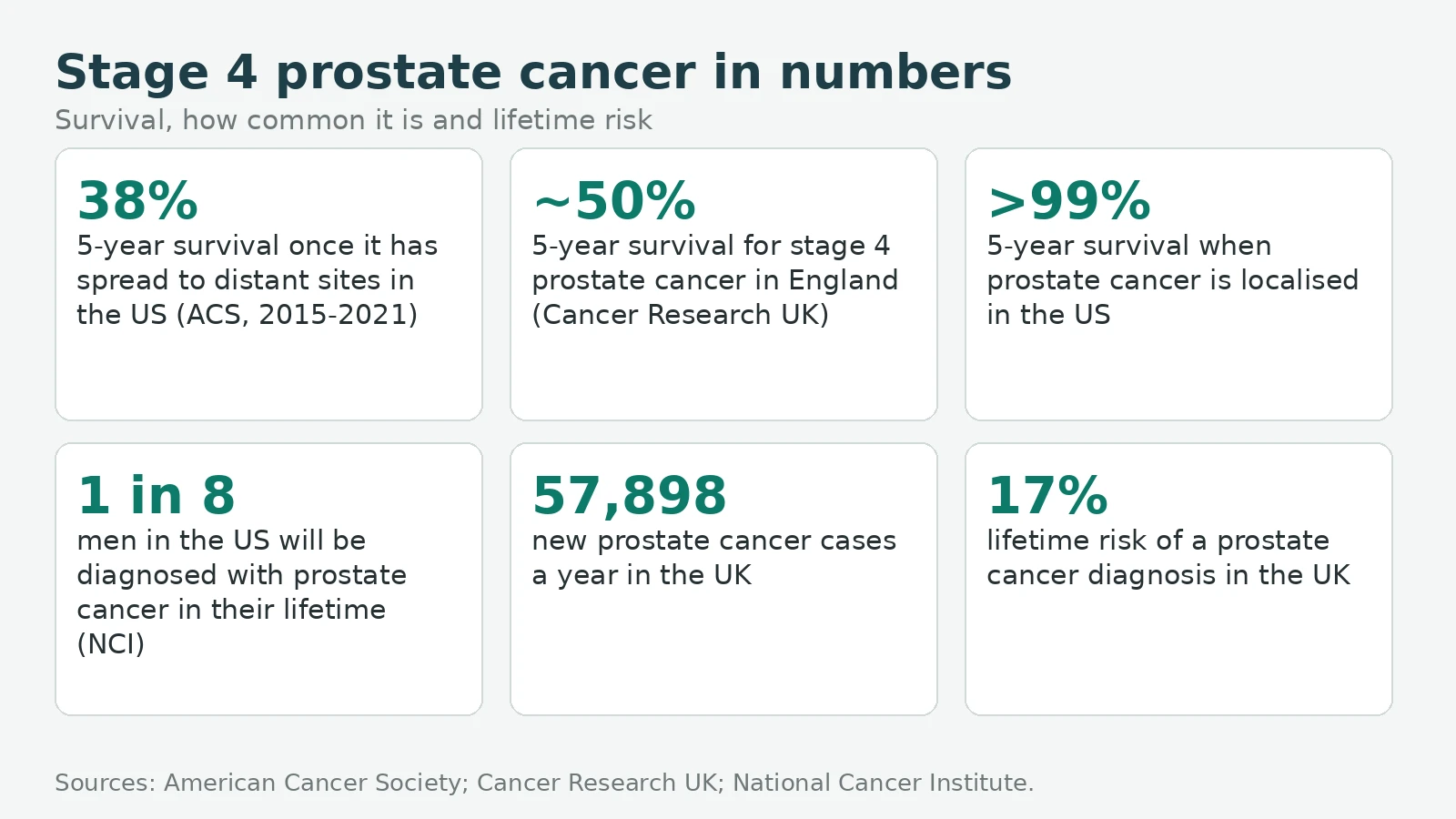
Prostate cancer is the most common cancer in men in the UK, with about 57,898 new cases a year, according to Cancer Research UK. In the United States, about 1 in 8 men will be diagnosed with prostate cancer in their lifetime, according to the National Cancer Institute. Risk rises with age, most cases develop in men aged 50 or older, and it is higher in Black men and in men with a family history of the disease.
What are the symptoms of stage 4 prostate cancer?
Prostate cancer often has no symptoms at first. It usually starts growing on the outer part of the prostate, away from the urine tube, so it may not press on the urethra until it has grown or spread. That is why some men are diagnosed only after the cancer has already reached stage 4, and why some men with advanced disease have no symptoms at all.
When symptoms do appear, the NHS lists difficulty starting to pee or straining, a weak flow, “stop-start” peeing, needing to pee urgently or often, feeling that the bladder has not emptied, and peeing during the night. Other symptoms include difficulty getting or keeping an erection, blood in the urine or semen, lower back pain and losing weight without trying. The last two can point to advanced disease.
Once the cancer has spread, symptoms depend on where it has gone. The Cleveland Clinic lists bone pain, unexplained weight loss, tiredness, pelvic or rectal pain, pain when peeing, blood in the urine, and a weak or slow stream. The National Cancer Institute also lists persistent pain in the back, hips or pelvis, shortness of breath, and feeling very tired, dizzy or pale because of anaemia.
These symptoms do not always mean cancer. An enlarged prostate, a very common non-cancerous condition, causes the same urinary symptoms, which is why they need checking rather than assuming. Our guide to enlarged prostate symptoms explains how the two conditions overlap.
How is stage 4 prostate cancer found?
There is no single test for prostate cancer. The main tests are a blood test for prostate-specific antigen (PSA), a physical examination of the prostate through the rectum, an MRI scan and a biopsy. A raised PSA can point to a prostate problem, but it cannot on its own confirm cancer, because PSA can also be raised by an enlarged prostate or a prostate infection. In the UK there is no routine screening programme; men aged 50 and over can ask a GP for a PSA test, and the GP weighs the benefits and risks with them.
A biopsy removes small pieces of tissue from the prostate, usually with a thin needle guided by ultrasound or MRI, and the tissue is examined under a microscope. That confirms the diagnosis and gives the cancer a grade. The Gleason score runs from 6 to 10: 6 is low grade, 7 is medium grade and 8 to 10 is high grade, with higher scores meaning the cancer is more likely to grow and spread quickly. Newer Grade Groups 1 to 5 describe the same scale.
Once cancer is confirmed, scans show how far it has spread. These can include a bone scan, CT, MRI, whole-body MRI and PET scans. A PSMA PET scan can find prostate cancer cells that have spread to bone, lymph nodes or other organs and help plan treatment.
Stage 4 prostate cancer survival rates
Survival figures are population averages, not individual predictions. They describe large groups of men diagnosed years ago, and they cannot tell any one person what will happen. Age, overall health, PSA level, grade, where the cancer has spread and how well it responds to treatment all affect the outlook. The American Cancer Society also notes that men being diagnosed now may do better than these figures suggest, because treatments have improved since the men in the statistics were treated.
| Group | 5-year survival | Source and period |
|---|---|---|
| Localised disease (US) | Over 99% | American Cancer Society, SEER 2015–2021 |
| Regional disease (US) | Over 99% | American Cancer Society, SEER 2015–2021 |
| Distant spread (US) | 38% | American Cancer Society, SEER 2015–2021 |
| Stage 1 and 2 (England) | Almost 100% | Cancer Research UK, 2013–2017 |
| Stage 3 (England) | Around 95% | Cancer Research UK, 2013–2017 |
| Stage 4 (England) | Around 50% | Cancer Research UK, 2013–2017 |
The US and UK figures are not directly comparable. The American “distant” group covers only cancer that has spread to distant organs, while the England “stage 4” group also includes cancer that has spread to nearby organs or lymph nodes. They also cover different countries and different years. What both sets show is the same pattern: the outlook is very good when prostate cancer is caught early and much poorer once it has spread, which is why early detection matters so much.
For all stages combined, about 98% of men in the US survive five years or more, according to the American Cancer Society. In the UK, around 85% survive five years or more and around 80% survive ten years or more, according to Cancer Research UK.
How is stage 4 prostate cancer treated?
Metastatic prostate cancer often cannot be cured, but treatments can slow it, ease symptoms and extend life. The Mayo Clinic and the Cleveland Clinic both stress that today’s therapies can often keep the disease managed for years, and some men go into remission for many years while receiving treatment.
Hormone therapy is the foundation. Prostate cancer cells rely on testosterone to grow, so treatment lowers testosterone or blocks it from reaching the cancer cells. Options include medicines that stop the body making testosterone, newer drugs that block the hormone’s effect, and surgery to remove the testicles. Two hormone treatments are often combined, and chemotherapy may be added if the cancer has spread widely.
Other treatments depend on the individual case. Chemotherapy drugs such as docetaxel and cabazitaxel are given through a drip, usually once every three weeks, alongside hormone therapy or when hormone therapy stops working. Targeted drugs called PARP inhibitors work best in men with certain DNA changes, such as BRCA1 or BRCA2 mutations, found by blood, saliva or tumour testing. Immunotherapy helps the immune system find and kill cancer cells, though most prostate cancers do not respond to it. Radiopharmaceuticals deliver radiation directly to cancer cells or to bone: lutetium Lu-177 targets the PSMA protein on prostate cancer cells, while radium Ra-223 is drawn to bone and can help bone pain. Radiation therapy can also be given to the prostate when there are only a few areas of spread, or to bones to relieve pain and lower the chance of a fracture.
When hormone therapy stops working, the cancer is called castration-resistant. Hormone therapy usually continues and other medicines are added. Men whose cancer has spread to the bone may also receive bone-protecting drugs to reduce bone disease and fracture risk. Monitoring usually means regular clinic visits and PSA blood tests, often every three months at first, with scans if PSA rises or new symptoms appear. Palliative care, which relieves pain and other symptoms, can run alongside cancer treatment, and clinical trials offer a chance to try the latest treatments.
Treatments carry side effects. Hormone therapy can cause hot flushes, loss of sex drive, erection difficulty, tiredness, muscle loss, weight gain, bone thinning and a higher risk of diabetes and heart disease. Chemotherapy can cause tiredness, nausea, hair loss, a higher risk of infection and nerve damage in the fingers and toes. A doctor can talk through which effects are likely for a particular treatment.
New prostate screening guidance for 2026
On 12 November 2026 the American Cancer Society issued new prostate cancer screening guidelines. For the first time, it recommends routine PSA screening every two years for men aged 50 to 69 at average risk. Black men and men with a strong family history should have annual screening from age 45 through 69. Men aged 70 to 74 should discuss the benefits and risks of continued screening with their doctors. The change reflects stronger evidence that screening can find cancer before it spreads and reduce deaths.
Marlon Jackson’s announcement came days after the new guidance. The 69-year-old Jackson 5 member said on a podcast episode released on 17 November 2026 that he has had cancer for four years, and that he had surgery to remove his prostate gland and radiation treatment. He also said he walks almost four miles four times a week and cut out sugar after his diagnosis. His doctors have not made a public medical statement, and he did not say whether he is still having treatment or is in remission, so his diet and walking routine should not be read as treatment or as a reason for his outcome.
When to see a doctor
See a GP if you have trouble peeing or other prostate symptoms, if you are over 40 with a faulty BRCA2 gene, or if you are worried about your risk. Get care promptly for blood in your urine or semen, unexplained weight loss, persistent pain in your back, hips or pelvis, or urinary changes that are new, getting worse or do not feel normal. A GP can arrange a PSA blood test and, if needed, refer you to a specialist.
In an emergency call 911 (US), 999 (UK) or 112 (EU).
Frequently asked questions
What does stage 4 prostate cancer mean?
Stage 4 means the cancer has spread beyond the prostate to nearby organs, lymph nodes or distant sites such as the bones, lungs or liver. The bones are the most common place it spreads to. It usually cannot be cured, but treatments can often control it for years and ease symptoms.
What are the first signs of stage 4 prostate cancer?
Many men have no symptoms at first. When they appear, they can include difficulty peeing, a weak flow, needing to pee at night, blood in the urine or semen, persistent back, hip or pelvic pain, unexplained weight loss and tiredness. These symptoms do not always mean cancer, so they need checking by a GP.
How long can you live with stage 4 prostate cancer?
It varies widely. In the US, 38% of men whose cancer has spread to distant sites survive five years or more, and in England about 50 in 100 men with stage 4 disease do. These are averages from large groups diagnosed years ago, and treatments have improved since, so people diagnosed now may do better.
Can stage 4 prostate cancer be cured?
Usually not. Once prostate cancer has spread widely it is rarely curable, but hormone therapy, chemotherapy, targeted drugs and radiopharmaceuticals can often slow it, ease symptoms and extend life. Some men live with the disease controlled for many years, and palliative care can run alongside treatment.
What treatment did Marlon Jackson have?
Jackson, 69, said he had surgery to remove his prostate gland and radiation treatment, and that he has lived with stage 4 prostate cancer for four years. He did not say whether he is still having treatment or is in remission, and his doctors have not made a public medical statement.
Sources
- NHS: Symptoms of prostate cancer www.nhs.uk
- Mayo Clinic: Metastatic (stage 4) prostate cancer — diagnosis and treatment www.mayoclinic.org
- Cleveland Clinic: What Is Advanced Prostate Cancer? health.clevelandclinic.org
- Cancer Research UK: Survival for prostate cancer www.cancerresearchuk.org
- Cancer Research UK: Prostate cancer statistics www.cancerresearchuk.org
- American Cancer Society: Survival Rates for Prostate Cancer www.cancer.org
- National Cancer Institute: Prostate Cancer Treatment (PDQ) — Patient Version www.cancer.gov
- AARP: Marlon Jackson, 69, Reveals Stage 4 Prostate Cancer www.aarp.org

Try the tool
Not sure if it can wait?
Common causes and warning signs for 16 everyday symptoms.
Open the symptom guide