Enlarged Prostate Symptoms: Signs, Causes and When to Get Checked
An enlarged prostate can cause a weak stream, frequent urination and night-time waking. Here are the common signs, causes, how it is assessed, and when to get checked.
- Written by
- Health Daily Advice
- Published
- Reading time
- 6 minutes
- Sources
- 10 cited

In this guide
An enlarged prostate, also called benign prostatic hyperplasia (BPH), is a non-cancerous growth of the prostate that can press on the bladder and urethra. It often causes urinary symptoms such as a weak stream, frequent urination and waking at night to pass urine. Symptoms usually develop slowly, so a change in your usual pattern is worth getting checked.
What an enlarged prostate is
The prostate is a small gland below the bladder that helps make semen and controls the flow of urine from the bladder to the penis, as NHS 111 Wales explains. It sits around part of the urethra, the tube that carries urine out of the body. When the prostate grows larger, it can squeeze that tube and make it harder for urine to pass.
Benign means non-cancerous. An enlarged prostate is not prostate cancer, and NHS Inform states that the risk of prostate cancer is no greater for people with an enlarged prostate than for those without one. That distinction matters, but it does not mean symptoms should be ignored: similar urinary symptoms can also be caused by other conditions, including prostate cancer, so a doctor needs to work out what is going on.
Enlargement is common with ageing. It is most common in men over 50, and Mayo Clinic notes that it rarely causes symptoms before age 40. Many people have some enlargement without troublesome symptoms, while others find the symptoms affect sleep, work, travel and confidence.
The prostate is usually about the size of a walnut, according to Mayo Clinic. Importantly, size alone does not tell the whole story: Mayo Clinic also notes that some people with a slightly enlarged prostate can have major symptoms, while others with a very enlarged prostate have only minor problems.
Common urinary symptoms
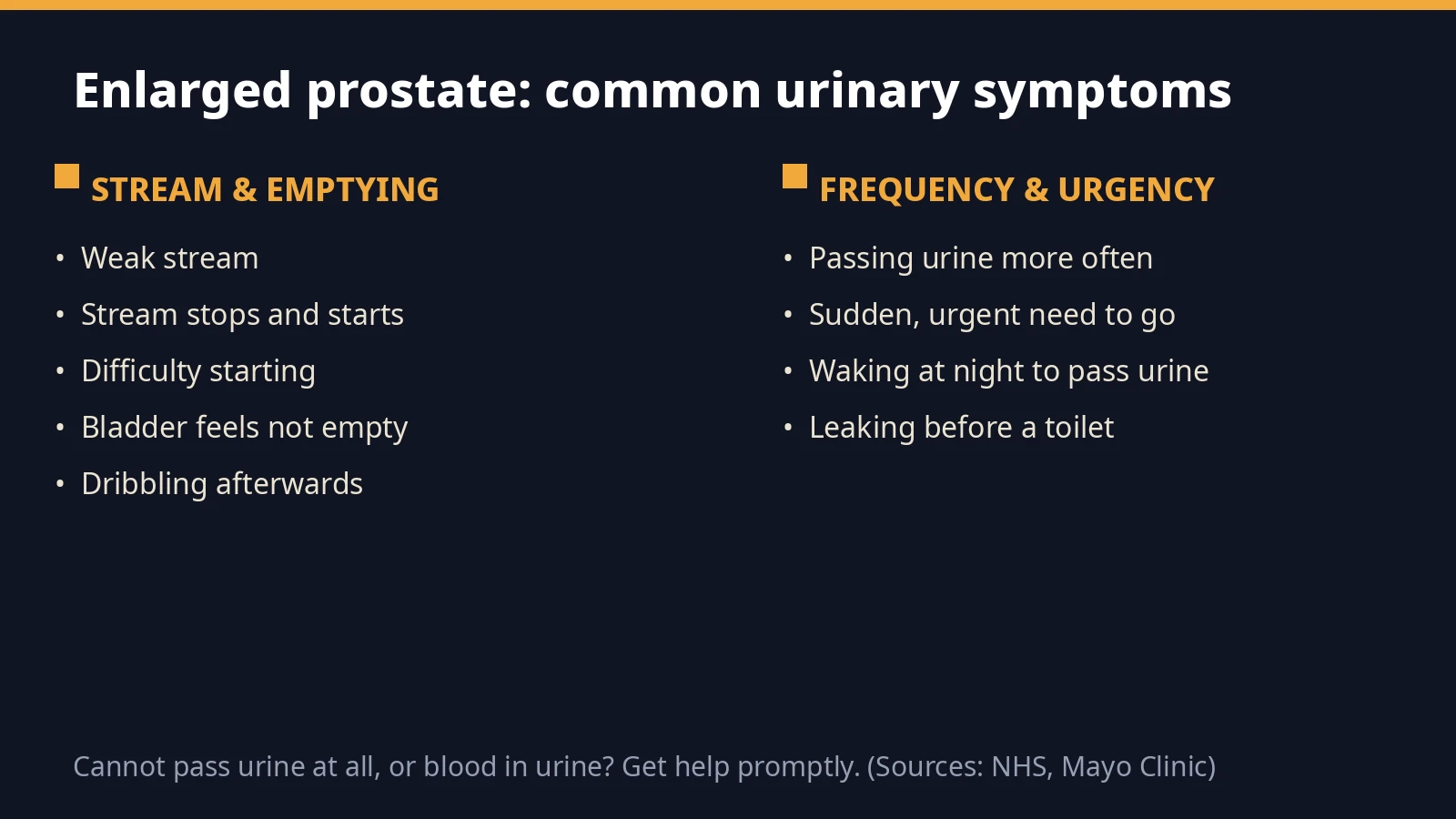
Most symptoms of an enlarged prostate relate to passing urine. They often build up gradually rather than appearing suddenly, and NHS 111 Wales notes that they may gradually get worse as you get older. Common signs include:
- Difficulty starting to pass urine, or needing to push or strain
- A weak urine stream, or a stream that stops and starts
- Taking longer than usual to empty the bladder
- Feeling that the bladder has not emptied fully
- Dribbling after finishing passing urine
- Needing to pass urine more often, or feeling a sudden, urgent need to go
- Waking during the night to pass urine
- Leaking urine before reaching a toilet
Less common signs listed by Mayo Clinic include a urinary tract infection, being unable to pass urine at all, and blood in the urine. MedlinePlus also lists pain during urination or after ejaculation, and urine with an unusual colour or smell, as symptoms that should prompt a check. Blood in the urine always needs investigation, even if it happens only once.
Enlarged prostate or something else?
Urinary symptoms are not specific to an enlarged prostate. Mayo Clinic lists other possible causes, including a urinary tract infection, inflammation of the prostate, narrowing of the urethra, bladder or kidney stones, nerve problems affecting the bladder, and cancer of the prostate or bladder. Some medicines can also make symptoms seem like those of an enlarged prostate.
That overlap is why self-diagnosis is unhelpful. A new, persistent or worsening change in how you pass urine deserves a proper assessment, even if it feels mild or embarrassing. Doctors hear about these symptoms every day, and early checking can rule out other causes and prevent complications.
Causes and risk factors
The exact cause of prostate enlargement is not known, but NHS Inform says most experts agree it is linked to hormonal changes that occur as a man gets older. Mayo Clinic likewise notes that it might be due to changes in the balance of sex hormones with age. The prostate typically keeps growing throughout life, which helps explain why symptoms become more common in later years.
Risk factors identified by Mayo Clinic include ageing, having a blood relative with prostate problems, diabetes and heart disease, and lifestyle factors: obesity raises the risk, while exercise can help lower it. MedlinePlus adds lack of physical activity and certain health conditions, including type 2 diabetes and heart and circulation problems, to the list of factors linked with a higher likelihood of developing BPH.
Nothing in this article should be read as a way to prevent enlargement. MedlinePlus states that researchers have not found ways to prevent BPH, although paying attention to symptoms and having regular check-ups can help problems be picked up earlier.
How an enlarged prostate is assessed
Assessment usually starts with a conversation about your symptoms: how often you pass urine, whether you wake at night, how strong the stream feels, and how much the symptoms bother you. NHS Inform explains that a doctor may ask you to complete a symptom questionnaire, with each answer scored so the overall score reflects how severe your symptoms are.
Other checks, described by NHS 111 Wales and MedlinePlus, may include a urine test, a blood test for prostate-specific antigen (PSA), a rectal examination to feel the size and shape of the prostate, a record of fluid intake and urination over several days, a urine flow test, an ultrasound scan, or a look inside the bladder with a camera. These tests also help rule out other conditions, because a raised PSA level alone cannot diagnose prostate cancer, as NHS Inform notes.
What happens next depends on how severe your symptoms are and how much they affect daily life. NHS Inform explains that mild to moderate symptoms may simply be monitored with regular check-ups, while moderate to severe symptoms may lead to a discussion of medicines or procedures. A doctor can explain the benefits and possible side effects of each option; this article does not recommend any particular medicine or procedure.
Possible complications of untreated enlargement, listed by Mayo Clinic, include being unable to pass urine, urinary tract infections, bladder stones, bladder damage and kidney damage. That is one reason persistent symptoms should not simply be waited out.
Self-care and living with it
Everyday habits will not shrink the prostate, but they can ease symptoms for some people. NHS 111 Wales suggests cutting down on alcohol and caffeine, reducing fluids before bed or before going out while still drinking enough during the rest of the day, eating enough fibre to help prevent constipation, keeping to a healthy weight, and waiting a few moments after passing urine and then trying again to help empty the bladder fully. It also advises against straining when passing urine, and against cutting fluids down too much, which can cause problems such as urinary tract infections.
NHS Inform also mentions regular exercise, limiting caffeine and alcohol, and bladder training carried out under medical supervision. MedlinePlus lists drinking less before bedtime or going out, avoiding or cutting back on caffeine and alcohol, bladder training and pelvic floor exercises, and preventing or treating constipation as lifestyle steps that may improve mild symptoms.
Keeping a simple note of symptoms can help at an appointment: how often you pass urine, how often you wake at night, any leaking or dribbling, and anything that seems to make symptoms better or worse. If you take medicines for other conditions, ask a doctor or pharmacist whether any of them could be worsening your urinary symptoms, as NHS 111 Wales suggests, rather than stopping a prescribed medicine on your own.
Symptoms can also affect mood, sleep and confidence, especially when night-time waking becomes frequent. Talking openly with a doctor, and with a partner or trusted person if that helps, is part of getting support — these are common symptoms, not something to be embarrassed about.
When to see a doctor
Talk to a doctor if you notice any problem with, or change to, your usual pattern of urination. NHS Inform advises seeing a GP even if symptoms are mild, because they could be caused by a condition that needs investigation. Mayo Clinic gives the same advice: talk to a health care provider about your symptoms, even if they do not bother you, so treatable causes can be found.
Get medical help promptly, or urgently, if you:
- Cannot pass urine at all
- See blood in your urine
- Have pain when passing urine
- Have fever and chills with painful, frequent and urgent urination
- Have pain in your lower abdomen
- Notice symptoms that keep getting worse, or that return again and again
Being unable to pass urine at all is a medical emergency and needs immediate help. This article is general information only and is not a substitute for medical advice. If you are worried about prostate symptoms, talk to a doctor.
In an emergency call 911 (US), 999 (UK) or 112 (EU).
Frequently asked questions
Is an enlarged prostate the same as prostate cancer?
An enlarged prostate is a non-cancerous growth of the prostate gland, also called benign prostatic hyperplasia (BPH). It is not prostate cancer, and NHS Inform states that having an enlarged prostate does not increase the risk of prostate cancer. However, both conditions can cause similar urinary symptoms, so new symptoms still need checking by a doctor.
What are the most common enlarged prostate symptoms?
Common signs are difficulty starting to pass urine, a weak or stop-start stream, dribbling afterwards, feeling the bladder has not emptied, needing to go more often or urgently, and waking at night to pass urine. Symptoms usually develop slowly and vary in severity. Some people have only mild symptoms, while others find sleep and daily life are badly affected.
What causes an enlarged prostate?
The exact cause is unknown, but it is linked to hormonal changes with ageing, and the prostate typically keeps growing throughout life. Risk factors include getting older, a family history of prostate problems, diabetes, heart disease and obesity, while regular exercise may help lower risk. Researchers have not found a way to prevent enlargement.
How does a doctor check for an enlarged prostate?
A doctor usually asks about symptoms, sometimes using a scored questionnaire, and may arrange a urine test, a PSA blood test, a rectal examination, a urination diary, a urine flow test or an ultrasound scan. These checks help confirm enlargement and rule out other causes, such as infection, stones or prostate cancer. A raised PSA alone cannot diagnose cancer.
When should I get urgent help for prostate symptoms?
Get medical help right away if you cannot pass urine at all, and seek prompt help for blood in your urine, pain when passing urine, fever with painful and urgent urination, or lower abdominal pain. Also talk to a doctor about any new or persistent change in your usual urination pattern, even if symptoms seem mild, so treatable causes are not missed.
What self-care steps may ease enlarged prostate symptoms?
Everyday steps may ease mild symptoms, such as cutting down on alcohol and caffeine, drinking less before bed while staying hydrated during the day, eating enough fibre to avoid constipation, exercising regularly and trying to empty the bladder fully. Do not strain when passing urine, do not cut fluids drastically, and ask a doctor before changing any prescribed medicine.
Sources
- NHS Inform: Benign prostate enlargement www.nhsinform.scot
- Mayo Clinic: Benign prostatic hyperplasia (BPH) — Symptoms and causes www.mayoclinic.org
- Cleveland Clinic: Benign Prostatic Hyperplasia (BPH) my.clevelandclinic.org
- MedlinePlus: Enlarged Prostate - BPH - Benign Prostatic Hyperplasia medlineplus.gov
- NHS 111 Wales: Prostate enlargement 111.wales.nhs.uk
- NIDirect: Benign prostate enlargement www.nidirect.gov.uk

Try the tool
Not sure if it can wait?
Common causes and warning signs for 16 everyday symptoms.
Open the symptom guide