HSV-1 and Alzheimer’s: Cold Sore Virus Linked to Dementia Risk
A review of 11 studies links the cold sore virus HSV-1 to a 48% higher risk of Alzheimer's or dementia — but the evidence cannot prove the virus causes the disease.
- Written by
- Health Daily Advice
- Published
- Reading time
- 5 minutes
- Sources
- 9 cited

In this guide
A review of 11 studies found that people infected with HSV-1, the virus behind most cold sores, had 48% higher odds of developing Alzheimer’s disease or dementia. The link held up across analyses, but the studies cannot prove the virus causes dementia. Most people with HSV-1 never develop dementia, and steps such as not smoking and staying active matter most.
What the review found
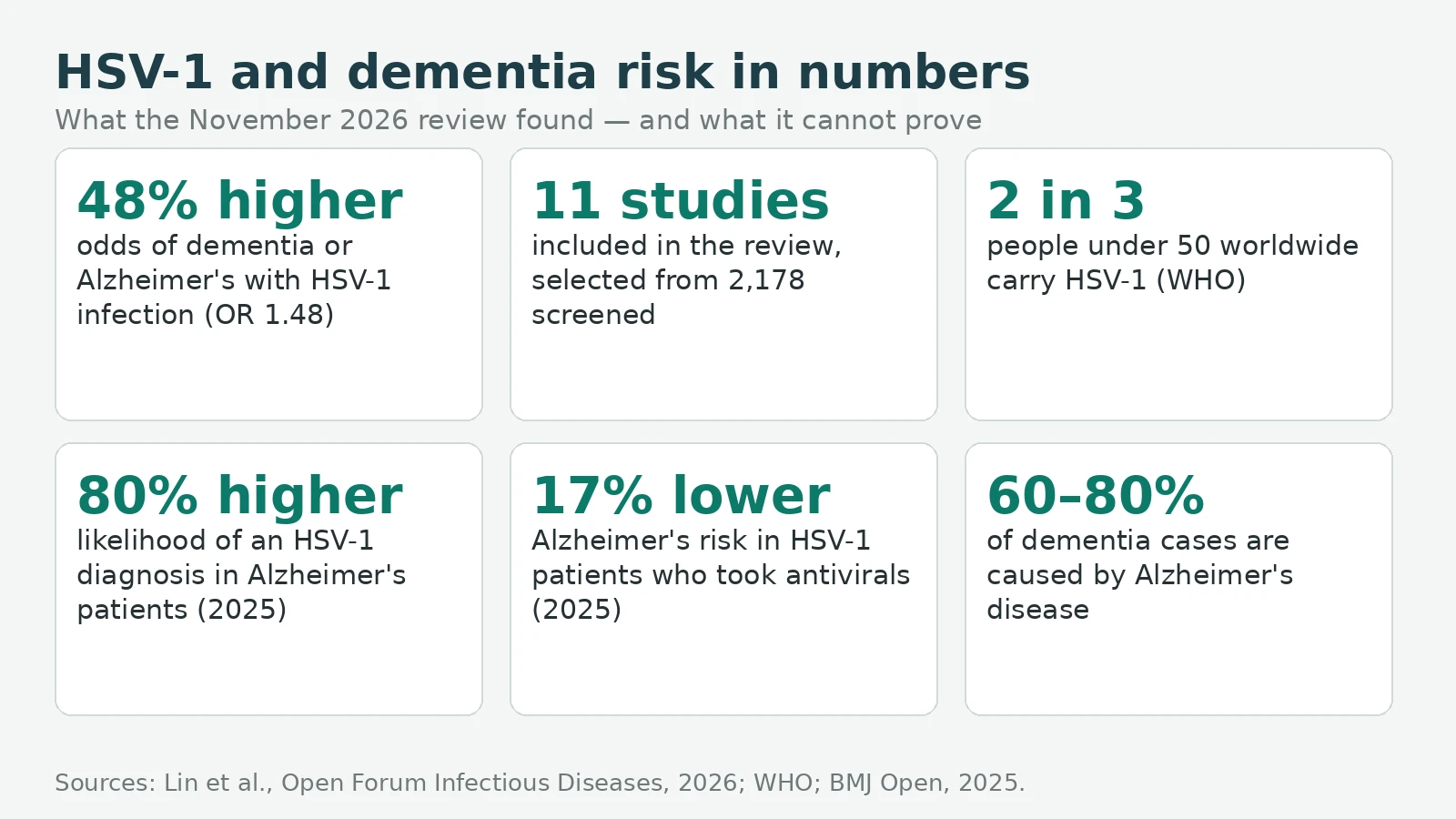
Researchers at the University of Southern California Keck School of Medicine searched eight research databases and screened 2,178 studies before selecting 11 for their analysis, published in Open Forum Infectious Diseases in November 2026. Pooling those studies, they found that HSV-1 infection was associated with a 48% higher odds of developing dementia or Alzheimer’s disease (odds ratio 1.48).
The link stayed consistent when the studies were grouped by age, by whether they accounted for the APOE gene — the best-known genetic risk factor for Alzheimer’s — and by heart disease, study type and study quality. That consistency is what makes the finding notable, even though earlier reviews of the same question had reached mixed conclusions, with one finding no increased risk at all.
How common is HSV-1?
HSV-1 is one of the most widespread viruses on earth. The World Health Organization estimates that 3.8 billion people under the age of 50 — about 64% of the world’s population in that age group — carry HSV-1. Most infections are picked up in childhood and cause oral herpes, better known as cold sores. HSV-1 can also cause genital herpes.
Most people with HSV-1 have no symptoms at all, or only mild ones. The virus lives inside nerve cells and alternates between lying dormant and becoming active again, with recurrences often triggered by illness, fever, sun exposure, injury or stress. Antiviral medicines can shorten outbreaks and reduce how often they happen, but they cannot cure the infection.
That scale is exactly why the finding matters — and why it should not be read as a personal prediction. A 48% higher odds is a relative figure across populations. The review does not give an absolute risk for any one person, and most people who carry HSV-1 will never develop dementia.
How could a cold sore virus affect the brain?
Scientists have been investigating this link for decades. HSV-1 can reach the brain and remain there, hidden, for much of a person’s life. In laboratory models using neural stem cells, the virus has been shown to cause changes similar to those seen in Alzheimer’s disease.
One proposed explanation involves inflammation: repeated reactivation of the virus may drive long-term inflammation in the brain. Another involves amyloid-beta, the protein that builds up in the plaques characteristic of Alzheimer’s. Researchers have found that amyloid-beta is produced in response to HSV-1 infection and appears to act as part of the brain’s defence against the virus — trapping it — while the plaques themselves damage nerve cells. HSV-1 DNA has also been found inside Alzheimer’s plaques.
Genetics may play a part too. People who carry the APOE-e4 gene variant, the most common genetic risk factor for Alzheimer’s, appear more vulnerable to HSV-1 infection, and some studies have found the link between HSV-1 reactivation and Alzheimer’s is strongest in APOE-e4 carriers. A Cleveland Clinic team has also described a possible pathway in which reactivated herpesviruses switch on fragments of DNA called transposable elements in ageing brains, disrupting genes involved in Alzheimer’s.
What earlier studies found
The new review is not the first to connect HSV-1 with dementia. A large study published in BMJ Open in 2025 compared the health records of 344,628 matched pairs of Americans and found that people with Alzheimer’s were 80% more likely to have a recorded HSV-1 diagnosis than similar people without the disease. The same study found that HSV-2 and varicella zoster virus — the virus behind chickenpox and shingles — were also linked to a higher risk of Alzheimer’s.
That study also offered a hint about treatment. Among the 2,330 people with a history of HSV-1, those who had taken antiviral medicine were 17% less likely to develop Alzheimer’s than those who had not. Other large studies have found similar patterns, with antiviral treatment linked to a lower dementia risk. But all of these studies are observational: they show a pattern, not proof that the treatment caused the difference.
There is wider context, too. Researchers have linked 22 types of viral infection to dementia, and several large studies have found that people who receive routine adult vaccines — against flu, RSV, pneumococcal disease, DTaP and shingles — have a lower risk of dementia, with some finding reductions of 25% to 40%. Randomised controlled trials testing antiviral treatments in Alzheimer’s disease are now under way.
What this does not prove
The most important caveat is that none of this proves HSV-1 causes Alzheimer’s or dementia. A review of observational studies can show that two things tend to occur together; it cannot show that one causes the other. It is possible, for example, that people in the early stages of dementia are more likely to have HSV-1 recorded in their medical records, or that some other factor explains the link.
The authors of the new review say the same thing themselves, concluding that further prospective studies and intervention trials are needed to clarify the relationship. They suggest future research could test whether antiviral medicines or preventive vaccines change dementia rates — but that work has not been done yet, and no one should take antivirals to prevent dementia on the basis of this evidence.
It is also worth remembering what the established risk factors are. According to the NHS, Alzheimer’s risk rises mainly with age — about 1 in 14 people over 65 and 1 in 6 over 80 in the UK develop the condition — along with family history, untreated depression and lifestyle factors linked to cardiovascular disease. Alzheimer’s accounts for 60% to 80% of all dementia cases, according to the Alzheimer’s Association.
Can you lower your risk?
There is no known way to prevent Alzheimer’s disease, but the NHS lists steps that may reduce risk or delay onset: stopping smoking, cutting down on alcohol, eating a healthy balanced diet, maintaining a healthy weight, and staying physically fit and mentally active. These measures also lower the risk of cardiovascular disease, which is itself linked to dementia.
For cold sores themselves, the WHO advises avoiding oral contact with others and not sharing items that have touched saliva while sores are present, and using sun protection if sunlight triggers outbreaks. Antiviral medicines are for treating herpes symptoms as prescribed by a doctor or pharmacist — not for preventing dementia. If you get frequent or severe cold sores, or you are worried about your memory, talk to your doctor rather than trying to treat either problem yourself.
When to see a doctor
See your GP if you are worried about your memory or think you may have dementia — for example, if you keep forgetting recent conversations or events, or the names of places and objects, or if you notice confusion, difficulty planning or problems with speech. Memory problems do not necessarily mean Alzheimer’s disease, but the NHS advises getting them checked, and taking someone who knows you well to the appointment can help describe any changes.
Seek medical advice promptly for cold sores that are very painful, keep coming back, do not heal, or affect your eyes or vision — rarely, HSV-1 can cause an eye infection. In an emergency call 911 (US), 999 (UK) or 112 (EU).
Frequently asked questions
Does having cold sores mean I will get Alzheimer's?
No. Most people who carry HSV-1 never develop dementia, and the review gives no absolute risk for any one person. The 48% figure is a relative increase across populations, and many other factors — above all age and family history — shape a person's risk. Having cold sores is very common; Alzheimer's is not an inevitable consequence.
How could HSV-1 affect the brain?
HSV-1 can reach the brain and lie dormant in nerve cells for life, reactivating from time to time. Researchers think repeated reactivation may drive inflammation, and that amyloid-beta — the protein in Alzheimer's plaques — is produced as part of the brain's defence against the virus. HSV-1 DNA has also been found inside Alzheimer's plaques, and APOE-e4 carriers appear more vulnerable.
Should I take antivirals to prevent dementia?
No. The evidence linking antiviral treatment to a lower dementia risk comes from observational studies, which cannot prove cause and effect. Trials testing antivirals in Alzheimer's are under way, but no antiviral is recommended for preventing dementia. Antivirals should only be taken as prescribed by a doctor or pharmacist for herpes symptoms.
What are the early signs of Alzheimer's?
The first sign is usually minor memory problems, such as forgetting recent conversations or events and the names of places and objects. As the condition develops, symptoms can include confusion, difficulty planning or making decisions, problems with speech and language, and changes in mood or behaviour. Memory problems do not always mean Alzheimer's, so they should be checked by a GP.
Can Alzheimer's disease be prevented?
There is no known way to prevent Alzheimer's, because its exact cause is not fully understood. The NHS says steps that may reduce risk or delay onset include stopping smoking, cutting down on alcohol, eating a healthy balanced diet, keeping a healthy weight, and staying physically fit and mentally active. These steps also lower cardiovascular risk, which is linked to dementia.
What is the difference between dementia and Alzheimer's?
Dementia is the umbrella term for a group of symptoms linked to an ongoing decline in brain function, affecting memory, thinking and other mental abilities. Alzheimer's disease is the most common cause of dementia, accounting for 60% to 80% of cases. Other causes include vascular dementia, dementia with Lewy bodies and frontotemporal dementia.
Sources
- Lin F et al. Association Between Herpes Simplex Virus-1 Infection and Dementia or Alzheimer's Disease: A Systematic Review and Meta-Analysis. Open Forum Infectious Diseases, 2026 doi.org
- CIDRAP: People with certain herpes infections have almost 50% higher risk of Alzheimer's or dementia, review finds www.cidrap.umn.edu
- WHO: Herpes simplex virus www.who.int
- NHS: Alzheimer's disease www.nhs.uk
- Alzheimer's Association: What is Alzheimer's Disease? www.alz.org
- Liu et al. Association between herpes simplex virus type 1 and the risk of Alzheimer's disease. BMJ Open, 2025 doi.org

Try the tool
Not sure if it can wait?
Common causes and warning signs for 16 everyday symptoms.
Open the symptom guide