Walking Pneumonia: Symptoms, Causes and When to Worry
A cough that lingers, a low fever and tiredness that feel like a bad cold can be walking pneumonia. What causes it, how long it lasts and when it needs a doctor.
- Written by
- Health Daily Advice
- Published
- Reading time
- 5 minutes
- Sources
- 9 cited

In this guide
Walking pneumonia is a mild form of pneumonia, most often caused by the bacterium Mycoplasma pneumoniae. Its symptoms — a dry cough that slowly gets worse, a low-grade fever, sore throat and tiredness — feel more like a bad cold than a chest infection. Most people recover in a few weeks, but it can occasionally turn serious.
The name comes from the way it behaves: people often feel well enough to keep walking around, going to work or school, while they are ill. That is also what makes it easy to miss — and easy to spread.
What is walking pneumonia?
Walking pneumonia is not a formal medical diagnosis. It is an informal name, also called atypical pneumonia, for a mild case of pneumonia. Pneumonia itself is inflammation of the lungs, usually caused by an infection, and it can be caused by bacteria, viruses or, more rarely, fungi.
The most common cause of walking pneumonia is the bacterium Mycoplasma pneumoniae. According to the Mayo Clinic, this germ typically produces milder symptoms than other types of pneumonia, and the illness is often not severe enough to require bed rest. Other germs, including Chlamydia pneumoniae and some viruses, can cause a similar mild illness.
It is a common germ. The CDC notes that when people need hospital care for pneumonia, M. pneumoniae is the most common bacterial cause in children and the second most common in adults. Infections surged in 2024 and, while they have since been falling in the United States, they remain higher than usual in some regions.
Walking pneumonia symptoms
Symptoms usually come on gradually, over days rather than hours, and can feel much like a bad cold. The most common ones are:
- a cough, often dry, that slowly gets worse
- a low-grade fever and chills
- a sore throat
- extreme tiredness
- a headache
- chest pain or discomfort, especially when breathing deeply or coughing
- shortness of breath
Children under five may look different: instead of a chest cold, they can have diarrhoea, sneezing, a stuffy or runny nose, vomiting, watery eyes and wheezing, according to the CDC.
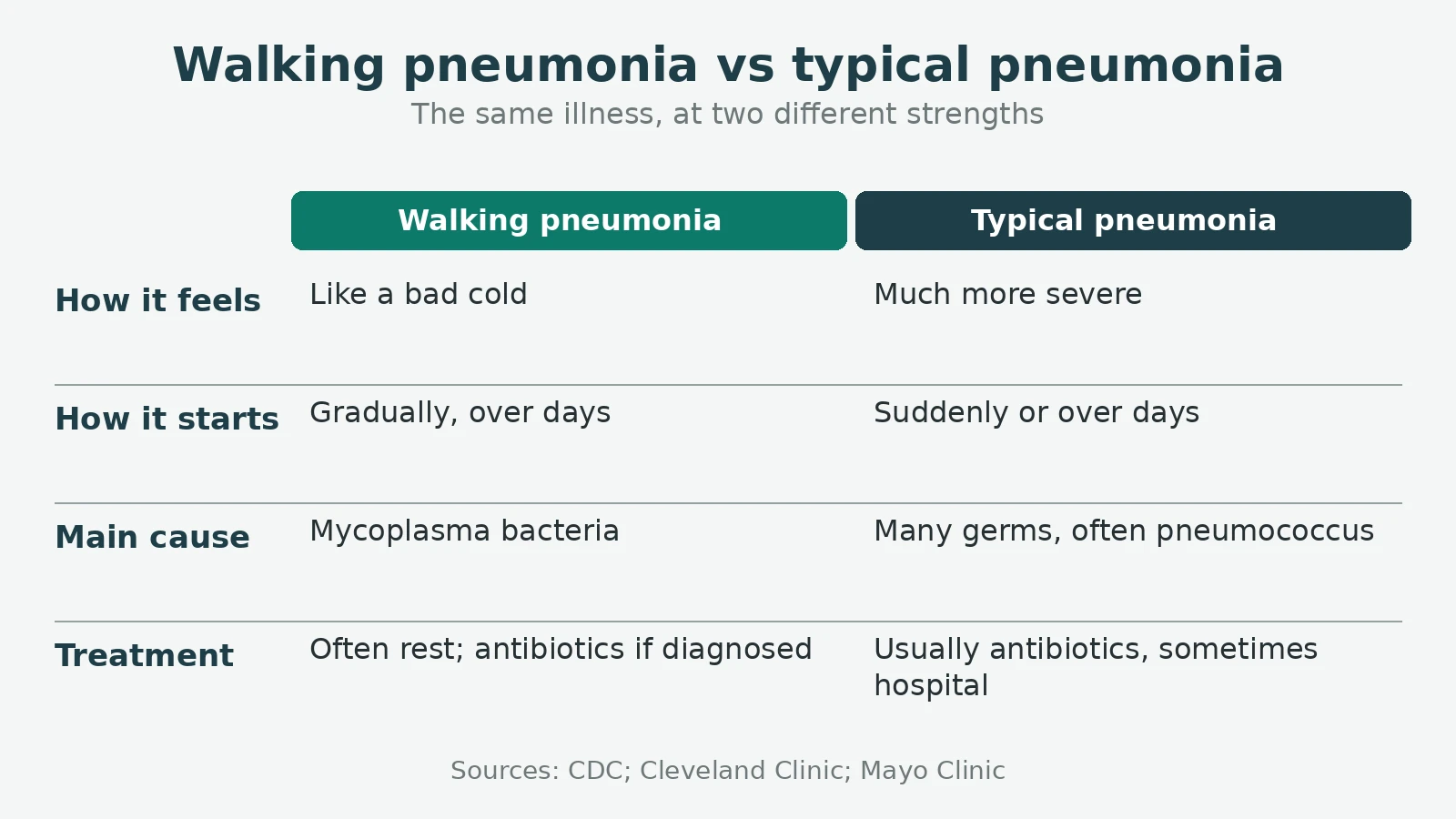
The difference from typical pneumonia is mostly one of degree. In typical pneumonia the air sacs in the lungs fill with mucus and fluid, which can make breathing hard and cause a high fever, severe chest pain, confusion and blue lips or nails. Walking pneumonia rarely reaches that point — but the symptoms overlap enough that only a clinician can tell them apart.
What causes walking pneumonia?
The usual cause is infection with Mycoplasma pneumoniae, a bacterium that damages the lining of the respiratory tract, including the throat, windpipe and lungs. It spreads from person to person through respiratory droplets — when someone coughs or sneezes near you without covering their mouth.
It spreads most easily where people live or work close together, such as schools, college dorms, military bases and care homes. Children, young adults and people in crowded conditions are the most likely to catch it, and the germ can be passed on even before symptoms appear: the Cleveland Clinic notes that people may be contagious throughout the incubation period, even with no symptoms at all.
How long does it last, and is it contagious?
It can take one to four weeks for symptoms to appear after exposure, and symptoms can last for several weeks, according to the CDC. The cough is often the longest-lasting part. The NHS says most people with pneumonia generally get better in two to four weeks, and the Cleveland Clinic advises expecting a few weeks before you are back to full speed.
Yes, it is contagious. The type of pneumonia linked to walking pneumonia usually spreads through coughing and sneezing, so handwashing, covering coughs and staying home while you feel unwell all help. Some people have no symptoms at all and can still pass the germ on.
How is it diagnosed and treated?
There is no quick test for M. pneumoniae, unlike some other respiratory illnesses. A clinician will usually examine you and listen to your lungs, and may order a chest X-ray to confirm pneumonia. A nose or throat swab can be sent to a laboratory, but many clinicians do not test for this germ in mild illness.
Most people with a mild infection recover on their own without medicine. When pneumonia caused by M. pneumoniae is diagnosed, clinicians routinely treat it with antibiotics. The Cleveland Clinic lists macrolides, fluoroquinolones and tetracyclines among the antibiotics used — the choice depends on the patient and local guidance, so this is a decision for a doctor, not something to start on your own.
The Cleveland Clinic also warns against taking antibiotics before pneumonia has been confirmed, because overuse can lead to antibiotic resistance, allergic reactions and a serious gut infection called C. difficile. If a virus is the cause, antibiotics will not help at all. Rest, fluids and over-the-counter remedies for fever and congestion can help while you recover — ask a doctor or pharmacist which ones suit you.
Rare complications to know about
Serious complications are uncommon, but they do happen, and they are part of why this germ has been in the news. The CDC lists asthma attacks, swelling of the brain (encephalitis), a shortage of red blood cells (haemolytic anaemia), kidney problems, serious pneumonia and blistering skin conditions among the possible complications. In November 2026, reports described rare brain complications in children linked to this germ, including encephalitis and stroke.
The risk of becoming seriously ill is greatest for children under two, adults over 65, people with weakened immune systems, and people with long-term conditions such as heart disease, diabetes or asthma — as well as people who smoke. Walking pneumonia can also turn into more serious pneumonia, most often in people in these higher-risk groups or when symptoms keep getting worse without treatment.
When to see a doctor
See a doctor if you think you have pneumonia, or if you are taking antibiotics and your symptoms have not improved after a few days. The Cleveland Clinic advises calling your doctor if you are not feeling better after a week of rest, fluids and any prescribed treatment, or if your symptoms keep getting worse.
Get urgent help straight away if you are struggling to breathe, are short of breath while sitting still, have rapidly worsening symptoms, new or worsening chest pain, blue or grey skin, lips or nails, or confusion. The NHS adds: call 999 or go to A&E if you are coughing up blood, suddenly feel confused, or cannot wake your baby. In an emergency call 911 (US), 999 (UK) or 112 (EU).
Frequently asked questions
Is walking pneumonia contagious?
Yes. The type of pneumonia linked to walking pneumonia usually spreads through respiratory droplets when someone coughs or sneezes. People may be contagious during the incubation period, before they have any symptoms. Handwashing, covering coughs and staying home while unwell all help to stop it spreading.
How long does walking pneumonia last?
It can take one to four weeks for symptoms to appear after exposure, and symptoms can last for several weeks, according to the CDC. The cough is often the longest-lasting part. The NHS says most people with pneumonia generally get better in two to four weeks, and the Cleveland Clinic advises expecting a few weeks before you are back to full speed.
Can walking pneumonia turn into pneumonia?
Walking pneumonia is already a mild form of pneumonia, so the question is really whether it can get worse. It can, most often in people at higher risk — children under two, adults over 65, people with weakened immune systems or long-term heart and lung conditions — or when symptoms keep getting worse without treatment.
Do you need antibiotics for walking pneumonia?
Not always. Most people with a mild infection recover on their own without medicine. When pneumonia caused by Mycoplasma pneumoniae is diagnosed, clinicians routinely treat it with antibiotics. If a virus is the cause, antibiotics will not help. A doctor should confirm pneumonia before antibiotics are started.
How do you know if it is walking pneumonia or a cold?
You cannot be sure on your own. Walking pneumonia often starts like a cold — sore throat, tiredness, low-grade fever — but the cough slowly gets worse and lingers for weeks, sometimes with chest discomfort or shortness of breath. Only a clinician, usually with a chest X-ray, can confirm pneumonia. See a doctor if a cough lasts more than a few weeks.
Can children get walking pneumonia?
Yes. Mycoplasma pneumoniae is the most common bacterial cause of pneumonia needing hospital care in children, according to the CDC. Children under five may have different symptoms from adults, such as diarrhoea, vomiting, wheezing, a runny nose and watery eyes. Children under two face the highest risk of becoming seriously ill.
Sources
- CDC: About Mycoplasma pneumoniae Infection www.cdc.gov
- NHS: Pneumonia www.nhs.uk
- Mayo Clinic: Pneumonia www.mayoclinic.org
- Cleveland Clinic: Walking Pneumonia my.clevelandclinic.org
- Cleveland Clinic: Walking Pneumonia vs. Pneumonia health.clevelandclinic.org

Try the tool
Not sure if it can wait?
Common causes and warning signs for 16 everyday symptoms.
Open the symptom guide