Do Thin Condoms Break Easily? What the Evidence Shows
Thin condoms are a breakout search this week — but do they actually break more easily? A 2025 trial says no. Here is what the evidence shows, what really causes condoms to fail, and how to use one correctly.
- Written by
- Health Daily Advice
- Published
- Reading time
- 8 minutes
- Sources
- 11 cited
In this guide
No. Thin condoms do not break more easily than standard condoms when they are used correctly. In a 2025 trial, the thinnest latex condom tested failed less often than two thicker ones. Thin condoms must pass the same safety tests as standard condoms, and most breakage comes from how a condom is used, not from how thin it is.
That answer surprises a lot of people, because it feels obvious that a thinner layer of latex should tear more easily. The worry is understandable, and it is one reason searches for thin and ultra-thin condoms have surged this week. But the worry does not match the evidence. What matters far more than thickness is fit, lubrication, storage and technique.
What does “thin” mean for a condom?
There is no single worldwide definition of a thin condom, so the word is used loosely on packaging. In practice, manufacturers describe condoms by the thickness of the latex wall, measured in micrometres (µm) — one micrometre is a millionth of a metre.
The two trials this article draws on give a useful sense of scale. In a 2025 trial published in Contraception, researchers tested a natural rubber latex condom 42 µm thick against two marketed alternatives at 55 µm and 70 µm. In a separate 2024 study, the thin latex control condom was 55 µm thick, while the same maker’s standard latex condom measured 70 µm. So a condom described as thin or ultra-thin is typically a few dozen micrometres thick — still a continuous sheet of latex, just a thinner one.
Thin condoms are also made from other materials. Polyurethane condoms can be made much thinner still — in the 2024 study, the two ultra-thin polyurethane condoms were 24 µm and 18 µm thick. Polyurethane is an option for people with a latex allergy, and it works with any type of lubricant. Latex-free condoms made from polyisoprene are another alternative.
Do thin condoms break more easily than standard condoms?
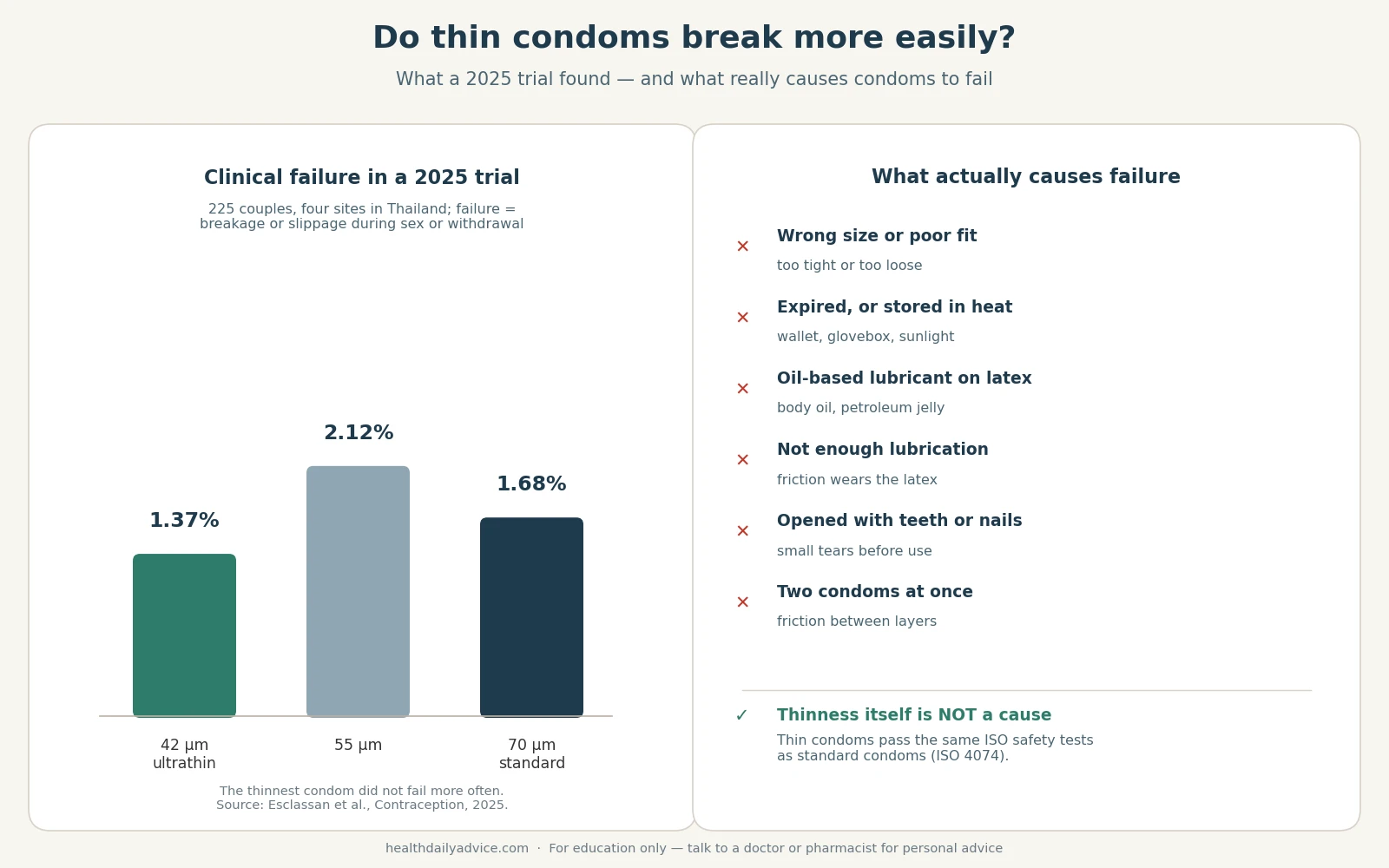
The best direct evidence comes from the 2025 trial mentioned above. Researchers at four sites in Thailand ran a blinded, three-way crossover study in which 225 couples each used condoms of all three thicknesses — 42 µm, 55 µm and 70 µm — and reported any breakage or slippage during sex or withdrawal. The trial was designed to test whether the thinnest condom was no worse than the thicker ones, and it was conducted to current International Organization for Standardization (ISO) standards.
The results went against the common worry. Clinical failure — breakage or slippage combined — was 1.37% for the 42 µm condom, 2.12% for the 55 µm condom and 1.68% for the 70 µm condom. In other words, the thinnest condom had the lowest failure rate of the three, and the authors concluded that its performance in terms of failure rate, slippage or breakage was not altered by its thinness. The differences between the three are small, and all three failure rates are low — roughly one or two failures per 100 uses.
That pattern fits the wider picture. The Family Planning Handbook notes that on average about 2% of condoms break or slip off completely during sex, mainly because they are used incorrectly, and that used properly, condoms seldom break. The gap between perfect and typical use is much bigger than any gap between thicknesses: the NHS says condoms are up to 98% effective at preventing pregnancy when used correctly every time, but 82% effective with typical use, while Planned Parenthood puts typical-use effectiveness at about 87%. Technique, not thickness, is what moves those numbers.
What about ultra-thin condoms made from polyurethane?
Polyurethane tells a slightly more careful story. A 2024 randomised, masked crossover study compared two ultra-thin polyurethane condoms — 24 µm and 18 µm thick — against a thin latex control condom 55 µm thick, in 300 heterosexual couples in California. All three condoms had low failure rates, but the polyurethane ones failed a little more often than the latex control.
The thin latex control had a total clinical failure rate of 1.3%, made up of 0.8% breakage and 0.5% slippage. The wider polyurethane condom (24 µm) had a total failure rate of 2.5% and met the study’s non-inferiority requirement — meaning it was judged not meaningfully worse than the latex control. The narrower polyurethane condom (18 µm) had a total failure rate of 3.0% and only met that requirement when the analysis was limited to men whose penis length was 170 mm or less.
That last detail is telling. Almost half of the narrower condom’s breakages happened in men with a penis longer than 170 mm, and nearly a fifth of users said it felt too tight, compared with 8.4% for the latex control. In other words, the failures were mostly about fit — a condom that is too small for the person wearing it — rather than about thinness as such. A condom that does not fully cover the penis, or that feels tight, is the wrong size, whatever material it is made from.
For most people, the practical message is the same either way: latex thin condoms perform as well as standard latex ones, and ultra-thin polyurethane condoms perform well too, provided the fit is right. People with a latex allergy may find polyurethane or polyisoprene condoms the better choice, and should talk to a pharmacist or sexual health clinic about options.
How are thin condoms tested for safety?
A thin condom is not simply a standard condom stretched thinner. Manufacturers use latex formulations designed to stay strong at lower thickness, and every condom sold legally in the UK or Europe must meet the same safety standard as any other condom.
The international standard for natural rubber latex condoms is ISO 4074, which sets minimum requirements and test methods, including tests for freedom from holes, burst volume and burst pressure, and shelf life. The 2025 trial’s ultrathin condom was, in the authors’ words, “clinically tested to current International Organization for Standardization standards”. The NHS advises checking the packet for a European CE mark or UKCA mark, which means the condom has been tested to high safety standards. Buying from a reputable shop or pharmacy, and checking for one of those marks, is the simplest quality check available.
What actually causes a condom to break?
Most condom failures are not manufacturing failures. They are use failures, and most of them are avoidable. The common causes are:
- Wrong size or poor fit. A condom that is too tight can tear, and one that is too loose can slip off. If a condom feels uncomfortably tight, or does not roll down easily, try a different size or shape.
- Expired or damaged condoms. Latex weakens with age and with heat. The NHS advises checking the use-by date, because an expired condom may not be effective, and keeping condoms in a cool, dry place — not in a wallet or a hot car for weeks on end.
- Oil-based lubricant on latex. Body oil, lotion, petroleum jelly and similar products can damage latex and make it likely to burst. With latex or polyisoprene condoms, use a water-based or silicone-based lubricant instead.
- Not enough lubrication. Friction is hard on latex. Extra lubricant, especially during anal sex, reduces the chance of a condom bursting, according to NHS inform.
- Damage when opening the packet. Teeth, sharp fingernails and jewellery can nick the latex. Push the condom to one side of the packet and tear along the edge.
- Using two condoms at once. Wearing two condoms, or a condom together with an internal condom, creates friction between the layers and can make one or both split. One condom, used correctly, is the protection you need.
- Putting it on late or taking it off early. The condom needs to be on before any genital contact and stay on until after withdrawal, with the base held as you pull out.
Notice what is not on that list: thinness. A thin condom that fits well, is in date, is stored properly and is used with the right lubricant is as reliable as a standard one.
How do you use a thin condom correctly?
The steps are the same as for any condom. The NHS sets them out plainly:
- Check the use-by date and look for a CE or UKCA mark on the packet. Squeeze the packet gently — if air escapes, the seal may be broken, so use a different one.
- Open the packet carefully, without teeth or sharp nails.
- Put the condom on before any genital contact, when the penis is fully erect.
- Hold the tip to squeeze out any air, then roll it all the way down to the base. If it does not roll down, it is probably the wrong way round — throw it away and start with a new one.
- Use extra water-based or silicone-based lubricant if needed, especially for anal sex.
- Keep the condom on until you have finished. When withdrawing, grip the base so it does not slip off, and withdraw while still erect.
- Remove it carefully, tie it off if you like, and put it in the bin — never in the toilet. Use a new condom every time.
How can you check a condom before and after use?
Before use, check three things: the date, the packet and the condom itself. The packet should be intact and in date. Once opened, the condom should look undamaged and unroll smoothly. If it feels dry, sticky, brittle or torn, or if it will not unroll, throw it away and use another.
After use, look at the condom before you throw it away. If it has split, torn or come off, act as if there was a risk — see the next section. A quick check takes seconds and is the simplest habit that catches a failure early, when something can still be done about it.
What should you do if a condom breaks?
First, do not panic — but do act promptly. If a condom splits or comes off, there may be a risk of pregnancy or a sexually transmitted infection, and the options available depend on how quickly you act.
Emergency contraception is available from a GP, a sexual health service and most pharmacies — ask a pharmacist as soon as possible, because it works best the sooner it is taken. An intrauterine device (IUD) can also be used as emergency contraception up to 5 days after sex, and is available from sexual health services. If there is a risk of HIV exposure, post-exposure prophylaxis (PEP) is available from sexual health clinics and, out of hours, from A&E. An STI check is available from a GP, a sexual health service and some pharmacies.
Talk to a doctor or pharmacist about which option fits your situation — they can advise on timing and on what testing is needed. Do not rely on washing or douching, which does not prevent pregnancy or infection.
When to see a doctor
See a doctor or visit a sexual health clinic promptly if a condom breaks or slips off and there is any chance of pregnancy or an STI, if you notice discharge, sores, pain when passing urine, or a rash after sex, or if you are unsure whether the condom stayed intact. Sexual health services are confidential, and in the UK many offer walk-in appointments and free testing.
If you find condoms keep breaking, slipping or feeling uncomfortable, that is worth discussing with a doctor, pharmacist or sexual health adviser too. It usually points to a fit or technique problem that can be fixed, and they can help you find a size and type that works.
In an emergency call 911 (US), 999 (UK) or 112 (EU)
Frequently asked questions
Do thin condoms break more easily than standard condoms?
No. In a 2025 trial of 225 couples, the thinnest latex condom (42 micrometres) had a clinical failure rate of 1.37%, lower than the 2.12% and 1.68% seen with 55 and 70 micrometre condoms. The authors concluded thinness did not change performance. Thin condoms must pass the same safety tests as standard condoms, and most breakage comes from incorrect use.
Are ultra-thin polyurethane condoms safe?
Yes, when the fit is right. In a 2024 study, a 24-micrometre polyurethane condom had a 2.5% total failure rate and was judged not meaningfully worse than a thin latex control at 1.3%. A narrower 18-micrometre version failed more often, mostly in men for whom it was too small. Polyurethane is also an option for people with a latex allergy.
What causes condoms to break most often?
Incorrect use causes most failures. The common causes are the wrong size or poor fit, expired or heat-damaged condoms, oil-based lubricant used with latex, not enough lubrication, damage when opening the packet with teeth or nails, and using two condoms at once. About 2% of condoms break or slip off, mainly for these reasons rather than any fault in the condom itself.
Can I use oil-based lubricant with thin latex condoms?
No. Oil-based products such as body oil, lotion or petroleum jelly can damage latex and make a condom likely to burst. With latex or polyisoprene condoms, use a water-based or silicone-based lubricant instead. Extra lubricant also reduces friction and lowers the chance of breakage, especially during anal sex. Any lubricant can be used with non-latex condoms.
What should I do if a thin condom breaks?
Act promptly. Ask a pharmacist or visit a sexual health clinic as soon as possible about emergency contraception, which works best the sooner it is taken, and an IUD can be used as emergency contraception up to 5 days after sex. If HIV exposure is possible, post-exposure prophylaxis (PEP) is available from sexual health clinics and, out of hours, from A&E. Get an STI check too.
Sources
- Esclassan F, et al. Comparative performance of ultrathin and standard latex condoms: A randomized multicentre trial. Contraception, 2025 pubmed.ncbi.nlm.nih.gov
- Potter W, et al. Clinical breakage, slippage and acceptability of two commercial ultra-thin polyurethane male condoms compared to a commercial thin latex condom. Reproductive Health, 2024 pmc.ncbi.nlm.nih.gov
- NHS: Condoms www.nhs.uk
- NHS inform: Condoms www.nhsinform.scot
- Planned Parenthood: What Is the Effectiveness of Condoms? www.plannedparenthood.org
- Family Planning Handbook: Questions and Answers About Male Condoms fphandbook.org
- ISO 4074: Natural latex rubber condoms — Requirements and test methods (IS/ISO 4074:2002 full text) archive.org

Try the tool
Not sure if it can wait?
Common causes and warning signs for 16 everyday symptoms.
Open the symptom guide