What Is Sundowning in Dementia? Causes and What Helps
As evening falls, many people with dementia grow more confused, anxious or restless. Here is what sundowning is, why it happens, and the everyday changes that can make evenings calmer.
- Written by
- Health Daily Advice
- Published
- Reading time
- 9 minutes
- Sources
- 10 cited

In this guide
Sundowning is the name for the confusion, anxiety and restlessness that many people with dementia develop in the late afternoon and evening. It is not a disease on its own, but a pattern of symptoms linked to dementia. The exact cause is unknown, though tiredness, a disrupted body clock and fading light all play a part.
If you care for someone with dementia, you may know the pattern well. The morning goes reasonably smoothly, the person is settled and recognisable, and then, as the light starts to fade, everything shifts. They grow restless, anxious or confused. They may pace, ask to go home, or become convinced that something is wrong. By morning, the episode has often passed — only to return the next evening.
That daily rhythm has a name, and understanding it is the first step to making evenings easier for both the person with dementia and the people who care for them.
What does sundowning look like?
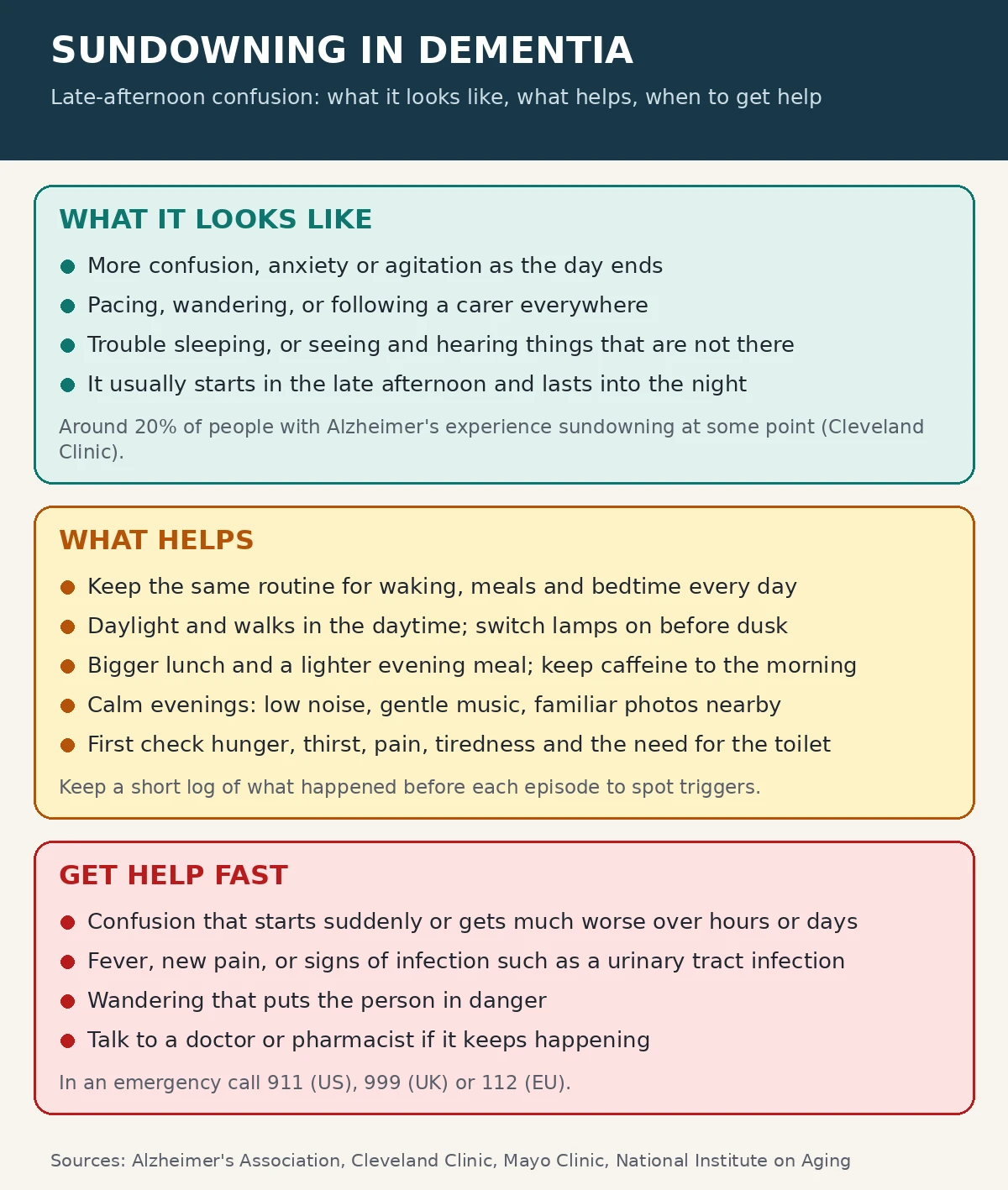
Sundowning is not one single behaviour. The Alzheimer’s Association describes it as increased confusion from dusk through the night, and the signs vary from person to person and from day to day. Common ones include:
- More confusion than usual — not recognising familiar rooms or people, or losing track of where they are.
- Anxiety, fear or agitation — becoming upset, tearful or angry without an obvious reason.
- Restlessness — pacing back and forth, rocking in a chair, or following a carer from room to room. Cleveland Clinic calls this last behaviour “shadowing”.
- Wandering or trying to leave — heading for the door, or insisting they need to go home, even when they are home.
- Seeing or hearing things that are not there — hallucinations and false beliefs are more likely in the evening.
- Trouble sleeping — struggling to fall asleep, or waking repeatedly through the night.
Not everyone shows all of these. Some people become quiet and withdrawn as evening falls; others become loud and demanding. What matters is the timing: the change arrives in the late afternoon or evening, and it is noticeably worse than the same person was earlier in the day.
How common is sundowning in dementia?
Sundowning is common, but estimates vary a lot because researchers define it differently and study different groups of people. The Cleveland Clinic puts it at around 20% of people diagnosed with Alzheimer’s disease experiencing sundowning at some point. The Alzheimer Society of Canada says it is thought to be a problem for as many as 66% of people with Alzheimer’s disease or other dementias.
That wide range is honest rather than sloppy. Mild episodes are easy to miss, and in care homes the figure tends to be higher than at home. What the sources agree on is the pattern of who it affects most: sundowning usually begins during the middle and later stages of Alzheimer’s disease, and the Alzheimer Society of Canada notes that it tends to peak in the middle stages and lessen as the disease progresses.
Why does sundowning happen in the late afternoon?
Nobody knows the full answer. The Mayo Clinic is clear that the exact cause of sundowning is not known, and the Alzheimer’s Association says the same. But researchers and clinicians have identified several factors that make an evening episode more likely, and most of them are things a family can actually do something about.
A body clock that has lost its bearings
Dementia damages the parts of the brain that keep our sleep-wake cycle — our circadian rhythm — in order. In Alzheimer’s disease, the brain’s internal clock can drift so that day and night get mixed up: the person feels drowsy during the day and wide awake at night. As daylight fades, that confusion deepens. The Alzheimer’s Association describes it as a mixed-up “internal body clock”, and the Cleveland Clinic lists disrupted circadian rhythms among the main triggers.
Tiredness after a long day
For someone with dementia, simply getting through the day takes enormous effort. Every conversation, every decision, every unfamiliar face draws on reserves that are already thin. By late afternoon, those reserves are spent. The Alzheimer’s Association points to mental and physical exhaustion from a full day of coping with a confusing environment, and the Mayo Clinic lists fatigue among the factors that can worsen late-day confusion.
Fading light and growing shadows
As the light drops, a familiar room stops looking familiar. Shadows stretch across the floor, mirrors turn into dark shapes, and a coat on a hook can look like a stranger standing in the corner. The Alzheimer’s Association warns that low lighting increases shadows and can lead the person to misinterpret what they see, which in turn makes them more agitated. The Mayo Clinic lists low lighting and increased shadows as factors that worsen sundowning, and the Alzheimer Society of Canada says the same.
Unmet physical needs
Sometimes the trigger is simpler than it looks. Hunger, thirst, pain, a full bladder, constipation or simply being cold can all show up as agitation in someone who can no longer explain what they feel. The Mayo Clinic lists being hungry or thirsty, being in pain and being bored among the factors that worsen late-day confusion, and the Cleveland Clinic adds dehydration, infection and medication side effects to the list. A urinary tract infection is a particularly common culprit — and one that is easy to miss, because the person may not be able to say that it hurts to pass urine.
Too much happening at once
Late afternoon is often the busiest time in a household: people come home from work, the television goes on, dinner is being cooked, several conversations overlap. For a brain that is already struggling to filter information, that noise is overwhelming. The Cleveland Clinic lists overstimulation from a busy day as a trigger, and the Alzheimer’s Association advises reducing stimulation in the evening for exactly that reason. Stress is contagious, too — the Alzheimer’s Association notes that people with dementia often pick up on tension or frustration in those around them.
What helps with sundowning?
There is no single fix, and what works for one person may not work for another. But the advice from the major dementia organisations is remarkably consistent, and it mostly comes down to shaping the day so the evening is calmer. It helps to think in three parts: the daytime plan, the evening routine, and what to do in the moment.
Shape the day so the evening is easier
- Keep a predictable routine. The same waking time, the same meal times, the same bedtime — every day, including weekends. The Mayo Clinic and the Alzheimer’s Association both put routine first, because a predictable day asks less of a damaged memory.
- Get daylight early. Time outside, or sitting by a bright window, helps reset the body clock. The National Institute on Aging recommends exercise each day and planning the most energetic activities for the morning, when the person is usually at their best.
- Put demanding tasks in the morning. Doctor’s appointments, trips out and bathing are all easier earlier in the day, when the person is more alert. The Alzheimer’s Association makes this point explicitly.
- Make lunch the main meal. A bigger meal at midday and a lighter evening meal is standard advice from the Alzheimer’s Association, and the National Institute on Aging says the same. It also helps to keep caffeine and sugar to the morning hours, as the Mayo Clinic advises.
- Limit long naps. A short rest is fine, but napping late in the day borrows sleep from the night. The National Institute on Aging recommends limiting naps and dozing late in the day.
Make the evening calm and well lit
- Switch the lights on before dusk. Do not let the house pass through a dim, shadowy stage. The Alzheimer’s Association advises keeping the home well lit in the evening, and the Alzheimer Society of Canada suggests closing the drapes to cut down shadows. A night light in the bedroom, hall and bathroom helps if the person wakes during the night.
- Turn the noise down. Switch off the television or choose something gentle and familiar — the evening news, with its raised voices and sirens, can be genuinely frightening to someone who is confused. The Mayo Clinic suggests familiar, gentle music or relaxing sounds of nature, such as waves.
- Keep familiar things close. Photographs, a favourite blanket, a well-loved chair: familiar objects anchor a person who is losing their bearings. In an unfamiliar place, the Mayo Clinic suggests bringing familiar items along.
- Offer a small snack and a drink in the late afternoon, before the difficult hour arrives. Hunger and thirst are easy to miss in someone who no longer asks.
What to do when an episode starts
When the person is already upset, the goal is to lower the pressure, not to win an argument. The Alzheimer’s Association’s advice is simple and worth remembering:
- Approach calmly, and speak slowly in short sentences.
- Check first whether they need something — food, a drink, the toilet, or relief from pain.
- Gently remind them of the time and where they are, without arguing about the facts.
- Offer reassurance that everything is all right, and try a soothing activity: familiar music, looking at photographs, or a short walk together.
- Do not use physical restraint. If they need to pace, let them, with supervision — it usually passes.
It also helps to keep a short log for a week or two: what happened in the hours before each episode, and what seemed to set it off. Patterns often emerge quickly — a late visitor, a skipped lunch, a noisy afternoon — and once you can see the pattern, you can change it.
Is sundowning the same as delirium?
Not quite, and the difference matters. Sundowning follows a daily rhythm: it comes on in the late afternoon, eases by morning, and repeats. Delirium is a sudden, sharp change in confusion that can appear at any time of day and is usually caused by something medical, such as an infection, dehydration or a new medicine.
That is why a sudden change deserves prompt attention rather than patience. The Mayo Clinic warns that a urinary tract infection or sleep apnoea could be making sundowning worse, especially if it comes on quickly. If the confusion is new, or much worse than usual over hours or days, treat it as a medical question first and a routine question second.
When to see a doctor
Talk to a doctor if sundowning is happening regularly, getting worse, or leaving the person — or their carer — exhausted and unable to cope. A doctor can check for the things that commonly make it worse: infections such as a urinary tract infection, pain, depression, sleep problems, and side effects from medicines. They can also talk through the best times of day for taking medicines, as the Alzheimer’s Association suggests, and discuss whether any treatment might help.
The Alzheimer’s Association notes that most experts encourage non-drug measures first for sleep problems linked to Alzheimer’s disease. In some cases, when those approaches do not work, a doctor may consider medicine for agitation in the late afternoon and evening. The Mayo Clinic adds that some research suggests melatonin may help ease sundowning, alone or combined with bright light during the day. Do not start any medicine or supplement on your own — talk to a doctor or pharmacist first, and always check with a healthcare professional before giving shop-bought sleep medicines, because many of them can make confusion worse, as MedlinePlus warns.
Get medical help urgently if confusion starts suddenly or worsens fast, if there is a fever or new pain, if the person is wandering into danger, or if you are worried they are not safe at home. In an emergency call 911 (US), 999 (UK) or 112 (EU).
Sundowning is hard on everyone it touches — the person living with dementia, who is frightened by a world that stops making sense each evening, and the family around them, who watch it happen. It is not caused by anything the family did wrong, and it is not the person being difficult. With a steadier routine, good light, calmer evenings and a doctor’s help when something changes, many families find the worst evenings become shorter and rarer — and the person they love gets more of the day back.
Frequently asked questions
What is sundowning in dementia?
Sundowning is increased confusion, anxiety, agitation or restlessness that starts in the late afternoon and lasts into the night in people with dementia. The Alzheimer's Association describes it as a set of symptoms rather than a disease on its own, and it can include pacing, wandering, trouble sleeping and seeing or hearing things that are not there.
What time of day does sundowning start?
It usually starts in the late afternoon, as daylight begins to fade, and continues into the evening and night. The exact time varies from person to person and can shift with the seasons. Episodes typically ease by morning, only to return the next evening, which is what makes the daily pattern so recognisable to families.
What causes sundowning?
The exact cause is unknown, but dementia damages the brain's internal body clock, so day and night get mixed up. Tiredness after a long day, fading light and growing shadows, hunger, thirst, pain, dehydration, infection and medication side effects can all make an episode more likely, as can a noisy or overstimulating evening.
How can I calm someone who is sundowning?
Stay calm, speak slowly and check first whether they need something — food, a drink, the toilet or relief from pain. Gently remind them of the time, avoid arguing, and try a soothing activity such as familiar music, looking at photographs or a short walk. Keep lights on before dusk, turn the noise down, and never use physical restraint.
Can sundowning be treated?
There is no single cure, but the triggers can often be reduced. A predictable daily routine, daylight and exercise in the morning, a bigger lunch and lighter evening meal, and calm, well-lit evenings help many families. A doctor can check for infections, pain or medicine side effects, and may consider treatment if non-drug measures do not work.
When should I call a doctor about sundowning?
Call a doctor if sundowning is happening regularly, getting worse, or leaving the person or their carer exhausted. Get help urgently if confusion starts suddenly or worsens fast, if there is a fever or new pain, or if wandering puts the person in danger — sudden confusion may be delirium from an infection. In an emergency call 911 (US), 999 (UK) or 112 (EU).
Sources
- Alzheimer's Association: Sleep Issues and Sundowning www.alz.org
- Cleveland Clinic: Sundown Syndrome: Causes, Treatment & Symptoms my.clevelandclinic.org
- Mayo Clinic: Late-day confusion in people with dementia www.mayoclinic.org
- Alzheimer Society of Canada: Restlessness or confusion, especially later in the day alzheimer.ca
- National Institute on Aging: Managing Sleep Problems in Alzheimer's Disease www.nia.nih.gov
- MedlinePlus: Dementia - behavior and sleep problems medlineplus.gov

Try the tool
Not sure if it can wait?
Common causes and warning signs for 16 everyday symptoms.
Open the symptom guide