Daylight and Dementia Risk: Why 42 Minutes of Bright Light Matters
A 2026 study of 87,577 adults found brighter days were linked to lower dementia risk, with 42 minutes of bright light a day as the key threshold. Here is what the numbers mean, and what they do not prove.
- Written by
- Health Daily Advice
- Published
- Reading time
- 7 minutes
- Sources
- 6 cited

In this guide
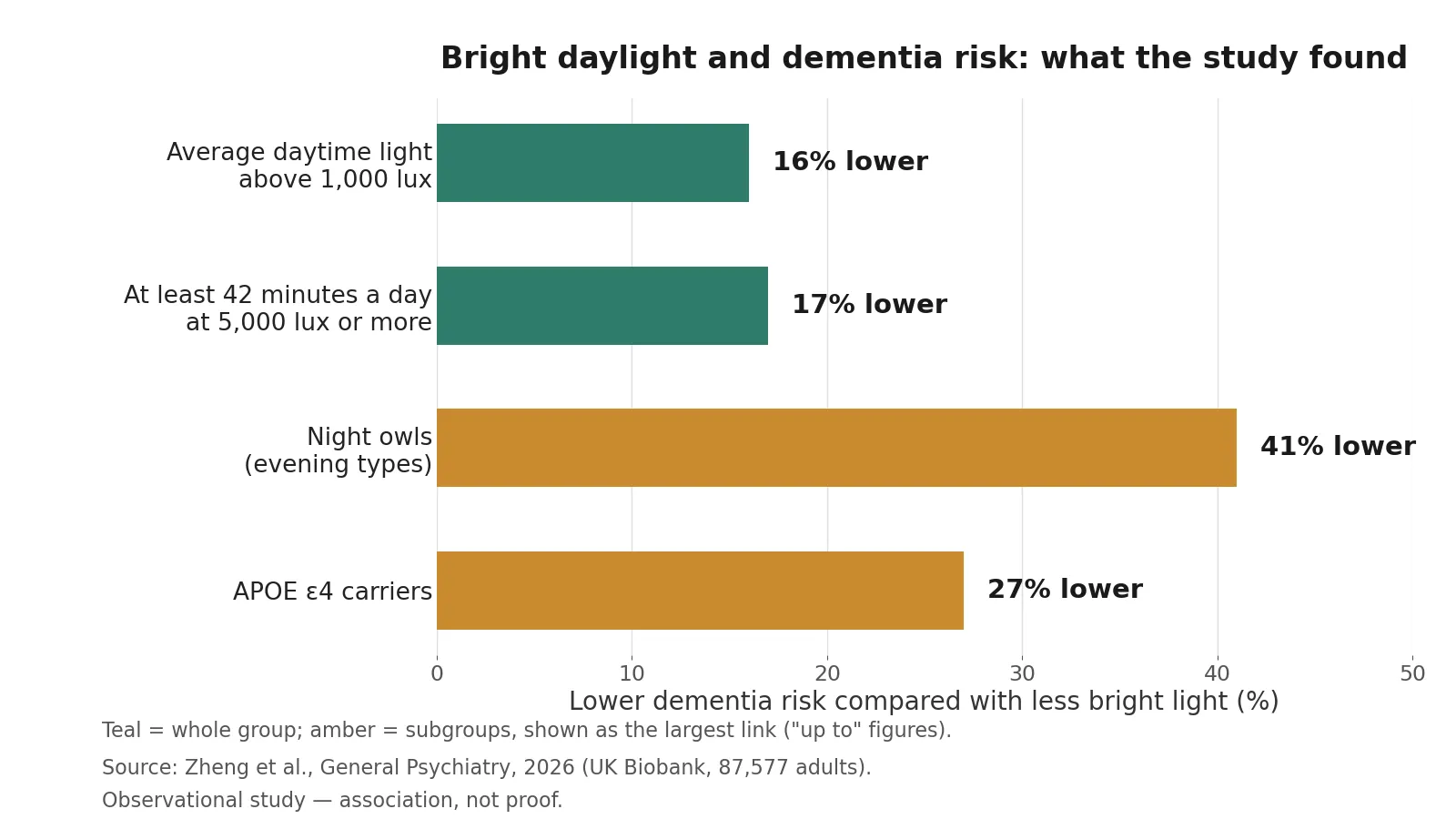
Getting about 42 minutes of bright daylight a day was linked to a 17% lower risk of dementia in a large 2026 UK Biobank study of 87,577 adults. People whose average daytime light topped 1,000 lux — roughly an overcast day outdoors — had a 16% lower risk. The study shows an association, not proof that daylight prevents dementia.
It is a striking headline, and it is worth slowing down for. The researchers did not ask people how much time they spent outside. They measured the light reaching their wrists, day and night, for a full week, then watched what happened to their health over the next eight years. Here is what they found, what it might mean, and where the evidence stops.
What did the study actually measure?
The study, published in 2026 in the journal General Psychiatry, used data from 87,577 adults in the UK Biobank, a large health project that recruited people at centres across England, Scotland and Wales. The volunteers had an average age of 62 and none of them had dementia when the study began. Each wore a wrist device with a built-in light sensor for seven days, recording how bright their surroundings were by day and by night.
Researchers from Guangzhou Medical University, the Chinese University of Hong Kong and other institutions then followed the group for a median of 8.1 years, checking GP records, hospital admissions and death records. During that time, 741 people developed dementia. The researchers adjusted their results for age, sex, education, deprivation, smoking, alcohol, physical activity, diet, chronotype and several health conditions, so the link between light and dementia was not simply explained by those factors.
How much daylight made a difference?
Two thresholds stood out. People whose average daytime light was above 1,000 lux had a 16% lower risk of dementia than those below that level. And people who spent at least 0.70 hours a day — about 42 minutes — in light of 5,000 lux or more had a 17% lower risk than those who spent less time in bright light.
Perhaps the most surprising finding was how strongly too little bright light predicted dementia. In a ranking of 19 predictors, getting less than 42 minutes a day of bright daytime light beat six of 15 known risk factors — including alcohol intake, obesity, air pollution and hearing loss. That does not mean dim days are more dangerous than obesity or heavy drinking. It means that, in this group, low bright-light exposure was a stronger statistical signal for future dementia than those familiar risk factors.
Light at night told a different story. On its own, nighttime light showed no clear link with dementia risk. It was daytime brightness that carried the signal.
What is a lux, and how bright is bright enough?
Lux is simply a measure of how much light falls on a surface. The numbers in this study sound technical, but they translate into everyday settings quite easily.
| Setting | Typical brightness |
|---|---|
| An ordinary room indoors | About 300 to 500 lux |
| Outside on an overcast day | About 1,000 lux |
| Bright daylight outdoors | 5,000 lux or more |
| A seasonal affective disorder (SAD) lamp | 10,000 lux, the NHS standard |
The gap between indoors and outdoors is the point. Ordinary indoor lighting usually gives about 300 to 500 lux, while bright light therapy typically uses more than 3,000 lux. So for most people, reaching a daytime average above 1,000 lux, or 42 minutes at 5,000 lux or more, usually means getting outside — or sitting very close to a bright source. That matters because people in modern society spend nearly 90 percent of their day indoors under artificial lighting, which is typically too dim during the day to reach these levels.
Why might daylight matter for the brain?
The honest answer is that nobody knows yet. The most likely explanation involves the body’s internal clock. When light enters the eyes, it activates the brain’s master clock, which keeps the body’s daily rhythms — sleep, waking, hormones — in step with the sun. Bright days and dark nights keep that clock steady; dim days and bright nights can throw it off. Previous studies have shown that brighter nights and darker days can disrupt circadian rhythms, and daytime light levels have also been linked to a lower risk of major depressive disorder, itself a risk factor for dementia.
There was also a clue in the brain scans. In this observational research, participants exposed to more daytime light tended to have greater brain volume or surface area in parts of the medial temporal lobe — a region that plays an important role in memory and is often one of the first areas affected by dementia.
Sunlight on the skin also stimulates vitamin D production, which is itself tied to dementia risk, so light could be acting through more than one route. What the study does show is that the amount of light reaching the eyes lines up with the strength of the brain’s daily rhythms — and those rhythms, in turn, are closely tied to sleep, mood and memory.
Who seemed to benefit most?
The link between bright daylight and lower dementia risk was stronger in three groups. In people exposed to more light at night, the cut in risk was 30 to 38%. In evening types — night owls, as opposed to morning people — it was 31 to 41%. And in carriers of the APOE e4 gene variant, which raises the risk of Alzheimer’s disease, it was 19 to 27%.
The night-owl finding is the one that has grabbed headlines, with some reports quoting a 41% reduction. That figure applies only to evening types, not to everyone. For the group as a whole, the result was 16 to 17% lower risk. It is also worth noting that APOE e4 is the most important common genetic risk factor for Alzheimer’s disease, so a stronger link in carriers is genuinely interesting — but it still comes from an observational study, and it needs to be confirmed before anyone draws conclusions from it.
What the study cannot tell us
This is an observational study, so it shows an association and cannot prove that daylight prevents dementia. People who get more light may be healthier or more active in ways the researchers could not fully measure, even after adjusting for many factors.
There are other limits too. The sensors were worn on the wrist rather than near the eyes, so they cannot precisely capture the amount of light reaching the eyes. They recorded light for only one week, which may not reflect long-term habits. The light data were collected more than a decade ago, before LED lighting and evening screen use became so common. And UK Biobank volunteers are healthier and better off than the wider population, so the results may not apply to everyone.
The authors themselves say the thresholds need testing in other groups before they can guide advice. What is needed next are clinical trials that deliberately increase daytime light exposure and see whether dementia risk actually falls.
How to get more daylight in your day
Nothing in this study is a prescription, and daylight is not a treatment for dementia. But getting outside in daylight is a simple, low-cost habit that supports sleep, mood and general health — and the NHS already advises people with low mood in winter to get as much natural daylight as possible and go outside every day.
- Take a morning walk. A walk before work, or part of the commute on foot, is the easiest way to bank bright-light minutes early in the day.
- Move lunch outside. Even a short break in the open air adds up, and midday light is the brightest of the day.
- Sit near a window. If you work indoors, a desk by a window gives you far more light than a desk in the middle of a room.
- Keep evenings dimmer. The study found no link between nighttime light and dementia on its own, but steady sleep rhythms are still good for the brain — and bright light late at night can make sleep harder.
- Be careful in strong sun. Bright light is not the same as baking in the midday sun. Shade, a hat and sunscreen still matter on hot, sunny days.
As the study’s corresponding author, Hongliang Feng of Guangzhou Medical University, put it: “Daytime light exposure may serve as a novel indicator of dementia risk.” The authors suggest their findings could inform future research into light-based interventions and public health guidance that recommends more daytime light as a low-cost way to support brain health, particularly in high-risk groups. That is a direction for future research, not a guarantee for any individual.
Dementia risk: the bigger picture
Daylight is only one small piece of a much larger picture. Dementia is not a disease itself. As the NHS explains, it is a collection of symptoms that result from damage to the brain caused by different diseases, such as Alzheimer’s, which is the most common cause. It is not a natural part of ageing.
The known, modifiable risk factors still matter far more than any single new finding. The CDC notes that nearly 45% of all dementia cases may be prevented or delayed, and points to five habits: staying physically active (150 minutes a week), preventing or managing diabetes, managing blood pressure, preventing or correcting hearing loss, and limiting or avoiding alcohol and smoking. Daylight may one day join that list. For now, it is best seen as one more reason to get outside — alongside exercise, sleep and social connection, not instead of them.
When to see a doctor
Anyone worried about memory problems should speak to their GP sooner rather than later. Common early symptoms of dementia include memory loss, difficulty concentrating, finding it hard to carry out familiar daily tasks, struggling to follow a conversation or find the right word, being confused about time and place, and mood changes. These symptoms are often mild at first and may get worse only very gradually — but dementia is not a natural part of ageing, and an early assessment can rule out other causes and open the door to support.
In an emergency call 911 (US), 999 (UK) or 112 (EU)
Frequently asked questions
How much daylight do I need to lower dementia risk?
The study found that people who spent at least 42 minutes a day in bright light of 5,000 lux or more had a 17% lower risk of dementia, while an average daytime light level above 1,000 lux was linked to a 16% lower risk. In practice that usually means getting outside, since ordinary indoor lighting is only about 300 to 500 lux. The study is observational, so it cannot prove daylight itself lowers risk.
What is 5,000 lux in everyday terms?
Lux measures how much light falls on a surface. An ordinary room indoors is about 300 to 500 lux, an overcast day outside is about 1,000 lux, and bright daylight outdoors reaches 5,000 lux or more. A seasonal affective disorder (SAD) lamp is 10,000 lux, the NHS standard. So 5,000 lux is roughly the brightness of a clear day outdoors, not an extreme level.
Does bright light at night affect dementia risk?
In this study, no. Nighttime light exposure on its own showed no statistically significant link with dementia risk. It was daytime brightness that carried the signal. Interestingly, the daytime link was actually stronger in people who were also exposed to more light at night, with a 30 to 38% lower risk, but the researchers did not find that night light itself raised or lowered risk.
Can daylight prevent dementia?
No, not on this evidence. The study is observational: it found an association between brighter days and lower dementia risk, but it cannot prove that more daylight prevents dementia. People who get more light may be healthier or more active in other ways. Clinical trials that deliberately increase daytime light are needed before anyone can say it works. Daylight is best seen as one small part of a wider brain-health picture.
Who benefited most from bright daylight?
The link was strongest in three groups: evening types or night owls, where brighter daylight was linked to up to 41% lower risk; people exposed to more light at night, with 30 to 38% lower risk; and carriers of the APOE e4 gene variant, which raises Alzheimer's risk, with 19 to 27% lower risk. For the group as a whole, the figures were 16 to 17% lower risk, so the headline 41% applies only to night owls.
How can I get more bright light each day?
The simplest ways are a morning walk, taking lunch outside, and sitting near a window if you work indoors, since midday light is the brightest of the day. The NHS already advises people with low mood in winter to get as much natural daylight as possible and go outside every day. Be careful in strong sun, and speak to your GP if you are worried about memory problems.
Sources
- ScienceAlert: Less Than 42 Minutes of Bright Light Daily Is a Stronger Predictor of Dementia Than Obesity, Study Finds www.sciencealert.com
- ScienceDaily: Less than 42 minutes of bright daylight linked to higher dementia risk sciencedaily.com
- Psychreg: How Much Daylight Do You Need? Study Links Less Than 42 Minutes a Day of 5,000 Lux Light to Higher Dementia Risk www.psychreg.org
- CDC: Reducing Risk for Dementia www.cdc.gov
- NHS: Symptoms of dementia www.nhs.uk

Try the tool
Not sure if it can wait?
Common causes and warning signs for 16 everyday symptoms.
Open the symptom guide