Vitamin K Deficiency Bleeding: Why Newborn Cases Are Rising
Two studies published on 5 November 2026 found newborn vitamin K shot refusals have more than doubled in the US since 2017 — and diagnosed cases of vitamin K deficiency bleeding have risen 347%. Here is what the research shows, the warning signs, and why doctors urge the shot.
- Written by
- Health Daily Advice
- Published
- Reading time
- 6 minutes
- Sources
- 10 cited

In this guide
Vitamin K deficiency bleeding (VKDB) is a rare but serious bleeding disorder in newborns whose blood cannot clot properly. Cases in the United States have risen sharply — up 347% since 2017 — as more parents decline the routine vitamin K injection given at birth. A single shot, given within six hours of birth, prevents almost all cases.
What is vitamin K deficiency bleeding?
Vitamin K helps the body make the proteins that form blood clots. Babies are born with very little of it: only small amounts pass through the placenta, the bacteria in a newborn’s gut are not yet making the vitamin, and breast milk contains only low levels. Without enough vitamin K, a baby’s blood cannot clot, and bleeding can start inside the body where parents cannot see it — including in the brain or intestines, as the American Academy of Pediatrics (AAP) explains.
Doctors divide VKDB by when it appears, according to the US Centers for Disease Control and Prevention (CDC):
| Type | When it appears | What it looks like |
|---|---|---|
| Early VKDB | Within the first 24 hours | Severe bleeding, usually linked to medicines the mother took during pregnancy |
| Classical VKDB | 2 days to 1 week | Bruising or bleeding from the umbilical cord |
| Late VKDB | 1 week to 6 months | The most dangerous type; most commonly occurs at 2 to 8 weeks |
Late VKDB is the form doctors worry about most. It strikes previously healthy babies, and in 30% to 60% of cases it presents as bleeding inside the brain, which can cause permanent brain damage or death. In most cases there are no warning signs at all before a life-threatening bleed, and warning bleeds before a severe event are rare.
Why are newborn vitamin K deficiency bleeding cases rising?
Two studies published on 5 November 2026 in JAMA and JAMA Pediatrics tell the same story from different angles: as fewer newborns receive the vitamin K shot, bleeding is climbing. In the JAMA study of more than 5.2 million US infants, the share of newborns who did not receive the injection more than doubled, from 3.1% in 2017 to 6.8% in 2025. The second study, of over 11 million infants, found vitamin K receipt fell from 97.7% to 95.0% over the same period — a small percentage change that covers a very large number of babies.
Diagnosed cases of VKDB rose far faster than the refusal rate. They climbed from 189 in 2017 to 903 in 2024, then jumped to 1,764 in 2025 — nearly double in a single year.
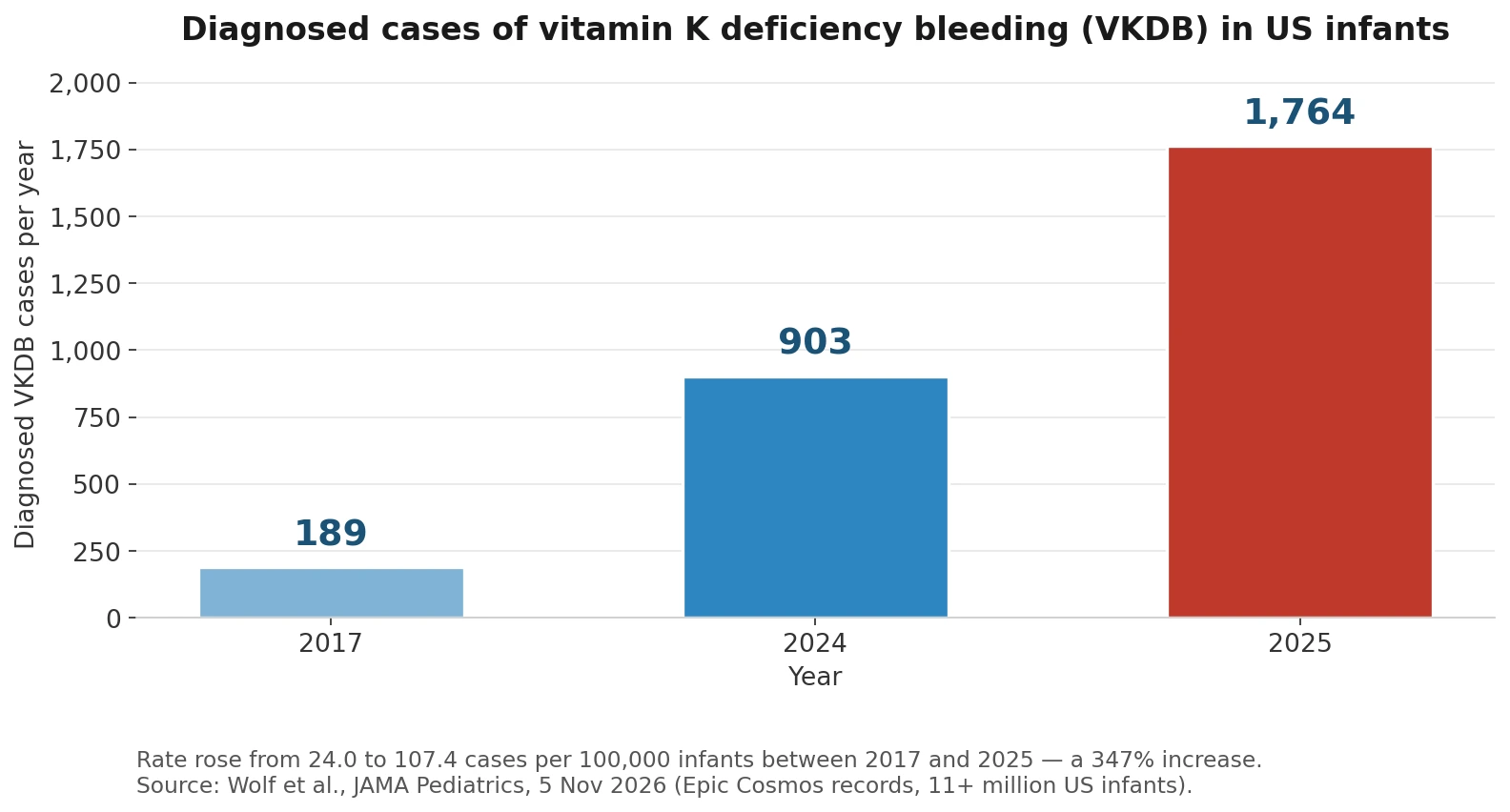
Both studies used health records rather than controlled trials, so they show a link rather than proof that declining shots caused every extra case. Bleeding rates rose in both groups of babies, but they rose significantly faster among babies who did not receive vitamin K, the JAMA editorial notes. The pattern matches the CDC’s long-standing estimate that babies who do not get the shot are 81 times more likely to develop late VKDB than babies who do.
What did the two November 2026 studies find?
The two research teams used different databases and measured different things, so their numbers are two independent confirmations rather than the same finding stated twice:
| Study | What it found |
|---|---|
| JAMA — Scott et al. (5,240,780 infants, 2017–2025) | Babies without the shot had a bleeding rate of 288 per 10,000 births in their first six months, versus 186 per 10,000 for babies who got it — a 47% higher adjusted risk. Bleeding inside the brain was more than twice as common (33.0 vs 13.2 per 10,000), and death with concurrent bleeding during the birth hospital stay was also higher (2.9 vs 1.1 per 10,000). |
| JAMA Pediatrics — Wolf et al. (11+ million infants, 2017–2025) | Diagnoses of vitamin K deficiency rose 215.7%, and VKDB rose 347.1% — from 24.0 to 107.4 cases per 100,000 infants. Of 5,217 infants diagnosed with VKDB, 123 had bleeding inside the brain. |
To put the JAMA figures in plain terms, the study’s authors calculated that one additional infant would have a bleeding event for every 114 newborns who did not receive vitamin K. And the consequences can be lasting: about one in five babies who have a stroke caused by this bleeding die, and 40% of survivors are left with lasting brain or nerve problems, the lead author told The Washington Post.
With the shot, the risk all but disappears. The CDC notes that the incidence of late VKDB falls to less than 1 in 100,000 infants when vitamin K is given at birth.
Why are more parents declining the vitamin K shot?
Researchers say they cannot prove what is behind the refusals, but the trend tracks with rising doubt about vaccines and public health advice, according to reporting in The Washington Post. Some parents mistake the vitamin K shot for a vaccine, though it is not one — it is a vitamin that helps blood clot, not an immunisation. Others worry about safety because of a study from the early 1990s that suggested a possible link with childhood leukaemia; many follow-up studies since then have found no such link. The AAP notes that cases of VKDB seem to be increasing partly because more parents are refusing the shot, and that many parents simply do not know how dangerous the condition can be.
How can parents spot the warning signs?
Often, there are none — most babies who develop VKDB look perfectly healthy until a serious bleed begins. When signs do appear, the AAP lists bleeding from the umbilical cord or nose, bruising easily (especially around the face and head), bloody stool or black, dark, sticky stool, vomiting blood, paler skin or pale gums, a yellow tint to the whites of the eyes three weeks or more after birth, and seizures, irritability, excessive vomiting or sleeping too much. The CDC adds a bulging soft spot on the head, jaundice and paleness. Late VKDB most commonly strikes at 2 to 8 weeks, often in babies who are exclusively breastfed, because breast milk supplies only small amounts of vitamin K.
Any unexplained bruising or bleeding in a young baby needs urgent medical help — do not wait to see whether it settles.
Is the vitamin K shot safe?
Paediatricians have recommended a single vitamin K shot for every newborn since 1961, and the injection is given into the baby’s thigh within six hours of birth. The vitamin is stored in the baby’s liver and released slowly over months, until the baby can get vitamin K from solid food and make it in the gut. In the UK, where the shot has been offered since the 1950s, the NHS says the risks are very small: a small chance of infection or inflammation at the injection site, and occasionally mild bruising or swelling. The NHS also notes that without the shot, between 2.5 and 17 out of every 1,000 babies will have some bleeding, and about 1 in 10,000 will bleed into the brain — a risk the supplement almost eliminates.
Can oral vitamin K replace the injection?
Some parents ask for vitamin K drops by mouth instead of the injection, but the shot is the safer and more reliable option. Babies cannot absorb the oral form very well, so it does not work as well to prevent VKDB, and several doses are needed instead of one — in the UK, three oral doses are given, at birth, one week and one month. The AAP is clear: a vitamin K shot is the safest and best option for all newborns. If you have concerns about the injection, talk to your baby’s doctor before the birth rather than deciding from posts you have seen online.
When to see a doctor
Get urgent medical help straight away if your baby has unexplained bruising or bleeding, bleeding from the nose or umbilical cord, blood in the stool or vomit, a bulging soft spot on the head, unusual paleness or yellowing of the skin, or seems unusually sleepy, irritable or feed poorly. If your baby is still jaundiced after two weeks, or is not gaining weight properly, ask a doctor or health visitor to check them. If you are expecting a baby and have questions about the vitamin K shot, raise them with your midwife or paediatrician before the birth — they can talk through the evidence and your concerns.
In an emergency call 911 (US), 999 (UK) or 112 (EU).
Frequently asked questions
What is vitamin K deficiency bleeding in newborns?
Vitamin K deficiency bleeding (VKDB) is a bleeding disorder that happens when a newborn's blood cannot clot because vitamin K levels are too low. Babies are born with very little vitamin K, and breast milk supplies only small amounts. It can cause bleeding from the cord or nose, bruising, bloody stools, or bleeding inside the body, including the brain. Late VKDB, at 1 week to 6 months, is the most dangerous form.
Why is vitamin K deficiency bleeding increasing?
Two studies published on 5 November 2026 in JAMA and JAMA Pediatrics found that more US parents are declining the routine vitamin K shot at birth. Nonreceipt more than doubled, from 3.1% of newborns in 2017 to 6.8% in 2025. Over the same period, diagnosed VKDB cases rose 347%, from 24.0 to 107.4 per 100,000 infants — from 189 cases in 2017 to 1,764 in 2025.
How effective is the vitamin K shot?
Very effective. The CDC says the incidence of late VKDB falls to less than 1 in 100,000 infants when vitamin K is given at birth. In the JAMA study of 5.2 million infants, babies who missed the shot had a bleeding rate of 288 per 10,000 births in six months, versus 186 per 10,000 for babies who got it. The authors calculated one extra bleeding event for every 114 newborns without the shot.
Is the vitamin K shot safe for newborns?
Yes. Paediatricians have recommended it since 1961, and it is a single 1 mg injection into the thigh within six hours of birth. The NHS says the risks are very small — a small chance of infection or inflammation at the injection site, or mild bruising. A study from the early 1990s suggested a possible link with childhood leukaemia, but many follow-up studies found no such link. It is a vitamin, not a vaccine.
Can my baby have oral vitamin K instead of the injection?
Oral vitamin K is less reliable than the injection. Babies cannot absorb the oral form very well, so it does not work as well to prevent VKDB, and several doses are needed instead of one — in the UK, three doses are given, at birth, one week and one month. The American Academy of Pediatrics says the injection is the safest and best option for all newborns. Talk to your baby's doctor if you have concerns.
What are the signs of vitamin K deficiency bleeding?
Often there are no warning signs before a serious bleed. When signs appear, they can include bleeding from the umbilical cord or nose, easy bruising especially around the face and head, bloody or black stools, vomiting blood, pale skin or gums, a yellow tint to the eyes after three weeks, or seizures, irritability and excessive sleepiness. Late VKDB most commonly strikes at 2 to 8 weeks. Any unexplained bruising or bleeding in a young baby needs urgent medical help.
Sources
- CDC: How to Protect Babies from Life-threatening Bleeding (vitamin K deficiency bleeding fact sheet) www.cdc.gov
- AAP HealthyChildren.org: Why Your Newborn Needs a Vitamin K Shot www.healthychildren.org
- NHS (University College London Hospitals): Vitamin K for Babies at Birth www.uclh.nhs.uk
- Scott K, et al. Nonreceipt of Newborn Vitamin K and Risk of Bleeding. JAMA, 2026 jamanetwork.com
- Wolf ER, et al. Vitamin K Deficiency and Associated Bleeding in Infants. JAMA Pediatrics, 2026 jamanetwork.com
- Kair LR, et al. Communicating Risk of Intramuscular Vitamin K Declination in the US. JAMA, 2026 jamanetwork.com
- Medindia: Newborn Bleeding Rises as Vitamin K Shots Decline www.medindia.net
- MedicineNet / HealthDay: Dangerous Newborn Bleeding Nearly Doubles as More Parents Skip Vitamin K Shot www.medicinenet.com

Try the tool
Not sure if it can wait?
Common causes and warning signs for 16 everyday symptoms.
Open the symptom guide