Why Do I Wake Up to Pee at Night? Causes in Men and Fixes
Waking once a night to pee is common after 60, but twice or more most nights is nocturia — and in men it is often, though not always, the prostate. Causes, self-care steps and when to see a GP.
- Written by
- Health Daily Advice
- Published
- Reading time
- 8 minutes
- Sources
- 13 cited
In this guide
Waking up once a night to pee is common, especially after 60. Waking twice or more most nights is called nocturia. In men it is often linked to an enlarged prostate, but it can also come from making too much urine at night, diabetes, sleep apnoea or medicines. Simple changes help many men, and a GP can check the cause.
What is nocturia?
Nocturia is waking up during the night because you need to pass urine. The Cleveland Clinic defines it as regularly waking more than once to pee, and distinguishes it from frequent urination while you are awake. Typically, you should be able to sleep 6 to 8 hours without getting up to pee — but the Cleveland Clinic also notes that getting up once or twice is normal. The line is crossed when it happens most nights and starts to disturb your sleep.
It helps to work out which of three things is happening, because each has different causes. The British Association of Urological Surgeons (BAUS) lists them side by side: you may be making too much urine at night; your bladder may hold less urine, or empty incompletely; or you may be waking for another reason — pain, anxiety, a noisy room — and then noticing the urge to pee once you are awake. Often it is a combination.
Making too much urine at night has its own name: nocturnal polyuria. BAUS defines it as passing more than a third of your 24-hour urine output at night. When you are young, less than a fifth of your daily urine is made at night; as you get older, it should still be less than a third.
How common is waking up to pee at night?
Very common — and it rises steeply with age. The Mayo Clinic reports that about one-third of men over 30 make at least two trips to the bathroom after going to bed. A 2023 community health survey of 6,210 men in Japan, published in the International Journal of Urology in 2026, found nocturia (two or more trips a night) in 27.1% of men overall — rising to 31.4% of men aged 40 and over, 39.8% of men aged 60 and over, and 58.1% of men aged 80 and over.
Age matters, but so does how much it bothers you. The Cleveland Clinic advises that if you are between 65 and 70 and going more than twice a night, you should make an appointment with your doctor — and if you are over 70 and going more than three times a night, the same applies. Even one trip a night is worth mentioning to your GP if it leaves you exhausted the next day.
Why do men wake up to pee at night?
The causes fall into a few groups. The most common in men is the prostate, but it is far from the only one — which is why the Mayo Clinic stresses that other causes should always be considered too.
An enlarged prostate
The prostate is a small gland below the bladder that surrounds the urethra, the tube urine passes through. As it grows with age, it can squeeze the urethra and stop the bladder emptying properly, so it fills to its trigger point faster and you need to pee more often — including at night. This is called benign prostatic hyperplasia (BPH), and the NHS says it is most common in men over 50. BPH is not cancer and does not increase the risk of prostate cancer.
How common are the symptoms? The Mayo Clinic reports that by age 60, about 30% of men show moderate to severe symptoms of BPH, and by age 80 the figure is 50%. Other BPH symptoms, listed by the NHS, include difficulty starting to pee, a weak flow that stops and starts, feeling that the bladder has not emptied fully, dribbling afterwards, and needing to pee more often or more urgently during the day as well.
An overactive bladder
Sometimes the bladder muscle contracts on its own even when it is not full, creating a sudden, hard-to-ignore urge. Guy’s and St Thomas’ NHS Foundation Trust describes this as urge incontinence: you may leak before you reach the toilet. An overactive bladder can occur on its own or alongside prostate problems.
Making too much urine at night
Several things can push the kidneys to make more urine overnight. Drinking a lot of fluid, especially close to bedtime, is the simplest — and alcohol, caffeine and fizzy drinks make it worse, because they irritate the bladder and disturb sleep. Diabetes is another cause: high blood sugar increases thirst, so you drink more, and it irritates the bladder too.
Heart problems can play a part as well. When the heart and circulation become less efficient, fluid collects in the ankles and legs during the day; when you lie down, that fluid returns to the bloodstream and the kidneys clear it as urine. Sleep apnoea has a similar effect: people with sleep apnoea do not reach deep sleep, so they make less antidiuretic hormone — the chemical that tells the kidneys to reduce urine production overnight — and drops in oxygen during apnoea episodes trigger the kidneys to excrete more water, the Cleveland Clinic explains.
Age itself changes the balance. You produce less antidiuretic hormone as you get older, which means more urine is produced at night, according to Guy’s and St Thomas’ NHS. That is one reason night-time trips become more frequent with age even without any disease.
Medicines
Diuretics — “water tablets” prescribed for high blood pressure — make the body produce more urine. Some calcium channel blockers and SSRI antidepressants are also linked to nocturia. Do not stop any prescribed medicine without your doctor’s advice; if you suspect a medicine is the cause, raise it with your GP or pharmacist, who may be able to adjust the timing.
Urinary infection and other causes
A bladder infection can cause burning or pain when passing urine, dark, cloudy or smelly urine, and a feeling that the bladder never fully empties. High blood pressure and restless legs syndrome are also listed among the causes by the Cleveland Clinic. And sometimes the pattern becomes a habit: you wake yourself up to pee at the same time each night even when you do not really need to.
How can I stop waking up to pee at night?
Self-care helps many men, especially when the cause is fluid timing or mild nocturnal polyuria. These steps are recommended by Guy’s and St Thomas’ NHS, the BAUS and the Cleveland Clinic.
Time your fluids
Have your last drink at least 2 hours before bed — for example, your last drink at 8pm instead of 10pm. But do not cut back on fluids overall: you still need 6 to 8 cups a day, about 2 litres. Cutting down on total fluids does not help unless you currently drink large amounts, and it can cause constipation and other problems.
Cut back on caffeine and alcohol in the evening
Tea, coffee, chocolate, cola, fizzy drinks and alcohol all irritate the bladder and disturb sleep. The Cleveland Clinic suggests cutting back to one alcoholic drink a day, or none, and reducing caffeine.
Raise your legs in the evening
If your ankles swell during the day, sit or lie down for about an hour in the late afternoon or evening with your legs raised to at least heart level, so the fluid is cleared during the day rather than at night. Support stockings and regular walking can help too.
Keep a bladder diary
Your GP will probably ask you to keep a record for at least 3 days of what and how much you drink, and how often and how much you pee — measuring volumes with a jug. This is the single most useful test for working out whether you are making too much urine at night or whether the bladder is the problem. The Cleveland Clinic notes that urinating more than 10 times in 24 hours may be too much.
Bladder training and pelvic floor exercises
Bladder training means holding on for a short time when you need to pee, and gradually increasing the time over a few weeks. Pelvic floor muscle training can also help. Both are recommended by the NHS for men with prostate-related symptoms.
Check your sleep
Look at what else disturbs your sleep — a room that is too light or cold, pain, daytime naps, or caffeine late in the day. If you snore loudly, gasp in your sleep or feel unrefreshed in the morning, mention sleep apnoea to your GP: treating it often reduces night-time trips to the toilet as well.
How is an enlarged prostate checked and treated?
If your GP suspects an enlarged prostate, the NHS explains what usually happens. Your GP will ask about your symptoms — how often you pee, and whether you struggle to start or stop — and may examine your tummy and do a rectal examination to feel the prostate. You will usually be asked to keep the 3-day bladder diary described above, and to give a urine sample. A PSA blood test may be offered. If needed, you may be referred to a hospital specialist for a urine flow test, an ultrasound scan of the bladder, or a cystoscopy, where a camera looks inside the bladder.
An enlarged prostate does not always need treatment — it depends on your symptoms and how they affect you. Mild symptoms are usually managed with the lifestyle changes above. For moderate or severe symptoms, medicines may be offered: some help you pee more easily, some reduce frequency and urgency, and some slow the prostate’s growth. If medicines do not help, or symptoms are severe, surgery may be discussed — most commonly TURP, where part of the prostate is removed through a thin tube passed up the penis. Your GP or specialist will talk through the options and their risks. Do not start or stop any medicine without medical advice.
When to see a doctor
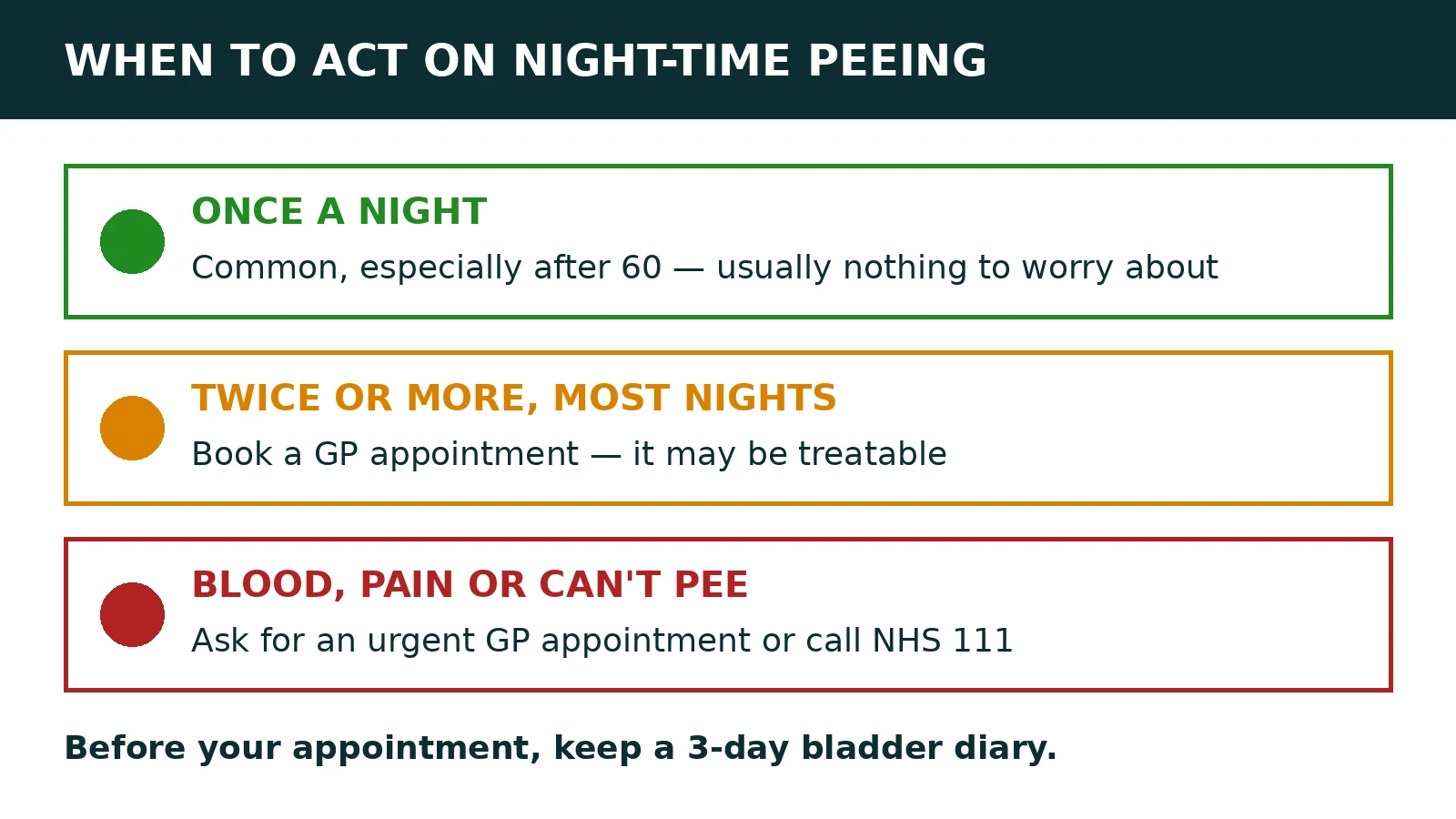
See your GP if you wake up to pee twice or more most nights, if the trips are getting more frequent, or if night-time peeing is leaving you tired during the day. Mention it sooner if you have new excessive thirst — that can be a sign of diabetes — or if you notice burning or pain when you pee, cloudy or smelly urine, or a feeling that your bladder never fully empties.
Ask for an urgent GP appointment, or get help from NHS 111, if you see blood in your pee, have pain when peeing, or cannot pee at all. The NHS notes these symptoms can sometimes be caused by more serious conditions, such as prostate cancer, and finding them early may mean easier treatment.
Before your appointment, it helps to bring your 3-day bladder diary and a list of your medicines. That gives your GP the clearest picture of what is happening at night.
In an emergency call 911 (US), 999 (UK) or 112 (EU).
Frequently asked questions
Is it normal to wake up once a night to pee?
Yes, especially after 60. Most people can sleep 6 to 8 hours without getting up, but getting up once or twice is normal, according to the Cleveland Clinic. It becomes nocturia when you wake twice or more most nights and it disturbs your sleep — that is worth discussing with your GP.
What causes waking up to pee at night in men?
The most common cause is an enlarged prostate, which stops the bladder emptying fully. Other causes include making too much urine at night, an overactive bladder, diabetes, heart problems, sleep apnoea, urinary infections and medicines such as diuretics. Often more than one cause is involved.
What can I do to stop waking up at night to pee?
Have your last drink at least 2 hours before bed, cut back on caffeine and alcohol in the evening, and raise swollen legs for an hour in the late afternoon. Keep drinking 6 to 8 cups a day overall — cutting total fluids does not help. If the problem persists, a GP can check the cause.
Does an enlarged prostate always need treatment?
No. The NHS says an enlarged prostate does not always need treatment — it depends on your symptoms and how they affect you. Mild symptoms are usually managed with lifestyle changes first. Medicines or surgery are considered if symptoms are moderate or severe, or medicines have not helped.
When should I see a doctor about peeing at night?
See your GP if you wake twice or more most nights, if trips are becoming more frequent, or if broken sleep is leaving you tired. Ask for an urgent appointment or call NHS 111 if you see blood in your pee, have pain when peeing, or cannot pee at all.
Will drinking less water stop me waking up to pee?
Only if you drink large amounts. The NHS advises that reducing total fluid intake does not help unless you currently drink a lot — you still need 6 to 8 cups a day. What helps is timing: drink less in the evening and have your last drink at least 2 hours before bed.
Sources
- Guy's and St Thomas' NHS: Nocturia – getting up at night to pee www.guysandstthomas.nhs.uk
- Cleveland Clinic: Nocturia my.clevelandclinic.org
- Mayo Clinic: Q and A: Aging and changing newsnetwork.mayoclinic.org
- Kira et al.: Prevalence and Factors Associated With Nocturia in Japan (Int J Urol, 2026) pubmed.ncbi.nlm.nih.gov
- NHS: Enlarged prostate www.nhs.uk
- BAUS: Getting up at night to pass urine (nocturnal polyuria) www.baus.org.uk
- Cleveland Clinic Health Essentials: How To Stop Peeing at Night health.clevelandclinic.org
- Mayo Clinic: Q and A: Minimally invasive options to treat enlarged prostate newsnetwork.mayoclinic.org

Try the tool
Not sure if it can wait?
Common causes and warning signs for 16 everyday symptoms.
Open the symptom guide