Do Adults Need a Measles Booster? 2026 Outbreak Explained
Most adults do not need an extra measles booster — but with 4,588 US cases in 2026, now is the time to check your MMR status. Here is who is covered, who should ask, and the red flags to act on.
- Written by
- Health Daily Advice
- Published
- Reading time
- 5 minutes
- Sources
- 10 cited
In this guide
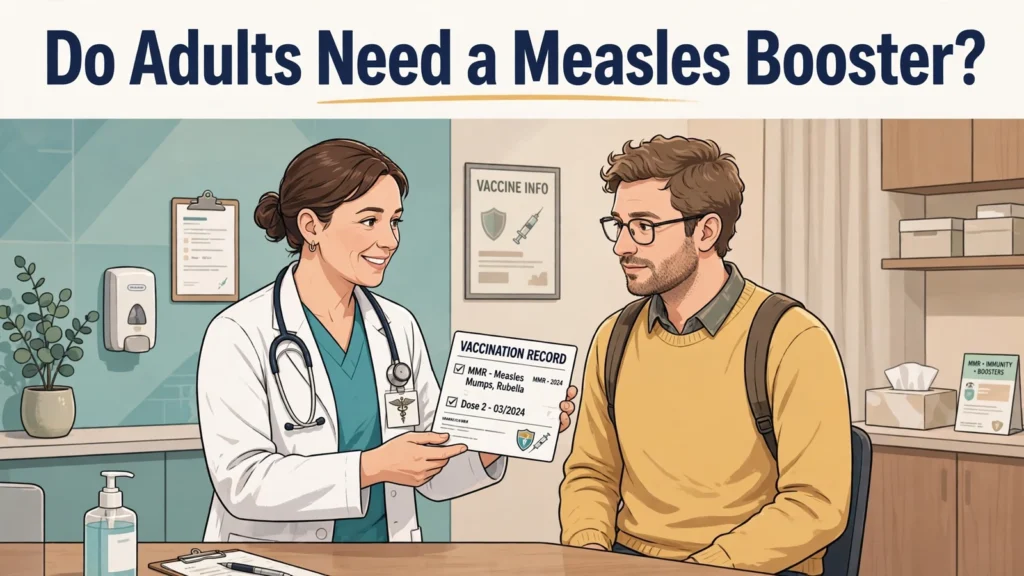
Most adults do not need an extra measles booster: two documented MMR doses count as lifelong protection, and adults born before 1957 are generally considered immune. But if you have no records, only one dose, or higher exposure risk, check your status. The 2026 US outbreak makes that check worth doing now.
Why adults are asking about a measles booster in 2026
Measles is back in the headlines. The US Centers for Disease Control and Prevention (CDC) reported 4,588 confirmed measles cases in the United States as of 22 October 2026, up 178 on the previous week, with 479 hospitalisations this year. Children and teenagers aged 5 to 19 made up 42% of cases (1,914), while adults aged 20 and over accounted for 41% (1,881). Most patients — 96% — were unvaccinated or had unknown vaccination status. That pattern is why health agencies are urging people to check their MMR status rather than assume they are covered.
It is also worth being clear about language. For most adults, this is not a routine “booster” like a yearly flu jab. It is a check: are you already protected, or do you need a catch-up dose? If you are unsure, talk to a doctor or pharmacist rather than guessing.
What is measles?
Measles is a highly contagious viral infection that spreads when an infected person breathes, coughs or sneezes. The World Health Organization (WHO) notes that the virus can remain active in the air or on surfaces for up to two hours, and that one infected person can generate up to 18 secondary infections among people without immunity. The CDC puts it starkly: if one person has measles, up to 9 out of 10 people nearby will become infected if they are not protected.
Measles is not just a childhood illness. The CDC warns that complications are more common in children under 5 and in adults older than 20, and can include pneumonia or brain swelling that might need hospital care.
Measles symptoms in adults
Symptoms usually begin 7 to 14 days after exposure. The NHS describes the typical pattern:
- a high temperature, runny or blocked nose, sneezing and a cough
- red, sore, watery eyes
- small white spots inside the cheeks and on the back of the lips a few days later
- a rash that usually appears a few days after the cold-like symptoms, starting on the face and behind the ears before spreading over the rest of the body
The WHO says the rash appears 3 to 5 days after the first symptoms and usually lasts 4 to 8 days before fading. A person with measles is infectious from around 4 days before the rash appears until 4 days after getting the rash, so the NHS advises staying off work for at least 4 days from when the rash first appears.
Who is already protected?
You are generally considered protected if any of these apply:
| Your situation | What the guidance says |
|---|---|
| Two documented MMR doses | Counts as full, lifelong immunisation. No extra dose is routinely needed. |
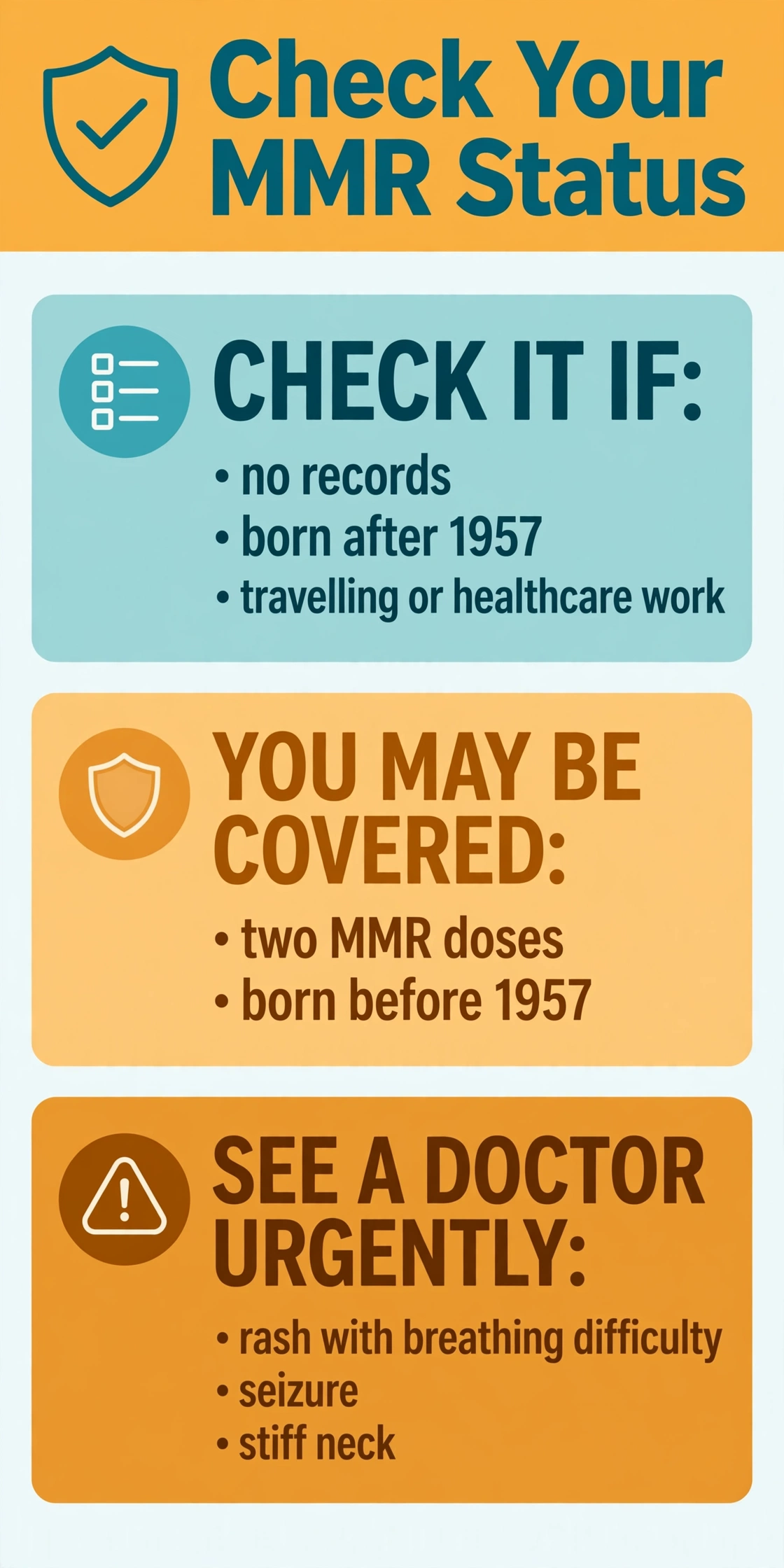
| Born before 1957 (US guidance) | Considered to have presumptive evidence of immunity, because measles was so widespread in childhood then. |
| Laboratory-confirmed past measles infection | Counts as evidence of immunity. |
| One documented dose, ordinary risk | Meets the basic adult standard in US guidance, though some higher-risk groups need a second dose. |
How effective is the vaccine? The CDC states that two doses of MMR vaccine are 97% effective at preventing measles, and one dose is 93% effective. (In the US, immunisation is spelled “immunization”.) Breakthrough infections can still happen, but they are uncommon and usually milder.
Who should check their MMR status?
Talk to a doctor or pharmacist about checking your status if you:
- were born in 1957 or later and do not have your vaccination records
- have had only one MMR dose and work in healthcare, study at a college or university, or travel internationally — US guidance recommends a second dose for these higher-risk groups, at least 28 days after the first
- live in, or are travelling to, an area with a measles outbreak
- were vaccinated in the 1960s with a version of the vaccine that is no longer used — Yale Medicine notes that people immunised between 1963 and 1967 may have received a less effective inactivated (killed) vaccine and should ask about revaccination
- are a healthcare worker born before 1957 without proof of immunity, who should also consider vaccination
In the UK, the picture is simpler: the MMR vaccine is recommended for adults and older children who were not vaccinated when younger, and the NHS says your GP can vaccinate you for free. The UK Health Security Agency adds that older children and adults born on or before 31 December 2019 who are not up to date can be caught up for free on the NHS whatever their age using the MMR vaccine.
How to check your vaccination status
Start with the obvious places: childhood health records, a parent or carer who may hold them, your GP surgery, or a national or state immunisation register. In the UK, ask at your GP surgery if you are unsure — the NHS says your GP can check and vaccinate you for free. In the US, state immunisation information systems may hold childhood records, and a blood test for measles antibodies can show whether you have immunity. If no record turns up, talk to a doctor or pharmacist about what to do next; the CDC notes it is safe to get another MMR dose even when you are already immune.
One caution: MMR is a live vaccine, so it is not suitable for everyone — for example, people with severely weakened immune systems and people who are pregnant are generally not given it. That is another reason to talk to a doctor or pharmacist first rather than booking a jab on assumption.
What if you think you have measles or have been exposed?
Do not just turn up at a GP surgery, clinic or emergency department. The CDC advises isolating yourself and calling your healthcare provider, urgent care or emergency department before arriving, so you can be tested safely. The NHS gives the same advice: call your GP surgery before you go in, as they may suggest talking over the phone or arranging a separated area. This matters because measles spreads so easily in waiting rooms.
When to see a doctor
Ask for an urgent GP appointment or get help from NHS 111 (or your local equivalent) if you think you may have measles, you have been in close contact with someone who has measles and you are pregnant, have a weakened immune system, or have not had measles or two MMR doses — or if a high temperature has not come down, you have difficulty breathing, or you feel very unwell.
Call 999 or go to A&E straight away if you or someone with measles has a seizure (fit), severe difficulty breathing, cannot stay awake, suddenly becomes confused, has a rash that does not fade when you press a glass against it, or has a stiff neck or finds light uncomfortable or painful.
In an emergency call 911 (US), 999 (UK) or 112 (EU)
This article is general information only and is not medical advice for any individual. If you are unsure about your MMR status, or you think you may have measles, talk to a doctor or pharmacist.
Frequently asked questions
Do I need a measles booster if I had two MMR doses as a child?
No, not routinely. Two documented MMR doses are considered full, lifelong immunisation, and the CDC puts their effectiveness at 97% against measles. You do not need a blood test or an extra dose just because there is an outbreak. The exception is if your records are unclear or you are in a higher-risk group — then talk to a doctor or pharmacist to confirm your status.
I was born before 1957 — do I need an MMR vaccine?
Usually not. US guidance treats people born before 1957 as having presumptive evidence of immunity, because measles was so common in childhood then that nearly everyone caught it. Healthcare workers born before 1957 without proof of immunity are the main exception and should consider vaccination. If you are unsure, talk to a doctor or pharmacist.
I have only had one MMR dose — should I get a second?
It depends on your risk. One dose is 93% effective and meets the basic adult standard in US guidance. But a second dose, at least 28 days after the first, is recommended for healthcare workers, post-secondary students, international travellers and people in outbreak areas. If none of those apply, talk to a doctor or pharmacist about whether you need one.
How can I check whether I have had the MMR vaccine?
Check childhood health records, ask a parent or carer, or contact your GP surgery or state immunisation register. In the UK, your GP can check your record and vaccinate you for free if you are not up to date. If no record exists, a blood test for measles antibodies can show immunity, or a doctor or pharmacist can advise on a catch-up dose.
Can adults catch measles if they were vaccinated?
It is possible but uncommon. Two MMR doses are 97% effective, so a small number of vaccinated people can still get a breakthrough infection, usually with milder symptoms. Risk is higher during outbreaks and in communities with low vaccination coverage. That is why checking your records matters even if you believe you were vaccinated as a child.
What should I do if I think I have been exposed to measles?
Isolate yourself and phone your doctor, GP surgery or NHS 111 before going anywhere, so you can be assessed without exposing others in a waiting room. Tell them about the exposure and your vaccination history. Pregnant women and people with weakened immune systems should seek advice urgently. Do not wait for a rash to appear before calling.
Sources
- CDC: Measles in Older Adults www.cdc.gov
- CDC: Measles Cases and Outbreaks www.cdc.gov
- NHS: Measles www.nhs.uk
- WHO: Measles fact sheet www.who.int
- UK Health Security Agency: What is measles and why is it so important we're up to date with our vaccines ukhsa.blog.gov.uk
- Yale Medicine: Should You Get a Measles Vaccine Booster? www.yalemedicine.org
- Contagion Live: Measles Update, October 23, 2026 (reporting CDC figures) www.contagionlive.com

Try the tool
Not sure if it can wait?
Common causes and warning signs for 16 everyday symptoms.
Open the symptom guide

