Morning Erections: Why They Happen and When to Worry
Morning erections are a normal, healthy part of sleep for men of all ages. This guide explains why they happen, how often is normal at different ages, and when losing them is worth discussing with a doctor.
- Written by
- Health Daily Advice
- Published
- Reading time
- 11 minutes
- Sources
- 7 cited

In this guide
Morning erections, medically called nocturnal penile tumescence (NPT), are a normal part of healthy sleep. They happen mainly during REM sleep, when testosterone is also at its morning peak. Most men have several each night, and waking with one usually means blood flow and nerves are working well.
What are morning erections?
A morning erection is an erection that is present when a man wakes up. The medical term is nocturnal penile tumescence (NPT). It is not usually caused by sexual thoughts, dreams, or stimulation. Instead, it is the last episode in a series of erections that happen naturally during sleep.
As Cleveland Clinic urologists explain, the penis may become erect and then flaccid several times during the night. A man is simply more likely to notice the final episode because he wakes up during or just after it. Regular NPT is generally seen as a sign that the nerves and blood supply to the penis are healthy, according to Medical News Today.
Morning erections can happen at any age. Cleveland Clinic notes that they can even occur before birth, and that parents often ask whether erections in young children are normal. They are. What changes with age is usually how often and how firmly they happen, not whether the process itself is normal.
Why do morning erections happen?
There is no single cause. Doctors describe several factors that work together during sleep, and the exact balance is still not fully understood. The main factors are changes in the nervous system during REM sleep, the morning rise in testosterone, and, to a smaller extent, bladder pressure and accidental physical stimulation.
REM sleep and the nervous system
Most NPT happens during rapid eye movement (REM) sleep, the stage of sleep linked with dreaming. During waking hours, signals from the sympathetic nervous system — the “fight or flight” system — help keep the penis flaccid. During REM sleep, that inhibitory signal eases and the parasympathetic nervous system — the “rest and digest” system — becomes more active.
This shift allows blood vessels in the penis to relax and widen, so more blood flows into the erectile tissue and an erection forms. Because REM periods get longer towards the end of the night, the final REM episode often lines up with waking. That is why the erection is noticed in the morning, even though similar erections have already happened several times overnight.
Testosterone peaks in the morning
Testosterone plays a supporting role in erections. Levels tend to rise during sleep and reach a peak in the morning. Cleveland Clinic lists this hormonal peak as one of the likely contributors to morning erections. Testosterone alone does not directly trigger a single erection in the way arousal does, but healthy levels help maintain the nerve and blood-vessel responses that make erections possible.
This also helps explain why morning erections often become less frequent from the 40s onwards. As Healthline notes, natural testosterone levels usually begin to fall between the ages of 40 and 50, and episodes of NPT may decrease as levels fall. A gradual change over years is different from a sudden stop, which is more likely to need medical attention.
Does a full bladder cause them?
A full bladder is often blamed for morning erections, but the evidence is mixed and it is unlikely to be the main cause. Cleveland Clinic notes that the bladder sits near the sacral nerve, which carries signals involved in erections, and that pressure from a full bladder could contribute. Healthline, however, states that needing to urinate is not responsible for morning wood.
The safest way to describe it is that bladder pressure may play a small part for some men, but it does not explain why erections happen repeatedly through the night, including in the early hours when the bladder is not full. REM sleep and hormone changes are the stronger explanations.
Other contributing factors
Accidental physical stimulation during sleep, such as tossing and turning or contact with bedding or a partner, can also trigger an erection. This is a normal reflex response and does not mean the man was dreaming about sex. Some men also notice that morning erections are more likely after a good night’s sleep, which fits with the link between NPT and healthy REM sleep.
Researchers also believe these overnight erections may help keep penile tissue healthy by regularly bringing oxygen-rich blood into the tissue. The mechanism is still being studied, but the idea helps explain why doctors pay attention when NPT disappears for a long period.
How often are morning erections normal?
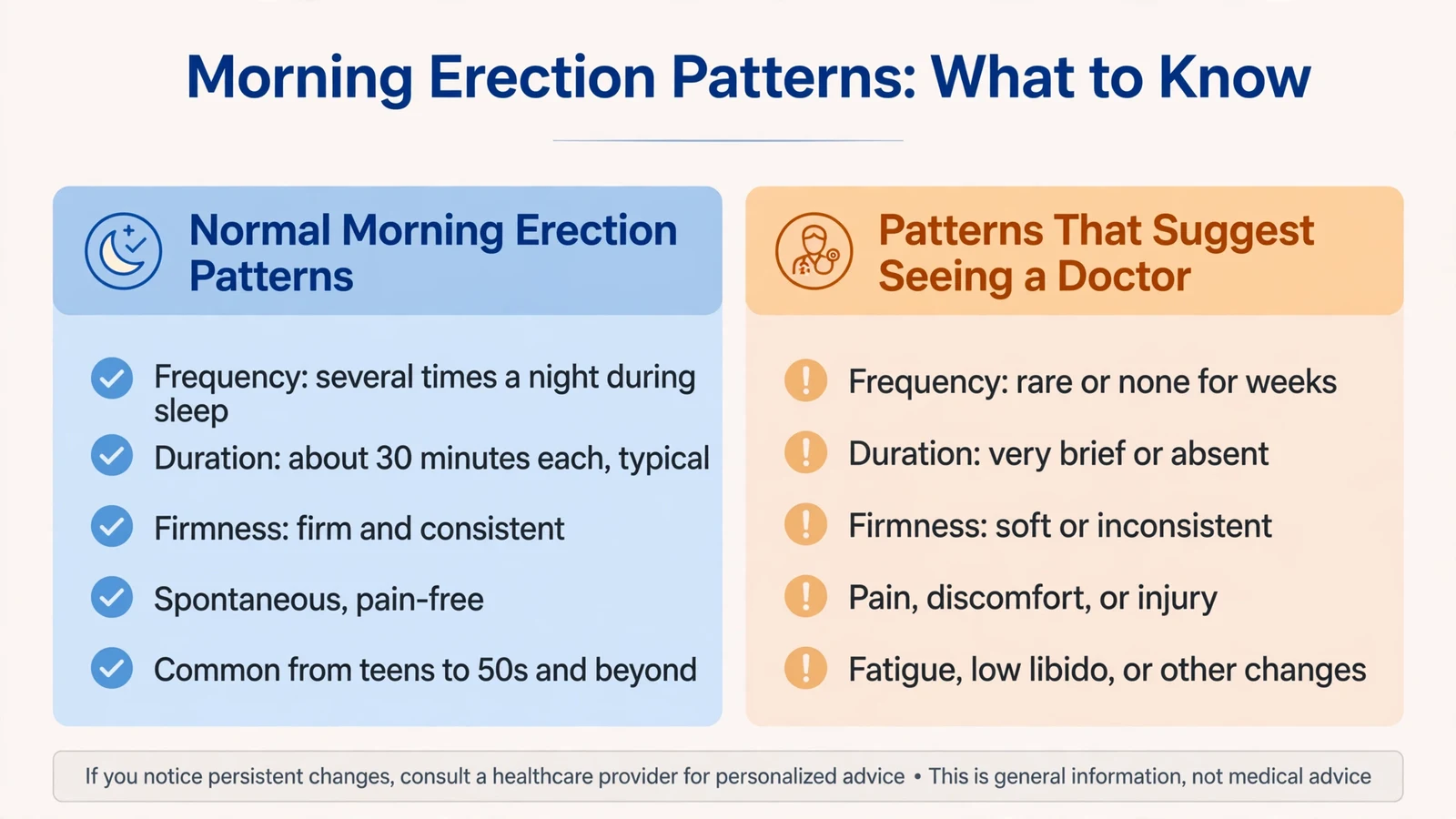
There is no single number that every man must reach. Frequency varies with age, sleep quality, stress, general health, and medicines. Some men wake with an erection most days. Others notice one less than once a week. Both can be normal, especially if there has been no sudden change and erections during sexual activity are not a problem.
Most healthy men have three to five erections during the night, each lasting about 30 minutes, according to UF Health and Healthline. Some episodes may last longer. The erection usually fades within a few minutes of waking.
| Life stage | What is typical |
|---|---|
| Children and teenagers | NPT can occur from infancy onwards and is often frequent during and after puberty, when testosterone levels are highest. |
| Men in their 20s and 30s | Often the most frequent NPT, sometimes every morning and several times during the night. |
| Men in their 40s and 50s | Episodes often become gradually less frequent as testosterone levels fall and blood vessels change with age. |
| Men in their 60s and 70s | NPT may still occur well into the 60s and 70s, but often less often and with less firmness. |
The pattern matters more than the count on any one morning. Waking at a different point in the sleep cycle can mean waking when no erection is happening, even in a healthy man. The International Society for Sexual Medicine (ISSM) makes this point clearly: the lack of a morning erection on a particular day is not necessarily a concern.
What does it mean if morning erections stop?
Missing morning erections now and then is common and is not, on its own, a diagnosis of erectile dysfunction (ED). Poor sleep, stress, tiredness, alcohol, illness, or a change in routine can all reduce NPT for a short time. If erections return when sleep and stress settle, that is reassuring.
A persistent change is different. Medical News Today advises speaking with a doctor if NPT suddenly stops or becomes much less frequent. Cleveland Clinic urologists give similar advice: if morning erections are really not happening, it could be an early indicator of ED or of hormone levels that need checking. It may also be a sign of a sleep disorder or stress.
Doctors often use NPT as a clue when a man reports erection problems. As the ISSM explains, if a man still has morning erections but has difficulty during sexual activity, the cause is more likely to be psychological, because the blood flow and nerve pathways appear to be working. If he has no morning erections and also has difficulty during sexual activity, a physical cause is more likely. Morning erections are not the only factor doctors consider — they also look at medical history, testosterone levels, and medicines — but the pattern is a useful starting point.
Possible causes when morning erections are lost
Several health conditions, medicines, and lifestyle factors can reduce NPT. Often more than one factor is involved at the same time.
Health conditions that affect blood flow, nerves, or hormones
Erections depend on the brain, nerves, hormones, and blood vessels working together. Cleveland Clinic lists vascular, neurogenic, hormonal, and psychological types of ED. Vascular causes, which affect blood flow, are the most common. Conditions linked with erection problems include diabetes, high blood pressure, high cholesterol, heart disease, and clogged arteries. Diabetes can damage both nerves and small blood vessels. Nerve conditions such as multiple sclerosis, Parkinson’s disease, stroke, and spinal cord injury can also interfere with the signals needed for an erection.
Low testosterone can contribute, although it more often affects sex drive. Thyroid problems can also play a part. The NHS notes that if erection problems keep happening, they may be caused by high blood pressure or high cholesterol, diabetes, depression or anxiety, or hormone problems. ED can sometimes be the first symptom of another health problem, including heart disease, so it is worth taking seriously rather than ignoring it.
Cleveland Clinic estimates that ED affects over 50% of men between the ages of 40 and 70, and that the true figure may be higher because many men do not seek help. That does not mean ED is inevitable with age, but it does mean it is common and treatable.
Medicines
Some prescribed medicines can reduce morning erections as a side effect. Medical News Today lists antidepressants, blood pressure medicines, muscle relaxants, hormonal medicines, seizure medicines, histamine H2 medicines used for some ulcers, chemotherapy drugs, medicines for heart rhythm problems, and diuretics. UF Health also lists antidepressants, blood pressure medicines — especially beta-blockers — heart medicines such as digoxin, sleeping pills, and some ulcer medicines.
If morning erections changed soon after starting a new medicine, mention it to a doctor or pharmacist. They may be able to adjust the dose or suggest a different medicine. Do not stop a prescribed medicine suddenly or change the dose without talking to a doctor or pharmacist first, as that can be unsafe.
Sleep, stress, and mental health
Because NPT depends on REM sleep, anything that disrupts sleep can reduce it. In a study of 61 men with obstructive sleep apnoea and ED, reported by Medical News Today, better-quality sleep led to more frequent NPT, and men who used continuous positive airway pressure devices had more frequent nocturnal erections than those who did not. Stress, anxiety, and depression can also affect erections, both by disrupting sleep and by changing the brain signals involved in arousal. The NHS notes that most men occasionally fail to get or keep an erection because of stress, tiredness, or drinking too much alcohol, and that this alone is usually nothing to worry about.
Lifestyle factors
Smoking, drinking heavily, lack of physical activity, and excess weight can damage blood vessels and reduce blood flow, which can affect both daytime and nighttime erections. UF Health lists nicotine, alcohol, and cocaine use among the physical causes of erection problems. These factors are often linked with the same conditions — high blood pressure, high cholesterol, and diabetes — that raise the risk of heart disease.
What will a doctor usually check?
A doctor will usually start by asking when the change began, whether it was sudden or gradual, whether erections still happen during sleep or at other times, and whether there are problems during sexual activity. They may also ask about medical history, medicines, mood, stress, relationships, smoking, alcohol, and sleep.
Basic checks may include blood pressure and blood tests for diabetes, cholesterol, and testosterone levels. UF Health notes that a doctor may also use a device worn at night to check for normal nighttime erections, or an ultrasound to check blood flow. The aim is to find any underlying cause that can be treated, not just to focus on the erection itself.
It can feel awkward to raise this topic, but doctors hear about it often. The NHS advises seeing a GP or going to a sexual health clinic if erection problems keep happening, as they may be a sign of a health condition that can be treated.
Supporting healthy erections
There is no guaranteed way to bring back morning erections, because the right step depends on the cause. General steps that support blood-vessel and overall health are a sensible starting point for most men. The NHS suggests losing weight if overweight, stopping smoking, eating a healthy diet, exercising daily, and trying to reduce stress and anxiety. It also advises not drinking more than 14 units of alcohol a week.
Good sleep habits may also help, since NPT is closely linked with REM sleep. That means keeping regular sleep hours, avoiding heavy alcohol late in the evening, and seeking help for snoring or possible sleep apnoea if a partner notices pauses in breathing or loud snoring. If low mood, anxiety, or relationship stress is part of the picture, talking therapy or counselling may help, and a doctor can discuss referral options.
Be cautious about products, supplements, or medicines bought online that claim to improve erections. The NHS warns that many websites sell fake medicines, and that online medicines are not always regulated. Talk to a doctor or pharmacist before buying medicines online or taking any supplement for erection problems.
When to see a doctor
Book an appointment with a doctor if morning erections have stopped or become much less frequent over several weeks, especially if you also have difficulty getting or keeping an erection during sexual activity. Also seek advice if erections have become painful, if they last more than an hour after waking, or if the change followed an injury, prostate surgery, or starting a new medicine.
See a doctor sooner if you have other symptoms that could point to an underlying condition, such as needing to urinate more often, low back or abdominal pain, a change in urination, low mood, or a loss of interest in sex. UF Health advises seeing a healthcare provider if trouble getting or keeping an erection happens more than 25% of the time.
Seek emergency medical help for an erection that does not go away after four hours. This is called priapism, and it can cause tissue damage and lasting problems with sexual function if it is not treated promptly.
In an emergency call 911 (US), 999 (UK) or 112 (EU)
Morning erections are a normal and usually reassuring part of men’s health. Noticing a change in them is not a reason to panic, but it is a reason to pay attention — particularly if the change is sudden, persistent, or happens alongside other erection problems. A short conversation with a doctor can rule out underlying health problems and, in many cases, provide reassurance.
Frequently asked questions
Is it normal to wake up with an erection every morning?
Yes, it can be normal, especially in younger men. Most healthy men have three to five erections during the night, and the last one may still be present on waking. Some men notice one most mornings, while others notice one less than once a week. The pattern matters more than a single morning, so an occasional missed morning is not usually a concern.
Why do I get morning erections if I am not aroused?
Morning erections are not usually caused by sexual arousal or dreams. They happen mainly during REM sleep, when the nervous system shifts in a way that allows blood flow into the penis, and testosterone is also near its morning peak. A full bladder or accidental stimulation during sleep may contribute for some men, but REM sleep is the main factor.
At what age do morning erections stop?
There is no set age at which they stop. They can occur from infancy into the 60s and 70s, but they usually become less frequent and less firm with age. Testosterone levels fall gradually from the 40s, and blood vessels change over time. A gradual decline is normal, while a sudden stop in a younger man is more likely to need a doctor's advice.
Does no morning erection mean I have erectile dysfunction?
Not necessarily. Missing morning erections now and then can happen with poor sleep, stress, tiredness, alcohol, illness, or a new medicine. It becomes more significant if the loss is persistent over weeks, especially if you also have difficulty getting or keeping an erection during sexual activity. A doctor can check for physical causes such as diabetes, high blood pressure, or low testosterone.
Can medicines stop morning erections?
Yes, some medicines can reduce morning erections as a side effect. These include some antidepressants, blood pressure medicines such as beta-blockers, sleeping pills, and some hormonal or heart medicines. If the change followed starting a new medicine, talk to a doctor or pharmacist about it. Do not stop a prescribed medicine suddenly without medical advice.
When should I see a doctor about morning erections?
See a doctor if morning erections have suddenly stopped or become much less frequent over several weeks, if erections are painful, or if they last more than an hour after waking. Seek help sooner if you also have erection problems during sex or other symptoms. Get emergency help for an erection lasting more than four hours.
Sources
- Cleveland Clinic: Why Do Men Get Morning Erections? health.clevelandclinic.org
- Medical News Today: Morning wood — causes and frequency www.medicalnewstoday.com
- International Society for Sexual Medicine: Is a lack of morning erections a concern? www.issm.info
- Cleveland Clinic: Erectile Dysfunction (ED) my.clevelandclinic.org
- Healthline: What Causes Morning Wood? www.healthline.com
- NHS Wales: Erectile dysfunction (impotence) 111.wales.nhs.uk
- UF Health: Erection Problems ufhealth.org

Try the tool
Not sure if it can wait?
Common causes and warning signs for 16 everyday symptoms.
Open the symptom guide