Prolonged Sitting Health Risks: What Too Much Sitting Does to You
Prolonged sitting is linked to higher risks of heart disease, type 2 diabetes and early death — even if you exercise. Here is how much sitting is too much, and the simple breaks that lower the risk.
- Written by
- Health Daily Advice
- Published
- Reading time
- 9 minutes
- Sources
- 10 cited

In this guide
Prolonged sitting — spending most of your waking hours seated — is linked to a higher risk of heart disease, type 2 diabetes and early death, even in people who exercise. Most American adults sit six to eight hours a day, and the risk climbs steeply above seven to nine hours. Short, frequent movement breaks can lower that risk.
That is the headline from a wave of new research covered by the Harvard Gazette in November 2026, which called prolonged sitting a growing public health worry. Sitting itself is not the enemy — we all need to rest — but hour after hour in a chair, day after day, quietly strains the heart, metabolism, muscles and circulation. The encouraging part is that the fix is not a gruelling workout. It is mostly about breaking up the sitting you already do.
What counts as prolonged sitting?
Prolonged sitting means long, unbroken stretches of sitting, reclining or lying down while awake — at a desk, in a car, or on the sofa — with very little movement in between. Researchers often draw the line at more than eight hours of sitting a day, but the pattern matters as much as the total. Six hours broken up by regular walks is not the same as six hours without standing up once.
It is also different from simply not exercising. You can go to the gym in the morning and still be a prolonged sitter if you then spend the next ten hours in a chair. As the NHS puts it, you can hit your weekly activity target and still be at risk if you spend the rest of your time sitting or lying down.
How common is it? Most American adults spend six to eight hours a day sitting, according to the Harvard Gazette coverage, and the NHS reports that many adults in the UK spend more than seven hours a day sitting, while people over 65 often spend ten hours or more sitting or lying down.
What are the health risks of prolonged sitting?
Large studies following hundreds of thousands of people have linked long daily sitting with a higher risk of several serious conditions. The evidence is mostly observational — it shows a link, not proof that sitting alone causes each outcome — but the pattern has now turned up again and again, including in studies that measured sitting with wearable activity trackers rather than relying on what people remembered.
Heart disease and stroke
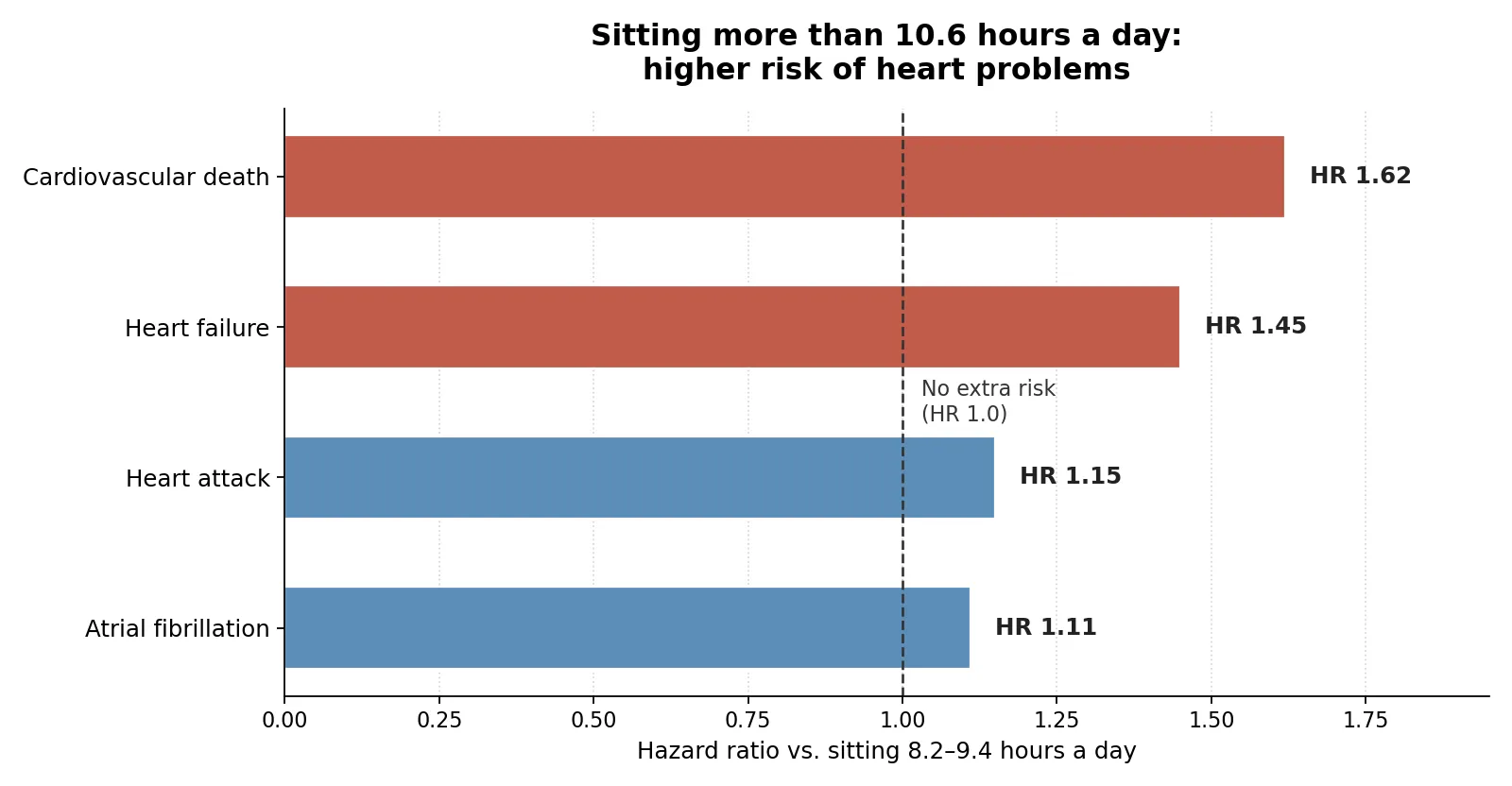
The strongest recent evidence comes from a 2025 study in the Journal of the American College of Cardiology, which tracked 89,530 UK Biobank participants wearing activity monitors. People who sat for more than 10.6 hours a day had a 45% higher risk of heart failure and a 62% higher risk of cardiovascular death than people sitting 8.2 to 9.4 hours a day, with smaller increases in atrial fibrillation and heart attack. The researchers found risk rose sharply once sitting passed about 10.6 hours a day.
Other pooled research points the same way. Mayo Clinic Press reports that studies have linked sitting for more than six to eight hours a day with a 125% to 150% increase in the risk of cardiovascular events, and that long sitting can raise blood pressure, raise cholesterol and reduce circulation.
Type 2 diabetes and metabolic health
Sitting for most of the day slows down the way your body handles blood sugar. When large leg muscles stay still, they take up less glucose from the blood, and the body becomes less responsive to insulin over time. Pooled studies cited by Mayo Clinic Press link sitting for more than eight hours a day with more than double the risk of developing type 2 diabetes.
Extended sitting is also linked to metabolic syndrome — a cluster of raised blood pressure, high blood sugar, excess fat around the waist and unhealthy cholesterol levels — according to the Mayo Clinic. Each of those factors on its own raises the risk of heart disease and diabetes; together, they matter more.
Early death
Mayo Clinic summarises a review of 13 studies covering more than one million people: those who sat for more than eight hours a day with no physical activity had a risk of dying similar to the risk posed by obesity and smoking. Sitting too much overall also seems to raise the risk of death from heart disease and cancer.
Cancer
A 2026 study of 91,292 UK Biobank participants, covered by the Harvard Gazette, found that every additional hour of prolonged sitting per day was associated with a 9% higher risk of cancer death. The same study found that replacing an hour of prolonged sitting with light physical activity was associated with a 12% lower risk of cancer death. The World Health Organization also lists cancer among the conditions linked to too much sedentary behaviour.
Muscles, joints and back pain
Hours in a chair tighten the hip flexors, weaken the glutes and switch off the core muscles that support your spine. Poor posture while slumped forward adds to the strain, and back pain is one of the most common complaints. Sitting still for long stretches can also let blood pool in the legs, which raises the risk of swelling and, more rarely, blood clots such as deep vein thrombosis — the same reason passengers are told to move around on long flights.
The effects are not only physical. Mayo Clinic Press notes a strong link between sedentary behaviour and higher rates of anxiety and depression, and reports that even two hours of uninterrupted sitting can reduce the flow of oxygen-rich blood to the brain, affecting concentration, memory and processing speed.
Why does sitting harm the body?
Your body is built to move, and sitting switches off several systems at once. Professor I-Min Lee of Harvard Medical School, quoted in the Harvard Gazette coverage, explains that sitting too much can reduce blood flow, weaken blood vessel function and impair glucose and insulin processing. Blood moves more slowly through the legs, muscles burn less energy, and the body clears sugar and fat from the blood less efficiently.
None of this happens after one long afternoon. The damage is cumulative: small metabolic and circulatory changes, repeated daily for years, gradually raise the odds of heart disease, diabetes and other chronic conditions. That is also why the pattern of sitting matters — long unbroken bouts appear worse than the same total time split up with movement.
How much sitting is too much?
There is no single official limit, and the WHO has not set a maximum number of sitting hours, because the evidence is not yet strong enough to pin down one threshold. But the research points to a clear gradient: the more you sit, the higher the risk — and the slope gets steeper at the top end.
| Daily sitting time | What the research found |
|---|---|
| 6 to 8 hours | Typical for most American adults; linked to a 125% to 150% higher risk of cardiovascular events (Mayo Clinic Press). |
| More than 8 hours | Linked to more than double the risk of type 2 diabetes; with no physical activity, risk of dying similar to that from obesity and smoking (Mayo Clinic). |
| 7 to 9 hours and above | Risk climbs more steeply from this point, according to Harvard professor I-Min Lee. |
| More than 10.6 hours | Heart failure risk 45% higher and cardiovascular death risk 62% higher than sitting 8.2–9.4 hours (Ajufo et al., 2025). |
If your day adds up to eight hours in a chair — a desk job, a commute, then an evening on the sofa — you are in the range where the research shows the clearest harm. That does not mean a desk job will make you ill. It means the total, and how often you break it up, is worth paying attention to.
Can exercise offset the risks of prolonged sitting?
Exercise helps a lot, but it does not erase the problem entirely. The 2025 JACC study found that physical activity could completely neutralise the extra risk of atrial fibrillation and heart attack from sitting, but only partly offset the risk of heart failure and cardiovascular death. Its lead author, Dr Ezimamaka Ajufo, concluded that avoiding excessive sitting matters for heart health even if you are physically active.
Mayo Clinic’s review of more than one million people reached a more optimistic conclusion for mortality: 60 to 75 minutes of moderate aerobic activity a day offset the effects of too much sitting. The two findings are not contradictory — exercise is powerful protection, and its limits show up most clearly at the highest sitting levels and for heart failure in particular.
The practical takeaway is that you need both: regular exercise and less unbroken sitting. The WHO recommends 150 to 300 minutes of moderate aerobic activity a week, plus muscle-strengthening activity, and advises adults to limit sedentary time and replace it with activity of any intensity, including light activity.
How can I break up sitting at work?
You do not need a new routine, just interruptions. The Mayo Clinic suggests taking a short break from sitting to standing every 30 minutes, and Mayo Clinic Press reports that standing, walking or stretching for at least five minutes for every hour of sitting can mitigate a lot of the health risks. Short “activity snacks” — a walk to the printer, a lap around the office, a few stretches — are exactly what the researchers behind the 2025 heart study recommend.
- Set a 30-minute timer. Stand up, stretch or walk for two to five minutes every half hour.
- Take walking phone calls. Pace around the room or walk outside while you talk.
- Hold walking meetings. Swap the conference room for a stroll with colleagues when you can.
- Walk to a colleague instead of messaging. Those short trips across the office add up.
- Use the stairs. Take the stairs and walk up escalators rather than standing still.
- Stand for simple tasks. Read documents, sort post or review notes on your feet.
- Move on breaks. Take a short walk every time you get a coffee or tea, rather than carrying it back to your chair.
How can I sit less at home?
Evenings are often the most sedentary part of the day, and small swaps make a real difference:
- Stand or move during TV adverts — stretch, tidy up or walk around the room instead of sitting through the whole show.
- Walk after meals. A short stroll after eating helps the body clear blood sugar.
- Do chores on your feet. Cooking, gardening and housework all count as light activity.
- Break up screen time. Get up between episodes, chapters or levels of a game.
- Stand on public transport. If you commute by bus or train, standing for part of the journey counts.
Do standing desks help with prolonged sitting?
Standing desks can help, but standing still is not the same as moving. Mayo Clinic notes that it is not clear whether standing on its own lowers the risk of too much sitting, and Mayo Clinic Press points out that standing for at least two hours a day burns around 170 extra calories — but prolonged standing can also cause muscle fatigue, joint compression and back pain, especially if you already have a weak core or joint problems.
The best approach is to mix it up: alternate between sitting, standing and walking through the day. If you have a standing desk, use it for part of the day rather than all of it. If you do not, a high table or counter works for short standing spells, and the movement breaks matter more than the furniture.
When to see a doctor
Prolonged sitting itself is a habit to change, not a condition to treat — but some symptoms should not be ignored. Talk to a doctor if you notice persistent leg swelling or pain, numbness or tingling in your legs, unexplained shortness of breath, chest pain, or back pain that does not ease with movement and rest. These can have many causes, and only a clinician who can examine you can tell what is going on.
Seek urgent care straight away for chest pain, sudden severe breathlessness, coughing up blood, or a painful swollen leg, as these can be signs of a blood clot that has travelled to the lungs. In an emergency call 911 (US), 999 (UK) or 112 (EU).
If you have a heart condition, diabetes, circulation problems or limited mobility, talk to a doctor or pharmacist before starting a new exercise routine, so any plan fits your situation. The goal is simple and realistic: sit less, move more, and break up the sitting you cannot avoid.
Frequently asked questions
How much sitting is too much?
Research points to more than eight hours a day as the level where the harms become clearest, with risk climbing more steeply above seven to nine hours. A 2025 study found heart failure and cardiovascular death risk rose sharply above 10.6 hours a day. There is no official maximum, so treat eight hours as a practical warning sign and break up your sitting as often as you can.
Can exercise cancel out sitting all day?
Not completely. A 2025 study of 89,530 people found exercise fully offset the extra risk of atrial fibrillation and heart attack from sitting, but only partly offset the risk of heart failure and cardiovascular death. Mayo Clinic's review found 60 to 75 minutes of moderate activity a day offset the higher risk of dying. So exercise is powerful protection — but breaking up sitting still matters.
How often should I get up from my desk?
Aim to stand, stretch or walk for a few minutes at least every 30 minutes. Mayo Clinic Press reports that moving for at least five minutes for every hour you sit can mitigate a lot of the health risks. Set a timer, take walking phone calls, and use coffee or tea breaks as a reason to move rather than sitting straight back down.
Does a standing desk fix the problem of sitting too much?
Only partly. Standing burns a little more energy than sitting — around 170 extra calories a day for two hours of standing — but standing still is not the same as moving, and too much standing can cause fatigue, joint compression and back pain. The healthiest approach is to alternate between sitting, standing and walking through the day.
Is prolonged sitting linked to cancer?
Yes, the evidence points that way. A 2026 study of 91,292 UK Biobank participants found each extra hour of prolonged sitting a day was linked to a 9% higher risk of cancer death, while replacing an hour of sitting with light activity was linked to a 12% lower risk. The WHO also lists cancer among the conditions linked to too much sedentary behaviour.
Sources
- MedicalXpress medicalxpress.com
- Harvard Gazette news.harvard.edu
- Mayo Clinic www.mayoclinic.org
- Mayo Clinic Press mcpress.mayoclinic.org
- NHS www.nhs.uk
- World Health Organization www.who.int
- Journal of the American College of Cardiology (Ajufo et al., 2025) www.sciencedirect.com

Try the tool
Not sure if it can wait?
Common causes and warning signs for 16 everyday symptoms.
Open the symptom guide