How Is Alzheimer’s Diagnosed? Tests, Blood Tests and Scans
No single test diagnoses Alzheimer's. The GP visit, memory tests, blood tests, scans and the new pTau217 blood test — what each step involves.
- Written by
- Health Daily Advice
- Published
- Reading time
- 5 minutes
- Sources
- 9 cited

In this guide
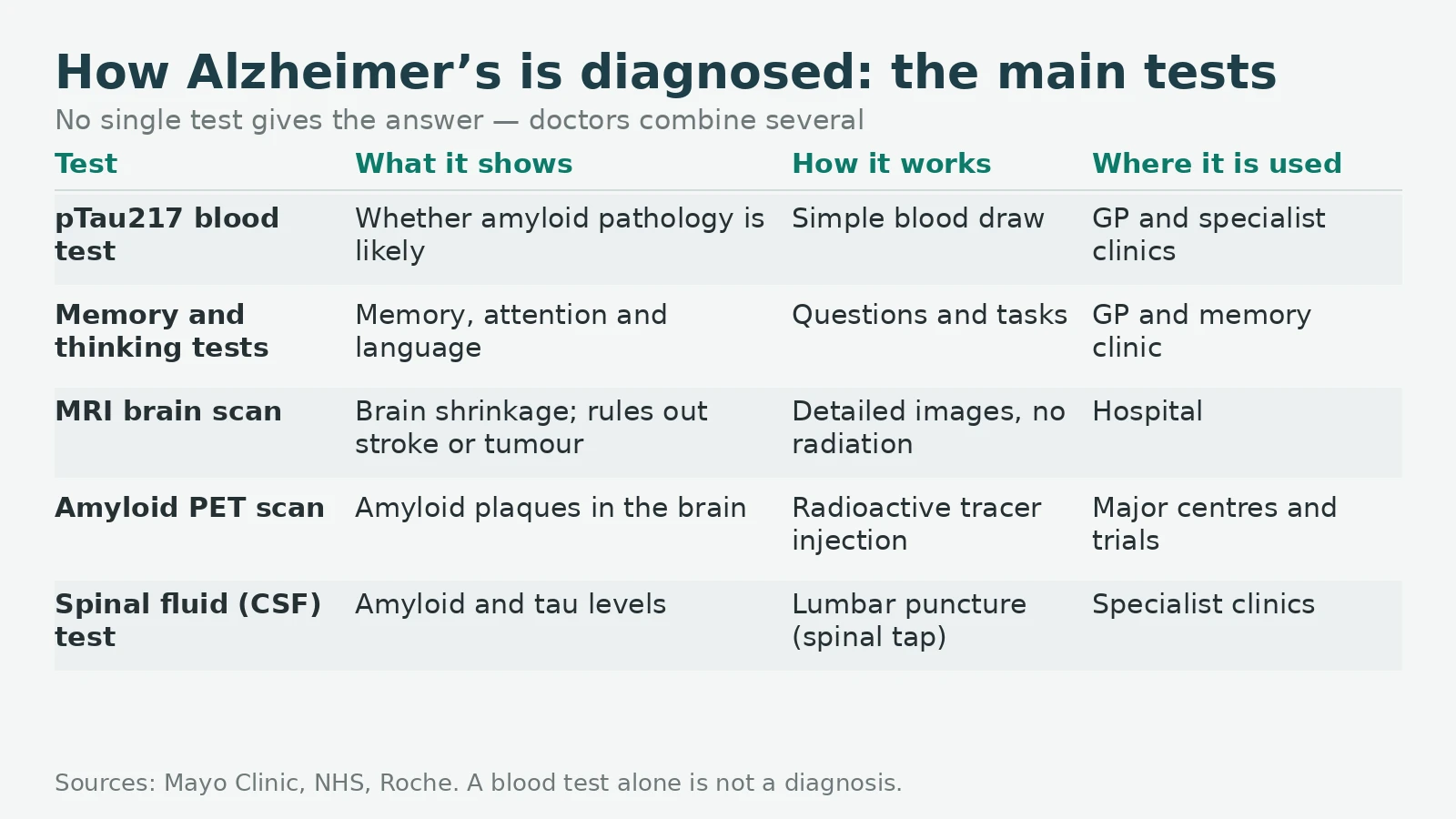
Alzheimer’s is diagnosed with a combination of tests, not one: a doctor takes a medical history, checks memory and thinking, rules out other causes with blood tests, and may use brain scans or spinal fluid tests. A blood test cleared by the FDA in August 2026 can now help show whether amyloid, a hallmark protein of the disease, is present.
Why getting a diagnosis matters
An estimated 75% of people living with dementia remain undiagnosed, according to Roche, and those who are diagnosed often wait years after symptoms first appear. A study by the Alzheimer’s Society, cited by the NHS, found that one in four people wait two years before getting help for dementia symptoms. An early, accurate diagnosis gives you and your family the best chance to prepare, to plan care and finances, and to consider treatments and clinical trials while they can still help. Memory problems do not necessarily mean dementia — depression, anxiety, an underactive thyroid, a sudden infection causing delirium, and side effects of some medicines can all affect memory — which is one reason a proper assessment matters.
What happens at the GP appointment
If you are worried about your memory, the first step is to see a GP. The GP will ask about your symptoms and whether everyday activities such as washing, cooking, shopping or paying bills have become harder. If possible, bring someone who knows you well, so they can describe changes they have noticed and help you remember what was said. The GP will do a physical examination and may organise blood and urine tests to rule out other causes of memory problems, and will ask you to do a short memory or cognitive test. If other causes have been ruled out, the GP may refer you to a specialist — an old-age psychiatrist, a geriatrician or a neurologist — often working in a memory clinic.
Memory and thinking tests
A brief mental status test checks memory and other thinking skills, and longer neuropsychological testing can give more detail, comparing your results with people of a similar age and education level. These tests help establish a diagnosis and provide a starting point to track symptoms in the future, as the Mayo Clinic explains. The specialist may also organise further, more detailed memory tests, and most cases of dementia can be diagnosed after these assessments, according to the NHS.
Blood tests: ruling out other causes
Routine blood tests can rule out other causes of memory loss and confusion, such as a thyroid disorder or vitamin levels that are too low. This step matters because some of these causes are treatable, and mistaking them for Alzheimer’s would delay the right care. But blood tests now do more than rule things out: newer tests can measure levels of beta-amyloid and tau protein, the two proteins whose build-up drives Alzheimer’s disease.
The new pTau217 blood test
On 24 August 2026, the US Food and Drug Administration cleared the Elecsys Phospho-Tau (217P) Plasma test, known as pTau217, developed by Roche with Eli Lilly. It is the first and only FDA-cleared single-biomarker blood test that supports both rule-in and rule-out assessment of amyloid pathology — the clumps of amyloid protein that are a hallmark of Alzheimer’s. It is designed for people aged 55 and older who have signs, symptoms or complaints of cognitive decline, and it gives a positive, intermediate or negative result. A standard blood draw is all it takes, and it runs on laboratory instruments already installed in thousands of US labs, which should make it far more accessible than brain scans or spinal taps. It is not a stand-alone diagnostic: results must be read alongside clinical history, cognitive testing and other findings, and it is not cleared as a general screening test for healthy people without symptoms. Earlier FDA-cleared blood tests include the Lumipulse pTau217/β-amyloid ratio test, cleared in May 2025, and Roche’s pTau181 test, cleared in October 2025 mainly to help rule out Alzheimer’s in primary care. You can read more about the blood-test story in our guide to the Alzheimer’s blood test.
Brain scans: MRI, CT and PET
Brain imaging looks for changes linked to Alzheimer’s and rules out other conditions that cause similar symptoms, such as strokes, tumours or injury. An MRI uses radio waves and a strong magnetic field to produce detailed images of the brain; it may show shrinkage of brain regions linked to Alzheimer’s, and it is generally preferred to a CT scan for evaluating dementia. A CT scan, a specialised X-ray, is usually used to rule out tumours, strokes and head injuries. PET scans use a low-level radioactive tracer to capture images of the disease process: FDG PET shows areas where the brain is not using energy properly, amyloid PET measures amyloid plaques, and tau PET measures tau tangles. These newer scans are mainly used in major medical centres or in clinical trials, because they are costly and not widely available.
Spinal fluid tests and genetics
Sometimes doctors measure amyloid and tau in cerebrospinal fluid — the fluid that surrounds the brain and spinal cord — collected by a lumbar puncture, or spinal tap. This may be done if symptoms are getting worse quickly or if dementia is affecting someone at a younger age. Genetic tests are not recommended for most people who might have Alzheimer’s. People with a family history of early-onset Alzheimer’s may consider testing, but only after meeting a genetic counsellor to talk through the risks and benefits. Having a parent or sibling with Alzheimer’s raises your risk by 10% to 30%, according to the Cleveland Clinic, and the APOE ε4 gene is linked to higher risk and earlier onset — but not everyone who carries it develops the disease.
What happens after a diagnosis
After the necessary tests, your doctor should ask whether you want to know your diagnosis, explain what it might mean, and give you time to talk it through. You should be told the type of dementia, how symptoms might develop, what treatments may be offered, and which professional will co-ordinate your support, as well as where to find care services, support groups and financial and legal advice. The GP should arrange follow-up appointments to check how you are managing, and the memory service may continue to see you in the early stages. Protein build-up in the brain can begin up to ten years before symptoms appear, the Cleveland Clinic notes, so a diagnosis is often the start of a long process of planning, not a single moment.
When to see a doctor
See a GP if you or someone close to you notices memory loss or other thinking problems that interfere with everyday life, such as forgetting recent conversations, getting lost in familiar places, struggling with familiar tasks, or changes in mood or personality. Bring a family member or friend to the appointment if you can. Do not assume memory problems are simply a normal part of getting older — many causes are treatable, and only an assessment can tell them apart. In an emergency call 911 (US), 999 (UK) or 112 (EU). If you are worried about someone’s memory, encourage them to make an appointment and offer to go with them.
Frequently asked questions
Can a blood test diagnose Alzheimer's?
Not on its own. Blood tests such as the FDA-cleared pTau217 test can show whether amyloid pathology, a hallmark of Alzheimer's, is likely present, but the result must be read alongside medical history, memory testing and other findings. A positive result means further evaluation is needed, and a negative result points doctors towards other causes of memory problems. No blood test replaces a full clinical assessment.
How accurate is the pTau217 blood test?
In the studies used for FDA clearance, Elecsys pTau217 showed high agreement with amyloid PET imaging, the established way of confirming amyloid in the brain. It gives a positive, intermediate or negative result, with the intermediate group needing further confirmatory testing. Experts still want to see real-world performance data, including how many people fall into the intermediate group, before judging it in everyday practice.
What is the first test for Alzheimer's?
The first step is usually a GP appointment, where the doctor takes a medical history, asks about everyday activities and gives a short memory or cognitive test. Blood and urine tests follow to rule out other causes, such as an underactive thyroid or low vitamin levels. If dementia is suspected, the GP refers you to a specialist, often in a memory clinic, for more detailed testing and brain scans.
Can an MRI show Alzheimer's?
An MRI can support the diagnosis but cannot confirm it alone. It produces detailed images of the brain and may show shrinkage of regions linked to Alzheimer's, and it is generally preferred to a CT scan for evaluating dementia. Its main job is often to rule out other causes of symptoms, such as strokes, tumours or injury. PET scans and spinal fluid tests are the tests that directly measure amyloid and tau.
How long does an Alzheimer's diagnosis take?
There is no fixed timetable. A GP assessment can happen in one or two appointments, but referral to a memory clinic, further memory tests and brain scans can take weeks or months, depending on where you live. A study by the Alzheimer's Society found that one in four people wait two years before getting help for dementia symptoms, so raising concerns early is the best way to shorten the process.
Is Alzheimer's diagnosis different from dementia diagnosis?
Dementia is the umbrella term for a group of conditions that affect memory and thinking, and Alzheimer's disease is the most common cause. A dementia diagnosis identifies that the symptoms are present, while an Alzheimer's diagnosis identifies the specific disease behind them. Biomarker tests for amyloid and tau, along with scans and spinal fluid tests, help doctors pin down Alzheimer's rather than another type of dementia.
Sources
- Mayo Clinic: Alzheimer's disease — diagnosis and treatment www.mayoclinic.org
- NHS: How to get a dementia diagnosis www.nhs.uk
- Cleveland Clinic: Alzheimer's Disease my.clevelandclinic.org
- Alzheimer's Association: How is Alzheimer's Disease Diagnosed? www.alz.org
- Medical News Today: Alzheimer's — new single biomarker blood test gets FDA clearance www.medicalnewstoday.com
- Roche: FDA clearance for Elecsys pTau217 diagnostics.roche.com

Try the tool
Not sure if it can wait?
Common causes and warning signs for 16 everyday symptoms.
Open the symptom guide