Flu or a Cold? How to Tell the Difference
Flu hits fast with a high temperature and aching muscles; a cold creeps in over a day or two and stays in the nose and throat. Here is how to tell them apart — and why it matters more than usual this winter.
- Written by
- Health Daily Advice
- Published
- Reading time
- 7 minutes
- Sources
- 9 cited
In this guide
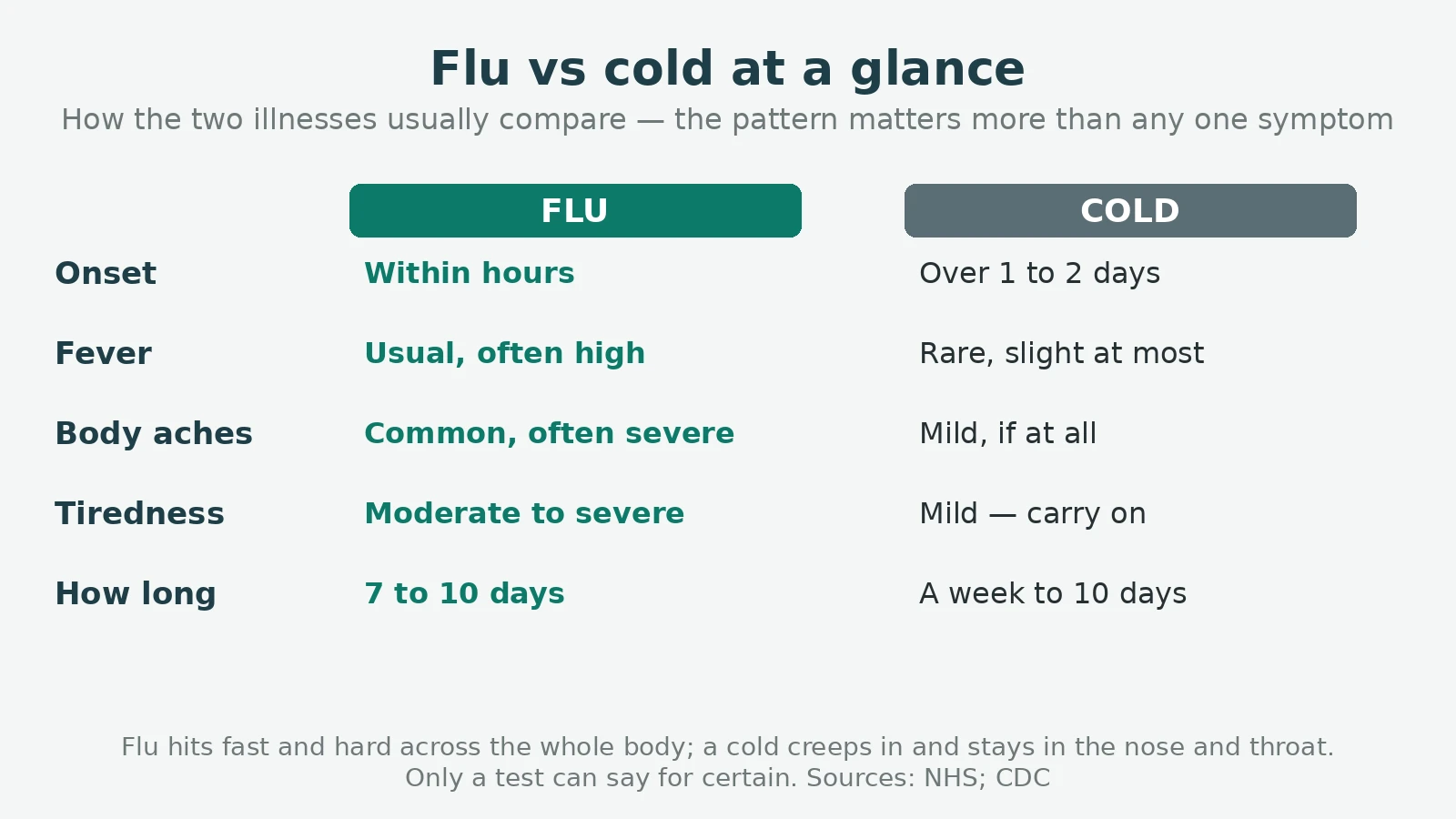
Flu usually arrives like a switch being flicked: a sudden high temperature, aching muscles and exhaustion within hours. A cold creeps in over a day or two, stays mostly in your nose and throat, and rarely brings a fever. If you feel flattened and feverish fast, it is more likely flu — but only a test can say for certain.
Flu vs cold at a glance
The two illnesses share a lot of symptoms, so no single sign settles it. What helps is the pattern: how fast it starts, how high the temperature goes, and how wiped out you feel. The NHS sums it up in three lines — flu appears quickly, affects more than your nose and throat, and leaves you too exhausted to carry on as normal, while a cold builds gradually, stays in the nose and throat, and lets you keep going.
| Sign | Flu | Common cold |
|---|---|---|
| Onset | Sudden, within a few hours | Gradual, over 1 to 2 days |
| Fever | Usual, often a sudden high temperature | Rare; a slight temperature at most |
| Body aches | Common and often severe | Mild, if at all |
| Tiredness | Moderate to severe exhaustion | Mild; you feel unwell but can carry on |
| Sore throat | Sometimes | Common |
| Runny or stuffy nose | Sometimes | Common — the hallmark of a cold |
| Sneezing | Sometimes | Common |
| Cough | Common, usually dry | Common, often hacking |
| How long it lasts | Typically 7 to 10 days, sometimes several weeks | Usually a week to 10 days; a cough can linger up to 3 weeks |
| Complications | Can lead to pneumonia and hospital admission | Rarely causes serious problems |
The clues, one by one
How fast it starts
This is often the clearest clue. Flu symptoms come on very quickly, within a few hours, according to the NHS — one morning you feel fine, by the afternoon you can barely get off the sofa. A cold, by contrast, builds slowly. The NHS says cold symptoms come on gradually over 2 to 3 days, often starting as a scratchy throat or a few sneezes before the blocked nose arrives. As a family doctor at Cleveland Clinic puts it, with a cold you may wonder for a couple of days whether you are getting ill at all; with flu, there is no wondering.
Fever
A sudden high temperature is the flu’s calling card. The CDC lists fever or feeling feverish with chills among the main signs of flu, and Cleveland Clinic notes fever is common with flu and often high, while it is rare with a cold. That does not mean a cold can never raise your temperature — the NHS says a cold can occasionally bring a high temperature — but a fever that arrives fast and feels fierce points towards flu. Bear in mind, though, that some people get flu without any fever, so its absence does not rule flu out.
Aches and tiredness
Flu tends to hurt all over. An aching body and feeling tired or exhausted are among the first symptoms the NHS lists for flu, and the CDC agrees that muscle aches, headaches and fatigue are typical. With a cold, aches are usually mild or absent, and tiredness is more a feeling of being generally unwell than being flattened. Cleveland Clinic’s comparison puts it plainly: fatigue with a cold is mild, while with flu it is moderate to severe, and flu can leave you exhausted for weeks after the worst has passed.
Sore throat, sneezing and a blocked nose
These are the cold’s home turf. A blocked or runny nose, sneezing and a sore throat are the main symptoms of a cold, according to the NHS, and the CDC says people with colds are more likely to have a runny or stuffy nose than people with flu. Flu can cause a sore throat and a stuffy nose too, so these symptoms alone do not settle anything — but if sneezing and a streaming nose dominate and you have no fever, a cold is the likelier culprit.
How long each one lasts
A cold usually peaks around day five and clears within a week to 10 days, Cleveland Clinic says, and the NHS advises you should begin to feel better in about 1 to 2 weeks. One exception is the cough, which can hang on for two or three weeks after everything else has gone. Flu typically sticks around for seven to 10 days, according to Cleveland Clinic, but it can last for several weeks, and the tiredness often outstays the other symptoms. The NHS advises seeking help if flu symptoms do not improve after 7 days, or if a cold has not improved after 10 days.
When it is probably flu
Put the clues together and a pattern emerges. Flu is the likelier answer when several of these are true:
- It hit suddenly, within hours, rather than creeping up over days.
- You have a sudden high temperature, chills or shivering.
- Your muscles ache and your head throbs.
- You feel exhausted — too ill to work or do normal activities.
- It is flu season and flu is circulating widely where you live, which is the case right now.
Even so, symptoms alone can mislead. The CDC is blunt about this: it can be difficult, or even impossible, to tell the difference between a cold and flu based on symptoms alone, and special tests can tell whether a person has flu. Home flu tests and tests at a GP surgery or clinic can give an answer, which matters because flu treatments work best when started early — so if you are in a higher-risk group, do not wait to ask a doctor or pharmacist.
Could it be COVID-19 or RSV instead?
Flu and colds are not the only winter bugs in circulation, and the others can look very similar. The UK Health Security Agency notes that flu, COVID-19 and RSV circulate at the same time in winter, and that COVID-19 today often brings cold-like symptoms — sometimes with fever or chills, a continuous cough, tiredness, body aches, a sore throat or a blocked nose, and occasionally a change in taste or smell. RSV typically brings cough, wheezing, shortness of breath, tiredness and fever, and while it is often mild in adults it can be serious in babies and older people: in the UK it accounts for around 20,000 hospital admissions a year in children under one, and around 9,000 a year in people aged 75 and over. If your symptoms include wheezing, breathlessness or a loss of taste or smell, or if a baby is breathing fast or noisily, that points away from a simple cold and towards medical advice.
Why this matters right now: flu is surging
This is not a quiet flu season. The CDC’s FluView report for the week ending 14 November 2026 shows flu activity rising across the United States and higher than is usual for mid-November. Visits to outpatient clinics for flu-like illness reached 3.8%, above the national baseline of 2.9% for the second week running, and 11.8% of laboratory specimens tested positive for flu. Hospitals reported 11,734 flu admissions that week — up from 9,584 the week before — and the cumulative hospitalisation rate of 12.0 per 100,000 people is the highest for this point in a season since 2010–11. Almost all of the flu in circulation is one strain: 96.4% of subtyped influenza A viruses were A(H1N1)pdm09. The CDC estimates at least 3.7 million illnesses, 50,000 hospitalisations and 2,800 deaths from flu so far this season, including seven deaths in children, and its forecasts predict a likely further rise in admissions and emergency visits in the week ending 5 December, with 9,200 to 36,100 new admissions expected. In the UK, last winter saw around 8,000 deaths associated with flu, according to the UK Health Security Agency — more than double the roughly 3,500 the year before. So if you feel suddenly feverish and floored this winter, the odds that it is flu rather than a cold are higher than usual.
Looking after yourself
Whether it is flu or a cold, the basics are the same: rest, sleep and plenty of fluids. The NHS advises drinking lots of water to avoid dehydration and, for flu, resting and taking steps to lower a temperature and ease aches — a pharmacist can advise on suitable over-the-counter options and check they are safe for you, especially if you take other medicines. Do not take paracetamol and a flu remedy containing paracetamol at the same time, the NHS warns, as it is easy to take more than the recommended amount. Antibiotics will not help either illness: the NHS is clear that they do not work for viral infections such as flu or a cold.
Think about other people, too. Flu is very infectious, and the NHS says you are most likely to pass it on in the first 5 days. With a cold, the NHS says you stay infectious until all your symptoms have gone, usually 1 to 2 weeks. Wash your hands often with warm water and soap, catch coughs and sneezes in a tissue and bin it quickly, and try to stay at home while you have a high temperature or feel too unwell for normal activities.
When to see a doctor
Most colds clear up without a GP, and many healthy adults recover from flu at home. But get medical advice promptly if you are 65 or over, pregnant, have a long-term condition such as diabetes or heart, lung, kidney or liver disease, have a weakened immune system, or feel very unwell or short of breath. The NHS advises an urgent GP appointment or NHS 111 if flu symptoms have not improved after 7 days, and for a cold, see a GP if symptoms have not improved after 10 days, if a high temperature lasts more than 3 days, if a cough lasts more than 3 weeks, or if symptoms get worse instead of better. Cleveland Clinic adds a useful warning sign: feeling better and then getting worse again can signal a second infection on top of the first, so that pattern deserves a call to your doctor too.
Call 999 or go to A&E straight away if you get sudden chest pain, have severe difficulty breathing, or start coughing up blood. In an emergency call 911 (US), 999 (UK) or 112 (EU).
Frequently asked questions
How can you tell if it's flu or a cold?
Look at how fast it starts and how ill you feel. Flu usually arrives within hours with a sudden high temperature, aching muscles and exhaustion that leaves you too unwell for normal activities. A cold builds gradually over a day or two, stays mainly in your nose and throat, and rarely brings a fever. A runny nose and sneezing point towards a cold. Only a flu test can say for certain.
Can a cold cause a fever?
Sometimes, but it is uncommon and usually mild. The NHS says a cold can occasionally bring a high temperature, along with aching muscles and a loss of taste or smell. With flu, fever is usual and often high, arriving suddenly with chills. If your temperature is high, comes on fast and leaves you feeling flattened, flu is the likelier cause — and if a high temperature lasts more than three days, see a GP.
How long does flu last compared to a cold?
They last a similar length of time, but flu feels worse for longer. A cold usually peaks around day five and clears within a week to 10 days, although the cough can linger for up to three weeks. Flu typically lasts seven to 10 days, but it can drag on for several weeks, and the tiredness often outstays the other symptoms. If flu symptoms have not improved after seven days, or a cold after 10 days, get medical advice.
Can you have flu without a fever?
Yes. Not everyone with flu gets a fever, and some people — older adults — may have flu with mild symptoms. That is one reason symptoms alone cannot settle the question: the CDC says it can be difficult, or even impossible, to tell flu from a cold on symptoms alone. If you feel exhausted and achy during flu season, or you are in a higher-risk group, a flu test and a word with your doctor or pharmacist can clarify things.
When should I see a doctor for flu or a cold?
Seek help promptly if you are 65 or over, pregnant, have a long-term condition such as diabetes or heart or lung disease, or have a weakened immune system. Also see a GP if flu symptoms have not improved after seven days, a cold has not improved after 10 days, a high temperature lasts more than three days, or a cough lasts more than three weeks. Call 999 straight away for sudden chest pain, severe difficulty breathing, or coughing up blood.
Is it flu, COVID-19 or RSV?
It can be hard to tell, because all three circulate in winter and share symptoms. COVID-19 today often brings cold-like symptoms, sometimes with fever, a continuous cough, tiredness, body aches or a loss of taste or smell. RSV usually causes cough, wheezing, shortness of breath, tiredness and fever, and can be serious in babies and older adults. A test is the only way to know for certain, so ask a doctor or pharmacist if you are unsure.
Sources
- NHS: Flu www.nhs.uk
- NHS: Common cold www.nhs.uk
- CDC: Cold Versus Flu www.cdc.gov
- CDC: Weekly US Influenza Surveillance Report, Week 45, ending November 14, 2026 (FluView) www.cdc.gov
- Cleveland Clinic: Cold or Flu? How To Tell the Difference health.clevelandclinic.org
- UK Health Security Agency: Do I have flu, COVID-19 or a cold? Know the signs and symptoms ukhsa.blog.gov.uk

Try the tool
Not sure if it can wait?
Common causes and warning signs for 16 everyday symptoms.
Open the symptom guide