Flu Symptoms in Children: What Parents Should Watch For
Flu is surging early in the US, and children under five are being hit hardest. The symptoms to watch for, how flu differs from a cold, and the warning signs that need urgent care.
- Written by
- Health Daily Advice
- Published
- Reading time
- 8 minutes
- Sources
- 11 cited

In this guide
Flu in children usually starts suddenly with a high fever, body aches, headache and exhaustion, and some children also vomit or have diarrhoea. Most children recover in about a week, but children under five face a higher risk of complications, so know the emergency warning signs and call your paediatrician within 24 hours if your child is under five.
Flu is surging early in the US
This year’s flu season has arrived early and is rising fast. The CDC’s FluView report for the week ending 14 November 2026 shows outpatient visits for flu-like illness at 3.8% — above the national baseline of 2.9% for the second week running, and up in every age group. That figure counts fever plus cough or sore throat, not lab-confirmed flu, so it can capture illness from any respiratory virus, but the laboratory picture points the same way: 11.8% of clinical specimens tested positive for flu that week.
Hospitals reported 11,734 laboratory-confirmed flu admissions in that one week, a rate of 3.5 per 100,000 people and a sharp rise on the week before. The CDC now estimates at least 3.7 million illnesses, 50,000 hospitalisations and 2,800 deaths so far this season. Seven children have died of flu this season, two of them reported in that week, both linked to H1N1 viruses.
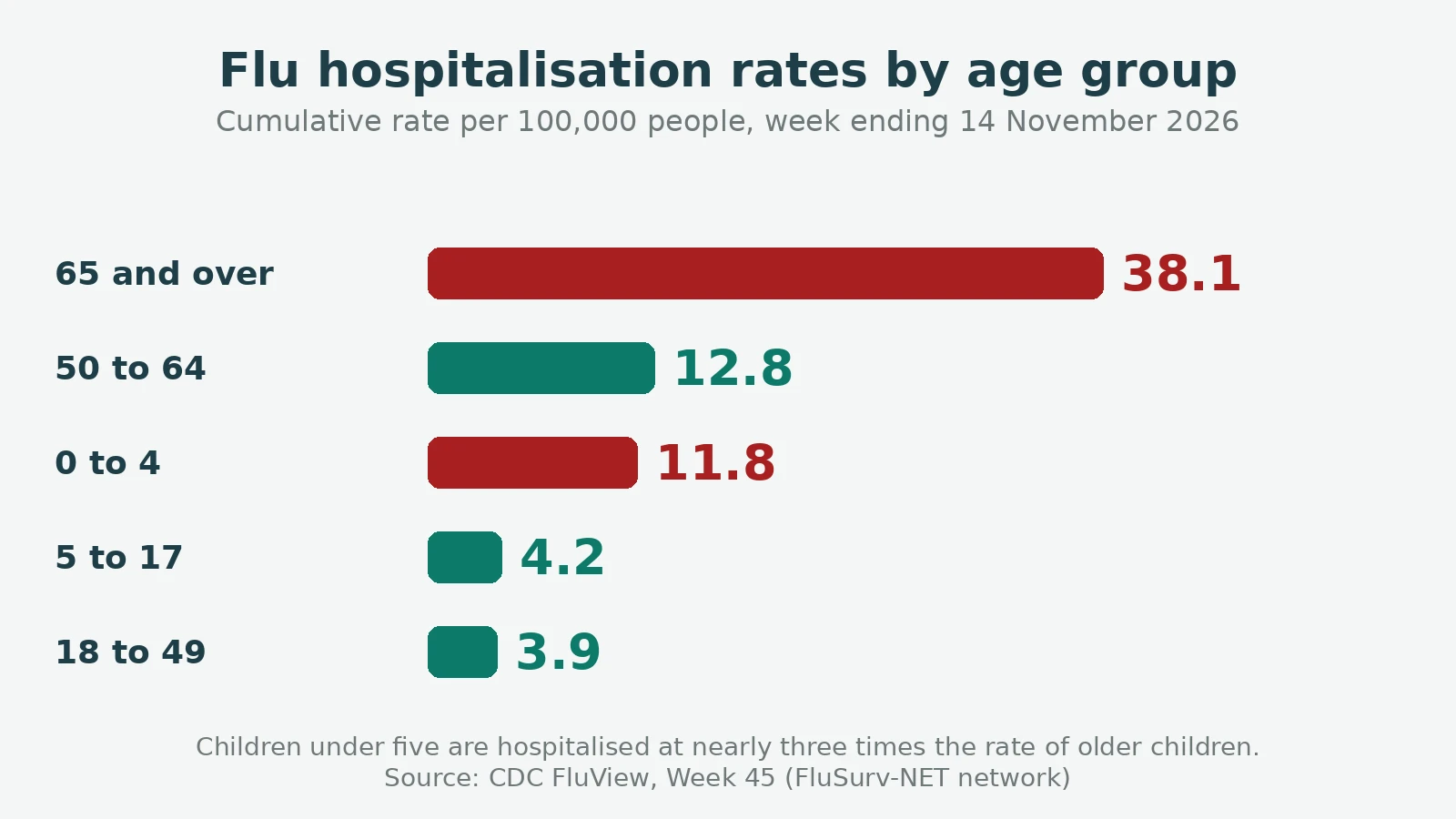
Almost all of the flu circulating is influenza A — 99.2% of viruses reported by public health laboratories — and of the influenza A viruses subtyped, 96.4% were A(H1N1)pdm09, the strain that emerged in 2009 and has circulated seasonally ever since. The cumulative hospitalisation rate in the CDC’s FluSurv-NET network reached 12.0 per 100,000, the highest for this point in a season since 2010–11. Among children, the highest rate is in the 0–4 age group, at 11.8 per 100,000, well above the 4.2 per 100,000 for children aged 5–17.
Two points of balance matter. First, the CDC still classifies the season’s overall severity as low across all ages, and notes that an early rise does not necessarily lead to a higher peak or a more severe season. Second, the CDC’s FluSight forecasts predict a likely rise in flu hospital admissions and emergency department visits for the week ending 5 December, so the numbers are expected to climb further before they fall.
What flu looks like in a child
Flu usually comes on suddenly. The typical symptoms are a fever or feeling feverish with chills, a cough, sore throat, runny or stuffy nose, muscle or body aches, headaches and fatigue. The American Academy of Pediatrics describes a sudden fever, usually above 100.4°F (38°C), with chills, headache, body aches, unusual tiredness, a sore throat, a dry hacking cough and a stuffy, runny nose.
Children have a few clues adults do not. Vomiting and diarrhoea are more common in children than in adults, and young children often cannot describe aches or a headache — they show it as fussiness or irritability, clinginess, poor feeding or being less active. The NHS adds that children can also get ear pain, sore eyes and swollen glands. Not everyone with flu will have a fever, so a child without a temperature can still have flu.
Children younger than five — especially those younger than two — are at higher risk of serious flu complications than healthy older children and adults. So are children of any age with chronic conditions such as asthma or other lung disease, heart disease, diabetes, disorders of the brain or nervous system, kidney disease, immune-system conditions or cancer. Even healthy children can get very sick from flu. Possible complications include sinus and ear infections, pneumonia, inflammation of the heart, brain or muscle, multi-organ failure and sepsis, and a worsening of chronic conditions such as asthma.
Flu vs a cold: how to tell them apart
A cold and flu share symptoms, but they feel very different. A cold appears gradually over one or two days and mainly affects the nose and throat. Flu appears quickly, often within hours, affects more than just the nose and throat, and leaves a child exhausted and too unwell to carry on as normal. The table below, based on the CDC’s comparison, shows the usual pattern.
| Sign | Common cold | Flu |
|---|---|---|
| Onset | Gradual, over 1–2 days | Abrupt, within hours |
| Fever | Rare, usually low-grade | Common, often high, lasts 3–4 days |
| Aches | Slight | Common, often severe |
| Chills | Uncommon | Fairly common |
| Fatigue | Sometimes | Usual, can be severe |
| Sneezing | Common | Sometimes |
| Sore throat | Common | Sometimes |
| Headache | Rare | Common |
| Chest discomfort, cough | Mild to moderate | Common, can be severe |
As the American Academy of Pediatrics puts it, a child with a cold usually has only a low-grade fever, a runny nose and a small amount of coughing, while children with flu usually feel much sicker, achier and more miserable. Healthy children get about six to ten colds a year, so a runny nose alone is rarely flu.
Flu, RSV and COVID: how they differ
Flu, RSV and COVID overlap so much in children that a test may be needed to tell them apart, and a child can be infected with flu and COVID at the same time. A few patterns help. Flu starts suddenly, one to four days after exposure, with fever, chills, headache, body aches and a dry cough; some children vomit or have diarrhoea. RSV builds gradually over four to five days, is worst on days three to five, and brings coughing, wheezing, fast or short breaths, flaring nostrils and poor feeding — it can lead to bronchiolitis or pneumonia in infants. COVID brings fever, cough, fatigue, muscle aches, congestion, sore throat and sometimes vomiting, diarrhoea or a loss of taste and smell. All three can be followed by a secondary illness such as an ear or sinus infection, bronchiolitis or pneumonia.
How long flu lasts in children
Most children get over flu in about a week, without lingering problems, according to the American Academy of Pediatrics. Fever and body aches usually ease in three to four days, but a cough or tiredness can linger for longer — the Cleveland Clinic says flu can last from a few days to two weeks, with mild symptoms such as fatigue, cough or a runny nose lasting several weeks in some children. The CDC puts it similarly: most people who get flu recover in a few days to less than two weeks.
Symptoms usually start one to four days after exposure to the virus. Children can spread flu from about a day before symptoms appear until about five to seven days after they start, and children and people with weakened immune systems may be contagious for slightly longer. Flu viruses travel in droplets when someone coughs, sneezes or talks, and can also be picked up from a contaminated object or surface and then transferred by touching the eyes, nose or mouth. The NHS says flu germs from coughs and sneezes can live on hands and surfaces for 24 hours.
Keep your child home from school or nursery until they feel better and have had no fever for at least 24 hours without using fever-reducing medicine.
The flu vaccine for children
Everyone aged six months and older in the US should get a flu vaccine every season, with rare exceptions, and the American Academy of Pediatrics recommends annual vaccination for all children from six months. This season’s vaccines are trivalent, protecting against three viruses: an influenza A(H1N1) virus, an influenza A(H3N2) virus and an influenza B/Victoria virus. Protection develops about two weeks after vaccination, and September and October are generally good times to get it — ideally by the end of October.
Children aged six months through eight years who have never had a flu vaccine, or have had only one dose, may need two doses given at least four weeks apart; after that, a single annual dose is enough. Both the injection and the nasal spray vaccine can be used this season, with no preference for one or the other. The nasal spray is approved for ages two through 49 and is not recommended for pregnant women, people with weakened immune systems or people with certain medical conditions. Children with egg allergies can receive the flu vaccine. The most common side effects are fever and soreness at the injection site after the shot, or a runny nose, congestion and sore throat after the nasal spray.
In the UK, the NHS offers a children’s flu vaccine each autumn and winter — check the NHS children’s flu vaccine page for who is eligible this year. So far this season, the CDC says almost all flu viruses collected in the US are antigenically similar to their vaccine reference viruses, which is reassuring, though it is too early to say what that means for vaccine effectiveness.
Antivirals: why the first 48 hours matter
Antiviral medicines work best when started as soon as possible, within two days of symptoms appearing, and they can shorten the illness and reduce the risk of severe disease. The American Academy of Pediatrics advises calling your paediatrician within 24 hours of the first flu symptom to ask about antivirals if your child is younger than five, especially under two, has an underlying health problem, has symptoms that are not improving, or is in contact with others who are at risk of complications. Treatment can still be started later for some children at higher risk, so it is worth calling even if the window has passed.
Antibiotics do not treat flu — it is a viral infection. At home, rest and plenty of fluids help, and paracetamol or ibuprofen can lower a temperature and treat aches — check the packaging for age suitability or ask a pharmacist. Never give aspirin to a child with flu: it is linked to Reye syndrome, a rare but serious condition.
When to see a doctor
Call your paediatrician or GP the same day if your child is under five, has a chronic condition, has a fever lasting longer than three days, or if symptoms do not start to improve after seven to ten days. In the UK, ask for an urgent GP appointment or get help from NHS 111 if you are worried about your baby’s or child’s symptoms.
Get medical care right away if your child shows any of the CDC’s emergency warning signs: fast breathing or trouble breathing; bluish lips or face; ribs pulling in with each breath; chest pain; severe muscle pain, so the child refuses to walk; dehydration — no urine for eight hours, a dry mouth or no tears when crying; not alert or interacting when awake; seizures; a fever above 104°F (40°C) that is not controlled by fever-reducing medicine; any fever in a child younger than 12 weeks; or a fever or cough that improves but then returns or worsens. The list is not exhaustive — if a symptom is severe or concerning, get medical advice. In an emergency call 911 (US), 999 (UK) or 112 (EU). In the UK, call 999 or go to A&E for sudden chest pain, severe difficulty breathing or coughing up blood.
Frequently asked questions
How can I tell if my child has flu or a cold?
Flu usually starts suddenly, with a high fever, body aches, headache and exhaustion, while a cold appears gradually over one or two days and mainly affects the nose and throat. A child with flu usually feels much sicker, achier and more miserable than a child with a cold. If your child has a sudden high fever and body aches, think flu and call your paediatrician for advice.
How long does flu last in children?
Most children get over flu in about a week, without lingering problems. Fever and body aches usually ease in three to four days, but a cough or tiredness can linger for longer — flu can last from a few days to two weeks. Keep your child home until they feel better and have had no fever for at least 24 hours without using fever-reducing medicine.
When should I take my child to the doctor for flu?
Call your paediatrician or GP the same day if your child is under five, has a chronic condition such as asthma, has a fever lasting longer than three days, or if symptoms do not improve after seven to ten days. Call within 24 hours of the first symptom if your child is under five or at higher risk, so antivirals can be considered within 48 hours.
What are the emergency warning signs of flu in children?
Get medical care right away for fast or troubled breathing, blue lips or face, ribs pulling in with each breath, chest pain, severe muscle pain, dehydration, not being alert when awake, seizures, a fever above 104°F (40°C), or any fever in a child younger than 12 weeks. A fever or cough that improves but then returns or worsens also needs urgent care.
Can my child get a flu vaccine this season?
Yes. Everyone aged six months and older in the US should get a flu vaccine every season, and the American Academy of Pediatrics recommends annual vaccination for all children from six months. Children aged six months to eight years who have never had a flu vaccine may need two doses, given at least four weeks apart. Both the injection and the nasal spray can be used this season.
Is flu dangerous for children?
Flu can be serious in children. Children under five, especially under two, and children with chronic conditions are at higher risk of complications such as pneumonia. This season, seven children in the US have already died of flu, and the hospitalisation rate for children under five is nearly three times that of older children. The CDC still classifies the season's overall severity as low, and most children recover in about a week.
Sources
- CDC: Weekly US Influenza Surveillance Report, Week 45, ending November 14, 2026 www.cdc.gov
- CDC: Signs and Symptoms of Flu www.cdc.gov
- CDC: Key Facts About Seasonal Flu Vaccine www.cdc.gov
- HealthyChildren.org (AAP): The Flu: What Parents Need to Know www.healthychildren.org
- HealthyChildren.org (AAP): RSV, Flu & COVID: How Are These Respiratory Illnesses Different? www.healthychildren.org
- NHS: Flu www.nhs.uk
- Mayo Clinic: Influenza (flu) www.amerikanhastanesi.org
- Cleveland Clinic: Influenza (Flu) my.clevelandclinic.org

Try the tool
Not sure if it can wait?
Common causes and warning signs for 16 everyday symptoms.
Open the symptom guide