RSV Symptoms in Children: Signs, Red Flags and When to Worry
RSV looks like a cold in most children, but in babies it can turn serious fast. Here are the symptoms to watch for, the red flags that need urgent care, and how to protect your child this winter.
- Written by
- Health Daily Advice
- Published
- Reading time
- 6 minutes
- Sources
- 11 cited

In this guide
RSV starts like a cold in children — a runny nose, cough and mild fever — but in babies under one it can turn serious, causing fast breathing, wheezing and feeding problems. Most children recover at home within one to two weeks. Watch for laboured breathing, blue lips, pauses in breathing or few wet nappies: those need urgent care.
What is RSV?
Respiratory syncytial virus, or RSV, infects the lungs and breathing passages. In older children and adults it usually causes only a mild, cold-like illness, but in babies it can spread to the small airways and cause bronchiolitis or pneumonia. The Mayo Clinic explains that nearly all children catch RSV before their second birthday, and repeat infections can happen throughout life, though later ones are usually milder.
RSV is the most common cause of hospital admission in children under one in the United States: the American Academy of Pediatrics says 2 to 3 out of every 100 infants with RSV may need a hospital stay. Each year in the US, RSV causes about 80,000 hospitalisations and up to 300 deaths in children under five, according to CDC figures. In the 2025–26 season, hospitalisation rates were highest in infants under 12 months, at 790.2 per 100,000 people, the CDC reported in its weekly surveillance summary.
This season, RSV activity is still low in most of the United States, but the CDC’s latest FluView update, covering the week ending 14 November 2026, reports that RSV emergency department visits are rising among children under five — just as flu activity is climbing early and families gather for Thanksgiving. If you are comparing winter bugs, see also our guide to flu, RSV and COVID symptoms and RSV symptoms in adults.
RSV symptoms in babies
In babies, the first signs of RSV can be easy to miss. They may be fussier than usual, less active, feed poorly or breathe differently — sometimes without any fever at all. Symptoms most commonly appear about four to six days after exposure.
As the illness develops, watch for:
- Fast, short or shallow breathing, or the skin and muscles between the ribs pulling inward with each breath
- A cough, wheezing or noisy breathing
- Feeding less than usual, or struggling to feed and breathe at the same time
- Unusual tiredness, irritability or floppiness
- Pauses in breathing lasting more than 10 seconds — especially dangerous in babies under six months
When RSV reaches the lower airways, extra signs can appear: nostrils flaring, the head bobbing with each breath, rhythmic grunting, belly breathing and tugging between the ribs or at the lower neck. The NHS says early bronchiolitis looks like a cold — sneezing, a runny or blocked nose and a slightly raised temperature — followed by a cough, faster breathing, difficulty feeding and noisy breathing.
RSV symptoms in older children
In older children, RSV usually looks like an ordinary cold: a congested or runny nose, dry cough, low-grade fever, sore throat, sneezing and headache. Most recover at home within one to two weeks, although some children wheeze again afterwards.
Symptoms are typically at their worst on days three to five and generally last an average of seven to 14 days. The cough can linger longer — the NHS says it usually gets better within three weeks. See a doctor sooner if symptoms do not start to improve after a week, or if they get worse instead of better.
RSV vs a cold vs flu
The three illnesses overlap, which is why symptoms alone often cannot identify the virus. As a rough guide:
| Illness | Typical start | Key features |
|---|---|---|
| Common cold | Gradual | Runny nose, sneezing, mild cough, little or no fever |
| RSV | Gradual | Cold-like symptoms, then cough and wheeze; in babies, poor feeding and fast breathing |
| Flu | Sudden | Fever, chills, headache, body aches and deep exhaustion arriving within hours |
Flu is surging early this season — the CDC estimates at least 3.7 million flu illnesses so far, with seven child deaths reported. If you are unsure which virus your child has, testing can help, and our guide to flu symptoms in 2026 explains what flu looks like this year.
How RSV spreads and how long it lasts
RSV spreads when an infected person coughs or sneezes nearby, through droplets reaching the eyes, nose or mouth, by direct contact such as kissing the face of a child with RSV, or by touching a contaminated surface — a doorknob, table or crib rail — and then touching the face. The virus can survive for many hours on hard surfaces. Children often pick it up at school or childcare and then pass it to the rest of the household.
People with RSV are usually contagious for three to eight days, and can become contagious a day or two before symptoms start. Some infants and people with weakened immune systems can keep spreading the virus for four weeks or longer, even after symptoms have stopped. The US RSV season generally starts in autumn, peaks in winter and tapers off by April.
Can RSV be prevented?
Yes — there are now two routes that protect babies, and usually only one is needed. Pregnant people can receive the maternal RSV vaccine at 32 to 36 weeks of pregnancy if the baby will be born during RSV season; the American Academy of Pediatrics says it cuts the risk of RSV hospitalisation for babies by 57% in their first six months. In the UK, the NHS offers the RSV vaccine from 28 weeks of pregnancy.
The other route is nirsevimab (Beyfortus), a ready-made antibody — not a vaccine — given as a single injection. The CDC and the American Academy of Pediatrics recommend one dose for infants younger than eight months who are born during or entering their first RSV season, if the mother was not vaccinated during the pregnancy. One dose protects for about five months, the length of a typical RSV season. In a trial published in the New England Journal of Medicine, healthy infants given nirsevimab were 74.5% less likely to have an RSV infection needing medical care than those given a placebo, and these infant immunisations have been shown to be about 80–90% effective at preventing hospitalisation with RSV.
Everyday steps help too: wash hands often with soap and water for at least 20 seconds, cover coughs and sneezes, clean frequently touched surfaces, wash or wipe toys regularly, avoid sharing cups and cutlery, and keep newborns away from anyone with a cold or flu — especially if the baby was born prematurely or has a serious health condition. Do not smoke around the child, as tobacco smoke raises the risk of severe illness.
Children at higher risk of severe RSV include premature babies and babies six months or younger, children with congenital heart disease or chronic lung disease, children with weakened immune systems, and children with neuromuscular disorders such as muscular dystrophy.
What helps a child with RSV?
There is no specific treatment for RSV and no antiviral for routine use. Antibiotics do not help, because RSV is a virus, and steroids do not help either. At home, supportive care is what matters: nasal saline with gentle suctioning, a cool-mist humidifier, plenty of fluids and frequent feeds, and paracetamol or ibuprofen for a low-grade fever — ibuprofen only if the child is older than six months. Avoid aspirin and cough-and-cold medicines in young children.
In hospital, severe RSV is treated with oxygen therapy, intravenous fluids to prevent dehydration and, if the child cannot breathe on their own, a ventilator. Hospital stays are usually a few days.
When to see a doctor
Call your child’s doctor promptly if a baby under 12 months has RSV symptoms, or if there is a temperature above 38°C (100.4°F) in a baby under three months, a fever above 40°C (104°F) at any age, symptoms that do not improve after a week, ear drainage or ear tugging, difficulty breathing, bad coughing fits or wheezing. Also call if your child has fewer than one wet nappy every eight hours, or is much less active and alert than usual.
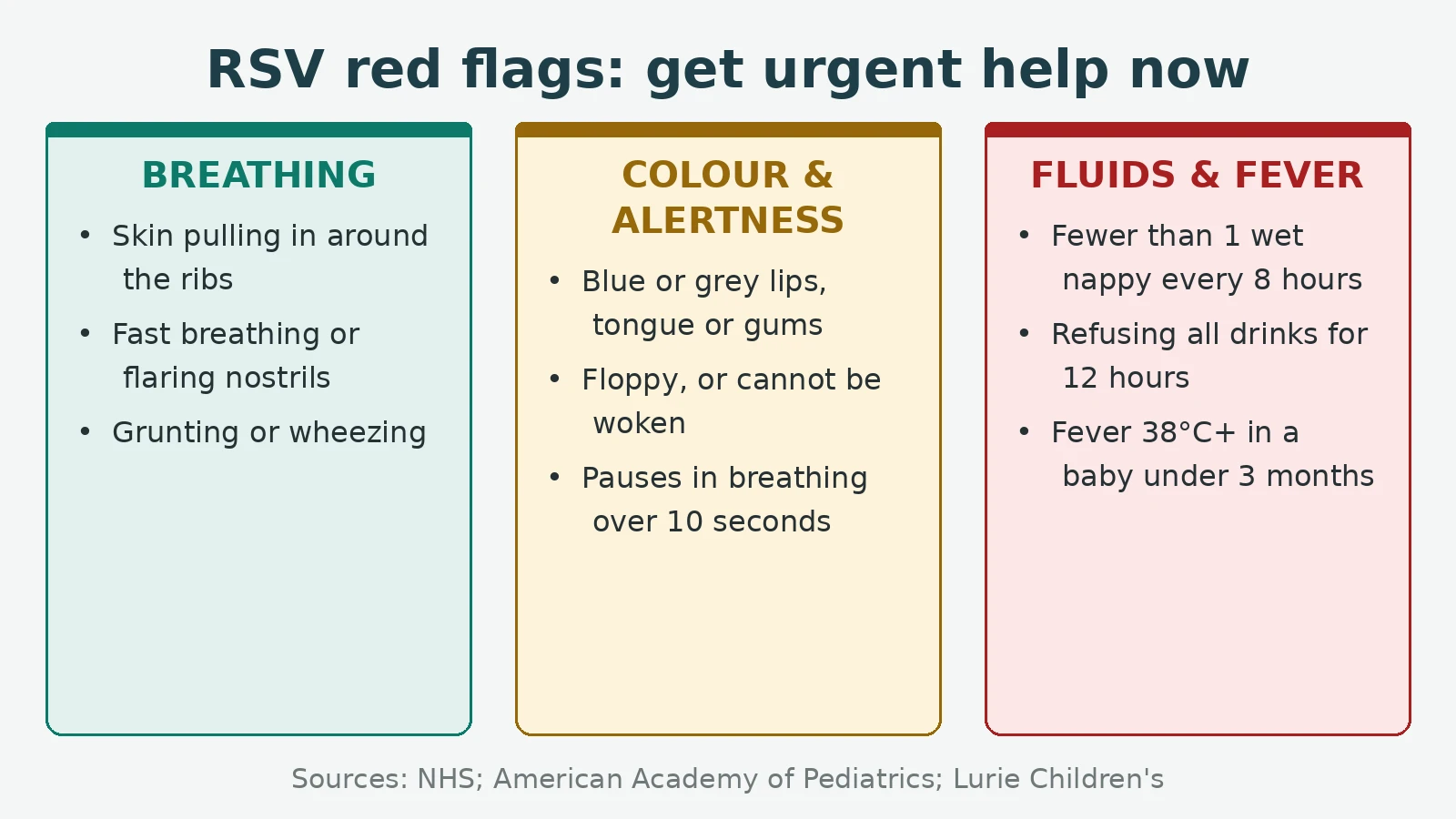
Get urgent help straight away if your child has difficulty breathing — skin pulling in tightly around the ribs, fast breathing, flaring nostrils or grunting — blue, grey or purple lips, tongue or gums, pauses in breathing of more than 10 seconds, or is floppy and cannot be woken or stay awake. In the UK, call 999 for these signs; the NHS lists them as emergencies for bronchiolitis.
In an emergency call 911 (US), 999 (UK) or 112 (EU).
Frequently asked questions
How do I know if my child has RSV or just a cold?
You often cannot tell from symptoms alone, because early RSV looks exactly like a cold: a runny nose, cough and mild fever. RSV is more likely if your baby develops fast breathing, wheezing, feeding problems or pauses in breathing, or if symptoms worsen after a few days instead of improving. A test can confirm it, but doctors usually judge by symptoms and how hard the child is working to breathe. When in doubt, call your GP or paediatrician.
How long does RSV last in children?
Symptoms are usually worst on days three to five and last an average of seven to 14 days, though the cough can linger for up to three weeks. Most children recover fully at home with rest and fluids. Call your doctor if symptoms do not start to improve after a week, if they get worse instead of better, or if your child develops breathing difficulty, poor feeding or signs of dehydration.
When should I take my child to A&E for RSV?
Go to A&E or call 999 straight away if your child struggles to breathe, has skin pulling in around the ribs, flaring nostrils or grunting, blue or grey lips or tongue, pauses in breathing of more than 10 seconds, or is floppy and cannot be woken. Also seek urgent care for a fever of 38°C or higher in a baby under three months, or fewer than one wet nappy every eight hours.
Can RSV be prevented in babies?
Yes. Pregnant people can have the maternal RSV vaccine from 28 weeks in the UK, or at 32 to 36 weeks in the US, which protects the baby for the first six months. Babies under eight months can instead receive nirsevimab, a single injection of ready-made antibody that protects for about five months and is about 80 to 90% effective at preventing hospitalisation. Hand washing, clean surfaces and keeping newborns away from people with colds also help.
Is RSV contagious, and can my child catch it twice?
Yes, RSV spreads easily through coughs and sneezes, direct contact and contaminated surfaces, and people are usually contagious for three to eight days. Children can catch it more than once — even twice in one season — because immunity does not last. Later infections are usually milder, but babies and children with heart or lung conditions can still become seriously ill, so keep them away from anyone with cold symptoms.
Does RSV need antibiotics?
No. Antibiotics do not work against viruses, so they cannot treat RSV itself, and steroids do not help either. Doctors may prescribe antibiotics only if a bacterial infection develops on top of RSV, such as an ear infection. Treatment is supportive: rest, fluids, saline nose drops, a cool-mist humidifier and paracetamol or ibuprofen for fever. Severe cases may need oxygen and fluids in hospital.
Sources
- CDC: How RSV Spreads www.cdc.gov
- Mayo Clinic: Respiratory syncytial virus (RSV) www.mayoclinic.org
- HealthyChildren.org (AAP): RSV: When It's More Than Just a Cold www.healthychildren.org
- NHS: Bronchiolitis www.nhs.uk
- Lurie Children's: When to Worry About RSV www.luriechildrens.org
- Immunize.org: Ask the Experts: RSV Preventive Antibody Recommendations for Infants www.immunize.org
- CDC MMWR: Respiratory Virus Activity, United States, July 2025–June 2026 www.cdc.gov
- EEW Magazine: Early Flu Season (CDC FluView, week ending 14 Nov 2026) www.eewmagazineonline.com

Try the tool
Not sure if it can wait?
Common causes and warning signs for 16 everyday symptoms.
Open the symptom guide