Flu vs RSV vs COVID: How to Tell Them Apart
Flu, RSV and COVID-19 are all rising this winter — but they feel different. Compare their symptoms, onset and duration, and learn when a test or a doctor is needed.
- Written by
- Health Daily Advice
- Published
- Reading time
- 7 minutes
- Sources
- 10 cited

In this guide
Flu, RSV and COVID-19 share so many symptoms — fever, cough, tiredness and a sore throat — that only a test can say for certain which one you have. Roughly, flu strikes suddenly with a high fever and aching body, COVID-19 builds gradually and can dull taste or smell, and RSV creeps in like a cold and often causes wheezing.
Winter viruses are stirring again. The UK Health Security Agency’s bulletin for 9 to 15 November 2026 showed flu climbing: the share of laboratory tests positive for flu rose to 11.4%, up from 8.3%, and flu hospital admissions reached 4.68 per 100,000 people, up from 3.76. RSV positivity rose to 5.2% from 3.2%, while COVID-19 held steady at 7%. Germany’s Robert Koch Institute estimated around 6 million new respiratory illnesses that week.
Why are flu, RSV and COVID-19 so easy to confuse?
All three infect the nose, throat and lungs, and spread in droplets and tiny particles breathed, coughed or sneezed out by someone who is ill. The CDC points out that flu and COVID-19 share most symptoms, and that you cannot tell them apart by symptoms alone. Cleveland Clinic puts it plainly: cough, runny nose and fever are common to all respiratory viruses, and a laboratory test is usually what settles it.
Flu vs RSV vs COVID: symptoms at a glance
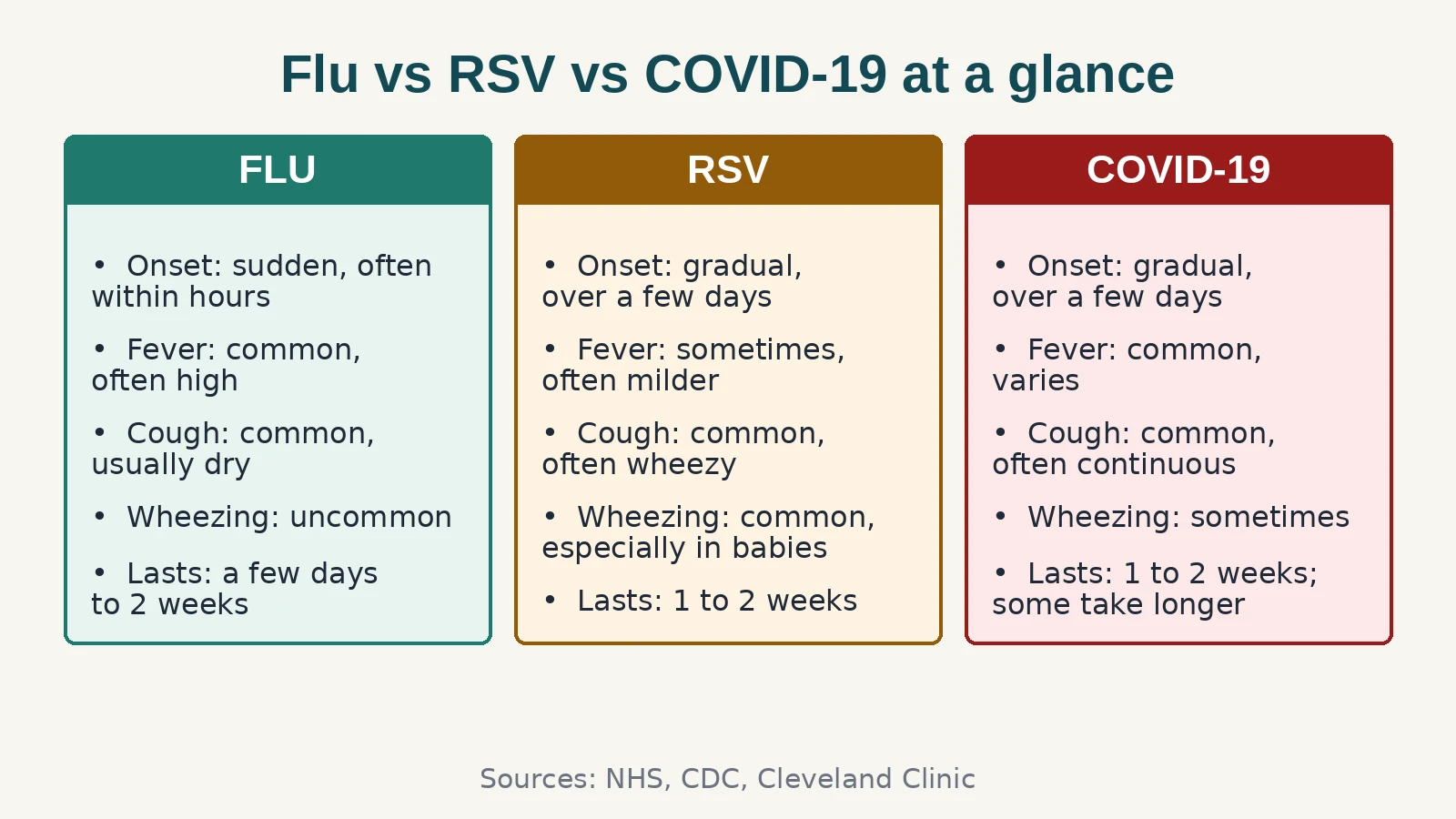
| Symptom or feature | Flu | RSV | COVID-19 |
|---|---|---|---|
| How it starts | Suddenly, often within hours | Gradually, over a few days | Gradually, over a few days |
| Time from exposure to symptoms | 1 to 4 days | 4 to 6 days | 2 to 5 days, up to 14 days |
| Fever | Common, often high — up to 39.4 to 40°C | Sometimes, often milder | Common, varies |
| Cough | Common, usually dry | Common, often with wheezing | Common, often continuous |
| Runny or stuffy nose | Sometimes | Common | Sometimes |
| Body aches | Common, often severe | Sometimes | Common |
| Wheezing | Uncommon | Common, especially in babies | Sometimes |
| Loss of taste or smell | Rare | Rare | Sometimes |
| How long it usually lasts | A few days to 2 weeks | 1 to 2 weeks | 1 to 2 weeks; some people take longer |
How does flu feel different?
Flu is the one that tends to floor you. The NHS describes flu symptoms as coming on very quickly — often within a few hours — with a sudden high temperature, an aching body, exhaustion, a dry cough, sore throat, headache and loss of appetite. Children may also develop ear pain, sore eyes and swollen glands.
Cleveland Clinic notes that flu can push a fever to 103 or 104 degrees Fahrenheit (39.4 to 40 degrees Celsius), and that people usually feel far more miserable than with other respiratory viruses. If you were fine at lunchtime and shivering by dinner, flu is the likeliest culprit. Most people recover within a few days to two weeks, according to the CDC.
What does RSV look like?
RSV is the gentlest of the three for most healthy adults, and the most worrying for the very young and the very old. In adults it usually behaves like a heavy cold. The NHS says RSV symptoms usually start within a few days of infection and include a runny or blocked nose, cough, sneezing, tiredness and a high temperature. Babies may also become irritable and feed less.
The clue that points most clearly to RSV is wheezing — a whistling or rattling sound when breathing. Cleveland Clinic calls wheezing the symptom unique to RSV, and notes it is a common cause of bronchiolitis and pneumonia. Almost all children catch RSV before their second birthday, and the CDC estimates it leads to 58,000 to 80,000 hospital admissions a year among children under five in the United States.
What does COVID-19 look like now?
COVID-19 has settled into a familiar pattern, but it still has features the other two rarely share. The NHS lists its symptoms as a high temperature, a new continuous cough, a loss or change to the sense of smell or taste, shortness of breath, tiredness, an aching body, headache, a sore throat, a blocked or runny nose, and stomach upset. Most people feel better within a few weeks.
Two things stand out. First, the loss of taste or smell is still far more associated with COVID-19 than with flu or RSV. Second, COVID-19 can linger: the CDC notes that some people develop long COVID, with ongoing symptoms lasting weeks, months or even years. COVID-19 also spreads more easily than flu, and people can pass it on without ever feeling ill themselves.
How quickly does each one appear — and how long does it last?
Timing is one of the most useful clues. The CDC gives these typical incubation periods: flu symptoms usually appear one to four days after infection, COVID-19 two to five days and up to 14 days, and RSV four to six days. A sudden illness a day after a crowded journey leans towards flu.
People with flu are potentially contagious for about a day before symptoms start and are most contagious during the first three days. With COVID-19, people can start spreading the virus two to three days before symptoms begin, and on average they remain contagious for about eight days after symptoms start. The NHS advises staying at home for five days after a positive COVID-19 test if you are 18 or over, or three days if you are under 18.
Who is most at risk?
All three viruses can make anyone seriously ill, including healthy people, but the risk is not spread evenly. The CDC lists older adults aged 65 and over, people with underlying medical conditions, pregnant women and infants as being at higher risk from both flu and COVID-19, and notes that flu tends to cause more severe illness in young children than COVID-19 does.
RSV’s highest risk falls on babies under six months, adults over 75, children born prematurely, and anyone with a weakened immune system or a long-term lung or heart condition. The NHS offers a free RSV vaccine to people who are 28 or more weeks pregnant, adults aged 75 and over, and people aged 65 to 74 with a weakened immune system or a long-term lung condition.
The UKHSA also flagged that more young children are seeing their GP with flu-like illness, and that only just over a third of two- and three-year-olds have had a flu vaccine this season. If your child is eligible for a flu nasal spray vaccine, book it as soon as possible.
How can you tell which one you have?
Symptoms alone often cannot settle it — and that is the official position of the CDC, which says testing is needed to confirm a diagnosis. Many clinics now use a single swab test that checks for flu, RSV and COVID-19 at once, and home tests for COVID-19 are widely available. Testing is most useful when the result would change what you do next: if you are in a higher-risk group, or if you live with or care for someone vulnerable.
You can also catch more than one virus at once, particularly children — Cleveland Clinic notes that co-infection is common in youngsters. Doctors have not seen evidence that having more than one virus leads to worse symptoms, and the care is the same either way.
Looking after yourself at home
Most of these infections are managed at home with rest and fluids. The NHS advice is consistent across all three: rest and sleep, drink plenty of water to avoid dehydration, and take paracetamol or ibuprofen if you have a high temperature and feel uncomfortable, checking the leaflet first. For a cough, the NHS suggests a teaspoon of honey, never for babies under 12 months. Antibiotics do not work against viral infections such as flu, and aspirin should not be given to children under 16.
How to avoid catching and spreading them
Prevention is mostly the same for all three viruses. The Mayo Clinic recommends getting a yearly flu vaccine and staying up to date with your COVID-19 vaccine, washing your hands often with soap and water for at least 20 seconds, and covering coughs and sneezes. When you are ill, stay home until you feel better and no longer have a high temperature, and keep newborn babies away from anyone with a cold or flu.
When to see a doctor
Some situations need prompt medical attention. Ask for an urgent GP appointment or get help from NHS 111 if you are 65 or over, pregnant, have a long-term condition or a weakened immune system, or your symptoms have not improved after seven days. For a baby or child, seek help urgently if they are feeding much less than normal, have had a dry nappy for 12 hours or more, or have a temperature of 38°C under three months old or 39°C or higher above that age.
Call 999 or go to A&E straight away if you or your child has sudden chest pain, severe difficulty breathing, starts coughing up blood, collapses, or becomes floppy and will not wake up. For babies, also watch for grunting noises, long pauses in breathing, or their tummy sucking in under their ribs.
In an emergency call 911 (US), 999 (UK) or 112 (EU)
Flu, RSV and COVID-19 will keep circulating all winter, and the latest figures suggest this season is already gathering pace. What matters is resting properly, protecting the people around you, and knowing when to seek help. If you are ever unsure, a test or a call to NHS 111 will settle it faster than guessing.
Frequently asked questions
How can I tell if I have flu, RSV or COVID-19?
You usually cannot tell from symptoms alone, because all three cause fever, cough, tiredness and a sore throat. Flu tends to arrive suddenly with a high fever and aching body, COVID-19 builds gradually and can dull taste or smell, and RSV creeps in like a cold and often causes wheezing. A swab test that checks for all three is the only reliable way to know for certain.
Which is worse, flu, RSV or COVID-19?
It depends on who catches it. Flu tends to hit hardest and fastest in healthy adults, with a high fever and severe aches. RSV is usually mild in adults but can be serious for babies under six months and adults over 75. COVID-19 is often milder now, but it spreads more easily and can linger as long COVID. All three can cause pneumonia and hospital admission in vulnerable people.
How long do flu, RSV and COVID-19 last?
Most people recover from flu within a few days to two weeks, and RSV usually clears within one to two weeks. Mild COVID-19 also lasts around one to two weeks, though some people take longer and a few develop long COVID, with symptoms lasting weeks, months or even years. A cough can linger for weeks after any of the three, even once the rest of the illness has cleared.
When should I see a doctor for flu, RSV or COVID-19?
Ask for an urgent GP appointment or get help from NHS 111 if you are 65 or over, pregnant, have a long-term condition or a weakened immune system, or your symptoms have not improved after seven days. Call 999 or go to A&E straight away for sudden chest pain, severe difficulty breathing, coughing up blood, or a child who becomes floppy and will not wake up.
Can I catch flu, RSV and COVID-19 at the same time?
Yes. Co-infection is common, particularly in children, because the three viruses circulate together in winter and spread in the same way. A child in a nursery or classroom full of coughing children can easily pick up two or even three viruses at once. Doctors have not seen evidence that having more than one virus leads to worse symptoms, and the care is the same either way.
Do I need a test for flu, RSV or COVID-19?
Not always. Most healthy adults can rest at home and recover without knowing exactly which virus they have. A test is worth doing if you are in a higher-risk group and early treatment could help, or if you live with or care for someone vulnerable. Many clinics use a single swab test that checks for all three viruses at once.
Sources
- UKHSA: Latest weekly winter virus surveillance data www.gov.uk
- NHS: Flu www.nhs.uk
- NHS: Respiratory syncytial virus (RSV) www.nhs.uk
- NHS: COVID-19 symptoms and what to do www.nhs.uk
- CDC: Similarities and Differences between Flu and COVID-19 www.cdc.gov
- Cleveland Clinic: Differences Between RSV, the Flu and Covid-19 health.clevelandclinic.org
- Mayo Clinic: COVID-19, cold, allergies and the flu: What are the differences? www.mayoclinic.org
- TechTimes: Germany Estimates About 6 Million New Respiratory Illnesses (RKI week 46 report) www.techtimes.com

Try the tool
Not sure if it can wait?
Common causes and warning signs for 16 everyday symptoms.
Open the symptom guide