Measles Symptoms in Children: Stages, Rash and Red Flags
Measles in children starts like a bad cold, then a red rash spreads from the face downwards. Here are the stages, how long a child stays infectious, the complications to watch for, and the 2026 US outbreak in numbers.
- Written by
- Health Daily Advice
- Published
- Reading time
- 7 minutes
- Sources
- 11 cited
In this guide
Measles in children usually starts like a bad cold, with a high fever, cough, runny nose and sore, watery eyes, followed three to five days later by a red rash that begins on the face and spreads downwards. Most children are ill for about seven to ten days, though measles can cause ear infections, pneumonia and, rarely, brain swelling.
What are the stages of measles in children?
Measles does not arrive all at once. It moves through four stages, and knowing the order helps parents recognise it early — and helps explain why a child can pass it on before the rash ever appears. The whole illness usually runs its course over two to three weeks, with the worst of it in the first few days after the rash shows up.
Stage 1: Incubation, with no symptoms
Symptoms begin 7 to 14 days after exposure, according to the CDC. During this quiet period the virus is spreading through the body, but the child looks and feels well. The World Health Organization gives the same 7 to 14 day range, while the Mayo Clinic puts it at 10 to 14 days.
Stage 2: Early illness, the cold-like phase
The first signs look like a bad cold or flu: a high fever, cough, runny nose, sore throat, and red, watery eyes. Doctors sometimes call the cough, runny nose and sore eyes the “three Cs” — cough, coryza and conjunctivitis. The fever climbs through this phase and often peaks above 104°F (40°C) around the time the rash appears.
Around two to three days after symptoms begin, some children develop Koplik spots: tiny white or bluish-white spots, about 2 to 3 mm across, on a red base inside the cheeks. They can appear a day before the rash and usually last two to three days. They are a useful clue when they are present, but not every child gets them, so their absence does not rule measles out.
Stage 3: The rash
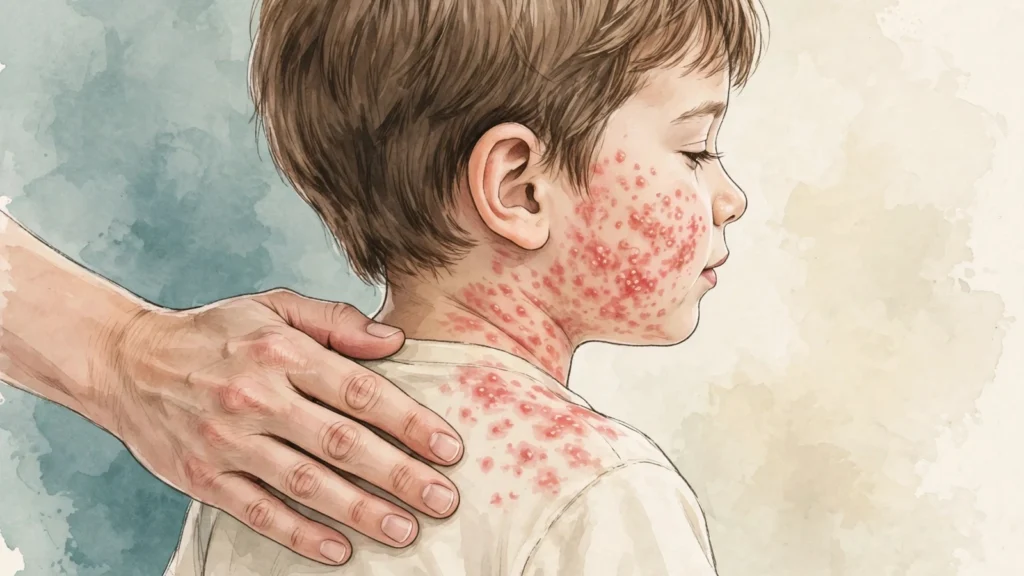
The rash appears three to five days after the first symptoms. It starts as flat red spots on the face, at the hairline and behind the ears, then spreads downwards over about three days to the neck, trunk, arms, legs and feet. The spots may join into blotchy patches, sometimes with small raised bumps on top. The rash is not usually itchy, and it can be harder to spot on brown or black skin, where it may look darker rather than bright red.
The rash lasts around three to seven days and fades in the same order it appeared, sometimes leaving brown discoloration or peeling skin. A child usually feels worst on the first or second day after the rash appears, and the cough can linger for up to about two weeks after other symptoms have faded.
Stage 4: Recovery
Most children start to feel better about two days after the rash appears, and most are ill for around seven to ten days in total. Recovery can still be slow, though, and measles weakens the immune system for a time afterwards, leaving a child more open to other infections. Rest, fluids and time are the mainstays of getting better — there is no medicine that kills the measles virus itself, as explained below.
How long is a child with measles infectious?
A child with measles can spread the virus from four days before the rash appears until four days after it — about eight days in total. That is why measles is so hard to contain: a child is already infectious while the illness still looks like an ordinary cold.
Measles is one of the most contagious infections known. The CDC says up to 9 out of 10 unprotected close contacts become infected, and the virus can stay active in the air or on surfaces for up to two hours after an infected person has left a room. Children should stay off school or nursery for at least four days from when the rash first appears, and should avoid contact with people who are not fully immunised, babies, pregnant women and anyone with a weakened immune system.
If measles is suspected, phone the clinic or doctor first rather than walking in, and say measles is suspected before arriving. That lets staff protect other children in the waiting room.
What complications can measles cause in children?
Most children recover fully, but measles is not a mild illness for everyone. The CDC’s figures for children show how the risks stack up:
| Complication | How often it happens |
|---|---|
| Ear infections | About 1 in 10 children |
| Diarrhoea | Less than 1 in 10 people |
| Pneumonia | Up to 1 in 20 children |
| Encephalitis (brain swelling) | About 1 in 1,000 children |
| Death | About 1 to 3 in 1,000 children |
Pneumonia is the most common cause of measles-related death in young children. Encephalitis can cause fits, deafness or lasting intellectual disability, and can appear straight after measles or months later. A very rare complication, subacute sclerosing panencephalitis, affects about 0.01% of cases and is a fatal brain disorder that appears years after infection. About 1 in 5 unvaccinated people in the US who catch measles are hospitalised, according to the CDC. Other complications include bronchitis, laryngitis and croup, vomiting and dehydration, and eye damage that can lead to blindness.
Who is most at risk?
Children younger than five face the highest risk of serious complications, and so do adults over 20, pregnant women and people with weakened immune systems, for example from leukaemia or HIV. Babies under 12 months are too young for the routine first MMR dose, so they depend on the people around them being protected. Malnourished children, especially those lacking vitamin A, are at the highest risk of dying from measles, and measles in pregnancy can cause miscarriage, premature birth or low birth weight. In short, anyone not protected by vaccination or a previous infection is at risk — but the youngest children carry the heaviest burden.
Measles in the US in 2026: the outbreak picture
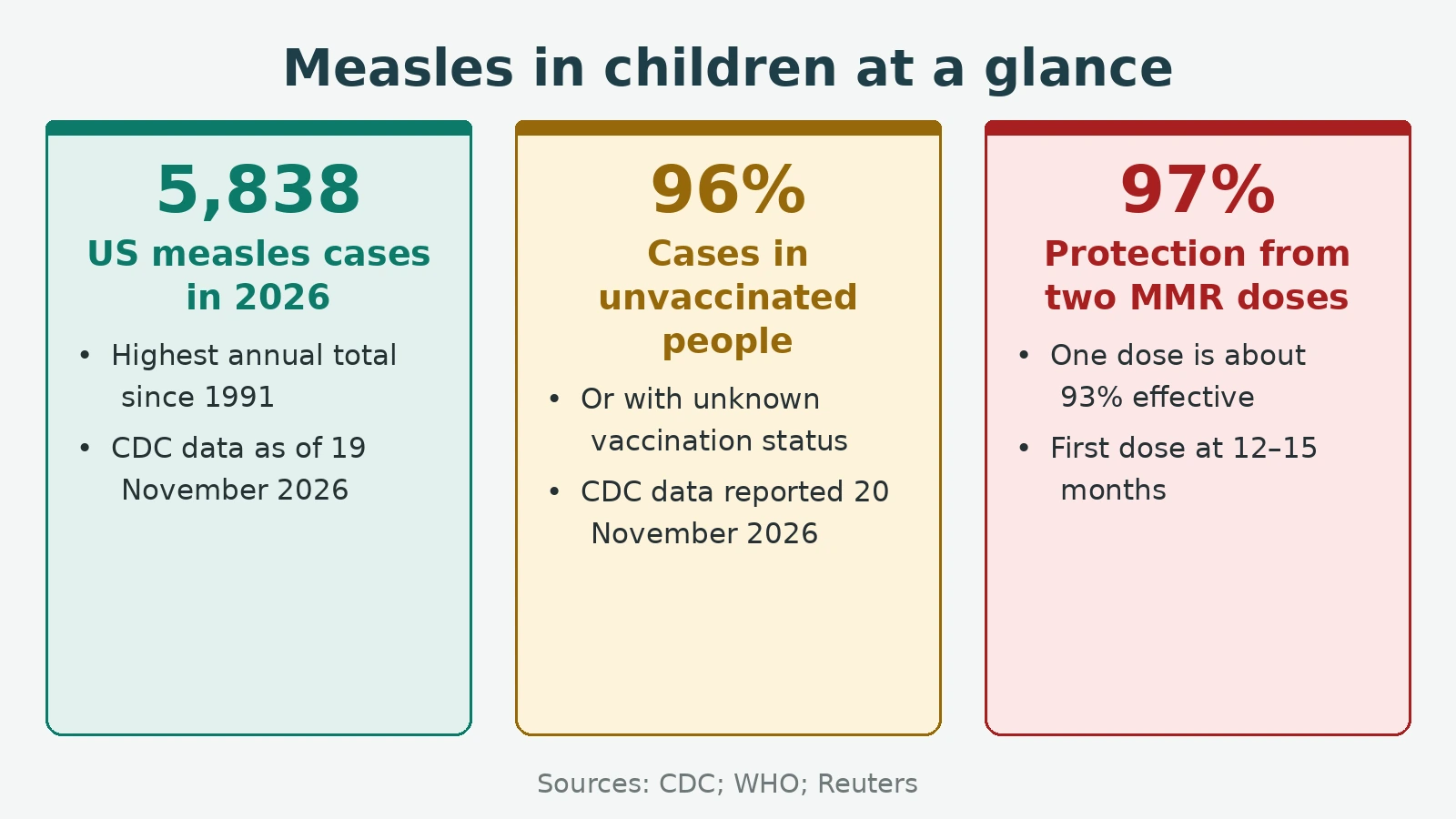
Measles is surging in the United States in 2026. The CDC reported 5,838 confirmed cases as of 19 November 2026, in an update published on 20 November 2026, with 43 new outbreaks reported during the year and 96% of cases linked to outbreaks. That is the highest annual US total since 1991, and about 2.6 times the whole of 2025, when 2,289 cases were confirmed. The weekly count was still rising: 426 new cases were reported in the week to 19 November, a 7.9% rise.
About 96% of the 2026 cases were in people who were unvaccinated or whose vaccination status was unknown, according to CDC data reported on 20 November 2026, and 646 people had been hospitalised — about 11% of confirmed cases. Pennsylvania was the hardest-hit state, with 1,631 cases and 326 hospitalisations as of 20 November 2026.
The CDC listed 6 confirmed measles-associated deaths in 2026 in its update of 20 November 2026, while state health departments have reported additional deaths. On 20 November 2026, the Virginia Department of Health announced the death of a young child aged 0 to 4 who had tested positive for measles, Virginia’s first measles-associated death of 2026. Virginia had reported 220 measles cases in 2026 as of 19 November, including 40 in children aged 0 to 4 and 75 in children aged 5 to 12.
On 17 November 2026, the US lost its measles elimination status, which it had held since 2000 — 26 years. The Pan American Health Organization declared the change after a single chain of transmission that began on 20 January 2025 persisted for more than 12 months, so measles is now classified as endemic in the US again. You can read more in our report on how the US lost measles elimination status. Regaining it requires stopping continuous spread for at least 12 months.
Behind the surge is a slow fall in vaccination coverage. US kindergarten MMR coverage fell from 95.2% in the 2019–2020 school year to 92.4% in 2025–2026, leaving about 280,000 kindergartners at risk. At least 95% coverage is needed for community protection. The global picture is sobering too: the WHO estimates about 95,000 measles deaths worldwide in 2024, mostly in unvaccinated or under-vaccinated children under five, though vaccination has averted nearly 59 million deaths between 2000 and 2024.
Measles can look different at different ages, so if you want the adult picture too, see our guide to measles symptoms in adults.
How well does the MMR vaccine protect children?
Two doses of the MMR vaccine are about 97% effective at preventing measles, and one dose is about 93% effective, according to the CDC. Protection after two doses is generally lifelong. The first dose is given at 12 to 15 months and the second at 4 to 6 years, before school entry. Infants aged 6 to 11 months can get an early dose if travelling to an outbreak area, but they still need the routine doses later, so talk to a doctor or pharmacist about timing.
There is no proven link between MMR and autism. Extensive reviews by the American Academy of Pediatrics, the National Academy of Medicine and the CDC conclude there is no scientifically proven link. The vaccine has been in use for about 60 years. At least 95% of a community needs two doses to stop measles spreading — which is why the fall in kindergarten coverage matters so much.
Is there a treatment for measles?
There is no specific antiviral treatment for measles. Care is supportive: rest, fluids and relief for fever, while the body fights off the virus. Antibiotics do not work against measles itself and are only used for secondary bacterial infections such as pneumonia or ear infections. If your child is ill, talk to a doctor or pharmacist before giving any medicine, and never try to treat measles at home without medical advice if symptoms are worsening.
When to see a doctor
Contact a doctor as soon as possible if measles is suspected, or if your child has been exposed to measles or develops a rash that looks like measles. Phone first and say measles is suspected before you arrive.
Get urgent medical advice for shortness of breath, sharp chest pain that is worse with breathing, coughing up blood, fits, or unusual sleepiness, lethargy or confusion. Doctors have a low threshold for admitting babies under one, children with weakened immune systems and pregnant young people with suspected measles, so do not wait to see if it passes.
In an emergency call 911 (US), 999 (UK) or 112 (EU)
Frequently asked questions
How long does measles last in a child?
Most children are ill for around seven to ten days in total, and usually start to feel better about two days after the rash appears. The cough can linger for up to about two weeks, and the rash itself lasts around three to seven days. The whole infection runs in stages over two to three weeks. If your child is not improving after the rash fades, or symptoms get worse, talk to a doctor promptly.
When is a child with measles most contagious?
A child can spread measles from four days before the rash appears until four days after it, about eight days in total. That means they are already infectious while the illness still looks like an ordinary cold. Measles spreads through the air and can stay active in a room for up to two hours. Keep your child home for at least four days from when the rash first appears, and phone the clinic before any visit.
How can I tell if a rash is measles?
Only a doctor can tell for certain, so phone your doctor if you suspect measles. The measles rash usually appears three to five days after a high fever, cough, runny nose and sore eyes, starting on the face and spreading downwards over about three days. Spots may merge into blotchy patches and the rash is not usually itchy. Do not try to diagnose it yourself — tell the clinic measles is suspected before arriving.
Can a child catch measles after one MMR dose?
Yes, but it is much less likely. One dose of MMR is about 93% effective at preventing measles, while two doses are about 97% effective, according to the CDC. That is why the second dose, given at four to six years, matters. About 96% of US cases in 2026 were in people who were unvaccinated or whose vaccination status was unknown. If you are unsure whether your child is fully vaccinated, talk to a doctor or pharmacist.
What should I do if my child has been exposed to measles?
Phone your doctor or local health team as soon as possible and say your child may have been exposed. Do not walk into a clinic unannounced, because measles spreads so easily. They can check your child's vaccination record and advise on next steps, which may include an MMR dose or immunoglobulin depending on age and risk. Keep your child away from babies, pregnant women and anyone with a weakened immune system until you have advice.
Is measles dangerous for children?
Yes, it can be. Most children recover, but about one in ten develop an ear infection, up to one in twenty develop pneumonia, and about one in a thousand develop encephalitis, or brain swelling. About one to three in every thousand children who catch measles die. Children under five face the highest risk, as do babies too young to be vaccinated. Two doses of MMR, about 97% effective, are the best protection.
Sources
- CDC: About Measles www.cdc.gov
- CDC: Measles Cases and Outbreaks (updated 20 Nov 2026; data as of 19 Nov 2026) www.cdc.gov
- WHO: Measles fact sheet www.who.int
- nidirect: Measles (adapted from NHS content) www.nidirect.gov.uk
- NHS Royal Hospital for Children, Glasgow: Measles guidance www.rightdecisions.scot.nhs.uk
- Mayo Clinic: Measles — Symptoms and causes www.mayoclinic.org
- Virginia Department of Health: First Measles-Associated Death in 2026 (20 Nov 2026) www.vdh.virginia.gov
- Science News: The U.S. just lost its measles elimination status. What now? (17 Nov 2026) www.sciencenews.org

Try the tool
Not sure if it can wait?
Common causes and warning signs for 16 everyday symptoms.
Open the symptom guide