Whooping Cough Symptoms: Stages, Whoop and When to Worry
Whooping cough starts like a cold, then turns into weeks of coughing fits — and only about half of people ever make the whooping sound. Here are the stages, the symptoms in babies, children and adults, and the warning signs that need urgent care.
- Written by
- Health Daily Advice
- Published
- Reading time
- 7 minutes
- Sources
- 11 cited
In this guide
Whooping cough starts like a cold, then turns into coughing fits that can last for weeks. The illness usually runs in three stages — a cold-like stage, a stage of repeated coughing fits, and a slow recovery — and only about half of people make the classic whooping sound when they gasp for air after a fit.
What is whooping cough?
Whooping cough, also called pertussis, is a highly contagious infection of the lungs and airways caused by a bacterium called Bordetella pertussis. It spreads in droplets when an infected person coughs or sneezes, and it passes very easily between people who live together: more than 80% of susceptible household contacts catch it, according to the CDC. Its basic reproduction number is roughly 12–17, which means one infected person can pass it to 12–17 others in a group with no immunity.
Symptoms usually appear 5–10 days after exposure, though they can take up to three weeks to show. The whole illness lasts 6–10 weeks if there are no complications, and the cough can linger for several weeks or months. That long, drawn-out course is why it is sometimes called the “100-day cough”.
The three stages of whooping cough
Whooping cough moves through three stages, each with its own pattern of symptoms. Knowing which stage someone is in helps explain how long the illness may last and when they are most likely to spread it.
Stage 1: Catarrhal — the cold-like stage (1–2 weeks)
The first stage looks like an ordinary cold. Expect a runny or blocked nose, a sore throat, red and watery eyes, sneezing, and a low-grade fever under 100.4°F (38°C). A mild, occasional cough appears and gradually gets worse, along with tiredness and a smaller appetite. A high temperature is uncommon at this point.
This is the stage when a person is most contagious, yet the illness is easy to mistake for a common cold. Many people carry on with normal life at this point, which is one reason the infection spreads so readily.
Stage 2: Paroxysmal — the coughing fits (usually 1–6 weeks, sometimes up to 10)
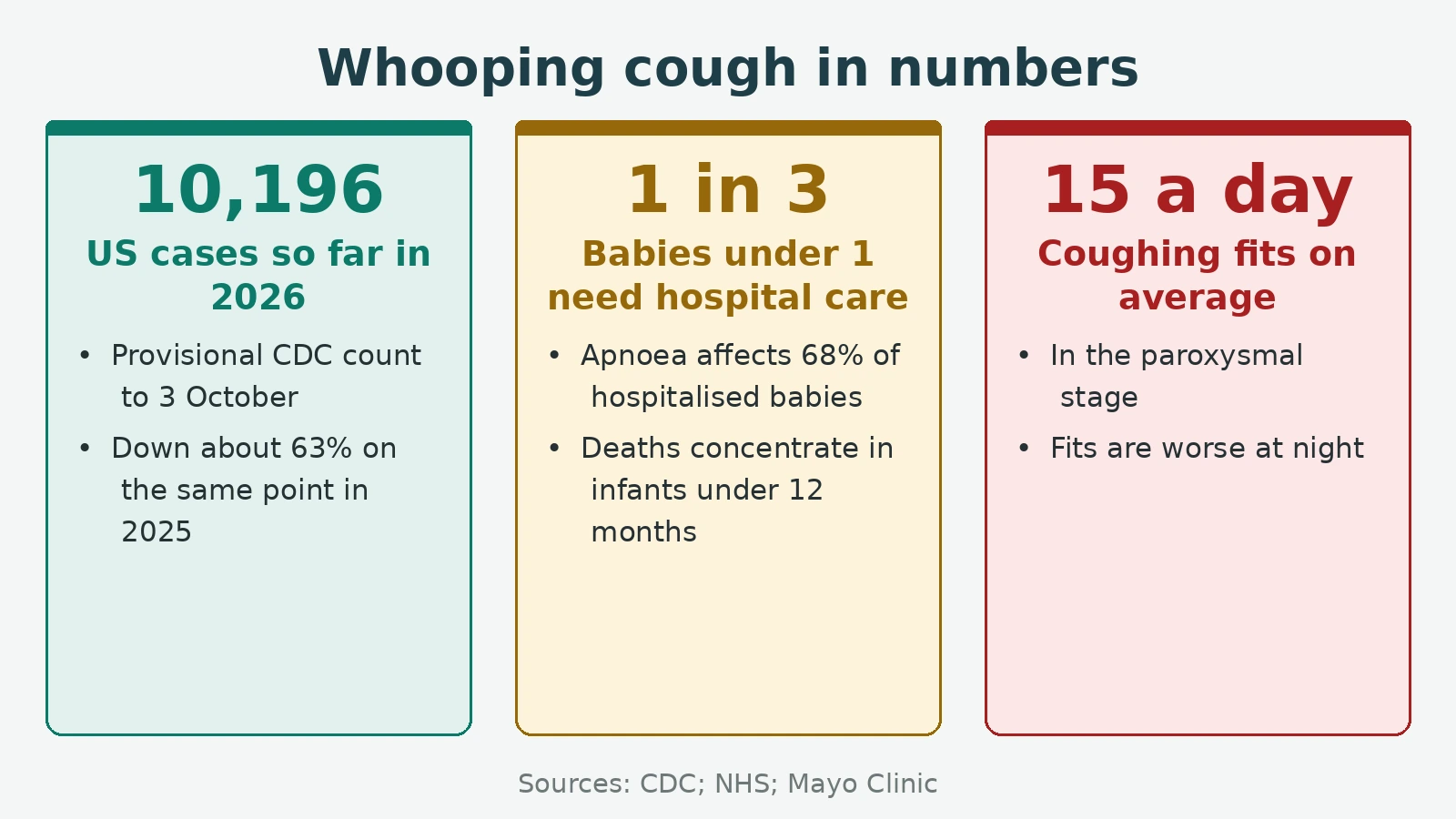
The cough then changes into repeated bursts of many rapid coughs, each lasting a few minutes at a time. Fits are worse at night and can be set off by crying, eating or laughing. The CDC gives an average of 15 attacks in 24 hours during this stage, with fits becoming more frequent over the first one to two weeks, holding steady for two to three weeks, and then easing.
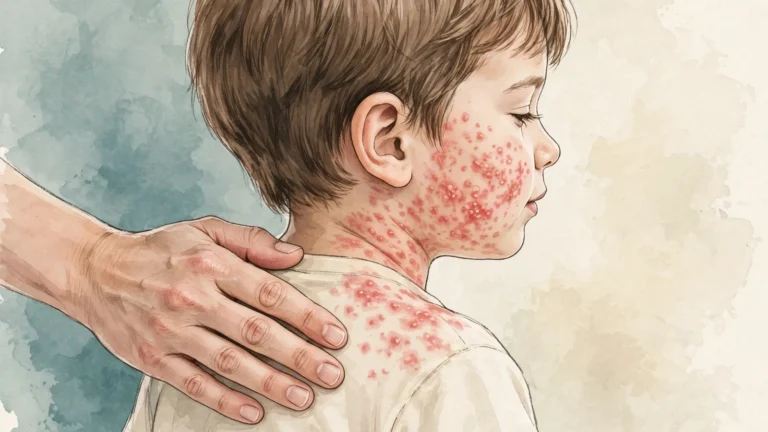
After a fit, the desperate gasp for air can produce the high-pitched “whoop” that gives the disease its name — but only about half of people whoop. Fits often end in vomiting, and they leave the person exhausted, although they usually seem well between fits. The face may turn very red, and in children slight bleeding under the skin or in the whites of the eyes can occur. In adults, very forceful coughing can even break ribs.
Stage 3: Convalescent — gradual recovery (up to 2–3 weeks, sometimes longer)
In the final stage, the coughing fits become milder and less frequent, and then stop. The Cleveland Clinic puts this recovery stage at up to six weeks, and the NHS notes the cough may last several weeks or months. Fits can return with another respiratory infection, even many months later.
Whooping cough symptoms in babies
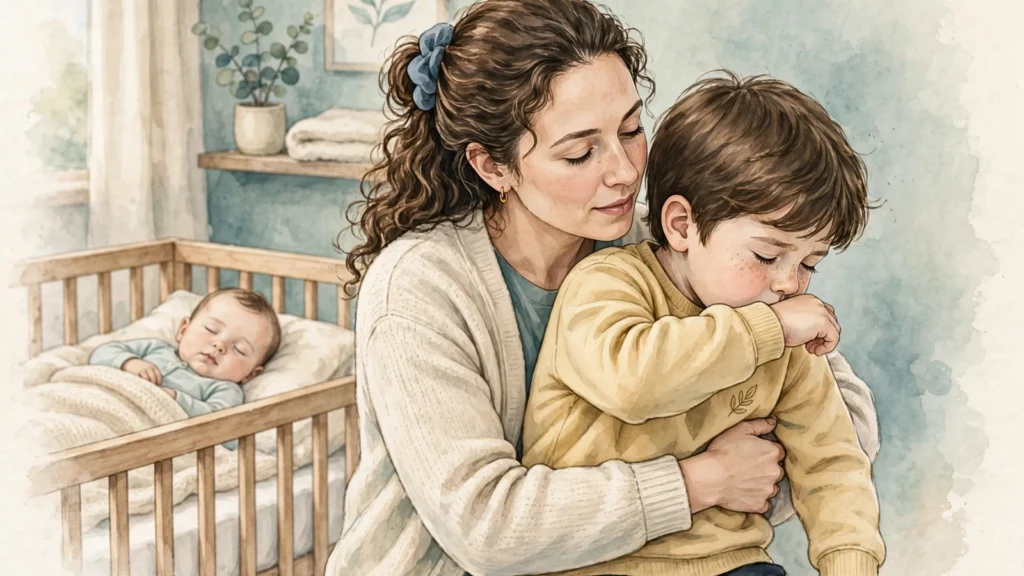
Babies, especially those under six months old, often look different from older children and adults — and they are the group at greatest risk. Many babies do not cough at all. Instead they may gag, struggle to breathe, or have apnoea: life-threatening pauses in breathing. They may turn blue or grey, and apnoea may be the only symptom. The whoop is less common in babies under three months.
About 1 in 3 babies under one year old who catch whooping cough need hospital care, according to the CDC, and the younger the baby, the more likely hospital treatment is. Babies often catch it from parents, older siblings or caregivers who do not realise they are infected, which is why protecting newborns matters so much.
Symptoms in children
Children usually follow the classic pattern: a cold-like start, then coughing bouts lasting a few minutes, worse at night, with thick mucus and vomiting after fits. They may turn blue or grey after a bout. Between fits, children usually seem well, which can make the illness look less serious than it is.
Symptoms in adults
In teens and adults, the illness is generally milder, especially if they have been vaccinated. Often a persistent hacking cough is the only symptom, and the whoop is seen less often. A red face during fits is more common in adults, who can also have sweating attacks with facial flushing and, rarely, faint after coughing.
Vaccine protection fades over time — the Mayo Clinic notes it tends to fade by age 11 and wanes 5–10 years after vaccination — leaving teens and adults prone to infection during outbreaks. Adults with a lingering cough may not suspect pertussis and can pass it to a newborn at home, a key risk when families gather for the holidays.
How long is whooping cough contagious?
A person can spread whooping cough from the start of symptoms until three weeks after the coughing fits begin. With a week of cold-like symptoms first, the contagious period totals about four weeks. Antibiotics end contagiousness after five days of appropriate treatment, though they may not shorten the cough much once the fits have started. Close contacts in the same household may be offered preventive antibiotics — talk to a doctor or pharmacist, or a local health department, about whether that applies to your household.
Complications of whooping cough
Most older children and adults recover without lasting problems, but intense coughing can cause bruised or cracked ribs, an abdominal hernia, broken blood vessels in the skin or the whites of the eyes, loss of bladder control, weight loss, fainting, difficulty sleeping, nosebleeds, ear infections and pneumonia.
For babies the risks are far higher. The figures below are for babies under one year old who were admitted to hospital with whooping cough, based on US data from 2004–2019:
| Complication | Share of hospitalised babies under 1 |
|---|---|
| Apnoea (pauses in breathing) | 68% |
| Pneumonia | 22% |
| Convulsions (fits) | 2% |
| Encephalopathy (brain disease) | 0.6% |
| Death | 1% |
Babies under six months also face a higher chance of dehydration, breathing difficulties, pneumonia and seizures. Other infant complications include ear infections, nosebleeds, feeding trouble and weight loss, and, rarely, permanent brain damage.
Whooping cough in 2026: the picture so far
After a record surge, cases have fallen sharply in 2026 — but the disease has not gone away. Provisional CDC figures show 10,196 cases in the US through 3 October 2026, against 27,370 at the same point in 2025 — a fall of roughly 63%. That follows 28,783 cases in 2025, the highest annual US total since 2012, and 43,321 cases in 2024, the highest in more than a decade. Even in quieter periods, the US typically reports more than 10,000 cases a year.
The fall is welcome, but two children had already died from whooping cough in the US in 2026, and deaths are concentrated in infants under 12 months who have not finished their primary vaccine series. Illinois recorded 328 cases through 3 October 2026, down from 705 a year earlier — yet on 19 November 2026, the McDonough County Health Department in Illinois warned of a “steady presence of pertussis” ahead of Thanksgiving gatherings, urging households with babies to check vaccination status. With 15,860 cases recorded over the 12 months to mid-November 2026, the infection is still circulating widely enough to reach the most vulnerable.
Vaccination and prevention
The best protection is the pertussis vaccine, given together with diphtheria and tetanus vaccines. In the US, the DTaP schedule is five doses: at 2, 4 and 6 months, at 15–18 months, and at 4–6 years, with a Tdap booster at 11–12 years and a Td or Tdap booster every 10 years for adults. Tdap is recommended in each pregnancy, ideally between 27 and 36 weeks, so antibodies pass to the baby before birth.
Vaccinated people can still catch whooping cough, but the illness is usually milder. Coverage has slipped, though: US kindergarten DTaP coverage fell from 95% in 2019 to 92.3% in the 2023–24 school year, and in 2025 only 1 in 5 children under six who caught whooping cough had completed their primary series of three or more DTaP doses. If you are unsure whether your family’s vaccinations are up to date, talk to a doctor or pharmacist.
Staying off school and work
Someone with whooping cough should stay off school, nursery or work until 48 hours after starting antibiotics, or for three weeks after the cough started if no antibiotics were taken. Household contacts who develop a cough should get checked promptly, since early treatment matters most in the first weeks.
When to see a doctor
Get same-day medical advice if a baby under six months old has symptoms, if a cough is very bad and getting worse, if there is vomiting after coughing spells, if someone turns red, purple or blue, if they are not drinking enough fluid, or if you are pregnant and have had contact with a known case.
Get emergency help straight away for lips, tongue, face or skin suddenly turning blue or grey; struggling to breathe or shallow breathing; pauses in breathing, especially in a baby; chest pain that is worse when breathing or coughing; seizures or fits; or a baby who cannot be woken or is very sleepy or confused.
In an emergency call 911 (US), 999 (UK) or 112 (EU)
Frequently asked questions
How do I know if my cough is whooping cough?
A cold-like illness that turns into repeated coughing fits lasting a few minutes, worse at night and often ending in vomiting, points toward whooping cough. Only about half of people make the whooping sound, so its absence does not rule it out. Symptoms usually appear 5 to 10 days after exposure. A doctor can confirm it, usually with a nose swab, which works best in the first few weeks of the cough.
Does everyone with whooping cough make the whooping sound?
No. Only about half of people make the classic high-pitched whoop when they gasp for air after a coughing fit. People with mild illness often do not whoop at all, and the sound is less common in babies under three months and in vaccinated teens and adults. A persistent hacking cough on its own can still be whooping cough, so do not rely on hearing the whoop to decide whether to seek care.
How long does whooping cough last?
The whole illness usually lasts 6 to 10 weeks if there are no complications. It starts with 1 to 2 weeks of cold-like symptoms, then 1 to 6 weeks of coughing fits, sometimes up to 10 weeks, followed by a gradual recovery of up to 2 to 3 weeks. The cough can linger for several weeks or months. A person stays contagious from the start of symptoms until 3 weeks after the fits begin, about 4 weeks in total.
Can adults get whooping cough if they were vaccinated as children?
Yes. Vaccine protection fades over time, tending to fade by age 11 and waning 5 to 10 years after vaccination, so vaccinated teens and adults can still catch whooping cough. The illness is usually milder in vaccinated people, and often the only symptom is a persistent hacking cough. That makes it easy to miss, and an adult with a lingering cough can pass the infection to a newborn at home.
When can my child go back to school after whooping cough?
Your child can return to school, nursery or work 48 hours after starting antibiotics, or 3 weeks after the cough started if no antibiotics were taken. The same rule applies to adults returning to work. Household contacts who develop a cough should be checked promptly, since early treatment matters most in the first few weeks of the illness.
Is whooping cough dangerous for babies?
Yes, it can be very serious for babies. About 1 in 3 babies under one year old who catch whooping cough need hospital care. Among babies under one who are admitted to hospital, 68% have pauses in breathing, 22% develop pneumonia and 1% die. Two children died from whooping cough in the US in 2026. Babies often catch it from family members who do not realise they are infected.
Sources
- NHS: Whooping cough www.nhs.uk
- CDC: Symptoms of Whooping Cough www.cdc.gov
- CDC: Clinical Features of Pertussis www.cdc.gov
- Mayo Clinic: Whooping cough — symptoms and causes www.mayoclinic.org
- Cleveland Clinic: Whooping Cough (Pertussis) my.clevelandclinic.org
- Medical Daily: McDonough County warns of steady whooping cough cases as Illinois families gather for the holidays www.medicaldaily.com
- Medical Daily: Whooping cough has already killed two children this year in the US www.medicaldaily.com

Try the tool
Not sure if it can wait?
Common causes and warning signs for 16 everyday symptoms.
Open the symptom guide