What Is POTS Syndrome? Symptoms, Causes and What Helps
Your heart races every time you stand up, the room tilts, and lying down is the only thing that helps. Here is what POTS syndrome is, why it happens, and what can genuinely help.
- Written by
- Health Daily Advice
- Published
- Reading time
- 9 minutes
- Sources
- 9 cited

In this guide
Postural orthostatic tachycardia syndrome (POTS) is a disorder of the autonomic nervous system in which the heart rate rises sharply on standing. Instead of the usual small increase, the heart may beat 30 or more extra times a minute, causing dizziness, a racing heartbeat, fatigue and brain fog that ease on lying down.
If you have ever stood up and felt the room tilt, your heart hammering as though you had just run upstairs, you will know how frightening that moment can be. For someone with POTS, it can happen every day — getting out of bed, queuing in a shop, standing in the shower. Searches for the condition have climbed steeply in 2026, yet POTS is still widely misunderstood and many people wait years for an answer. This guide explains what it is, what it feels like, what causes it, how doctors diagnose it and what can help.
What is POTS syndrome?
POTS stands for postural orthostatic tachycardia syndrome: postural means it relates to body position, orthostatic means it happens when you are upright, tachycardia means a fast heart rate, and syndrome means a group of symptoms that occur together.
POTS is a problem with the autonomic nervous system, which runs the jobs you never think about: heart rate, blood pressure, digestion, sweating and body temperature. When you stand, gravity pulls blood down towards your legs. In a healthy person, nerves instantly tell the blood vessels in the lower body to tighten, nudging blood back up to the heart and brain, while the heart rate rises only slightly — by about 10 to 15 beats a minute, according to Mayo Clinic.
In POTS, that automatic adjustment goes wrong. The blood vessels do not tighten enough, so blood pools in the legs and less of it returns to the heart. To compensate, the heart beats far faster than it should, and too little blood reaches the brain while you are upright. Lying down restores normal blood flow, which is why symptoms usually ease within minutes of lying flat. POTS is one form of dysautonomia, the umbrella term for disorders of the autonomic nervous system.
What are the symptoms of POTS?
POTS affects everyone differently: some people have mild symptoms, for others the condition is disabling. Symptoms often flare and settle over months and years, and they tend to be worse in the morning, as the NHS notes. Two groups are usually described: symptoms that appear on standing and ease on lying down, and symptoms that can happen at any time.
Symptoms when you stand up
- Dizziness or light-headedness, especially on standing, standing still, or walking a long distance
- A noticeably fast, pounding or fluttering heartbeat (palpitations)
- Feeling faint, or fainting
- Shakiness or trembling, and sweating
- Shortness of breath
- Chest pain or discomfort
- Blurred or tunnel vision
- Legs and feet turning pale, red or purple, and feeling cold
Symptoms that are not linked to posture
- Extreme tiredness (fatigue) — more than 90% of patients report chronic fatigue, according to a 2022 review in the Canadian Medical Association Journal
- Brain fog: trouble thinking clearly, remembering things or concentrating, often worse while upright
- Headaches, including migraine — about 40% of patients have migraine
- Poor sleep
- Digestive problems such as nausea, bloating, stomach pain, constipation or diarrhoea
- Difficulty exercising, even at a level that used to feel easy
Similar symptoms can come from low blood pressure, anaemia, thyroid problems, dehydration or anxiety, so they always need proper checking, as the NHS stresses.
What causes POTS syndrome?
Doctors do not fully understand what causes POTS, and in many people no single cause is ever found. Several different mechanisms can lead to the same result, grouped into three overlapping types.
The three main types of POTS
- Neuropathic POTS. Nerve damage, particularly in the legs and core, means the blood vessels there cannot tighten properly, so blood pools below the heart. About half of patients have a loss of small autonomic nerve fibres in the skin, according to Dysautonomia International.
- Hyperadrenergic POTS. The sympathetic nervous system — the “fight or flight” system — is overactive, flooding the body with stress hormones and driving the heart rate up.
- Hypovolemic POTS. The total amount of blood circulating in the body is lower than normal, so there is simply less blood to send to the brain when upright.
Many people have a mix of more than one type. Growing evidence suggests the immune system plays a role for some: 15% to 20% of patients report a history of an autoimmune condition such as Hashimoto thyroiditis, rheumatoid arthritis or Sjögren syndrome, as the CMAJ review describes. Around 40% of patients have a family member with POTS or a similar form of dysautonomia, which points to a genetic element for some.
POTS often begins after an event that stresses the body — a viral illness, surgery, pregnancy, puberty, a head injury or a long period of bed rest. In recent years many cases have followed COVID-19, and the NHS lists long COVID, ME/CFS (myalgic encephalomyelitis/chronic fatigue syndrome) and joint hypermobility syndrome among the conditions that make POTS more likely.
Everyday factors can flare symptoms up, too: heat and hot showers, standing for a long time, large meals, not drinking enough fluid, alcohol, too little sleep, illness, stress and being on your period.
Who gets POTS syndrome?
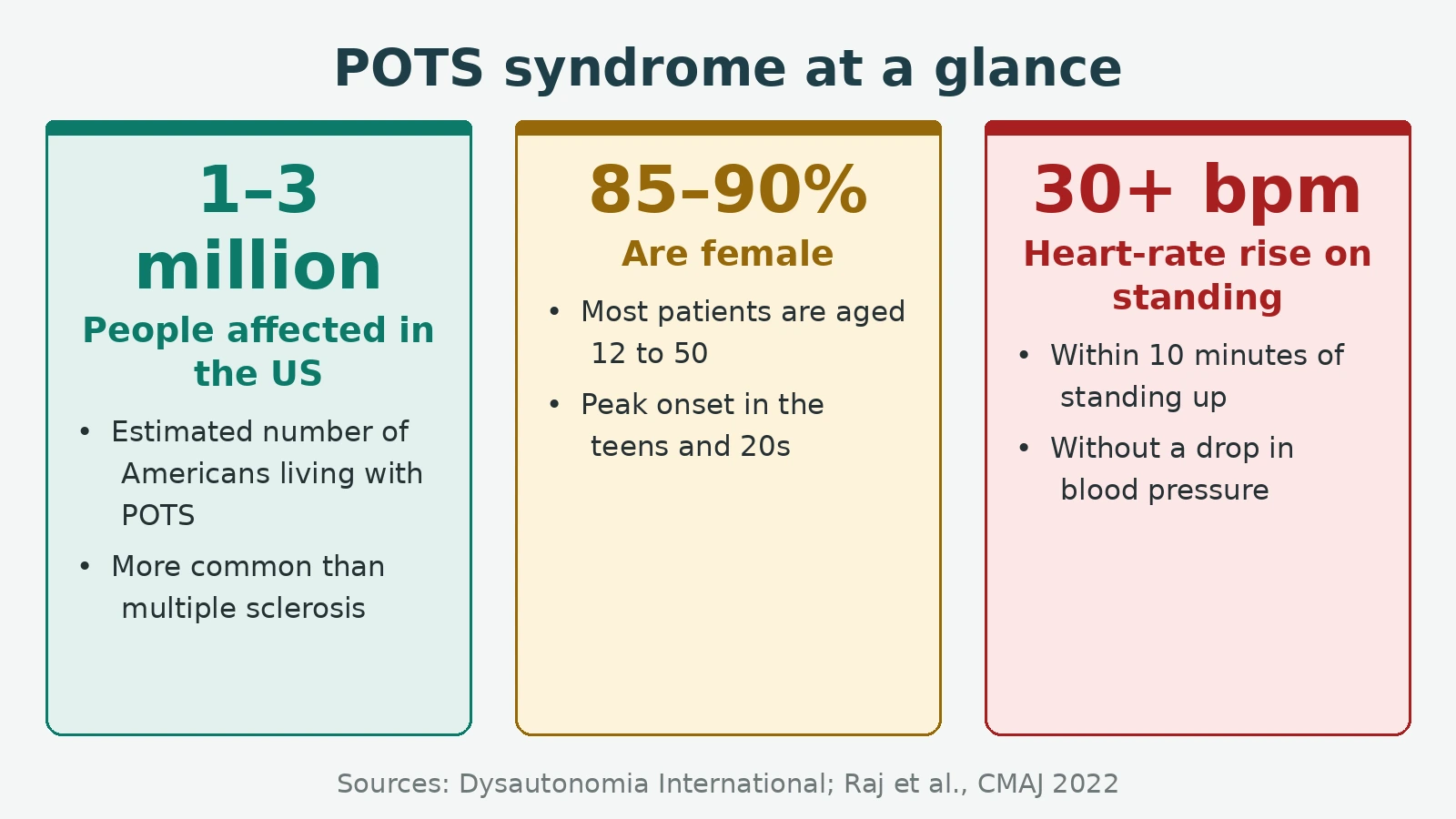
POTS is far more common than most people realise. Dysautonomia International estimates that 1 to 3 million Americans are living with POTS, making it more common than multiple sclerosis, while the CMAJ review puts the estimated prevalence at 0.1% to 1% of the US population. Mayo Clinic estimates that it affects 1 in every 100 teenagers.
About 85% to 90% of people with POTS are female, most aged 12 to 50, and symptoms often begin in the teenage years or early adulthood; about half develop it in adulthood. Experts believe the true numbers are higher still, as POTS long went undiagnosed.
The impact can be severe: around a quarter of patients are so disabled by POTS that they cannot work or attend school, and researchers compare the level of disability to that seen in congestive heart failure or chronic obstructive pulmonary disease (COPD).
How is POTS diagnosed?
There is no single blood test or scan for POTS; diagnosis rests on the pattern of symptoms, the heart-rate response to standing, and other causes ruled out. Specialist criteria, set out in the 2015 Heart Rhythm Society consensus and summarised in the CMAJ review, require all of the following:
- The heart rate rises by at least 30 beats per minute within 10 minutes of standing (at least 40 beats per minute for ages 12 to 19), and stays raised
- Blood pressure does not fall significantly on standing — a big drop would point to a different condition, orthostatic hypotension
- Symptoms of orthostatic intolerance occur frequently when upright and improve quickly on lying down
- Symptoms have been present for at least three months
- No other condition explains the fast heart rate — for example anaemia, fever, dehydration, an overactive thyroid, or medicines that raise the heart rate
A GP will usually start with an active stand test: blood pressure and heart rate are measured lying down, then again at intervals after standing up. Blood tests may check for other causes, and an electrocardiogram (ECG) records the heart’s rhythm. If the picture is unclear, a specialist may arrange a tilt table test — lying on a table that is tilted upright while heart rate and blood pressure are monitored — as the NHS describes.
Why POTS is often mistaken for anxiety
One of the hardest parts of POTS is how often it is dismissed. In a large patient survey cited in the CMAJ review, 77% of respondents said they had been told they had a psychiatric or psychological disorder before receiving their POTS diagnosis. The confusion is understandable: a racing heart, shaking, sweating and light-headedness are also features of anxiety and panic. But in POTS these symptoms are driven by posture and blood flow, not by worry — and they improve when you lie down. Dysautonomia International reports that patients wait an average of four years for a diagnosis. If you have been told your symptoms are “just anxiety” but they clearly track with standing up, it is worth asking your doctor specifically about POTS and an active stand test.
What helps with POTS syndrome?
There is currently no cure for POTS, and no medicine is approved specifically to treat it. But the condition can often be managed well, and many teenagers improve substantially over time. Mayo Clinic notes that about 80% of teenage patients grow out of POTS by their 20s, and its research found that about five years after diagnosis, 86% of adolescent patients had seen some improvement. Treatment is always tailored to the individual.
Fluids and food
Because low blood volume is part of the problem for many people, clinicians often talk about increasing fluid and salt intake to expand blood volume — but only under medical guidance, since extra salt is not suitable for everyone. Cleveland Clinic advises drinking plenty of water through the day and choosing salty foods such as broth, pickles, olives and nuts, while avoiding alcohol. Large meals can worsen symptoms, so several smaller meals spread through the day are often easier.
Moving your body — slowly and lying down
Exercise is one of the most powerful tools for POTS, but it has to be approached carefully, because upright exercise is exactly what triggers symptoms. Cleveland Clinic notes that some of the best evidence for treating POTS comes from cardiac rehabilitation programmes. Reclined aerobic exercise — swimming, rowing and recumbent cycling — is often the most helpful, along with strengthening core and leg muscles. Start small, build up gradually, and talk to a doctor before beginning a new exercise programme.
Compression and posture tricks
Compression garments that squeeze the legs and abdomen help stop blood pooling. Waist-high garments work best, and research cited in the CMAJ review found that compressing the abdomen as well as the legs was more effective than compressing the legs alone. Moving slowly from lying to sitting to standing, and sitting down promptly if you feel faint, also helps. The NHS suggests that if you suddenly feel faint, lying down and raising your legs helps — and if you cannot lie down, crossing your legs and clenching your muscles can keep blood flowing to the brain.
Sleep, pacing and medicines
POTS often disrupts sleep, and poor sleep in turn worsens symptoms. Raising the head of the bed by a few inches can help, and good sleep habits are worth protecting. Pacing matters too: spreading activity through the day and resting before you are exhausted rather than after.
When lifestyle measures alone are not enough, doctors sometimes prescribe medicines to ease specific symptoms, such as drugs that slow the heart rate or tighten blood vessels. None is approved specifically for POTS, and they generally only help when the lifestyle measures are in place too.
Living with POTS syndrome
A POTS diagnosis changes how you plan a day: standing in a queue, taking a hot shower, walking across a warm room — ordinary moments become calculations. Practical adjustments help: a shower chair, a water bottle always within reach, compression garments under everyday clothes, and sitting down the moment symptoms start rather than pushing through.
The emotional side deserves attention too. Living with an invisible condition that some doctors have dismissed is exhausting in itself, and support from family, friends and patient organisations helps many people feel less alone. The outlook is genuinely hopeful: symptoms and function often improve with treatment, and research into POTS — including its links with long COVID and autoimmunity — is moving faster than ever.
When to see a doctor
See a GP if you regularly feel dizzy, faint or light-headed on standing, notice your heart racing when you get up, or have fatigue and brain fog that keep coming back. Mention POTS by name so the possibility is considered.
Get urgent help if you faint and injure yourself, have chest pain, severe breathlessness, or a very fast heartbeat that does not settle when you lie down. In an emergency call 911 (US), 999 (UK) or 112 (EU).
POTS syndrome is real, common and — once it is recognised — manageable. If standing up keeps making your heart race, you are not imagining it: the first step is a conversation with a doctor who takes the symptoms seriously.
Frequently asked questions
Is POTS syndrome dangerous?
POTS itself is rarely life-threatening, but fainting can cause injuries and the condition can seriously limit daily life. Chest pain, severe breathlessness or fainting should always be checked promptly, and emergency help is needed if symptoms do not settle on lying down. Most people manage POTS with lifestyle changes and medical support.
Can POTS syndrome go away?
For some people, yes, especially teenagers: Mayo Clinic notes about 80% of teenage patients grow out of POTS by their 20s, and about 86% of adolescents improve within five years of diagnosis. In adults the picture is more mixed, with symptoms often improving with treatment but not always disappearing completely.
What triggers POTS symptoms?
Common triggers include heat, hot showers, standing still for a long time, large meals, dehydration, alcohol, poor sleep, illness, stress and menstruation. Symptoms also tend to be worse in the morning. Keeping a simple diary of symptoms, fluids, sleep and activity can help you spot your own triggers and plan around them.
How is POTS different from anxiety?
The symptoms overlap — racing heart, shaking, sweating and light-headedness happen in both — but in POTS they are driven by posture and blood flow and improve on lying down, while anxiety symptoms follow worry and stress. In one large survey, 77% of POTS patients had first been told their problem was psychiatric. An active stand test helps doctors tell the two apart.
Can you exercise with POTS syndrome?
Yes, and exercise is one of the most effective ways to manage POTS, but it needs care: upright exercise triggers symptoms, so reclined activities such as swimming, rowing and recumbent cycling are usually best to start with. Begin gently, build up slowly, and talk to a doctor first, especially if you faint.
Is POTS linked to long COVID?
Yes. Many cases of POTS have followed COVID-19, and the NHS lists long COVID among the conditions that make POTS more likely. POTS can also follow other viral illnesses, and it commonly occurs alongside ME/CFS and joint hypermobility. If racing-heart or dizziness symptoms began after COVID-19, mention POTS to your doctor.
Sources
- Cleveland Clinic: POTS — Causes, Symptoms, Diagnosis & Treatment my.clevelandclinic.org
- NHS: Postural tachycardia syndrome (PoTS) www.nhs.uk
- Mayo Clinic: Q and A — All about POTS, postural tachycardia syndrome newsnetwork.mayoclinic.org
- Raj S, Fedorowski A, Sheldon RS: Diagnosis and management of postural orthostatic tachycardia syndrome, CMAJ 2022 pmc.ncbi.nlm.nih.gov
- Dysautonomia International: 10 Facts About POTS www.dysautonomiainternational.org

Try the tool
Not sure if it can wait?
Common causes and warning signs for 16 everyday symptoms.
Open the symptom guide