What Is Diphtheria? Symptoms, Vaccine and the 2026 Outbreak
A throat infection that can damage the heart and nerves is surging in Nigeria. What diphtheria is, how to spot it, and why the vaccine matters.
- Written by
- Health Daily Advice
- Published
- Reading time
- 7 minutes
- Sources
- 7 cited

In this guide
Diphtheria is a serious bacterial infection that coats the throat in a thick grey membrane and can damage the heart and nerves. It is rare where vaccination is routine, but Nigeria’s outbreak has passed 28,000 confirmed cases in 2026 — a reminder of what happens when vaccine coverage falls.
Nigeria is in the middle of its largest diphtheria outbreak on record. By 7 November 2026, the country’s disease control centre had recorded 37,529 suspected cases, 28,151 confirmed cases and 1,126 deaths this year alone. Two-thirds of the confirmed patients were unvaccinated. And on 13 November, Doctors Without Borders warned that stocks of diphtheria antitoxin — the only specific treatment for the toxin — are dangerously low and are being rationed.
For readers in the UK, the US and Europe, diphtheria feels like a disease of the past. It is not. No region of the world is completely free of it, and the Nigerian outbreak shows how quickly it returns when vaccination slips. Here is what diphtheria is, how to recognise it, and how the vaccine protects.
The bacteria behind the disease
Diphtheria is a contagious disease caused by toxin-producing bacteria, most commonly Corynebacterium diphtheriae. It mainly affects the nose and throat and, less often, the skin. The serious damage is done not by the bacterium itself but by the toxin it releases, which kills healthy tissue and can damage the heart and nerves.
Before vaccination was introduced and widely used in the 1930s, diphtheria occurred throughout the world. Routine childhood vaccination has made it rare in the UK, the US and Europe — but it has never gone away. Outbreaks resurge whenever population immunisation coverage falls, and overcrowding and poor hygiene increase the risk of infection.
The 2026 Nigeria outbreak
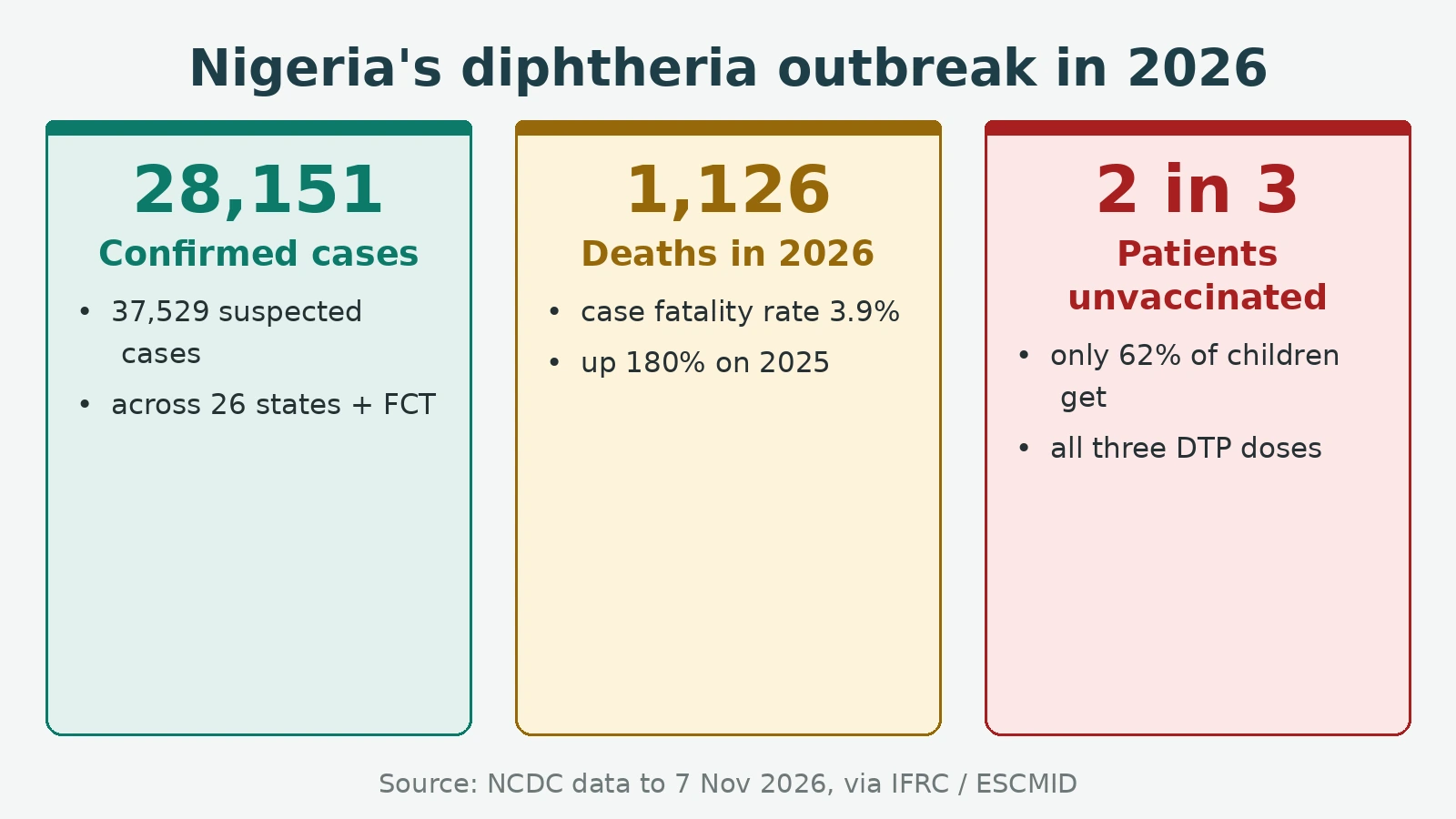
Nigeria’s outbreak began in late 2022 and has grown every year since. The 2026 figures, from the Nigeria Centre for Disease Control and Prevention as of 7 November, are stark: 37,529 suspected cases, 28,151 confirmed cases and 1,126 deaths across 26 states and the Federal Capital Territory, covering 361 local government areas — a case fatality rate of 3.9%. Confirmed cases in 2026 are up 180% compared with 2025. Since the outbreak began, 68,277 cases and 3,269 deaths have been confirmed.
Kano State is the epicentre, with 12,008 confirmed cases — about 43% of the national total — including nearly 1,000 cases in the past month alone. The driving force is a vaccination gap: only 62% of children in Nigeria receive all three recommended doses of the diphtheria vaccine, and two-thirds of confirmed patients were unvaccinated. In Zamfara State, about four in five patients were unvaccinated, and of 90,000 vaccine doses needed, suppliers delivered only 25,000.
The treatment situation is now critical. Diphtheria antitoxin neutralises the toxin in the bloodstream, but it works best within 48 hours of symptoms appearing — and global production is limited. On 13 November 2026, Doctors Without Borders warned that antitoxin stocks in northern Nigeria are dangerously low and teams are rationing the only specific treatment for the toxin. Its medical coordinator in Nigeria, Dr David Kizito, said: “The global shortage of diphtheria antitoxin is becoming a matter of life and death.” The organisation has treated more than 9,000 diphtheria patients since the start of its response in 2026.
Symptoms of diphtheria
Symptoms usually begin two to five days after exposure. The early signs are easy to mistake for an ordinary sore throat: a mild fever, a sore throat, swollen glands in the neck and weakness. Within two to three days, the picture can change dramatically.
In respiratory diphtheria, dead tissue in the throat forms a thick, grey coating called a pseudomembrane that can cover the nose, tonsils and throat, making it hard to breathe and swallow. The membrane is firmly attached — trying to remove it causes bleeding — and it can extend into the voice box and block the airway, which is a medical emergency. Markedly enlarged neck glands with swelling of the surrounding tissue produce the swollen-neck appearance sometimes called “bull neck”. Other symptoms can include hoarseness, a barking cough, difficulty or pain when swallowing, bloody watery nasal discharge, rapid breathing and a high-pitched sound when breathing in.
Skin diphtheria is different. It causes open sores or ulcers with clearly defined edges and a membrane, pus-filled blisters on the legs, feet and hands, and large ulcers surrounded by red, sore-looking skin. Skin infections rarely cause severe disease or death and are usually treated with antibiotics alone.
How diphtheria spreads
Diphtheria spreads from person to person when an infected person coughs or sneezes, releasing respiratory droplets. People can also catch it by touching open sores caused by the bacteria, or by sharing items such as cups, cutlery, clothing or bedding with an infected person. Some people carry the bacteria without developing symptoms but can still pass it on.
Close contact raises the risk — living together, sharing saliva or respiratory secretions, or exposure to wound secretions. In the United States, nearly all cases are linked to international travel to an area where diphtheria is found. Anyone who is not immune — not vaccinated or under-vaccinated — is at risk.
How dangerous is diphtheria?
Very. The toxin can inflame the heart muscle and damage nerves, causing paralysis, and it can also damage the kidneys. Airway blockage is a deadly complication of throat diphtheria.
The CDC states that even with treatment, about one in ten people with respiratory diphtheria will die — and without treatment, up to half die. The WHO puts the figure at around 30% fatal for unvaccinated people without proper treatment, with children under five at the greatest risk. In Nigeria’s 2026 outbreak, the fatality rate among confirmed cases is 3.9%, reflecting treatment in health facilities — but that still means more than a thousand deaths this year.
The diphtheria vaccine
The vaccine is the reason diphtheria is rare in wealthy countries — and the reason it returns where coverage falls. The WHO recommends a three-dose primary series plus three booster doses. The vaccine is safe and effective: combination vaccines introduced since 1974 have prevented more than 90% of cases between 1980 and 2000, and the WHO estimates diphtheria vaccines protect about 97 out of 100 people, with protection usually lasting around ten years.
In the UK, children receive diphtheria vaccine as part of the 6-in-1 vaccine at 8, 12 and 16 weeks and at 18 months, then a 4-in-1 pre-school booster at 3 years and 4 months, and a 3-in-1 teenage booster at 14 years. In the US, the schedule is DTaP at 2, 4 and 6 months, boosters at 15–18 months and 4–6 years, Tdap at 11–12 years, and then a Tdap or Td booster every ten years. Travellers to areas where diphtheria is a risk may need a booster if their last dose was more than ten years ago; in the UK a combined diphtheria, tetanus and polio vaccine may be available free on the NHS.
Globally, the picture is mixed. In 2025, an estimated 85% of infants worldwide received the recommended three doses, leaving about 20 million children with no or incomplete coverage. Only 83 countries have all three WHO-recommended booster doses in their programmes, and 42 countries have no boosters at all.
How rare is diphtheria in the UK and US?
Diphtheria is rare in the UK because babies and children have been routinely vaccinated against it since the 1940s. In England, toxigenic diphtheria was identified in 87 people in 2022, up from 10 the year before, against a long-run average of two to eleven cases a year; three people died in 2022. UK health officials have said the risk to the wider UK public is very low, and most cases are imported from countries with ongoing epidemics.
There is, however, a warning sign at home. Uptake of the teenage Td/IPV booster among children in England has fallen to 69%, down from about 88% in 2018/19. That is the kind of gap in which a disease like diphtheria can reappear — as Nigeria’s outbreak shows, the bacteria are always waiting for coverage to slip.
Diagnosis and treatment
If diphtheria is suspected, testing should be done promptly and treatment started as soon as possible — doctors do not wait for test results. Diagnosis uses a swab from the throat or nose (and from any skin wound), sent to a laboratory to grow and identify the bacteria; the lab must then test whether the bacteria make diphtheria toxin, which is the only way to confirm the disease.
Respiratory diphtheria is treated with diphtheria antitoxin plus antibiotics. The antitoxin neutralises toxin already circulating in the blood; the antibiotics stop the bacteria multiplying and making more toxin, clear the infection and prevent spread. Skin infections are generally treated with antibiotics only. The NHS says treatment usually lasts two weeks, and skin ulcers usually heal within two to three months but may leave a scar.
Close contacts of a case should receive preventive antibiotics, be monitored and tested, and be offered the vaccine if they are not fully vaccinated. People who have had diphtheria should still be vaccinated once the acute illness is over, because the disease itself does not always give lasting immunity.
When to see a doctor
The CDC advises seeking medical care immediately if you or your child has symptoms and has been exposed to someone with diphtheria. The NHS advises asking for an urgent GP appointment or calling NHS 111 if you have travelled to a country where diphtheria is found and have symptoms, or if you have been in close contact with someone who has diphtheria. Call the GP surgery before going in, and if symptoms appear while travelling, get medical help as soon as possible rather than waiting until you are back home.
Seek urgent help for difficulty breathing or swallowing, a thick grey coating in the throat, a markedly swollen neck, or a high fever with a sore throat after travel to an affected area or contact with a case. Early treatment matters — the antitoxin works best within 48 hours of symptoms, so do not wait to see whether it gets better on its own. In an emergency call 911 (US), 999 (UK) or 112 (EU).
Frequently asked questions
What is diphtheria?
Diphtheria is a contagious disease caused by toxin-producing bacteria, most commonly Corynebacterium diphtheriae. It mainly affects the nose and throat and, less often, the skin. The serious damage is done by the toxin the bacteria release, which kills healthy tissue and can damage the heart and nerves. Before vaccination in the 1930s, diphtheria occurred throughout the world.
What are the symptoms of diphtheria?
Symptoms usually begin two to five days after exposure, starting with a sore throat, mild fever, swollen neck glands and weakness. Within two to three days, a thick grey coating can form in the throat, making it hard to breathe and swallow. The neck can swell markedly, known as 'bull neck'. Skin diphtheria causes slow-healing open sores or ulcers, usually on the legs, feet or hands.
How do you catch diphtheria?
Diphtheria spreads when an infected person coughs or sneezes, releasing droplets that others breathe in. It can also spread by touching open sores caused by the bacteria, or by sharing cups, cutlery, clothing or bedding. Some people carry the bacteria without symptoms but can still pass them on. Anyone who is not immune — not vaccinated or under-vaccinated — is at risk.
Is diphtheria deadly?
Yes, it can be. Even with treatment, about one in ten people with respiratory diphtheria die, and without treatment up to half die. The WHO puts the figure at around 30% for unvaccinated people without proper treatment, with children under five at greatest risk. The toxin can inflame the heart and damage nerves, and the grey membrane in the throat can block the airway.
How effective is the diphtheria vaccine?
The vaccine is about 97% effective, with protection usually lasting around ten years. The WHO recommends a three-dose primary series plus three boosters. In the UK, children receive five diphtheria-containing doses between 8 weeks and 14 years. In 2025, about 85% of infants worldwide received the recommended three doses, leaving around 20 million children with no or incomplete coverage.
Is diphtheria a risk in the UK?
Diphtheria is rare in the UK because babies and children have been routinely vaccinated since the 1940s — England saw 87 toxigenic cases in 2022, against a long-run average of two to eleven a year. Health officials say the risk to the wider public is very low, and most cases are imported. But teenage booster uptake has fallen to 69%, down from about 88% in 2018/19.
Sources
- WHO: Diphtheria fact sheet www.who.int
- CDC: About Diphtheria www.cdc.gov
- CDC: Diphtheria Symptoms and Complications www.cdc.gov
- NHS: Diphtheria www.nhs.uk
- ESCMID: Epi Alert, 17 November 2026 www.escmid.org
- Outbreak News Today: Nigeria's diphtheria crisis, 15 Nov 2026 outbreaknewstoday.substack.com
- UKHSA: Diphtheria cases among asylum seekers in England, 2022 to 2026 www.gov.uk

Try the tool
Not sure if it can wait?
Common causes and warning signs for 16 everyday symptoms.
Open the symptom guide