Mpox Symptoms in 2026: Signs, Spread and the Vaccine
Cases keep appearing while public awareness fades: what mpox looks like now, how it spreads, who is most at risk and how well the vaccine protects.
- Written by
- Health Daily Advice
- Published
- Reading time
- 9 minutes
- Sources
- 7 cited
In this guide
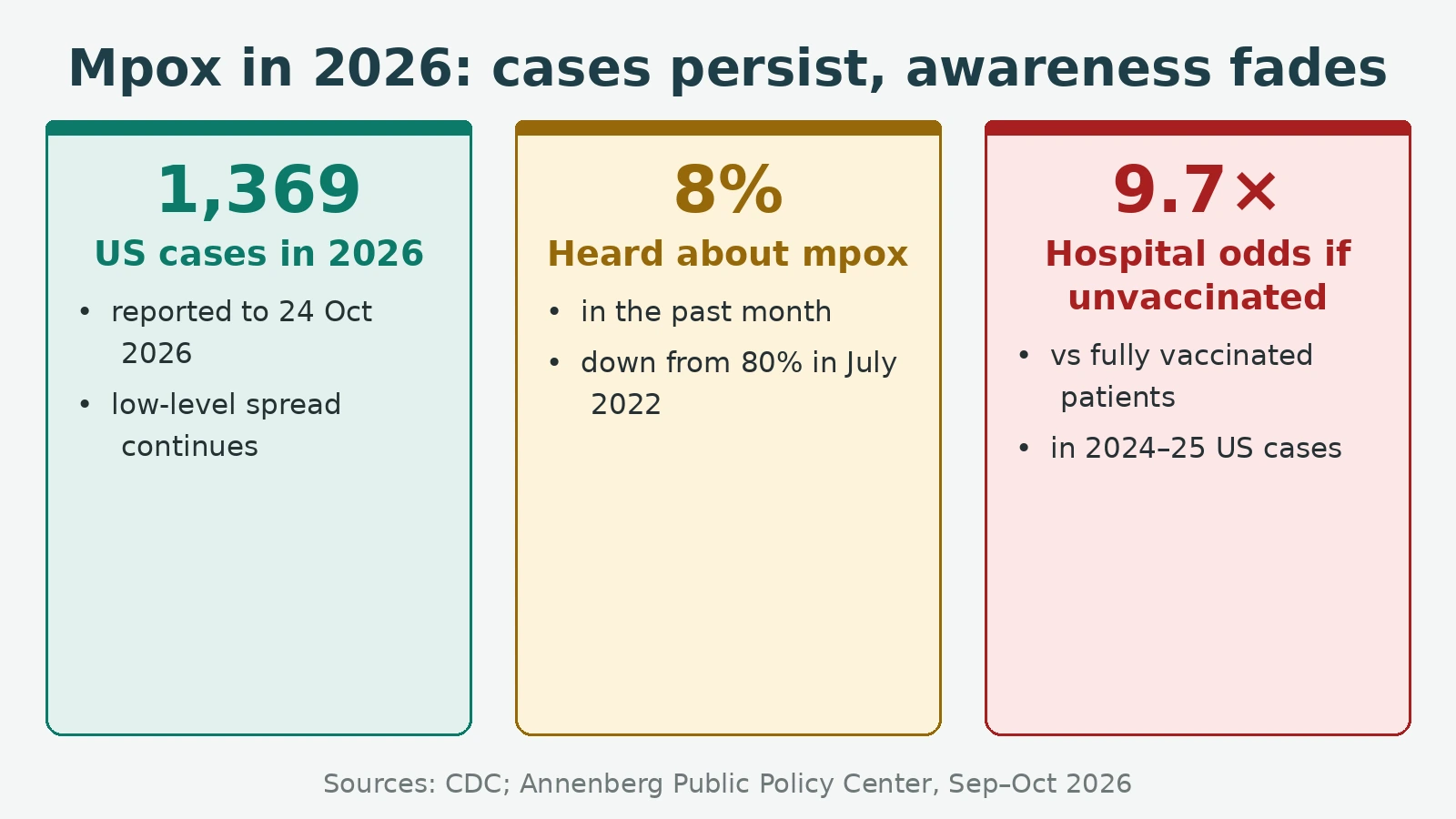
Mpox has not gone away: 1,369 cases were reported in the United States in 2026 up to late October, yet only 8% of Americans had heard anything about it in the past month. Most people recover in two to four weeks, but knowing the symptoms, how it spreads and who should be vaccinated still matters.
A new survey from the Annenberg Public Policy Center at the University of Pennsylvania, published on 19 November 2026, found that public awareness of mpox has barely moved in two years — even as cases keep appearing. Fewer than half of Americans know a vaccine exists, and only about one in five know mpox is less contagious than Covid-19. That gap is the story of mpox in 2026: the virus is still circulating, but the public conversation has moved on.
What is mpox?
Mpox, previously known as monkeypox, is a viral illness caused by the monkeypox virus, a member of the orthopoxvirus family that also includes smallpox. The virus was first found in research monkeys in Denmark in 1958, and the first human case was reported in the Democratic Republic of Congo in 1970.
There are two main types, called clades. Clade IIb caused the global outbreak of 2022–2023 and is still the type circulating in the United States. Clade Ib emerged in the Democratic Republic of Congo in late 2023 and has since been found outside Africa. Most people who catch mpox recover fully, but some become very ill, and the illness can be fatal in rare cases.
Mpox causes a distinctive blistering rash, often with fever and swollen glands. It is not a new disease, and it is not spread the way a cold or flu is — it needs close physical contact. That matters, because it means ordinary daily life carries very little risk, while a small number of situations carry much more.
Mpox in 2026: the numbers
According to the US Centers for Disease Control and Prevention (CDC), 1,369 mpox cases were reported in the United States in 2026 up to 24 October. That is lower than the same period of 2025, when 1,940 cases had been reported — but it shows the virus has settled into persistent, low-level spread rather than disappearing. The CDC has said cases “have declined substantially in the United States; however, ongoing low-level transmission has persisted”, suggesting the virus may be moving towards becoming endemic.
Over 2024 and 2025 combined, the CDC recorded 5,322 cases in the US — 2,803 in 2024 and 2,519 in 2025. Cases briefly doubled in September and October 2025 compared with the same months in 2024, then returned to background levels by December. About one in ten cases with known hospital status needed hospital care, and deaths were rare: five in 2024 and one in 2025, a case-fatality rate of 0.18% and 0.04% respectively.
Globally, the World Health Organization (WHO) reports that more than 120 countries recorded mpox between January 2022 and August 2024, with over 100,000 confirmed cases and more than 220 deaths. In the UK, the NHS says only a small number of cases have been seen since 2022, and the risk of catching mpox is low for most people.
The awareness gap
The Annenberg survey, carried out between 22 September and 5 October 2026 among 1,842 US adults, paints a clear picture of a public that has stopped paying attention:
- Only 8% had seen, read or heard anything about mpox in the past month — down from 11% in July 2024 and 80% in July 2022.
- Just 24% said they were familiar with mpox, essentially unchanged since 2024.
- Only 44% knew a vaccine against mpox exists, and 48% were unsure.
- Only 18% knew mpox is less contagious than Covid-19, and 62% were unsure.
- Only 7% were worried about catching mpox in the next three months.
There were some brighter findings. Almost seven in ten Americans (69%) said they would probably get an mpox vaccine if they were exposed, and 73% said the benefits of the vaccine outweigh the risks. And 73% knew that people with mpox should stay at home until the rash has gone. The problem is not unwillingness — it is that most people no longer know the basics.
Symptoms, in order
Symptoms usually begin within a week of exposure, but they can start anywhere from 1 to 21 days afterwards — the NHS gives the usual range as 5 to 21 days. For some people the first symptom is a rash; for others, flu-like symptoms come first.
Early symptoms include a high temperature, headache, muscle aches, backache, swollen glands, shivering or chills, exhaustion and a sore throat. The rash usually appears one to five days after the first symptoms. It often begins on the face and spreads over the body, including the palms of the hands and soles of the feet, and it can also start where contact was made — for example, on the genitals or around the anus.
The rash changes over days: it starts as flat spots or raised sores, develops into blisters filled with liquid that may be painful or itchy, then dries up, crusts over and falls off. Some people have only one or a few lesions; others have hundreds. The illness typically lasts two to four weeks, and it can last longer in someone with a weakened immune system.
Some people develop painful swelling of the rectum, pain or difficulty when peeing or swallowing, or anal pain and bleeding. Severe cases can involve more painful sores in the mouth, genital or anal area, and pain that makes eating, urinating or having a bowel movement difficult. Complications can include bacterial skin infection, pneumonia, eye infection with loss of vision, dehydration, sepsis and inflammation of the brain or heart.
How mpox spreads now
Mpox spreads mainly through close contact with someone who has it. The WHO lists the main routes as skin-to-skin contact (including sex), mouth-to-mouth or mouth-to-skin contact such as kissing, and face-to-face contact close enough to breathe in infectious droplets. It can also spread through contaminated objects such as clothing, bedding, towels and dishes.
During the global outbreak that began in 2022, the virus mostly spread through sexual contact, and it has mainly affected gay, bisexual and other men who have sex with men — though it can affect anyone. People with multiple sexual partners are at higher risk. A pregnant person can pass the virus to the baby through the placenta or during or after birth, which can lead to loss of the pregnancy, stillbirth or complications for the parent.
A person can spread mpox from the time symptoms start until the rash has fully healed and a fresh layer of skin has formed. The Children’s Hospital of Philadelphia notes that people can spread it from up to four days before symptoms appear. Brief interactions without physical contact are unlikely to spread it — direct physical contact, typically with lesions, or prolonged close contact is how it spreads.
Who is most at risk?
Children, pregnant people and people with weak immune systems — including people living with HIV that is not well controlled — are at higher risk of serious illness. The NHS says the risk of needing hospital treatment is higher for older people, young children, and people whose immune system is affected by a condition or medicine.
In the United States, cases have continued to affect men who have sex with men disproportionately: in 2024–2025, 96.5% of cases in 2024 and 97.8% in 2025 were in men, with a median age of 35 to 36. Black and Hispanic or Latino patients have been disproportionately affected. People with HIV that is not suppressed, or with low CD4 counts, face a higher risk of severe infection and death.
The mpox vaccine
There is a vaccine, and it works well — but fewer than half of Americans know it exists. The vaccine is called JYNNEOS in the United States, Imvanex in the UK and Europe, and Imvamune in Canada. It is the same vaccine in each case, made from a weakened form of the vaccinia virus. It does not contain smallpox or mpox virus, and it cannot cause either disease.
The vaccine is given as two doses, four weeks apart, with the highest protection about two weeks after the second dose. It can also be given after exposure: ideally within four days of contact, when it can prevent infection, and up to fourteen days, when it can reduce symptoms.
The protection is substantial. In the CDC’s analysis of US cases in 2024–2025, unvaccinated patients had 9.7 times the odds of being hospitalised compared with fully vaccinated patients. More than three-quarters of cases in that period — 76.1% — were in unvaccinated people. Small early studies suggested the vaccine protected six to eight in ten vaccinated people against infection; larger studies are ongoing.
The WHO recommends vaccination for people at high risk, especially during an outbreak: health and care workers at risk of exposure, people in the same household or close community as someone with mpox, people with multiple sex partners (including men who have sex with men), and sex workers of any gender and their clients. In the UK, it is offered to men who have sex with men with multiple partners or who use sex-on-premises venues, people who have had close contact with a case, and healthcare workers caring for a confirmed case. Common side effects are pain, redness and itching where the injection was given, and sometimes fever, headache, tiredness, nausea, chills and muscle aches.
How mpox is diagnosed and treated
The best test is a PCR test that detects the virus’s DNA, taken by swabbing the rash — the skin, fluid or crusts. Blood testing is not recommended, and antibody tests may not be useful because they cannot distinguish between different orthopoxviruses. Testing matters because mpox can look like other infections, including chickenpox, herpes and syphilis, and because a person with mpox may also have another sexually transmitted infection at the same time.
Most people recover within two to four weeks with supportive care: pain and fever relief, fluids, good nutrition, skin care and treatment of any secondary infection. The WHO states there is no proven effective antiviral treatment for mpox to date, although some antivirals have emergency-use authorisation in some countries and are being studied in trials. People with HIV and mpox should keep taking their antiretroviral treatment.
The mpox rash is sometimes confused with chickenpox. The two illnesses can look similar, and no single visible feature reliably separates them — which is why testing, rather than appearance alone, is needed to confirm the diagnosis.
How to protect yourself
The practical steps are simple. Get vaccinated if you are eligible. Wash your hands often with soap and water or hand sanitiser, especially before and after touching any sores. Avoid close physical contact, including sex, with someone who has mpox, and do not share their bedding or towels.
If you have mpox, stay at home until the rash has fully healed, the scabs have fallen off and a new layer of skin has formed. Wear a mask and cover lesions around other people, keep skin dry and uncovered when alone, avoid touching items in shared spaces, and do not pop blisters, scratch sores or shave areas with sores until they have healed. Use condoms during sex for twelve weeks after recovery, as a precaution. Close contacts should watch for symptoms for 21 days.
When to see a doctor
The NHS advises calling NHS 111 if you have a rash with blisters or sores and you have travelled to an area with mpox in the past three weeks, or you have had close contact — including sexual contact — with someone who has mpox symptoms. If you have a rash with blisters and have had one or more new sexual partners in the past three weeks, call a sexual health clinic first, before visiting. If you cannot reach a clinic, call 111.
Seek care promptly if your symptoms are severe or you become unwell — hospital treatment is more likely to be needed for older people, young children, pregnant people and anyone with a weakened immune system. Warning signs include sores in the eyes, trouble swallowing or breathing, severe pain, or signs of a spreading skin infection. In an emergency call 911 (US), 999 (UK) or 112 (EU).
Frequently asked questions
What are the first symptoms of mpox?
Symptoms usually start within a week of exposure, but can appear 1 to 21 days afterwards. Early signs are a high temperature, headache, muscle aches, backache, swollen glands, chills, exhaustion and a sore throat. The rash usually appears one to five days later. For some people, the rash is the first symptom. The illness typically lasts two to four weeks.
How long does mpox last?
The illness typically lasts two to four weeks, and it can last longer in someone with a weakened immune system. The rash changes over days — flat spots become fluid-filled blisters, then dry up, crust over and fall off. A person can spread mpox from the time symptoms start until the rash has fully healed and a fresh layer of skin has formed.
How do you catch mpox?
Mpox spreads mainly through close contact: skin-to-skin contact including sex, kissing, and face-to-face contact close enough to breathe in infectious droplets. It can also spread through contaminated clothing, bedding or towels. Brief interactions without physical contact are unlikely to spread it. The virus mostly spread through sexual contact during the 2022 outbreak.
Is there a vaccine for mpox?
Yes. The vaccine is called JYNNEOS in the US and Imvanex in the UK and Europe — the same vaccine under different names. It is given as two doses four weeks apart, with the highest protection about two weeks after the second dose. It can also be given after exposure, ideally within four days. In 2024–25, unvaccinated patients had 9.7 times the odds of hospitalisation.
Can mpox be serious or deadly?
Most people recover fully, but some become very ill. About one in ten cases with known hospital status needed hospital care in 2024–25, and deaths were rare — five in 2024 and one in 2025. Children, pregnant people and people with weak immune systems, including people with uncontrolled HIV, are at higher risk of severe illness. Complications can include pneumonia, eye infection and sepsis.
How is mpox different from chickenpox?
The mpox rash is sometimes confused with chickenpox, and the two can look similar. No single visible feature reliably separates them, which is why testing is needed to confirm the diagnosis. The best test is a PCR test on a swab taken from the rash. Mpox can also look like herpes, syphilis or bacterial skin infections, so a doctor may test for several conditions.
Sources
- Annenberg Public Policy Center: Mpox cases persist in U.S., but public awareness remains low, 19 Nov 2026 www.annenbergpublicpolicycenter.org
- WHO: Mpox fact sheet www.who.int
- NHS: Mpox www.nhs.uk
- CDC: Monkeypox Virus Surveillance — United States, 2024–2025 (MMWR) www.cdc.gov
- CDC: Nationally Notifiable Diseases weekly tables, week ending 24 Oct 2026 stacks.cdc.gov
- Children's Hospital of Philadelphia: Mpox — The Disease & Vaccine www.chop.edu
- UKHSA: Protecting your family against mpox www.gov.uk

Try the tool
Not sure if it can wait?
Common causes and warning signs for 16 everyday symptoms.
Open the symptom guide