What Is Kratom? Effects, Risks and What the Evidence Says
Kratom is a leaf extract sold as a natural energy booster and pain reliever, but it acts on the brain's opioid receptors and carries real risks of dependence, liver injury and seizures. Here is what the evidence actually says.
- Written by
- Health Daily Advice
- Published
- Reading time
- 9 minutes
- Sources
- 9 cited
In this guide
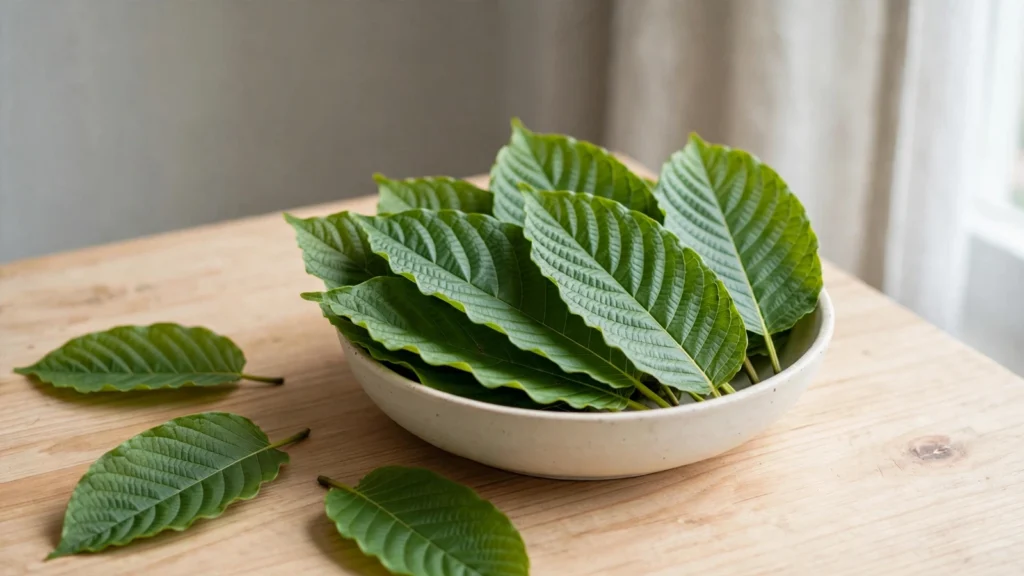
Kratom is an extract made from the leaves of Mitragyna speciosa, a tree native to Southeast Asia. Its compounds act on opioid receptors, producing stimulant-like effects in smaller amounts and pain-relieving, sedative effects in larger ones. It is sold as a supplement, but no kratom product is approved as safe or effective by the US Food and Drug Administration.
You may have seen kratom in a petrol station, a vape shop or an online advert — a powder, a capsule or a small bottled drink marketed as a natural energy booster, mood lifter or pain reliever. Behind the friendly packaging is a substance acting on the same brain receptors as opioid drugs. In November 2026 the warnings grew louder: searches surged, newspapers reported people becoming dependent within months of trying kratom drinks, and regulators moved against derivatives.
What is kratom and where does it come from?
Kratom comes from the leaves of Mitragyna speciosa, a tropical evergreen tree that grows in Thailand and neighbouring countries in Southeast Asia. A coffee-family tree, its leaves have been chewed or brewed into tea for generations in its home region — traditionally to fight tiredness, ease pain and diarrhoea, and sometimes as a substitute for opium. Western science first described it in 1839, but regional use likely stretches back centuries.
It is sold as dried leaf powder, capsules, tablets, concentrated extracts, edibles and ready-to-drink shots, often in bright packaging. It is easy to buy online and in shops, yet with no federal regulation in the United States, the contents can vary a great deal. Common street names for kratom include thang, kakuam, thom, ketum and biak.
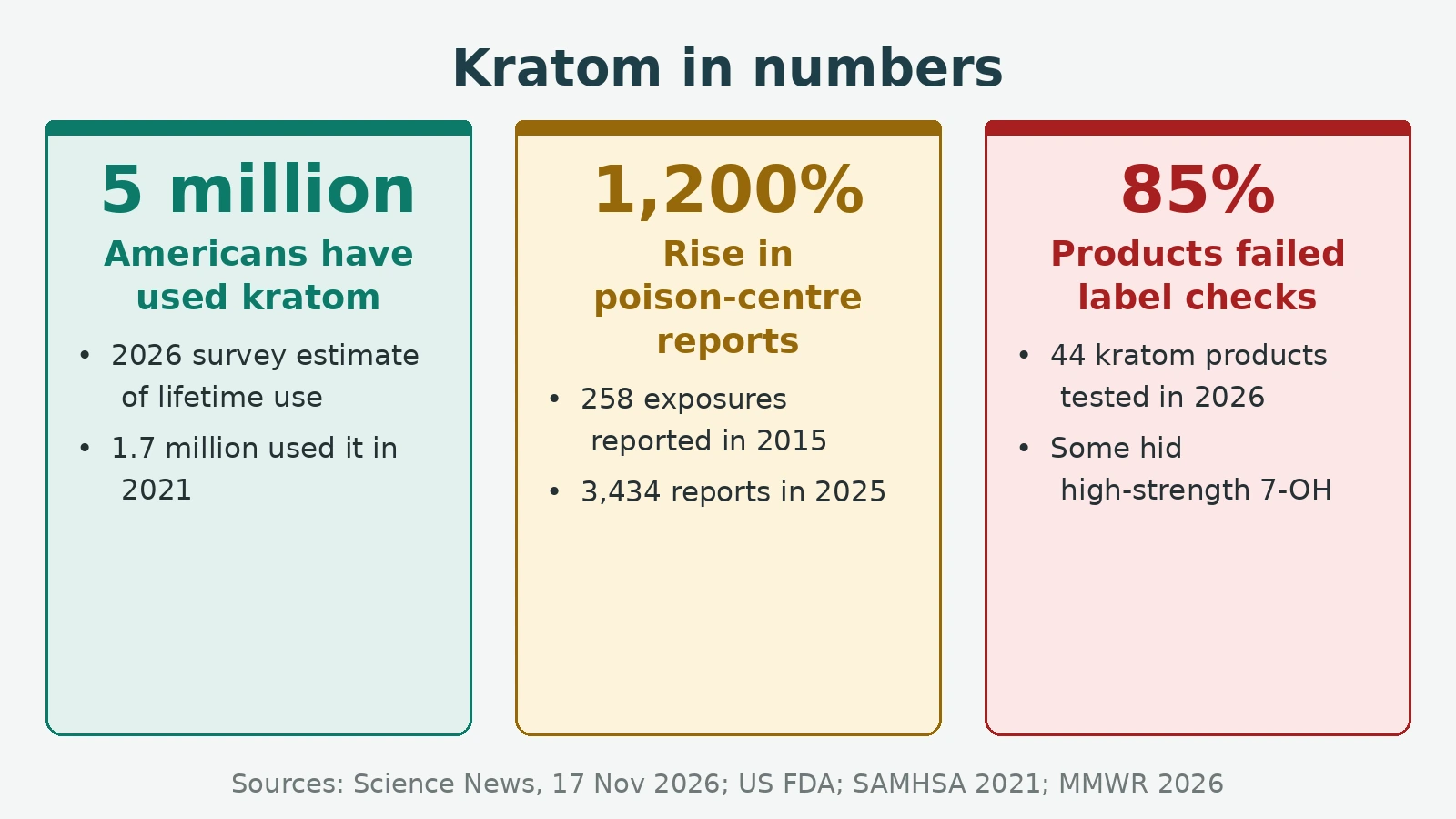
Use has grown steadily: an estimated 1.7 million Americans aged 12 and older used kratom in 2021, per the Substance Abuse and Mental Health Services Administration, and a 2026 survey estimated about 5 million Americans have used kratom or similar products.
How does kratom work in the body?
Kratom leaves contain more than 50 naturally occurring chemicals called alkaloids. Two matter most: mitragynine, about two-thirds of the plant’s alkaloid content, and 7-hydroxymitragynine, usually shortened to 7-OH. Both interact with mu-opioid receptors in the brain, spinal cord and gut — the same receptors that respond to the body’s own pain signals and to drugs such as morphine.
Mitragynine is unusual because it only partly switches those receptors on — a toxicologist likened it to a dimmer switch rather than a light switch. That partial action is one reason some researchers think kratom may carry a lower risk of slowed breathing than classic opioids, though human evidence is thin. Mitragynine also acts on brain systems involving serotonin, dopamine and noradrenaline (norepinephrine in the US), explaining its stimulating edge.
After kratom is taken, the body converts some mitragynine to 7-OH. That small change makes a large difference: 7-OH binds about 10 times more strongly to mu-opioid receptors and switches them on fully, much like morphine. In the natural leaf, 7-OH is present only in trace amounts, under 2% of total alkaloid content — yet many products contain far more than nature ever put in a leaf.
Effects begin within minutes and last a few hours.
What effects do people report from kratom?
Kratom’s effects depend on how much is taken, and people often describe two very different experiences. In smaller amounts it tends to act like a stimulant: more energy, alertness and talkativeness, with a faster heartbeat. In larger amounts the opioid-like effects take over: relaxation, pain relief, sometimes euphoria, alongside drowsiness and confusion. Some feel both at once.
People say they use kratom for pain relief, to lift mood, boost energy and concentration, and to ease coming off opioids, alcohol or stimulants. Some turn to it because it is easier to buy than prescription medicines. The US National Institute on Drug Abuse (NIDA) notes people also report using it to manage drug cravings and mental health problems.
None of this amounts to proof that kratom works as a treatment. The National Center for Complementary and Integrative Health (NCCIH) states that research is in its early stages and kratom has not been shown safe and effective for any medical use. Mayo Clinic agrees: the claims for kratom cannot be rated because reliable evidence is lacking.
What are the risks and side effects of kratom?
Kratom’s side effects range from unpleasant to life-threatening, worsening with regular, heavy use. Commonly reported effects include nausea and vomiting, constipation, dry mouth, weight loss, muscle pain, dizziness and drowsiness. Effects on the mind and nervous system can include confusion, hallucinations, false beliefs (delusions), low mood and tremors.
The serious risks are why health agencies warn against it. The FDA has warned consumers not to use kratom because of the risk of liver toxicity, seizures and substance use disorder. Cases of acute liver injury, including hepatitis and liver failure, have been reported. High blood pressure, abnormal heart rhythms, breathing suppression, coma and death have all been linked to kratom, although deaths from kratom alone appear extremely rare and nearly all involved other drugs or contaminants.
Poison control data show the problem growing. US poison centres received over 3,400 reports about kratom use between 2014 and 2019, including deaths, with high blood pressure, confusion and seizures recorded. A 2026 CDC report found a 1,200% increase in kratom-related calls to US poison centres between 2015 and 2025, from 258 exposures in 2015 to 3,434 in 2025 — a peak linked to the growing availability of high-potency 7-OH products.
Contamination adds another risk: the FDA has warned when kratom products contained Salmonella bacteria or concerning levels of heavy metals, and these contaminants have caused documented illnesses. With no drug-standard testing, buyers cannot reliably know what they are taking. In pregnancy, newborns exposed to kratom before birth have shown withdrawal signs such as jitteriness, irritability and stiffness. Kratom can also interact with prescription medicines: Mayo Clinic reports cases of abnormal brain function when kratom was taken alongside prescribed drugs.
Can kratom cause dependence and withdrawal?
Yes — one of the clearest findings in the research, and the part most often missing from the marketing. Regular users can develop tolerance — needing more for the same effect — and cravings when they try to stop. The FDA has documented people using kratom for longer than intended, continuing despite harm to health or personal life, and experiencing withdrawal when they stopped.
Withdrawal usually begins within 5 to 48 hours of stopping after regular use. The symptoms resemble opioid withdrawal: irritability and restlessness, a runny nose, body aches, enlarged pupils, nausea, vomiting, chills, sweats, muscle spasms, diarrhoea, anxiety, low mood, hot flushes and difficulty sleeping. NIDA describes withdrawal as mild to moderate, though research is still limited. In one study cited by Mayo Clinic, people who had taken kratom for more than six months reported withdrawal symptoms similar to opioid withdrawal, and some later needed the same medicines used for opioid addiction.
Regular users can develop a mild to moderate substance use disorder under the DSM-5-TR criteria. About one-third of people who use kratom report at least one other substance use disorder, including opioid or stimulant use disorder, so kratom use often sits alongside other drug problems rather than replacing them.
What is 7-OH, and why are regulators worried about it?
7-OH, or 7-hydroxymitragynine, is the chemical at the centre of the current alarm. In nature it is a minor by-product, forming in tiny amounts as kratom leaves dry, and the body makes a little more from mitragynine. But today’s 7-OH products are laboratory-made concentrates — tablets, edibles and drinks — with far higher 7-OH levels than any leaf ever would. By the mid-2010s, scientists found products with more than 500% more 7-OH than occurs in the plant alone; products labelled as pure 7-OH are now openly on sale.
That matters because 7-OH is far more potent than kratom leaf, binding about 10 times more strongly to opioid receptors, with greater risk of dependence, breathing suppression and overdose. Clinicians report patients arriving at hospital with severe withdrawal from 7-OH products, sometimes needing addiction treatment for kratom.
Regulators have responded. In July 2025 the FDA announced new measures to control 7-OH. In July 2026 the Drug Enforcement Administration temporarily classified 7-OH and related derivatives, including mitragynine pseudoindoxyl and compounds MGM-15 and MGM-16, as Schedule I drugs — treated as having high abuse potential and no accepted medical use. That scheduling was renewed in October 2026. None of this changes the legal status of the kratom leaf, which remains unscheduled at federal level.
Labelling is part of the problem. In a 2026 analysis of 44 kratom products, researchers found that 85% had contents that did not match the label. Some products advertised as kratom contained very high levels of 7-OH; others contained alkaloids that were not listed at all. When the label cannot be trusted, neither can assumptions about what a product will do.
What do regulators say about kratom?
The official position in the United States is unambiguous, even if the legal picture is messy. The FDA states that kratom is not lawfully marketed as a drug product, a dietary supplement or a food additive, and no FDA-approved kratom products exist. The agency still warns consumers not to use kratom and has seized shipments and acted against companies making unproven health claims. The Drug Enforcement Administration lists kratom as a drug of concern for its sedative effects and addiction potential, though it has not scheduled the leaf itself under the Controlled Substances Act.
State laws add a patchwork: 26 US states do not regulate kratom at all, 6 states and the District of Columbia list its ingredients as Schedule I substances, and a further 18 states regulate sale and manufacture in some way. Some other countries ban kratom outright. Legality varies sharply and is changing quickly, so check the law where you live.
What is not yet known matters. The FDA notes few published reports from well-designed studies in which kratom was given to humans, and it has funded studies to characterise kratom’s safety profile, including a human abuse potential study begun in 2024. Until that evidence exists, claims that kratom is a proven treatment for pain, anxiety, depression or opioid withdrawal remain unproven.
What help is available if kratom use becomes a problem?
Anyone who cannot cut down or stop using kratom should talk to a doctor or pharmacist. No medicines are approved specifically for kratom use disorder; counselling and behavioural therapy are the main treatments. Some doctors prescribe buprenorphine, a medicine used for opioid use disorder, off-label for kratom dependence, but this has not been well studied.
Tell a healthcare professional exactly what was taken — leaf kratom or a concentrated 7-OH product — as the type affects treatment. Kratom is not an approved treatment for opioid use disorder, and people who try to treat opioid addiction with it on their own remain at risk of a fatal overdose. Proven medicines such as methadone and buprenorphine are effective, widely available and reduce the risk of overdose and death.
In the United States, the Substance Abuse and Mental Health Services Administration runs a free, confidential helpline on 1-800-662-4357, with treatment services listed at FindTreatment.gov. US Poison Control: 1-800-222-1222. Elsewhere, contact your local health service or a national addiction helpline.
When to see a doctor
See a doctor promptly if you use kratom and notice yellowing of the skin or eyes, dark urine, persistent nausea, confusion, hallucinations, seizures, chest pain, a fast heartbeat or trouble breathing. The same applies if you cannot cut down or stop, if cravings interfere with work, school or relationships, or if you are pregnant or planning a pregnancy and have used kratom.
Seek emergency help straight away for seizures, loss of consciousness, severely slowed or stopped breathing, or signs of an overdose. If someone has collapsed or is struggling to breathe after taking kratom, call an ambulance and stay with them until help arrives. In an emergency call 911 (US), 999 (UK) or 112 (EU).
Kratom is often sold as a natural shortcut to energy, calm or pain relief. The evidence tells a more complicated story: a plant with real power, in products whose strength and contents are often unknown, with documented risks of liver damage, seizures, dependence and withdrawal and no proven medical benefit. Natural does not mean safe — and the agencies studying kratom most closely say the risks are not worth taking.
Frequently asked questions
Is kratom legal in the United States?
Kratom leaf is legal at federal level in the United States and is not a scheduled controlled substance, though the Drug Enforcement Administration lists it as a drug of concern. It varies by state: six states and the District of Columbia treat its ingredients as Schedule I substances, 18 states regulate sale and manufacture, and 26 states do not regulate it at all. The FDA says kratom cannot lawfully be marketed as a drug, dietary supplement or food additive.
Can kratom help with opioid withdrawal?
There is no reliable evidence that it can. Some people use kratom to ease opioid withdrawal symptoms, and researchers are studying whether its compounds could have medical uses, but kratom has not been shown safe or effective for this or any other purpose. It also carries its own risk of dependence, so using it can simply replace one withdrawal with another. Proven medicines such as methadone and buprenorphine are the recommended treatments.
Is kratom addictive?
Yes, kratom can be addictive. Regular users can develop tolerance and cravings, and stopping after regular use can bring withdrawal symptoms within 5 to 48 hours, including irritability, restlessness, body aches, nausea and difficulty sleeping. The FDA has documented cases of substance use disorder linked to kratom, and regular users can meet the criteria for a mild to moderate substance use disorder. Concentrated 7-OH products carry a higher risk of dependence.
What is 7-OH and why is it more dangerous than kratom?
7-OH, or 7-hydroxymitragynine, is a compound that forms in tiny amounts in kratom leaves and is also made in the body from mitragynine. It binds about 10 times more strongly to opioid receptors than mitragynine and switches them on fully. Commercial 7-OH products are laboratory-made concentrates with far higher levels than any leaf contains, carrying greater risks of dependence, breathing suppression and overdose. The DEA temporarily placed 7-OH in Schedule I in July 2026.
Can kratom damage the liver?
Yes. The FDA warns that kratom can cause liver toxicity, and cases of acute liver injury, including hepatitis and liver failure, have been reported in people who used kratom. Risk appears higher with heavy or long-term use and with concentrated products, and liver damage is one serious effect that can also occur when kratom is combined with other drugs. Yellowing skin or eyes, dark urine or persistent nausea after using kratom should be checked by a doctor promptly.
Is kratom safe to take with other medicines?
No one can say it is safe. Kratom's interactions with prescription medicines are poorly studied, but Mayo Clinic reports cases of abnormal brain function when kratom was taken alongside prescribed drugs. Risks are greater when kratom is combined with other substances: nearly all deaths linked to kratom involved other drugs, and the FDA warns that mixing kratom with opioids or sedatives such as alcohol increases the risk of severe harm. Tell a doctor or pharmacist about any kratom use.
Sources
- US FDA: FDA and Kratom www.fda.gov
- Mayo Clinic: Kratom: Unsafe and ineffective www.mayoclinic.org
- NIDA: Kratom nida.nih.gov
- NCCIH: Kratom www.nccih.nih.gov
- Science News: What to know about kratom and its powerful derivatives www.sciencenews.org
- NY State Office of Addiction Services and Supports: Kratom oasas.ny.gov

Try the tool
Not sure if it can wait?
Common causes and warning signs for 16 everyday symptoms.
Open the symptom guide