What Is Tirzepatide? How It Works, Weight Loss and Side Effects
Tirzepatide is the active ingredient in Mounjaro and Zepbound — a once-weekly injection that copies two gut hormones. Here is how it works, how much weight people lose, its side effects, and why there is no tirzepatide pill.
- Written by
- Health Daily Advice
- Published
- Reading time
- 9 minutes
- Sources
- 9 cited
In this guide
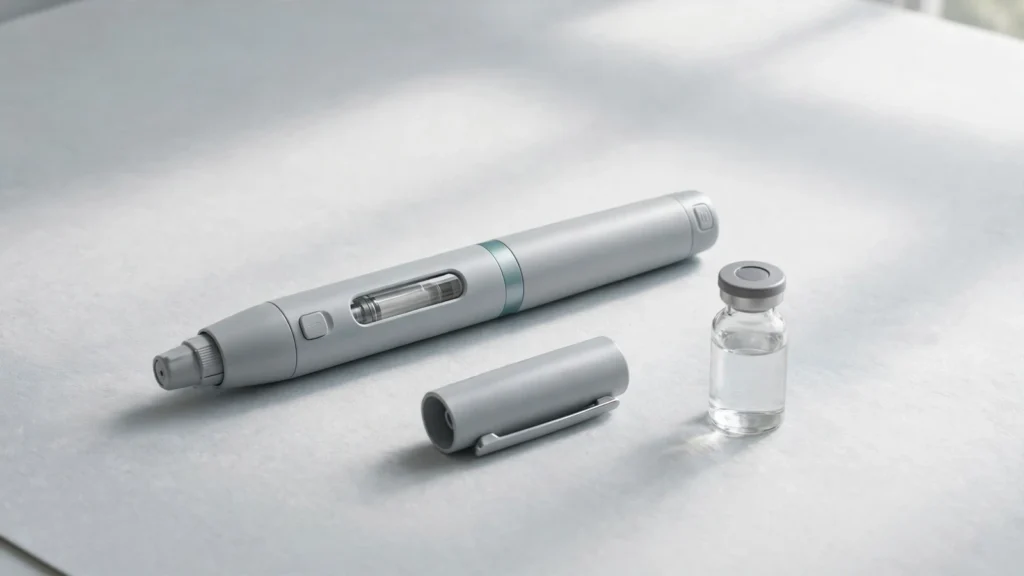
Tirzepatide is a prescription medicine that copies two gut hormones, GIP and GLP-1, to curb appetite and steady blood sugar. Sold as Mounjaro for type 2 diabetes and Zepbound for weight management, it is given as a once-weekly injection under the skin. In trials, people lost up to about a fifth of their body weight over 72 weeks.
It is the active ingredient behind two of the most talked-about medicines of recent years. Is it a diabetes drug or a weight-loss drug? Is there a pill? How much weight do people lose, and what are the risks? Here are the answers.
What is tirzepatide?
Tirzepatide is a prescription medicine made by Eli Lilly. It is one molecule that switches on the receptors for two gut hormones released after a meal: glucose-dependent insulinotropic polypeptide (GIP) and glucagon-like peptide-1 (GLP-1). It was the first medicine to activate both at once, which is why it is called a dual GIP/GLP-1 receptor agonist.
The same active ingredient is sold under two brand names, for two different jobs:
- Mounjaro — for type 2 diabetes. The FDA approved it on 13 May 2022, to improve blood sugar control in adults with type 2 diabetes, alongside diet and exercise. It is not for type 1 diabetes.
- Zepbound — for chronic weight management. The FDA approved it on 8 November 2023 for adults with obesity, or overweight adults with at least one weight-related condition, such as high blood pressure, type 2 diabetes or high cholesterol, used with a reduced-calorie diet and more activity.
Zepbound is also approved for moderate-to-severe obstructive sleep apnea in adults with obesity, according to MedlinePlus. The brands are the same medicine in different packaging. The need is large: the FDA notes that approximately 70% of American adults have obesity or overweight.
How does tirzepatide work?
After you eat, your gut releases hormones telling the body food has arrived. GIP and GLP-1 are two of the most important, and tirzepatide mimics both.
- It helps insulin work when it is needed. It prompts the pancreas to release insulin when blood sugar is high, and lowers glucagon, which pushes sugar into the blood. MedlinePlus explains that insulin then moves sugar from the blood into the body’s tissues, where it is used for energy.
- It slows the stomach down. Food leaves the stomach more slowly, so you feel full for longer after a smaller meal.
- It quiets appetite in the brain. It acts on appetite centres in the brain, so hunger fades. Weill Cornell Medicine puts it simply: the medicine helps a person eat less because it signals to the brain that you are full.
Older medicines in this family, such as semaglutide, switch on the GLP-1 receptor only. Tirzepatide switches on both, which researchers believe is part of why its weight-loss results are larger. It does not burn fat directly; it changes appetite and blood sugar signals, and the weight loss follows from eating less.
What conditions is tirzepatide used to treat?
Type 2 diabetes (Mounjaro)
Mounjaro is used with diet and exercise to improve blood sugar control in adults with type 2 diabetes. In the SURPASS trial programme, average A1C — blood sugar over two to three months — fell by between 1.7% and 2.4%, and participants lost on average between 12 lb and 25 lb, according to Eli Lilly’s summary. Mounjaro is also approved to reduce the risk of heart attack and stroke in adults with type 2 diabetes at high risk.
Weight management and sleep apnea (Zepbound)
Zepbound is for adults with a body mass index (BMI) of 30 or higher, or 27 or higher plus at least one weight-related condition, such as high blood pressure, type 2 diabetes, high cholesterol, sleep apnea or cardiovascular disease. It is also used for moderate-to-severe obstructive sleep apnea — where breathing stops briefly during sleep — in adults with obesity. It is not for type 1 diabetes, and it has not been studied in people with a history of pancreatitis or severe stomach problems.
How much weight do people lose on tirzepatide?
Results vary from person to person, but the trial figures are unusually strong for a weight-loss medicine.
The SURMOUNT-1 trial
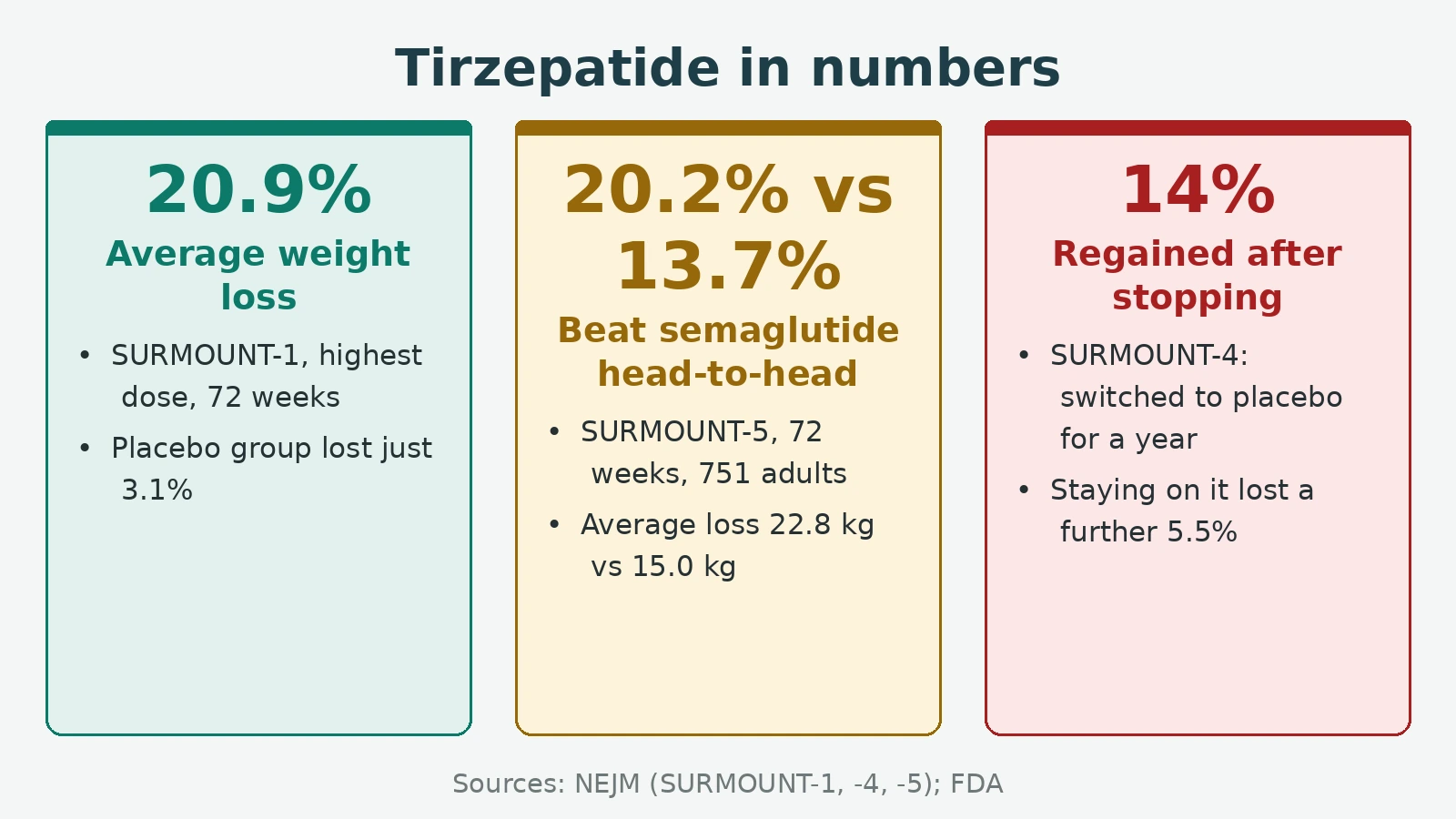
The main trial, SURMOUNT-1, followed 2,539 adults with obesity or overweight but without diabetes for 72 weeks. Participants were randomly assigned to one of three tirzepatide doses or a placebo injection, alongside lifestyle support. Their average starting weight was 104.8 kg (about 231 lb) and average BMI was 38.0, according to the American College of Cardiology’s summary of the trial, published in the New England Journal of Medicine.
| Group | Average weight change at 72 weeks | Lost at least 5% of body weight | Lost at least 20% of body weight |
|---|---|---|---|
| Tirzepatide 5 mg | −15.0% | 85.1% | 30.0% |
| Tirzepatide 10 mg | −19.5% | 88.9% | 50.1% |
| Tirzepatide 15 mg | −20.9% | 90.9% | 56.7% |
| Placebo | −3.1% | 34.5% | 3.1% |
Waistlines shrank too: waist circumference fell by 14.0 cm, 17.7 cm and 18.5 cm on the three doses, against 4.0 cm on placebo. The results held up: in a three-year follow-up, average weight loss at week 176 was still 12.3%, 18.7% and 19.7%, against 1.3% on placebo. Among participants who started with prediabetes, new type 2 diabetes developed in 1.5%, 2.0% and 0.4% of the tirzepatide groups, against 13.3% on placebo.
People with type 2 diabetes tend to lose somewhat less: in the FDA’s summary of the second weight-management trial, those on the highest dose lost on average 12% of body weight compared with placebo. Averages hide a wide range — some lose much more, and some much less.
Tirzepatide vs semaglutide
No trial had compared tirzepatide directly with semaglutide, the medicine in Ozempic and Wegovy, until SURMOUNT-5. It randomly assigned 751 adults with obesity but without diabetes to the highest tolerated dose of each drug for 72 weeks.
At 72 weeks, people on tirzepatide had lost an average of 20.2% of their body weight, against 13.7% on semaglutide — a difference of 6.5 percentage points, according to the American College of Cardiology. In kilograms, that was 22.8 kg versus 15.0 kg, and waistlines shrank by 18.4 cm versus 13.0 cm. Side effects that led people to stop treatment were less common with tirzepatide (2.7%) than with semaglutide (5.6%). That does not make tirzepatide right for everyone — semaglutide has a longer track record — but on weight loss alone, tirzepatide came out clearly ahead.
Does tirzepatide come as a pill?
No. As of November 2026, there is no FDA-approved tirzepatide pill, tablet or capsule. Every approved tirzepatide product — Mounjaro and Zepbound — is a once-weekly injection under the skin. MedlinePlus describes tirzepatide only as a liquid in a vial or pre-filled pen.
So why do so many searches and adverts talk about a “tirzepatide pill”? The new once-daily weight-loss pills that made headlines in 2025 and 2026 are real medicines — but they are not tirzepatide. Unapproved products sold online also use tirzepatide’s name to sell tablets, drops or dissolvable strips no regulator has approved, with no proven contents, strength or safety record.
Here are the two real pills, and how they differ from tirzepatide:
- Foundayo (orforglipron). A once-daily GLP-1 tablet from Eli Lilly, approved by the FDA on 1 April 2026 for weight management in adults with obesity or overweight with a weight-related condition. It is a different molecule: it switches on the GLP-1 receptor only, not GIP. It was approved just 50 days after filing — the fastest approval of a new molecular entity since 2002.
- The Wegovy pill (oral semaglutide). A once-daily tablet version of semaglutide, approved by the FDA on 22 December 2025 — the first oral GLP-1 therapy approved for weight management. In its main trial, OASIS 4, people who stayed on treatment lost an average of 16.6% of body weight, and one in three lost 20% or more.
In short: if you want tirzepatide itself, it is an injection. The pill options that exist contain different medicines, with different results and side effects. A doctor or pharmacist can talk through which, if any, fits your situation.
What are the side effects of tirzepatide?
Most side effects are digestive. They tend to be worst early on and often settle as the body adjusts. The most common, listed by the FDA and MedlinePlus, are nausea, diarrhea, vomiting, constipation, reduced appetite, stomach pain and indigestion. Fatigue, burping, hair loss, acid reflux and injection-site reactions are also reported. Smaller meals, eaten slowly, can help — but if symptoms are severe or will not go away, call your doctor rather than pushing through.
Serious risks to know about
- Thyroid tumors. Tirzepatide carries the FDA’s strongest warning, a boxed warning, because it caused thyroid C-cell tumors in rats. It is not known whether it causes these tumors, including a type of thyroid cancer called medullary thyroid carcinoma, in people. It should not be used by anyone with a personal or family history of medullary thyroid cancer, or with Multiple Endocrine Neoplasia syndrome type 2 (MEN 2). Tell your doctor right away about a lump or swelling in the neck, hoarseness, trouble swallowing or shortness of breath.
- Pancreatitis. Inflammation of the pancreas can be severe. Stop the medicine and get medical help at once for severe stomach pain that will not go away, with or without vomiting, especially if it spreads to your back.
- Gallbladder problems. Gallstones and gallbladder inflammation have been reported — severe stomach pain, nausea, vomiting or fever need prompt medical attention.
- Low blood sugar. The risk is higher with insulin or medicines that raise insulin levels. Signs include shakiness, sweating, confusion, a fast heartbeat and feeling very hungry.
- Kidney problems. Ongoing vomiting and diarrhea can dehydrate you and injure the kidneys. A drop in urination is a warning sign.
- Severe allergic reaction. Swelling of the face, lips, tongue or throat, trouble breathing or swallowing, a severe rash or a rapid heartbeat need emergency help.
Tirzepatide can make hormonal birth control — pills, patches, rings and injections — less effective, so MedlinePlus advises that your doctor may suggest another form for four weeks after starting and after each dose change. Tell your doctor or dentist you take tirzepatide before surgery, because slowed stomach emptying can matter for anesthesia. Never share pens with anyone else, even if the needle is changed. Weight loss is not recommended during pregnancy — tell your doctor if you are pregnant, plan to become pregnant or are breastfeeding.
What happens when you stop tirzepatide?
In the SURMOUNT-4 trial, everyone took tirzepatide for 36 weeks first and lost an average of 20.9% of their body weight. Then 670 participants were randomly assigned either to keep taking it or to switch to a placebo for another year.
Those who stayed on tirzepatide lost a further 5.5%. Those who switched to placebo regained 14% of their body weight — roughly half of what they had lost, according to Weill Cornell Medicine, which led the trial. Those who stopped were still almost 10% lighter than at the start, but their improvements in blood pressure, blood sugar and cholesterol had reversed.
Obesity is a chronic condition, and tirzepatide treats it only while you take it — which has real implications for cost and how long you might stay on treatment. If you do stop, do not do it suddenly on your own: talk to your doctor or pharmacist first, and keep up the diet and activity habits that support keeping weight off.
When to see a doctor
Get medical advice promptly if side effects are severe, will not go away, or stop you eating and drinking normally. Vomiting or diarrhea that leaves you unable to keep fluids down, a big drop in urination, or stomach pain that keeps getting worse all need checking the same day.
Seek urgent help straight away for severe stomach pain that will not go away, especially if it spreads to your back; a lump or swelling in your neck, hoarseness or trouble swallowing or breathing; swelling of the face, lips or tongue; or sudden vision loss. These can be signs of pancreatitis, a thyroid problem, an allergic reaction or another serious complication.
If you already take tirzepatide, do not stop it suddenly without talking to your doctor or pharmacist, and tell any new doctor, dentist or surgeon that you take it.
In an emergency call 911 (US), 999 (UK) or 112 (EU)
The bottom line on tirzepatide
Tirzepatide is a once-weekly injection that works on two gut hormones at once, and on the evidence so far it produces more weight loss than any other medicine in its class — an average of about a fifth of body weight in the main trial, and more than semaglutide in the only head-to-head comparison. But the benefits come with real trade-offs: common digestive side effects, a boxed warning about thyroid tumors seen in animals, and weight that tends to return when treatment stops.
For the right person, with the right medical supervision, tirzepatide can be a powerful tool. It is not a shortcut, a cosmetic fix or a substitute for healthy eating and activity. If you are considering it, talk to a doctor or pharmacist, ask about the benefits and risks for your situation, and decide with the full picture in front of you.
Frequently asked questions
What is tirzepatide used for?
Tirzepatide is sold as Mounjaro for type 2 diabetes and as Zepbound for chronic weight management and moderate-to-severe obstructive sleep apnea in adults with obesity. Mounjaro was approved by the FDA in May 2022 and Zepbound in November 2023. Zepbound is for adults with obesity, or overweight adults with at least one weight-related condition, used with a reduced-calorie diet and more activity.
How much weight can you lose on tirzepatide?
In the SURMOUNT-1 trial, adults without diabetes lost an average of 15.0%, 19.5% and 20.9% of their body weight over 72 weeks on the three doses, compared with 3.1% on placebo. More than 9 in 10 people on the highest dose lost at least 5% of their body weight. People with type 2 diabetes tend to lose somewhat less. Results vary a lot from person to person.
Is there a tirzepatide pill?
No. As of November 2026, there is no FDA-approved tirzepatide pill, tablet or capsule. Mounjaro and Zepbound are only available as a once-weekly injection under the skin. The weight-loss pills in the news are different medicines: Foundayo (orforglipron), approved in April 2026, and the Wegovy pill (oral semaglutide), approved in December 2025. Pills sold online as tirzepatide are unapproved.
What are the most common side effects of tirzepatide?
The most common side effects are digestive: nausea, diarrhea, vomiting, constipation, reduced appetite, stomach pain and indigestion. Fatigue, burping, hair loss, acid reflux and injection-site reactions are also reported. They tend to be worst early on and often settle. Tirzepatide also carries a boxed warning about thyroid C-cell tumors seen in rats, and rare risks include pancreatitis and gallbladder problems.
What happens if you stop taking tirzepatide?
Weight usually comes back. In the SURMOUNT-4 trial, people who had lost an average of 20.9% of their body weight over 36 weeks were then switched to a placebo for a year. They regained 14% of their body weight — roughly half of what they had lost — while people who stayed on tirzepatide lost a further 5.5%. Do not stop suddenly on your own; talk to your doctor or pharmacist first.
Is tirzepatide better than semaglutide for weight loss?
In the only head-to-head trial, yes. SURMOUNT-5 randomly assigned 751 adults with obesity to the highest tolerated dose of tirzepatide or semaglutide for 72 weeks. People on tirzepatide lost an average of 20.2% of their body weight, against 13.7% on semaglutide — 22.8 kg versus 15.0 kg. That does not make it right for everyone: semaglutide has a longer track record.
Sources
- FDA: FDA Approves New Medication for Chronic Weight Management (Zepbound, 8 Nov 2023) www.fda.gov
- MedlinePlus: Tirzepatide injection medlineplus.gov
- Eli Lilly: FDA approves Lilly's Mounjaro (tirzepatide) injection for type 2 diabetes (13 May 2022) lilly.mediaroom.com
- American College of Cardiology: Tirzepatide Once Weekly for the Treatment of Obesity (SURMOUNT-1) www.acc.org
- American College of Cardiology: SURMOUNT-5: Greater Loss of Weight, Waist Circumference With Tirzepatide Than Semaglutide www.acc.org
- Weill Cornell Medicine: Tirzepatide Enhances Weight Loss with Sustained Treatment but Discontinuation Leads to Weight Regain (SURMOUNT-4) news.weill.cornell.edu
- FDA: FDA Approves First New Molecular Entity Under National Priority Voucher Program (Foundayo, 1 Apr 2026) www.fda.gov
- Novo Nordisk: Wegovy pill approved in the US as first oral GLP-1 for weight management (22 Dec 2025) www.novonordisk.com

Try the tool
Not sure if it can wait?
Common causes and warning signs for 16 everyday symptoms.
Open the symptom guide